AI integration for retail document processing connects directly to the file upload and data capture modules within your retail execution platform. When a field rep or store manager uploads a promotional leaflet, vendor agreement, or safety certificate, an AI agent is triggered via a webhook or API call. This agent uses OCR and LLMs to extract key data points—such as promotion dates, vendor terms, or certificate expiration—and structures them into the platform's native data objects (e.g., custom fields, tasks, or compliance records). This turns unstructured documents into actionable, searchable data without manual data entry.

Integration
AI Integration for Retail Document Processing
Extract structured data from in-store documents uploaded to retail execution platforms using OCR and LLMs. Automate compliance tracking, action item creation, and vendor management workflows.
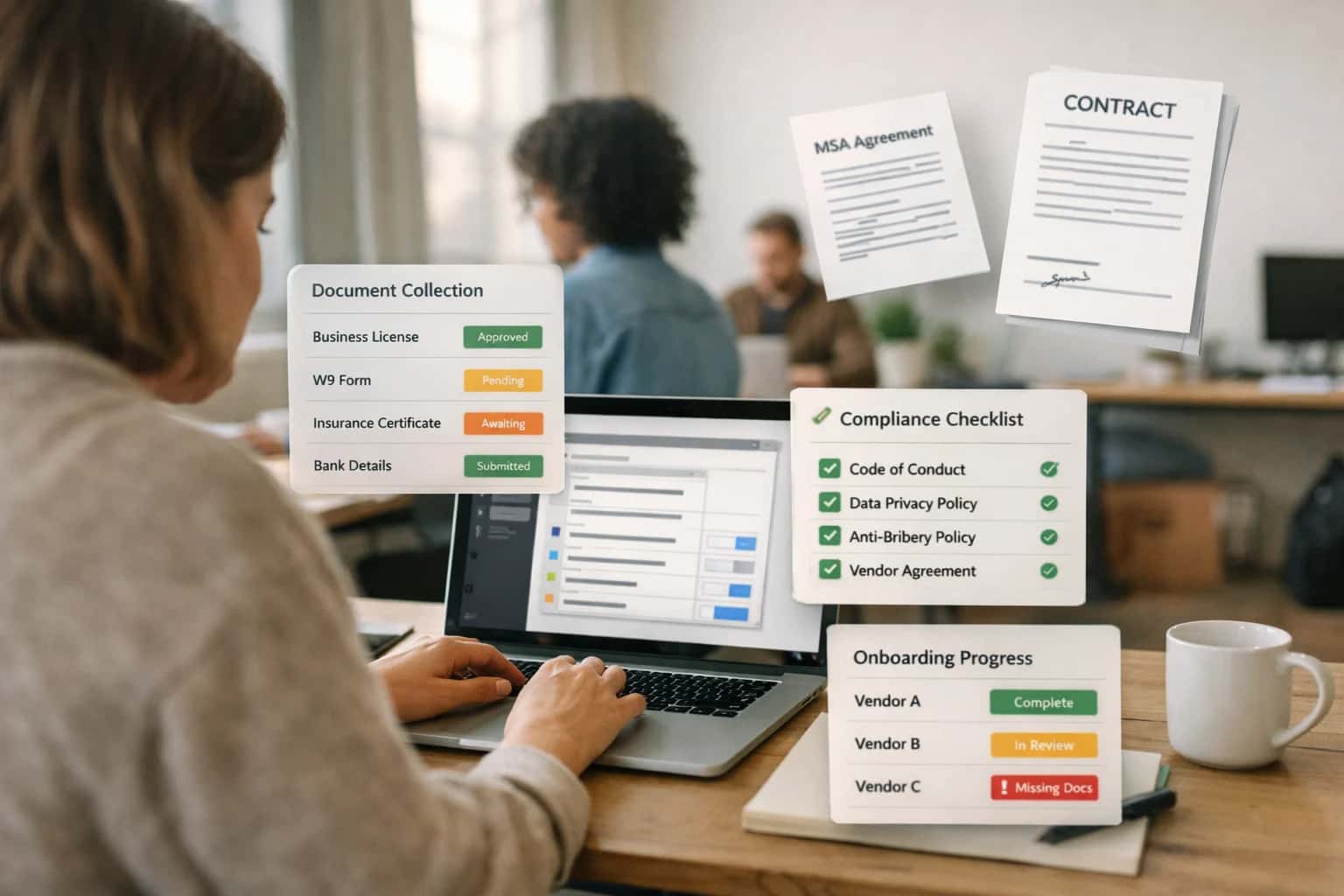
ARCHITECTURE AND ROLLOUT
Where AI Fits into Retail Document Workflows
A practical guide to integrating AI document intelligence into retail execution platforms like Repsly, Zipline, YOOBIC, and Movista.
The implementation typically involves a secure middleware layer that handles the document processing, ensuring PII and sensitive commercial terms are redacted before analysis. High-value workflows include automatically creating follow-up tasks in the platform for expiring certificates, flagging non-compliant vendor agreements for legal review, or updating a store's promotional calendar based on extracted dates. Impact is directional: teams move from days of manual review to same-day compliance tracking, and field managers spend less time on paperwork and more on execution.
Rollout requires a phased approach: start with a single document type (e.g., safety inspection sheets) and a pilot region. Governance is critical; implement human-in-the-loop approval steps for high-stakes extractions and maintain a full audit trail of all AI-generated data points within the platform's activity logs. For a deeper technical blueprint, see our guide on AI Integration for Retail Execution Platform APIs. To extend this intelligence to your analytics stack, consider feeding the structured data into AI Integration for Retail Execution and BI Tools.
RETAIL EXECUTION PLATFORMS
Document Upload and Processing Surfaces by Platform
Audit & Compliance Modules
These are the primary surfaces for document uploads. Field reps use mobile apps to attach photos of promotional leaflets, vendor agreements, or safety certificates directly to audit forms or tasks.
Key Integration Points:
- Audit Form Attachments: APIs to push AI-extracted data (e.g.,
promo_dates,vendor_name,cert_expiry) back into custom audit fields after processing. - Task Completion Workflows: Webhooks triggered when a document is attached to a task, signaling the AI pipeline to begin processing. The resulting data can auto-close the task or spawn new corrective actions.
- Photo Galleries & Evidence Libraries: Bulk processing endpoints for historical document images, enabling backfile digitization and compliance trend analysis.
Processing here turns manual photo review into structured, actionable records for tracking and reporting.
FOR RETAIL EXECUTION PLATFORMS
High-Value Use Cases for AI Document Processing
Transform unstructured in-store documents—promotional leaflets, vendor agreements, safety certificates—uploaded to platforms like Repsly, Zipline, and YOOBIC into structured, actionable data. AI-powered OCR and LLMs automate compliance tracking, task creation, and operational insights, moving from manual review to automated workflows.
01
Promotional Compliance Verification
Automatically extract key terms, dates, and imagery from vendor promotional leaflets and circulars uploaded by field reps. Compare the extracted data against planograms and promotional calendars in the retail execution platform to flag discrepancies (e.g., incorrect pricing, missing displays) and generate corrective tasks.
Batch -> Real-time
Verification speed
02
Vendor Agreement & Contract Monitoring
Process scanned vendor agreements and SLAs attached to store visits. Use LLMs to identify critical clauses (e.g., placement fees, performance penalties) and obligations. Automatically create calendar reminders for review dates and sync obligation statuses to the platform's task management module for field follow-up.
1 sprint
Typical implementation
03
Safety & Regulatory Certificate Tracking
Extract expiration dates, inspector names, and compliance codes from food safety certificates, fire inspection reports, and OSHA documents. Feed this structured data into the platform's analytics engine to create a real-time compliance dashboard and automatically trigger renewal workflows for store managers weeks before expiry.
Hours -> Minutes
Audit preparation
04
Automated Work Order Creation from Maintenance Logs
Parse handwritten or digital maintenance request forms and equipment inspection logs. Use NLP to classify the issue (e.g., HVAC, refrigeration), assess urgency, and extract location details. Automatically generate and route a prioritized work order within the platform to the appropriate facility management or vendor system.
Same day
Issue resolution
05
Proof-of-Delivery & Invoice Reconciliation
Process delivery slips and vendor invoices captured in-store. Extract line items, quantities, and pricing to match against purchase orders in a connected ERP (e.g., SAP, NetSuite). Flag discrepancies for review and automatically update inventory records in the retail execution platform based on confirmed deliveries.
Batch -> Real-time
Reconciliation cycle
06
Employee Training & Certification Management
Extract employee names, training types, completion dates, and certifying bodies from uploaded training certificates and sign-off sheets. Use this data to automatically update compliance profiles within the platform, identify skill gaps for scheduling, and ensure audit-ready records for health, safety, and brand standards.
Hours -> Minutes
Record updating
RETAIL EXECUTION PLATFORMS
Example AI-Powered Document Workflows
These workflows show how AI can automate the processing of in-store documents uploaded to platforms like Repsly, Zipline, YOOBIC, or Movista. By extracting structured data and triggering actions, you move from manual filing to automated compliance tracking and task creation.
Trigger: A store manager uploads a photo of a new promotional leaflet or endcap display to a retail execution platform task.
AI Action:
- OCR extracts text from the image.
- An LLM classifies the document type (e.g.,
Vendor A - Q3 Coffee Promotion). - The LLM extracts key compliance fields:
- Promotion dates
- Required SKUs
- Display specifications (e.g.,
must be placed on aisle endcap) - Claim submission deadline
System Update:
- Creates a structured record in the platform, linking the image to the store and task.
- Compares extracted SKUs against the store's planogram data in the platform to flag mismatches.
- Schedules a follow-up audit task for the district manager 7 days later to verify in-store execution.
Human Review Point: The platform flags any low-confidence extractions (e.g., blurry date) for the manager's quick review within the same task.
FROM UPLOAD TO ACTIONABLE INSIGHT
Implementation Architecture: Data Flow and Integration Points
A practical blueprint for connecting AI document processing to your retail execution platform's workflows.
The integration architecture connects at three primary points within platforms like Repsly, Zipline, YOOBIC, or Movista: the document upload/attachment module, the task or audit creation engine, and the compliance or analytics dashboard. When a field rep uploads a promotional leaflet, vendor agreement, or safety certificate via the mobile app, a webhook triggers the AI pipeline. The document is routed to an OCR service (like Azure Form Recognizer or Google Document AI) for initial text extraction, then passed to an LLM (e.g., GPT-4, Claude) configured with prompt chains specific to retail compliance. The LLM extracts structured data—promotion dates, vendor terms, certificate expiry, required actions—and classifies the document type.
The extracted data is then posted back to the retail execution platform via its REST API. Key integration payloads include: creating a new corrective action task in the rep's queue for an expiring safety cert, updating a compliance tracking object with extracted promotion details for audit trails, or appending structured data to the original audit record as custom fields. For high-confidence extractions, workflows can be fully automated; for ambiguous documents, the system can flag them for manager review within the platform's native interface, creating a human-in-the-loop approval step before any task is generated.
Governance is built into the data flow. All processed documents and extractions are logged with audit trails in a separate system-of-record, linking the source platform record ID to the AI processing job ID for traceability. The architecture supports role-based access control (RBAC) synced from the retail platform, ensuring only authorized managers can review sensitive vendor agreements. For rollout, we recommend a phased approach: start with a single, high-volume document type (e.g., food safety certificates) in a pilot region, measure the reduction in manual data entry time and improvement in compliance tracking accuracy, then expand to other document workflows. This pattern ensures AI augments—rather than disrupts—existing field operations, turning document uploads from static attachments into structured, actionable intelligence.
AI INTEGRATION FOR RETAIL DOCUMENT PROCESSING
Code and Payload Examples
Webhook Trigger from Retail Execution Platform
When a field rep uploads a document (e.g., a vendor agreement PDF) to a store's file library in Repsly, Zipline, or YOOBIC, the platform can send a webhook payload to your AI processing service. This payload contains the document metadata and a secure URL for download.
json{ "event": "document.created", "timestamp": "2024-05-15T14:30:00Z", "payload": { "document_id": "doc_abc123", "store_id": "store_789", "user_id": "rep_456", "file_name": "Vendor_Agreement_Q2_2024.pdf", "file_type": "application/pdf", "file_size": 1048576, "download_url": "https://platform.example.com/files/doc_abc123?token=secure_temp_token", "tags": ["vendor", "agreement"] } }
Your ingestion service listens for this event, downloads the file, and initiates the AI processing pipeline, logging the document_id and store_id for traceability back to the platform.
RETAIL DOCUMENT PROCESSING
Realistic Time Savings and Operational Impact
How AI integration for retail document processing transforms manual, error-prone workflows into automated, auditable operations within platforms like Repsly, Zipline, YOOBIC, and Movista.
| Workflow / Metric | Before AI Integration | After AI Integration | Operational Impact & Notes |
|---|---|---|---|
Promotional Leaflet Compliance Check | Manual review of uploaded PDFs/JPGs against plan; 15-30 minutes per store | AI extracts key terms, dates, and visuals; flags exceptions in <2 minutes | Enables same-day correction of non-compliant promotions; scales to 1000s of stores |
Vendor Agreement Data Entry | Admin manually transcribes key clauses (rates, SLAs) from scanned contracts into platform fields | LLM parses document, populates structured data objects; human reviews for accuracy | Reduces data entry time by 80%; ensures critical dates and terms are never missed |
Safety Certificate Expiry Tracking | Spreadsheet or calendar-based manual tracking; reactive expiry alerts | OCR reads certificate dates; AI creates & assigns renewal tasks in platform 30 days prior | Proactive compliance; eliminates lapses in mandatory certifications (OSHA, food safety) |
In-Store Document Search & Retrieval | Manually scrolling through platform's document library or email archives to find a specific agreement | Semantic search via RAG; ask natural language questions to find relevant documents instantly | Field reps and managers resolve vendor disputes or audit queries in minutes, not hours |
Action Item Creation from Audit Findings | Manager reads document, interprets violation, and manually creates a follow-up task in the platform | AI analyzes extracted data, maps to compliance rules, and drafts a pre-populated task for approval | Accelerates corrective action loop; ensures consistent task formatting and priority setting |
Multi-Location Document Analysis & Reporting | Regional manager manually aggregates data from dozens of store-level documents for monthly reports | AI processes all documents in batch; auto-generates a summary report with trends and heat maps | Shifts manager focus from data compilation to strategic decision-making and coaching |
Exception Handling & Routing | All document exceptions require manual triage and routing to the appropriate department (Legal, Ops, Vendor Mgmt) | AI classifies exception type and severity, suggests routing, and can auto-create tickets in connected systems | Reduces administrative burden; ensures critical issues are escalated without delay |
ARCHITECTURE FOR PRODUCTION
Governance, Security, and Phased Rollout
A practical guide to deploying AI document processing for retail execution platforms with control, security, and measurable impact.
A production-ready integration for retail document processing is built on a secure, event-driven architecture. Documents uploaded to platforms like Repsly, Zipline, or YOOBIC trigger a webhook to a secure processing service. This service orchestrates the workflow: first, a dedicated OCR engine (like Azure Form Recognizer or Google Document AI) extracts text and layout from images or PDFs of promotional leaflets, vendor agreements, or safety certificates. The raw text is then passed to a governed LLM (e.g., GPT-4, Claude, or a fine-tuned open model) via a secure API gateway. The LLM's task is structured—extracting specific fields like promotion_dates, vendor_name, certificate_expiry, and required_actions—and its prompts are version-controlled and tested to ensure consistent, accurate output. The resulting structured data is written back to the retail execution platform via its REST API, creating new compliance records, updating vendor objects, or generating follow-up tasks, all while maintaining a full audit trail of the source document, processing steps, and data lineage.
Governance is critical when handling vendor contracts and compliance documents. Implement a human-in-the-loop review step for low-confidence extractions or documents above a certain financial threshold before data is committed. Access to the AI service and the processed data should be controlled via the platform's existing RBAC; for instance, only district managers or compliance officers might see extracted contract terms. All document processing should occur in a VPC or private cloud environment, with data encrypted in transit and at rest. PII detection and redaction can be run as a pre-processing step if store-level documents contain employee or customer information. For auditability, log every document's journey—original file hash, extraction results, confidence scores, and the user who approved the output—enabling full traceability for internal audits or regulatory requests.
Roll out the integration in phases to manage risk and demonstrate value. Start with a pilot on a single, high-volume document type, such as safety inspection certificates, where the business impact (avoiding fines) is clear and the data structure is relatively consistent. Run the AI extraction in parallel with manual processes for 4-6 weeks, comparing outputs to validate accuracy and tune prompts. Phase two expands to promotional leaflets, automating the creation of task lists for field reps to execute promotions. The final phase incorporates vendor agreements, extracting key terms for compliance tracking. Each phase should have defined success metrics: reduction in manual data entry hours, improvement in compliance task completion rates, or faster time-to-action for expired certificates. This iterative approach builds trust, refines the system, and delivers tangible ROI at each step, turning a store's paper trail into a structured, actionable asset.
Enabling Efficiency, Speed & Accuracy
Intelligent Analysis, Decision & Execution
We build AI systems for teams that need search across company data, workflow automation across tools, or AI features inside products and internal software.
Talk to Us
Search across company data
Give teams answers from docs, tickets, runbooks, and product data with sources and permissions.
Useful when people spend too long searching or get different answers from different systems.
Enterprise searchRAGPermissions
Read more
Automate internal workflows
Use AI to route work, draft outputs, trigger actions, and keep approvals and logs in place.
Useful when repetitive work moves across multiple tools and teams.
AI agentsWorkflow automationGovernance
Read more
Add AI to products and internal tools
Build assistants, guided actions, or decision support into the software your team or customers already use.
Useful when AI needs to be part of the product, not a separate tool.
AI integrationDecision supportModel routing
Read moreAI INTEGRATION FOR RETAIL DOCUMENT PROCESSING
Frequently Asked Questions
Practical questions and workflow details for teams adding AI-powered document intelligence to retail execution platforms like Repsly, Zipline, YOOBIC, and Movista.
This workflow automates the extraction of key terms and dates from vendor promotional materials uploaded by field reps.
- Trigger: A field rep uploads a PDF or image of a promotional leaflet to a task or audit in the retail execution platform (e.g., Repsly).
- Context Pulled: The integration service captures the file, along with metadata like store ID, rep ID, and upload timestamp via a platform webhook.
- AI Action: The document is processed through a pipeline:
- OCR: Extracts all text from the image/PDF.
- LLM Extraction: A structured prompt instructs an LLM (like GPT-4 or Claude) to identify and return:
promotion_name,vendor,start_date,end_date,discount_terms,required_actions.
- System Update: The extracted data is written back to the platform, typically as:
- Structured custom fields on the task/audit record.
- A new compliance tracking record linked to the store and vendor.
- Human Review Point: If the LLM's confidence score is below a threshold (e.g., on date formats), the task is flagged for manual review by a regional manager within the platform's dashboard.

About the author
Prasad Kumkar
CEO & MD, Inference Systems
Prasad Kumkar is the CEO & MD of Inference Systems and writes about AI systems architecture, LLM infrastructure, model serving, evaluation, and production deployment. Over 5+ years, he has worked across computer vision models, L5 autonomous vehicle systems, and LLM research, with a focus on taking complex AI ideas into real-world engineering systems.
His work and writing cover AI systems, large language models, AI agents, multimodal systems, autonomous systems, inference optimization, RAG, evaluation, and production AI engineering.
LinkedIn
Limited slotsGet a Free AI Consultation
Partnered with leading AI, data, and software stack.





How We Work
Custom AI workflows for your Business
One-fit-all AI don't work for modern businesses. At Inferensys, we aim to understand your business & custom requirements; which we use to define most efficient agentic workflows, the data, and the tools for your business.
01
Review the use case
We understand the task, the users, and where AI can actually help.
Read more02
Pick the right approach
We define what needs search, automation, or product integration.
Read more03
Build the first useful version
We implement the part that proves the value first.
Read more04
Improve from there
We add the checks and visibility needed to keep it useful.
Read moreThe first call is a practical review of your use case and the right next step.
Talk to Us