Integrating a voice AI assistant with your Toast, Square for Restaurants, or Clover system requires a secure, low-latency bridge between the voice interface and core POS APIs. The architecture typically involves a voice processing layer that converts speech to intent, which then executes authorized actions via the POS's Order API, Menu API, or Check/Table API. Key integration points include querying real-time item availability from the inventory module, applying modifiers from the menu builder, adding items to an open check, and calling up checks for payment—all without manual screen interaction.

Integration
AI Voice Assistant Integration for Restaurant POS
A technical blueprint for connecting low-latency voice AI to restaurant POS systems like Toast and Square for hands-free order querying, modification, and kitchen communication in drive-thru and expo line environments.
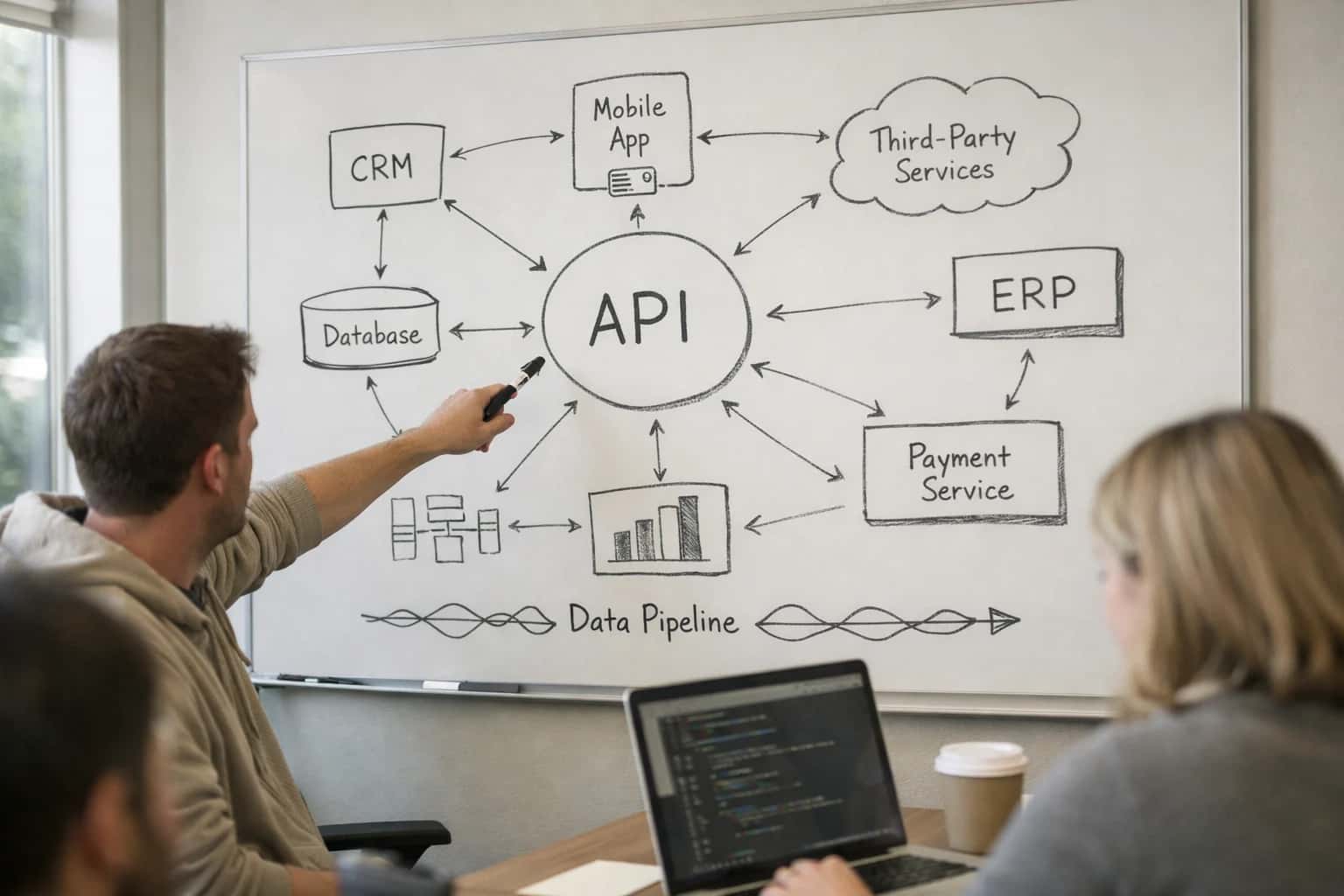
ARCHITECTURE FOR HANDS-FREE OPERATIONS
Where Voice AI Meets the Restaurant POS
A technical blueprint for connecting voice AI agents to the restaurant POS to automate drive-thru, expo line, and kitchen communication workflows.
For production, this means deploying a voice agent that listens on dedicated hardware (e.g., drive-thru headsets, kitchen intercoms) and connects via a webhook-enabled middleware layer. This layer must handle context (e.g., 'add bacon to the current order for lane three'), validate against business rules (e.g., upcharge enforcement, allergy warnings), and post transactions to the POS with the same integrity as a cashier. Implementation nuances include managing order state across potentially disconnected voice channels, implementing a fallback to human review for low-confidence interpretations, and ensuring all voice-initiated transactions are logged in the POS audit trail for reconciliation.
Rollout should start in a controlled environment, like a dedicated expo line station, using the POS platform's sandbox API to test voice commands against a mirrored menu. Governance is critical: define RBAC so voice commands can only modify orders within certain price limits or menu categories, and establish a monitoring dashboard to track voice-order accuracy and latency. The result is a hands-free workflow that reduces miscommunication, speeds up service in high-noise environments, and allows staff to focus on customer interaction and food quality, not data entry.
ARCHITECTURAL BLUEPOINT
POS Touchpoints for Voice AI Integration
Core Transaction Surfaces
Voice AI interacts with the POS at the moment of order creation and modification. Key integration points include:
- Menu & Modifier APIs: The voice agent queries the POS in real-time to confirm item availability, current pricing, and valid modifications (e.g., "Is the salmon gluten-free?"). This requires calling endpoints like
GET /menu/items/{id}orGET /modifier-groups. - Order Object APIs: To create or modify a check, the voice system must construct a payload matching the POS's order schema, often a nested JSON structure specifying items, quantities, applied modifiers, and seat/table numbers. A successful POST to
POST /tickets/{id}/line-itemsfinalizes the transaction. - Upsell & Combo Logic: Based on the initial order, the AI can suggest add-ons or bundled meals by accessing pre-configured combo rules or performing real-time margin analysis via the POS's product API.
Integration ensures the voice stream becomes a structured, auditable transaction without manual keying.
DRIVE-THRU & KITCHEN OPERATIONS
High-Value Voice AI Use Cases for Restaurants
Connecting voice AI to your restaurant POS enables hands-free, low-latency workflows for drive-thrus, expo lines, and back-of-house. These integrations use secure APIs to query live POS data, modify orders, and trigger actions without manual input.
01
Drive-Thru Order Taking & Upselling
Voice AI agent listens to customer orders, confirms items via POS API for real-time availability and pricing, and suggests relevant add-ons (e.g., 'Would you like to add a cookie?'). The finalized order is sent directly to the POS and KDS, reducing order-taking time and increasing average check size.
Batch -> Real-time
Order flow
02
Expo Line Status Queries & Alerts
Expediters use voice commands to ask for order status ('Where's table 12's burger?') or item details. The AI queries the POS/KDS and responds verbally, and can proactively alert about delays or incorrect items, keeping the kitchen synchronized without checking screens.
Same day
Training time
03
Hands-Free Modifications & Void Requests
During rush periods, staff can verbally request order modifications or voids (e.g., 'Void the fries on check 45'). The voice AI validates permissions, executes the action via POS API, and confirms completion audibly, maintaining speed and accuracy without touching the terminal.
Hours -> Minutes
Error resolution
04
Inventory & Item Availability Checks
Managers or cooks can ask, 'How many chicken tenders do we have left?' or 'Is the salmon 86'd?'. The AI fetches live counts from the POS inventory module and speaks the answer, enabling instant decisions for menu changes or supplier calls without leaving the line.
Real-time
Data access
05
Secure Payment & Check Lookup
For curbside or call-in payments, customers provide last name or order number. The voice AI securely retrieves the check total from the POS, confirms the amount, and—when integrated with a payment gateway—can initiate a secure transaction, streamlining pickup workflows.
1 sprint
Integration scope
06
Multi-Language Order Support
Voice AI detects customer language and processes the order, translating item requests into the POS's native menu structure. It confirms the order in the customer's language before submitting, expanding service accessibility without requiring bilingual staff at every station.
Batch -> Real-time
Translation
RESTAURANT POINT OF SALE INTEGRATION
Example Voice AI Workflows in Action
These concrete workflows illustrate how a voice AI assistant can be securely connected to your restaurant POS via APIs to automate tasks in high-noise, hands-free environments like drive-thrus, expo lines, and busy kitchens.
Trigger: A customer places a verbal order at the drive-thru (e.g., "I'll take the avocado toast").
Context/Data Pulled: The voice AI transcribes the request and calls the POS API to query the menu_items table, checking the in_stock flag and current inventory_level for the named item and its components.
Model/Agent Action: The AI agent processes the API response. If the item is available, it confirms the order and proceeds to the next item. If out of stock, it uses a pre-configured substitution rule (e.g., "The avocado toast is 86'd for today. We have the mushroom toast available instead. Would you like that?") and speaks the alternative.
System Update/Next Step: Upon full order confirmation, the AI agent constructs a JSON payload matching the POS's order creation schema and posts it via API, creating a pending order in the POS system, typically flagged for drive-thru payment.
Human Review Point: The order appears on the Kitchen Display System (KDS) for the kitchen staff to prepare. The AI can be configured to flag orders with complex modifications for a quick manager review on a dashboard before firing to the kitchen.
A PRACTICAL BLUEPRINT FOR HANDS-FREE OPERATIONS
Implementation Architecture: Data Flow & Key Components
A secure, low-latency system connecting voice AI to your POS for real-time order management and kitchen coordination.
The core integration connects a voice AI platform (like a custom solution using OpenAI Whisper and GPT-4o, or a vendor like SoundHound) to your restaurant POS (Toast, Square, Clover) via a dedicated middleware layer. This layer handles three critical data flows: 1) Real-time Audio Streams from drive-thru headsets or expo line microphones are transcribed and sent for intent recognition. 2) Secure POS API Calls query the live menu for item availability, modify existing orders, or call up checks using the customer's phone number or order ID. 3) Event Webhooks from the POS, like a completed payment, trigger voice confirmations back to the customer or kitchen.
Key technical components include a gateway service for authentication and rate-limiting calls to the POS API, a context cache to maintain short-term memory of an active order's items and modifiers, and a fallback queue that holds voice requests if the POS is temporarily unavailable—preventing dropped orders. For security, all audio is processed ephemerally, and the middleware uses the POS's OAuth or API key system with role-based permissions, ensuring the voice agent can only perform actions like adding an item or applying a discount as configured by management.
Rollout typically starts in a single lane or station. The voice agent is initially deployed in a shadow mode, where it processes audio and suggests API calls but requires a human to approve them via a tablet dashboard before execution. This builds confidence in its accuracy for complex modifications (e.g., "no mayo, add bacon") and allows for prompt tuning. Governance is managed through the middleware's audit log, which records every voice intent, the corresponding POS transaction ID, and the agent's action for reconciliation. This architecture ensures the integration enhances speed and accuracy without disrupting the core, mission-critical POS operations.
VOICE AI TO POS INTEGRATION PATTERNS
Code & Payload Examples for Key Interactions
Querying Live Orders and Modifying Items
This workflow handles a common drive-thru or expo line scenario: a customer asks, "Can you add bacon to order #42?" The voice AI must securely fetch the open check, validate the modification, and push the update back to the POS.
Key steps involve:
- Extracting intent and entities (order number, modification) from the speech-to-text output.
- Calling the POS API to retrieve the specific open check by its tender ID or ticket number.
- Validating the request against menu rules (e.g., is bacon available as an add-on for that item?).
- Constructing the modification payload and posting it to the POS.
This requires low-latency API calls (<200ms) to maintain a natural conversation flow. The response payload should confirm the change and provide a new total for the voice AI to read back.
VOICE AI FOR DRIVE-THRU & EXPO LINE OPERATIONS
Realistic Operational Impact & Time Savings
This table illustrates the practical workflow improvements when integrating a low-latency voice AI assistant with your restaurant POS (Toast, Square, Clover, TouchBistro). Impact is measured in time saved, error reduction, and operational focus.
| Workflow / Metric | Before AI Voice Integration | After AI Voice Integration | Implementation Notes |
|---|---|---|---|
Drive-thru order taking | Agent manually inputs all items, repeats for accuracy | AI transcribes and inputs items in real-time; agent verifies | Agent focuses on complex requests & customer service; reduces order time by 30-45 seconds |
Expo line item availability check | Expo calls to kitchen or manager, waits for answer | AI queries POS inventory API, provides instant verbal answer | Reduces kitchen interruptions; answers in <3 seconds vs. 30+ second wait |
Order modification (e.g., 'no onion') | Server finds check on POS terminal, manually edits | AI identifies check by table/order #, executes modification via API | Hands-free operation; critical for expo line during rush; reduces errors |
Check lookup for payment | Server asks manager or goes to terminal to search | AI retrieves open check by table number, reads total aloud | Enables quick payment questions without leaving station |
Menu question resolution | Staff pause to search POS menu module or ask manager | AI answers common queries (e.g., 'gluten-free options', 'soup of the day') | Grounded in live POS menu data; reduces manager interruptions by ~50% |
New employee training on POS | Shadowing for 5-10 shifts to learn POS navigation | Voice AI serves as a hands-free 'copilot' for common tasks | Accelerates proficiency; reduces initial training time by ~25% |
Daily pre-shift system check | Manager manually verifies POS connectivity, printer status | AI runs automated diagnostic query, reports status verbally | Proactive issue detection; saves 5-10 minutes per shift opening |
SAFETY AND SCALE IN THE KITCHEN AND DRIVE-THRU
Governance, Security & Phased Rollout
Deploying voice AI in a restaurant requires a security-first architecture and a controlled rollout to protect customer data and ensure operational reliability.
A production voice AI integration for a platform like Toast or Square for Restaurants must be built on a zero-trust data model. The AI agent should never have persistent access to the POS database. Instead, it operates through a secure middleware layer that exposes only the necessary APIs for the current session—such as GET /menu/availability or POST /orders/{id}/modify. All queries from the voice interface are authenticated via short-lived tokens, and every API call to the POS is logged to an immutable audit trail, linking the voice session ID to the specific order or check modified. Payment card data (PCI) must remain entirely within the POS's secure boundary; the AI layer should only handle order intent and item IDs.
Rollout should follow a phased, location-based strategy, not a big-bang deployment. Start with a single non-peak shift in one lane or expo station, using a human-in-the-loop (HITL) design where all AI-suggested actions (e.g., 'add avocado to burger') are confirmed by a staff member on a tablet before the POS API is called. This allows for prompt tuning and latency testing under real conditions. Phase two automates high-confidence actions (like item availability queries) while keeping modifications manual. The final phase enables full automation for trusted workflows, with a clear escalation path—a physical 'AI mute' button or a vocal command to immediately transfer to a live person.
Governance is critical for maintaining trust and compliance. Establish a weekly review of audit logs to detect anomaly patterns, such as unusual modification volumes or failed authentication attempts. Implement a prompt registry to version-control the voice agent's instructions and item mappings, ensuring that a change to the menu in the POS is reflected in the AI's knowledge within a defined SLA. For multi-location franchises, use a centralized control plane to deploy configuration updates (like new promotional items) while allowing location-specific overrides for regional dialects or menu variations. This balance ensures consistency, security, and the ability to quickly roll back a change if the AI's behavior drifts.
Enabling Efficiency, Speed & Accuracy
Intelligent Analysis, Decision & Execution
We build AI systems for teams that need search across company data, workflow automation across tools, or AI features inside products and internal software.
Talk to Us
Search across company data
Give teams answers from docs, tickets, runbooks, and product data with sources and permissions.
Useful when people spend too long searching or get different answers from different systems.
Enterprise searchRAGPermissions
Read more
Automate internal workflows
Use AI to route work, draft outputs, trigger actions, and keep approvals and logs in place.
Useful when repetitive work moves across multiple tools and teams.
AI agentsWorkflow automationGovernance
Read more
Add AI to products and internal tools
Build assistants, guided actions, or decision support into the software your team or customers already use.
Useful when AI needs to be part of the product, not a separate tool.
AI integrationDecision supportModel routing
Read moreIMPLEMENTATION BLUEPRINT
Voice AI for POS: Technical & Commercial FAQs
A practical guide for integrating voice AI assistants into restaurant POS systems like Toast, Square, and Clover. This FAQ covers the technical architecture, security, rollout, and ROI considerations for hands-free environments like drive-thrus and expo lines.
The integration uses a secure, low-latency API layer that sits between the voice AI platform and the POS. Here's the typical data flow:
- Trigger: A voice command is captured (e.g., "Add bacon to order 42") and processed by a speech-to-text (STT) service.
- Context & Intent Recognition: The transcribed text is sent to an LLM or intent classifier, which extracts the action (
modify), target (order 42), and detail (add bacon). - POS API Call: The integration service makes a secure API call to the POS (e.g., Toast Order API, Square Orders API) using OAuth 2.0 tokens scoped with minimal necessary permissions.
- Payload Example (Toast):
json
POST /v1/orders/{order_id}/lineItems Authorization: Bearer {access_token} { "quantity": 1, "name": "Bacon", "price": 250, "itemId": "{menu_item_id}" } - Confirmation: The POS response is parsed, and a success/failure message is generated by a text-to-speech (TTS) service for audio confirmation.
Security Note: API tokens are never exposed to the voice front-end; all calls are proxied through a backend service with strict IP allow-listing and audit logging. See our guide on secure API integration patterns.

About the author
Prasad Kumkar
CEO & MD, Inference Systems
Prasad Kumkar is the CEO & MD of Inference Systems and writes about AI systems architecture, LLM infrastructure, model serving, evaluation, and production deployment. Over 5+ years, he has worked across computer vision models, L5 autonomous vehicle systems, and LLM research, with a focus on taking complex AI ideas into real-world engineering systems.
His work and writing cover AI systems, large language models, AI agents, multimodal systems, autonomous systems, inference optimization, RAG, evaluation, and production AI engineering.
LinkedIn
Limited slotsGet a Free AI Consultation
Partnered with leading AI, data, and software stack.





How We Work
Custom AI workflows for your Business
One-fit-all AI don't work for modern businesses. At Inferensys, we aim to understand your business & custom requirements; which we use to define most efficient agentic workflows, the data, and the tools for your business.
01
Review the use case
We understand the task, the users, and where AI can actually help.
Read more02
Pick the right approach
We define what needs search, automation, or product integration.
Read more03
Build the first useful version
We implement the part that proves the value first.
Read more04
Improve from there
We add the checks and visibility needed to keep it useful.
Read moreThe first call is a practical review of your use case and the right next step.
Talk to Us