AI integration for Yardi Construction focuses on three core surfaces: the Project module for budget and schedule oversight, the Documents repository for RFIs and submittals, and the Job Cost ledger for real-time financial control. The goal is to create a closed-loop system where AI monitors these data streams, identifies deviations from plan, and triggers precise workflows—like automatically escalating a change order that exceeds a budget threshold or summarizing a week's worth of daily reports for the project executive.

Integration
AI Integration with Yardi Construction
Connect AI to Yardi's project management module for construction, automating progress report analysis, change order review, and budget variance alerts for developers.
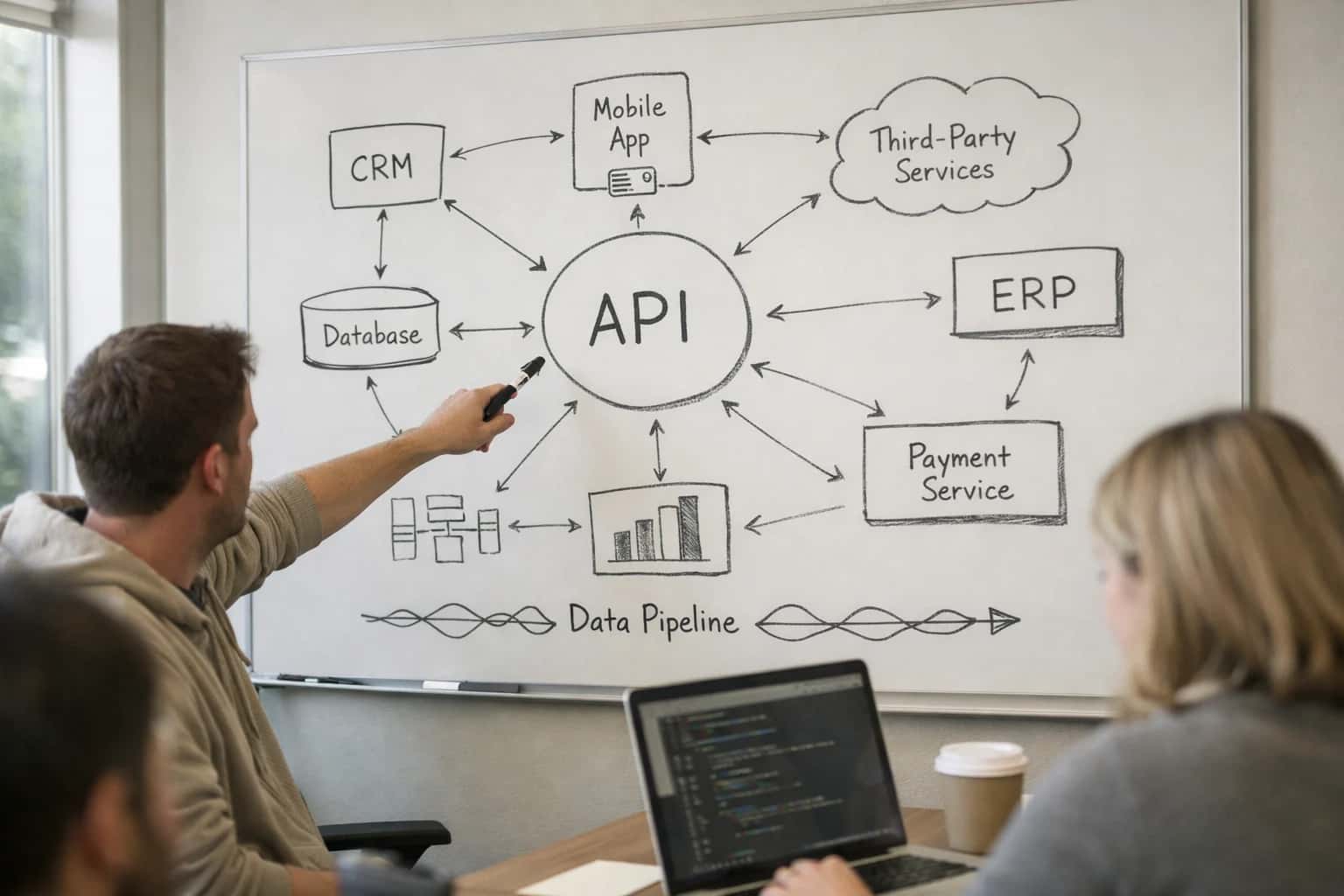
ARCHITECTING PRODUCTION WORKFLOWS
Where AI Fits into Yardi Construction Project Management
A practical guide to embedding AI agents and automation into Yardi's construction module for real-time project intelligence.
Implementation typically involves a middleware layer that subscribes to Yardi's REST API webhooks for new documents, cost transactions, and schedule updates. An AI agent, using a Retrieval-Augmented Generation (RAG) pipeline over project documents, can then answer complex, contextual questions (e.g., "What's the status of the electrical rough-in for Building A based on the last three inspector reports?"). For financial control, a separate workflow can ingest Job Cost Detail feeds, apply anomaly detection models to spot unusual vendor invoices or labor overruns, and create alerts directly in Yardi's Message Center for the project accountant.
Rollout should be phased, starting with read-only document intelligence (like automated RFI categorization) before progressing to write-back actions like creating Change Order Requests. Governance is critical: all AI-generated actions should be logged in Yardi's audit trail and, for financial triggers, require a human-in-the-loop approval step configured within Yardi's standard Approval Workflow engine. This ensures the AI augments the existing process without bypassing established controls.
ARCHITECTING AI FOR PROJECT MANAGEMENT
Key Integration Surfaces in Yardi Construction
Core Project Objects and Budget Feeds
AI integration for Yardi Construction begins with the foundational data objects that define a project's scope and financial health. The primary surfaces are the Project and Budget modules, which contain the master schedule, contract values, and committed costs.
Key integration points include:
- Project API Endpoints: Pull real-time project status, milestones, and key dates to power AI-driven schedule risk analysis and progress reporting.
- Budget Line Items: Ingest detailed budget data (original, revised, committed, actual) to train AI models for variance detection. AI can monitor categories like General Conditions, Subcontracts, and Materials for early warning signs of overruns.
- Change Order Logs: Connect to the Change Order register to analyze the frequency, value, and approval velocity of changes. AI can summarize change impact and suggest proactive scope management.
This data layer enables use cases like automated weekly progress reports, predictive budget alerts, and executive summaries of project financial health.
PROJECT MANAGEMENT AUTOMATION
High-Value AI Use Cases for Yardi Construction
Integrate AI directly into Yardi Construction's project management workflows to automate manual analysis, accelerate decision-making, and surface risks from project data.
01
Automated Progress Report Analysis
Deploy an AI agent to ingest daily reports, photos, and inspector notes from the field. The agent extracts key progress metrics, compares them against the project schedule in Yardi, and flags delays or deviations for the project manager's review. This turns a manual daily review into an automated exception report.
Hours -> Minutes
Report review time
02
AI-Powered Change Order Review
Connect AI to the change order workflow. When a new RFI or change request is logged, the AI analyzes the scope, references historical cost data from Yardi, and suggests preliminary budget impacts. It can also check for similar past changes to recommend approval paths or flag potential scope creep.
Same day
Initial impact assessment
03
Proactive Budget Variance Alerts
Implement a continuous monitoring agent that compares committed costs, invoices, and actuals in Yardi against the project budget. The AI detects subtle variance trends (e.g., consistent overruns in a trade) and alerts the project executive before the monthly financial review, enabling proactive intervention.
Batch -> Real-time
Variance detection
04
Subcontractor & Document Compliance Tracking
Use AI document intelligence to automatically review uploaded subcontractor documents (certificates of insurance, bonds, safety plans) against project requirements stored in Yardi. The agent flags missing or expiring items and creates follow-up tasks, reducing administrative burden and compliance risk.
1 sprint
Setup & integration
05
Predictive Submittal & Approval Workflow Support
Train an AI model on historical submittal log data to predict approval timelines based on document type, reviewer, and complexity. Integrate these predictions into Yardi's workflow to set realistic expectations, prioritize reviewer queues, and automatically nudge stalled items.
06
Safety Incident Analysis & Prevention
After a safety incident report is filed in Yardi, an AI agent analyzes the description to categorize the event, suggest root causes based on past incidents, and recommend preventive actions. This structures unstructured notes into actionable safety intelligence for the site safety officer.
FOR YARDI CONSTRUCTION
Example AI-Augmented Workflows
These workflows illustrate how AI agents can connect to Yardi's project management module (typically Yardi Construction or Yardi Project Management) to automate high-friction processes, reduce manual review, and provide proactive insights for project teams.
Trigger: A new weekly progress report PDF is uploaded to the project's document folder in Yardi.
AI Agent Action:
- The agent is notified via a Yardi webhook or scheduled scan.
- It extracts text and tables from the report using document intelligence.
- It identifies key metrics:
% Complete,Actual Cost to Date,Planned Cost to Date,Schedule Status. - The agent compares extracted values against the project's baseline budget and schedule stored in Yardi via API.
- It calculates variances and applies pre-defined logic:
- Cost Variance > 5%: Flag for review.
- Schedule Delay > 3 days: Flag for review.
- Missing Safety Report: Flag for compliance.
System Update: The agent creates a task in Yardi's task module assigned to the Project Manager with a summary: "Alert: Cost overrun detected in Progress Report for Phase 2A. Actual ($125,450) vs. Planned ($115,000). Variance: 9.1%." It attaches the relevant data snippet.
Human Review Point: The Project Manager reviews the flagged task, investigates the cause, and updates the forecast in Yardi.
CONNECTING AI TO YARDI'S CONSTRUCTION MODULE
Implementation Architecture: Data Flow & System Design
A practical blueprint for integrating AI agents into Yardi's project management workflows for construction and development.
The integration connects to Yardi's Construction Management module via its REST API, focusing on key objects like Projects, ChangeOrders, BudgetLines, Commitments, and ProgressBillings. An AI middleware layer acts as a real-time monitor, ingesting data from Yardi's webhooks for new document uploads, status changes on change orders, and budget line item updates. This layer uses document intelligence to parse uploaded progress reports, RFI responses, and inspection photos stored in Yardi's document repository, extracting key dates, completion percentages, and flagged issues.
For a typical workflow, the system is triggered when a new ChangeOrder draft is submitted. The AI agent retrieves the document, compares the scope and cost against the original contract and baseline budget, and generates a risk summary highlighting potential overruns or schedule impacts. This analysis is appended as a note to the Yardi record and can trigger an automated alert to the project manager via Yardi's notification system. Similarly, for budget variance, the agent runs scheduled checks, comparing ActualCost against BudgetedCost at the line-item level, flagging anomalies that exceed configured thresholds and suggesting causal factors from recent change orders or commitments.
Rollout follows a phased approach: start with a single pilot project, connecting AI to read-only endpoints for document analysis and alert generation. Governance is critical; all AI-generated notes and alerts are tagged with a source identifier and stored in Yardi's audit trail. The final phase enables controlled write-backs, where the AI agent can auto-populate certain fields in change order logs or create follow-up tasks in Yardi's task management system, but always requiring a human-in-the-loop approval for any financial commitment. This architecture ensures AI augments the existing Yardi workflow without disrupting established approval chains and financial controls.
For teams managing multiple developments, this pattern can be scaled by project portfolio. The AI layer can be configured with project-specific rules (e.g., different variance thresholds for ground-up vs. renovation). The result is a system that turns Yardi from a system of record into a proactive intelligence hub, reducing the manual hours spent cross-referencing documents and spreadsheets and providing earlier, data-driven warnings on project health. For a deeper technical dive on Yardi's API capabilities, see our guide on Property Management Platform APIs.
YARDI CONSTRUCTION INTEGRATION PATTERNS
Code & Payload Examples
Ingesting and Analyzing Daily Logs
AI can process unstructured text from Yardi Construction's daily logs or progress reports via its API. A common pattern is to extract the report document, use an LLM to summarize key activities, flag delays, and identify mentioned subcontractors or materials. The structured output can then update the project's JobCost records or create follow-up tasks.
python# Example: Fetch a progress report and send for AI analysis import requests def analyze_progress_report(report_id, yardi_api_key): # Fetch report from Yardi Construction API headers = {'Authorization': f'Bearer {yardi_api_key}'} report_resp = requests.get( f'https://api.yardi.com/construction/v1/reports/{report_id}', headers=headers ) report_text = report_resp.json()['content'] # Call Inference Systems' analysis endpoint analysis_payload = { "text": report_text, "instructions": "Summarize work completed, identify delays, extract mentioned subcontractors and materials." } ai_resp = requests.post('https://api.inferencesystems.com/v1/analyze', json=analysis_payload) return ai_resp.json() # Returns structured summary and flags
The resulting JSON can trigger alerts in Yardi for schedule variance or automatically log potential change order triggers.
AI FOR CONSTRUCTION PROJECT MANAGEMENT
Realistic Time Savings & Operational Impact
How AI integration with Yardi Construction transforms manual, reactive processes into proactive, data-driven workflows for project managers, superintendents, and developers.
| Workflow / Metric | Before AI Integration | After AI Integration | Implementation Notes |
|---|---|---|---|
Daily/Weekly Progress Report Review | Manual review of 50+ photos and notes; 2-3 hours per report | AI-generated summary with risk highlights; 15-20 minute review | AI analyzes photo logs and superintendent notes, flags delays or safety issues for human follow-up |
Change Order Document Processing | Manual data entry and cross-checking against contracts; 1-2 hours per order | AI extracts key terms, suggests budget impact; 20-30 minute validation | Human approves AI-suggested coding and routing; integrates with Yardi's change management module |
Budget Variance & Cost Forecasting | Monthly spreadsheet reconciliation; often misses trends until month-end | AI monitors daily cost postings, alerts on significant variances in real-time | Alerts trigger workflows in Yardi; forecasts update based on committed costs and progress |
Submittal & RFI Log Management | Manual tracking in spreadsheets; status updates delayed, risking schedule impact | AI parses incoming emails/documents, auto-updates log status, flags overdue items | Connects to Yardi's document management; provides a single source of truth for the project team |
Safety & Compliance Photo Audit | Spot-checking photos for PPE and site hazards; inconsistent coverage | AI scans all uploaded site photos, generates a daily compliance scorecard | Focuses superintendent review on flagged incidents; creates audit trail for insurers |
Punch List Generation from Photos | Superintendent walks site with notepad, later transcribes; 4-8 hours per list | AI suggests punch items from photo analysis; superintendent reviews and confirms | Items flow directly into Yardi's task tracking; reduces clerical work for field staff |
Project Health Executive Summary | Manual compilation from multiple reports for weekly OAC meetings; 3-4 hours | AI auto-generates a one-page dashboard with KPIs, risks, and next steps | Pulls live data from Yardi; ensures leadership has consistent, timely information |
ARCHITECTING FOR CONTROLLED DEPLOYMENT
Governance, Security & Phased Rollout
A secure, phased rollout ensures AI augments Yardi Construction workflows without disrupting critical project delivery.
Production AI integrations for Yardi Construction must respect the platform's data model and existing governance. We architect integrations to operate as a secure middleware layer, typically using a dedicated service account with scoped API permissions to Yardi's Project Management and Job Cost modules. This layer ingests data like daily reports, RFIs, change orders, and budget line items via Yardi's REST APIs or webhooks. All AI processing—such as extracting progress percentages from PDF reports or flagging cost variances—occurs outside Yardi in a governed environment, with results written back as notes, alerts, or updated custom fields. This keeps the core system's audit trails intact and allows for human-in-the-loop approval steps before any financial data is modified.
A phased rollout mitigates risk and builds confidence. Phase 1 often targets a single, high-value workflow like automated Progress Report Analysis. An AI agent is configured to monitor a specific project's report folder, summarize key milestones and delays, and post a digest to the project's communication log. This non-invasive start demonstrates value without altering core financials. Phase 2 expands to Change Order Review, where AI pre-fills a risk assessment template by analyzing the change order's scope against the original contract and budget. Phase 3 introduces proactive Budget Variance Alerts, where the system monitors committed cost vs. budget and flags discrepancies for project managers, with alerts routed through Yardi's native notification system or a connected channel like Microsoft Teams.
Governance is built around role-based access, audit logging, and model oversight. Access to AI-generated insights is controlled via Yardi's existing user roles—superintendents see progress summaries, while project executives receive portfolio-level variance reports. All AI interactions are logged with a correlation ID back to the source Yardi record. For generative tasks like drafting RFI responses, outputs are clearly marked as AI-drafted and require a manager's review before submission. This controlled approach ensures AI serves as a copilot for your construction teams, enhancing decision velocity while maintaining the accountability required for capital projects.
Enabling Efficiency, Speed & Accuracy
Intelligent Analysis, Decision & Execution
We build AI systems for teams that need search across company data, workflow automation across tools, or AI features inside products and internal software.
Talk to Us
Search across company data
Give teams answers from docs, tickets, runbooks, and product data with sources and permissions.
Useful when people spend too long searching or get different answers from different systems.
Enterprise searchRAGPermissions
Read more
Automate internal workflows
Use AI to route work, draft outputs, trigger actions, and keep approvals and logs in place.
Useful when repetitive work moves across multiple tools and teams.
AI agentsWorkflow automationGovernance
Read more
Add AI to products and internal tools
Build assistants, guided actions, or decision support into the software your team or customers already use.
Useful when AI needs to be part of the product, not a separate tool.
AI integrationDecision supportModel routing
Read moreIMPLEMENTATION BLUEPRINT
Frequently Asked Questions
Common technical and operational questions for integrating AI agents and automation into Yardi Construction's project management workflows.
AI integrations connect primarily via Yardi's RESTful API and secure webhook endpoints. The key objects for construction workflows are:
- Projects & Phases: For overall budget and schedule context.
- Change Orders: To analyze scope, cost, and approval status.
- Budget Lines & Commitments: For real-time cost tracking and variance analysis.
- Documents (Drawings, RFIs, Submittals): Stored in Yardi's document management, accessed via API for content analysis.
- Progress Billing Applications (PBAs): For automated review of percentage complete against work-in-place.
An AI middleware layer typically:
- Polls the API on a schedule for new records or listens for webhook events (e.g.,
change_order.created). - Extracts relevant data and document references.
- Processes the information using an LLM or specialized model.
- Posts analysis results, alerts, or suggested updates back to Yardi via API calls (e.g., adding a note to a change order, creating a task for review).

About the author
Prasad Kumkar
CEO & MD, Inference Systems
Prasad Kumkar is the CEO & MD of Inference Systems and writes about AI systems architecture, LLM infrastructure, model serving, evaluation, and production deployment. Over 5+ years, he has worked across computer vision models, L5 autonomous vehicle systems, and LLM research, with a focus on taking complex AI ideas into real-world engineering systems.
His work and writing cover AI systems, large language models, AI agents, multimodal systems, autonomous systems, inference optimization, RAG, evaluation, and production AI engineering.
LinkedIn
Limited slotsGet a Free AI Consultation
Partnered with leading AI, data, and software stack.





How We Work
Custom AI workflows for your Business
One-fit-all AI don't work for modern businesses. At Inferensys, we aim to understand your business & custom requirements; which we use to define most efficient agentic workflows, the data, and the tools for your business.
01
Review the use case
We understand the task, the users, and where AI can actually help.
Read more02
Pick the right approach
We define what needs search, automation, or product integration.
Read more03
Build the first useful version
We implement the part that proves the value first.
Read more04
Improve from there
We add the checks and visibility needed to keep it useful.
Read moreThe first call is a practical review of your use case and the right next step.
Talk to Us