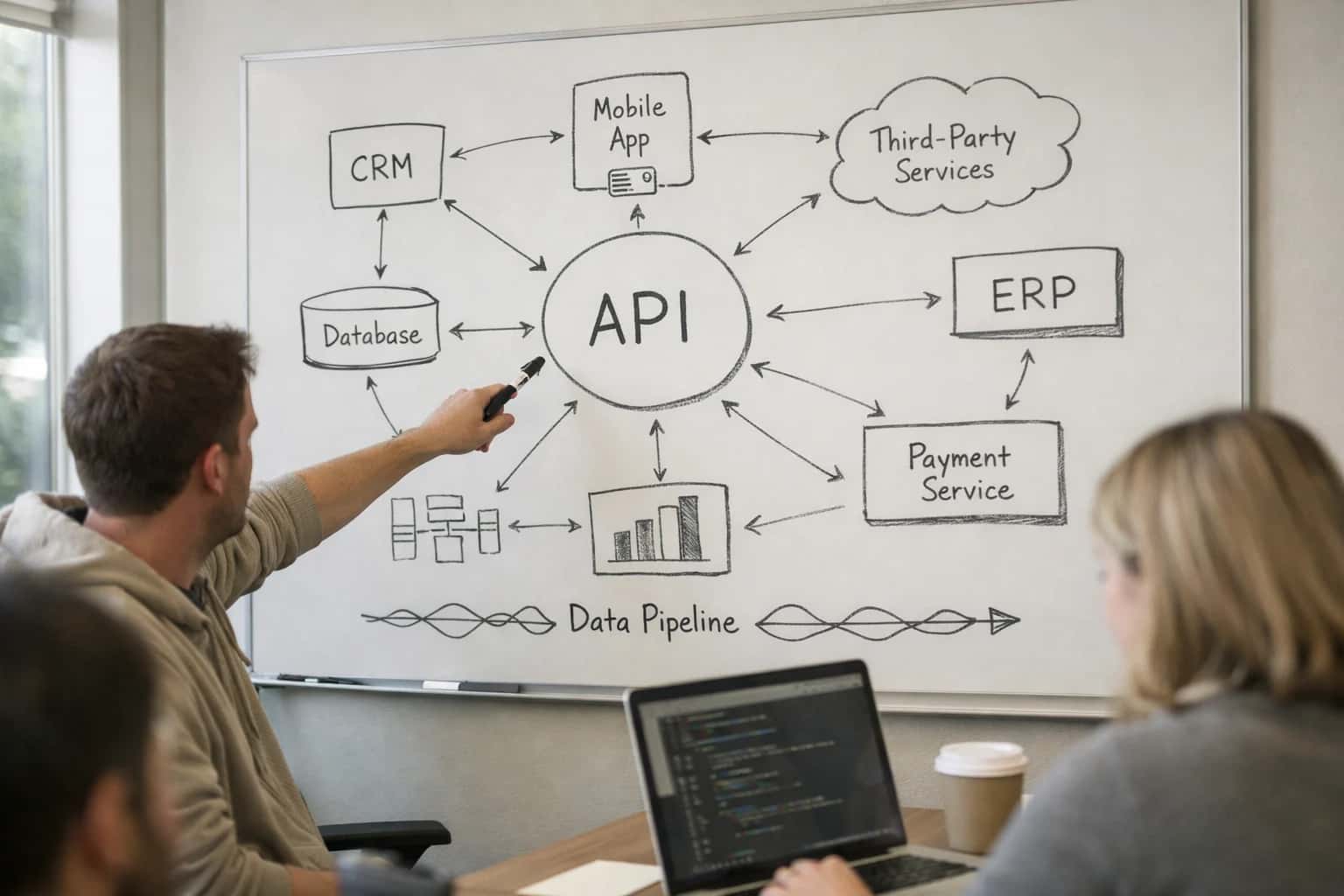
This integration connects an AI analysis layer to the core financial APIs of your property management platform—be it AppFolio, Yardi Voyager, Entrata, or MRI Software. The system ingests daily transactional data (rent receipts, vendor invoices, CAM charges) and compares it line-by-line against the budget categories and forecasts stored in the platform's General Ledger and Budget Module. Instead of waiting for a monthly close, the AI runs continuous variance detection, using rules and statistical models to flag discrepancies that exceed configured thresholds (e.g., >10% variance or >$5,000 absolute difference).

Integration
AI Integration for Budget Variance Detection
Build an AI monitor that compares actual income and expenses from your property management platform against budgets, automatically flagging significant variances and suggesting root-cause explanations for faster financial oversight.
ARCHITECTURE & ROLLOUT
From Monthly Review to Real-Time Financial Oversight
How to build an AI monitor that compares actual income and expenses from your property management platform against budgets, automatically flagging significant variances and suggesting explanations.
Implementation involves setting up a secure, scheduled data pipeline (often using a tool like Fivetran or custom scripts) that pulls Actuals and Budget data from the PM platform's database or REST APIs. The AI engine, which can be hosted in your cloud, calculates variances, enriches them with context (e.g., "Vendor invoice for HVAC repair 300% over budget for Q3"), and pushes alerts and a summarized report back into the platform. This can be done by creating Custom Objects for AI findings in the PM platform or by posting comments to relevant GL Account records, ensuring the insight lives where the action is.
Rollout should start with a pilot on 2-3 high-value budget categories (like Repairs & Maintenance or Utilities). Governance is critical: the AI's suggestions should be reviewed by a property accountant or portfolio manager before any automated journal entries are posted. Establish an audit trail by logging all AI-generated flags and the subsequent human actions taken in the PM platform's Activity Log. This creates a closed-loop system where the AI learns from overrides, improving its accuracy over time. For a deeper look at connecting AI to property management financials, see our guide on AI Integration for AppFolio Accounting.
ARCHITECTURE BLUEPRINT
Where AI Connects to Your PM Platform's Financial Data
The Core Financial Surface
AI connects directly to the General Ledger (GL) and Chart of Accounts (COA) API endpoints to read actual income and expense transactions. This is the source of truth for financial performance.
Key Integration Points:
- Transaction Feeds: Poll or receive webhooks for new journal entries, posted invoices, and bill payments.
- Account Mapping: Use the COA structure to categorize spend against budget line items (e.g.,
Repairs & Maintenance,Utilities,Marketing). - Period Close Data: Access period-end trial balances to compare closed financials against budget forecasts.
A typical integration extracts daily transaction batches, normalizes account codes, and prepares a structured feed for the variance detection model. Security requires scoped API tokens with read-only access to financial data.
PROPERTY MANAGEMENT PLATFORMS
High-Value Use Cases for AI-Powered Variance Detection
AI-powered variance detection moves budget monitoring from a monthly accounting task to a continuous operational intelligence layer. By connecting to your property management platform's financial APIs, these systems compare actual income and expenses against budgets in near real-time, automatically flagging significant variances and suggesting root causes.
01
Automated Monthly Variance Reporting
Replaces manual spreadsheet reconciliation. An AI agent queries the PM platform's GL and budget modules daily, compares line items, and generates a preliminary variance report for the property accountant. It highlights top variances with suggested explanations (e.g., 'Water expense 15% over budget; check for possible leak at Unit 304 based on recent work order').
Days -> Hours
Report generation
02
Real-Time CAM & Operating Expense Alerts
Critical for commercial portfolios. AI monitors invoice feeds and expense postings against annual CAM budgets. When a vendor invoice is coded to a CAM account and causes a >5% monthly variance, the system alerts the property manager with context: 'Q1 landscaping invoice 22% over budget; check scope vs. contract.' Prevents year-end reconciliation surprises.
Batch -> Real-time
Anomaly detection
03
Revenue Leakage Detection
Identifies missing income that budgets assumed. AI cross-references scheduled rent in the budget with actual payments posted in the PM platform. Flags units with consistent underpayments, missed late fees, or unapplied concessions. Explains variance: 'Unit 205 budgeted at $1,800; average collected rent last quarter was $1,725 due to recurring late payment discount.'
Proactive
Cash flow protection
04
Capital Project & Renovation Budget Tracking
Tracks CapEx variance across projects. AI ingests purchase orders and contractor invoices from the PM platform's project module, comparing them to the approved project budget. Provides weekly digest: 'Lobby renovation: plumbing invoices are 18% over allocated budget; electrical is 5% under.' Helps project managers reallocate before overruns.
Weekly Digest
Project oversight
05
Predictive Budget Forecasting Adjustments
Uses variance history to improve future budgets. AI analyzes historical variance patterns (e.g., 'Utilities consistently under-budgeted in winter') and suggests adjustments for the next budget cycle within the PM platform's budgeting tool. Shifts the role from detective to strategic planner.
Data-Driven
Budget accuracy
06
Portfolio-Wide Variance Benchmarking
Surfaces outliers across a portfolio. An AI analytics layer queries budget vs. actual data from multiple properties in the PM platform. Flags properties with variance patterns outside portfolio norms: 'Property A's repair & maintenance is 40% above budget while portfolio average is +5%.' Enables centralized oversight and knowledge sharing.
Cross-Property
Executive insight
BUDGET VARIANCE DETECTION
Example AI Monitoring Workflows
These workflows illustrate how an AI agent can be integrated with your property management platform to continuously monitor financial data, detect significant budget variances, and trigger automated analysis and alerts.
Trigger: Nightly batch job after the property management platform (e.g., AppFolio, Yardi Voyager) closes its daily financial posting.
Context/Data Pulled:
- Actual income and expense transactions posted to the General Ledger for the period (day, week, month-to-date).
- Budget data for the corresponding property, account, and period from the platform's budgeting module.
- Historical variance patterns for the same account.
Model or Agent Action:
- The AI agent calculates variances (Actual vs. Budget).
- It applies a multi-factor scoring model to determine significance:
- Percentage Variance:
(Actual - Budget) / Budget - Absolute Dollar Variance: Thresholds differ for income vs. expense accounts.
- Historical Context: Is this variance a recurring pattern or a new anomaly?
- Account Criticality: Higher scores for major income lines (rent) or controllable expenses (repairs & maintenance).
- Percentage Variance:
- Variances scoring above a configurable threshold are flagged for explanation.
System Update or Next Step:
The agent creates a structured alert in a dedicated budget_variance_alerts table or external system (e.g., Slack, Microsoft Teams, a dashboard), including:
- Property ID, Account Code, Period
- Budget Amount, Actual Amount, Variance Amount & %
- Significance Score
- A link back to the source transaction(s) in the PM platform.
Human Review Point: The alert is routed to the appropriate role (Property Accountant, Portfolio Manager) based on property and account type for investigation.
PRODUCTION BLUEPRINT
Implementation Architecture: Data Flow, APIs, and Guardrails
A practical architecture for deploying an AI variance monitor that connects to your property management platform's financial data.
The integration is built as a secure middleware layer that sits between your property management platform (e.g., AppFolio, Yardi Voyager, MRI) and your AI models. It follows a three-stage flow: Data Extraction, AI Analysis & Enrichment, and Actionable Output. First, a scheduled job queries the PM platform's financial APIs—typically the GeneralLedger, Budget, and Property endpoints—to pull actuals and budget data for a defined period (e.g., month-to-date). This raw data is normalized, tagged with property and account codes, and staged in a secure data store.
The core AI engine then processes this staged data. It uses a combination of rule-based thresholds (e.g., >10% variance) and machine learning models trained on historical patterns to flag significant deviations. For each flagged variance, the system attempts to generate a contextual explanation by correlating it with other platform events—like a surge in Maintenance expense codes coinciding with a specific work order, or a dip in Other Income linked to an amenity closure. These enriched alerts, containing the variance amount, percentage, likely cause, and links to source transactions, are queued for review.
Governance is critical. All alerts are first written to an audit log. Based on configuration, they can be routed to different channels: high-severity items might create a task in the PM platform's Workflow module for the property manager, while a summary report is posted to a dedicated Slack channel or emailed to the regional portfolio analyst. Before any automated task creation, alerts can be sent to a human-in-the-loop dashboard for approval. The entire system is permission-aware, querying the PM platform's RBAC to ensure users only receive alerts for properties they manage. Rollout typically starts with a single property or portfolio, using the AI as an advisory tool, before scaling to automated reporting.
AI BUDGET MONITORING
Code and Payload Examples
Ingesting Budget vs. Actuals
The first step is to programmatically pull budget and actual income/expense data from the property management platform. This typically involves querying the General Ledger, Budget modules, or specific financial reports via API. Data must be normalized (e.g., mapping chart of accounts, aligning periods) before comparison.
Example API Call to Fetch GL Data (Yardi Voyager-style):
pythonimport requests def fetch_actuals_from_pm(property_id, start_date, end_date): # Example endpoint for financial transaction data url = "https://api.propertyplatform.com/v1/financial/transactions" headers = {"Authorization": "Bearer YOUR_API_KEY"} params = { "propertyId": property_id, "startDate": start_date, "endDate": end_date, "reportBasis": "Accrual", "detailLevel": "Summary" } response = requests.get(url, headers=headers, params=params) return response.json() # Returns list of GL line items
This payload returns categorized income and expense line items, which can then be aggregated by account code and compared to the corresponding budget.
BUDGET MONITORING WORKFLOW
Realistic Time Savings and Operational Impact
How AI-driven variance detection changes the monthly financial review cycle for property portfolios.
| Process Step | Manual Process (Before AI) | AI-Assisted Process (After AI) | Operational Impact |
|---|---|---|---|
Variance Identification | Manual spreadsheet comparison, 4-8 hours per property | Automated daily scan, alerts in <5 minutes | Shifts effort from finding issues to resolving them |
Root Cause Analysis | Manual investigation across GL, invoices, and lease files | AI suggests likely causes (e.g., 'vacancy', 'vendor overage') | Reduces investigation time by 60-70% for common variances |
Exception Reporting | Manual compilation for asset manager review, 1-2 days | Auto-generated report with prioritized exceptions, same-day | Accelerates reporting cycle from monthly to weekly or daily |
Approval & Workflow Routing | Email chains and manual task assignment in PM platform | AI routes flagged variances to appropriate manager based on GL code & threshold | Ensures faster accountability and reduces follow-up emails |
Forecast Adjustment | Manual recalculation of future monthly budgets | AI provides revised forecast scenarios based on variance trends | Improves forecast accuracy and supports proactive decision-making |
Audit Trail Documentation | Manual note-taking in budget module or separate files | Automated log of detection, analysis, and action taken linked to PM platform record | Strengthens compliance and simplifies audit preparation |
ARCHITECTING A CONTROLLED AI FINANCIAL MONITOR
Governance, Security, and Phased Rollout
A production-ready AI variance monitor requires careful planning for data security, model governance, and a phased rollout to build trust and value.
The integration architecture is built around a secure, external AI service layer that polls the property management platform's financial APIs (e.g., Yardi Voyager's FinancialTransaction API, AppFolio's JournalEntry endpoints) on a scheduled basis. This layer ingests actuals and budget data, processes it through a dedicated variance detection model, and posts findings—such as flagged GL accounts, variance percentages, and suggested root causes—back to a custom object or note field within the PM platform via its REST API. All data flows are encrypted in transit, and the AI service operates with a least-privilege service account scoped only to the necessary financial modules and properties. Audit logs track every data pull, analysis run, and alert creation for full traceability.
A phased rollout is critical for adoption and model tuning. Phase 1 (Pilot): Begin with a single asset or small portfolio, focusing on high-impact expense categories like Utilities, Repairs & Maintenance, and Contract Services. The AI model generates daily variance reports in a sandbox environment, allowing the finance team to review its accuracy and suggested explanations (e.g., 'Variance driven by unseasonal HVAC repairs in Building B'). Phase 2 (Expansion): After refining prompts and confidence thresholds, expand to the entire portfolio and include revenue line items like Rental Income and Late Fees. Integrate alerts directly into the PM platform's workflow engine to create tasks for property accountants. Phase 3 (Automation): Enable automated, closed-loop workflows where high-confidence, low-risk variances (e.g., a minor utility overage with a clear weather-related explanation) can auto-generate an adjusting journal entry draft for review, while high-value anomalies trigger immediate notifications via email or Slack.
Governance is maintained through a human-in-the-loop review stage that remains mandatory for the initial rollout period. The system is designed to be an assistant, not an autopilot. Property managers and regional controllers retain final approval authority over any system-generated journal entries or budget adjustments. Furthermore, the AI's 'explanation' feature is not a black box; it references specific transaction IDs, vendor names, and dates from the source system, allowing for easy verification. Regular model performance reviews are scheduled to check for drift—ensuring the detection logic remains aligned with evolving accounting practices and portfolio changes. This structured approach minimizes financial risk while delivering the operational benefit of shifting variance analysis from a monthly manual hunt to a continuous, AI-augmented process.
Enabling Efficiency, Speed & Accuracy
Intelligent Analysis, Decision & Execution
We build AI systems for teams that need search across company data, workflow automation across tools, or AI features inside products and internal software.
Talk to Us
Search across company data
Give teams answers from docs, tickets, runbooks, and product data with sources and permissions.
Useful when people spend too long searching or get different answers from different systems.
Enterprise searchRAGPermissions
Read more
Automate internal workflows
Use AI to route work, draft outputs, trigger actions, and keep approvals and logs in place.
Useful when repetitive work moves across multiple tools and teams.
AI agentsWorkflow automationGovernance
Read more
Add AI to products and internal tools
Build assistants, guided actions, or decision support into the software your team or customers already use.
Useful when AI needs to be part of the product, not a separate tool.
AI integrationDecision supportModel routing
Read moreIMPLEMENTATION AND WORKFLOW
Frequently Asked Questions
Practical questions for technical teams planning an AI-driven budget variance detection system that integrates with your property management platform.
The integration connects via the platform's secure APIs (e.g., AppFolio's Reporting API, Yardi Voyager's Financial Suite API, MRI's RESTful APIs). The typical workflow is:
- Authentication & Scheduling: The system authenticates using OAuth 2.0 or API keys and runs on a scheduled basis (e.g., nightly).
- Data Extraction: It queries for budget vs. actual reports for specified properties, portfolios, or GL accounts. Key data points include:
- Budgeted income/expense by category
- Actual posted amounts
- Variance percentages
- Time period (month, quarter, year-to-date)
- Secure Transfer: Data is pulled into a secure processing environment. We recommend using a dedicated service account with read-only permissions scoped to necessary financial modules.
Example API Payload Request (Yardi Voyager-style):
json{ "endpoint": "/api/budgetVariance", "params": { "propertyIds": ["PROP001", "PROP002"], "fiscalPeriod": "2024-04", "glLevel": "summary" } }
The goal is to create a repeatable, auditable data pipeline without manual export/import.

About the author
Prasad Kumkar
CEO & MD, Inference Systems
Prasad Kumkar is the CEO & MD of Inference Systems and writes about AI systems architecture, LLM infrastructure, model serving, evaluation, and production deployment. Over 5+ years, he has worked across computer vision models, L5 autonomous vehicle systems, and LLM research, with a focus on taking complex AI ideas into real-world engineering systems.
His work and writing cover AI systems, large language models, AI agents, multimodal systems, autonomous systems, inference optimization, RAG, evaluation, and production AI engineering.
LinkedIn
Limited slotsGet a Free AI Consultation
Partnered with leading AI, data, and software stack.





How We Work
Custom AI workflows for your Business
One-fit-all AI don't work for modern businesses. At Inferensys, we aim to understand your business & custom requirements; which we use to define most efficient agentic workflows, the data, and the tools for your business.
01
Review the use case
We understand the task, the users, and where AI can actually help.
Read more02
Pick the right approach
We define what needs search, automation, or product integration.
Read more03
Build the first useful version
We implement the part that proves the value first.
Read more04
Improve from there
We add the checks and visibility needed to keep it useful.
Read moreThe first call is a practical review of your use case and the right next step.
Talk to Us