AI integration for AppFolio maintenance triage connects directly to the platform's Work Order API and Resident Portal webhooks. The primary surfaces for automation are the incoming request queue and the technician dispatch board. An AI agent acts as a middleware classifier, ingesting unstructured tenant descriptions, attached photos, and property history to perform three core functions: classify the issue (e.g., plumbing, electrical, appliance), assign a priority score (emergency, routine, preventive), and suggest initial resolution steps or required parts. This pre-processing happens before a human property manager reviews the ticket, transforming raw resident input into a structured, actionable work order with suggested vendor assignments pulled from AppFolio's vendor network.

Integration
AI Integration for AppFolio Maintenance Triage
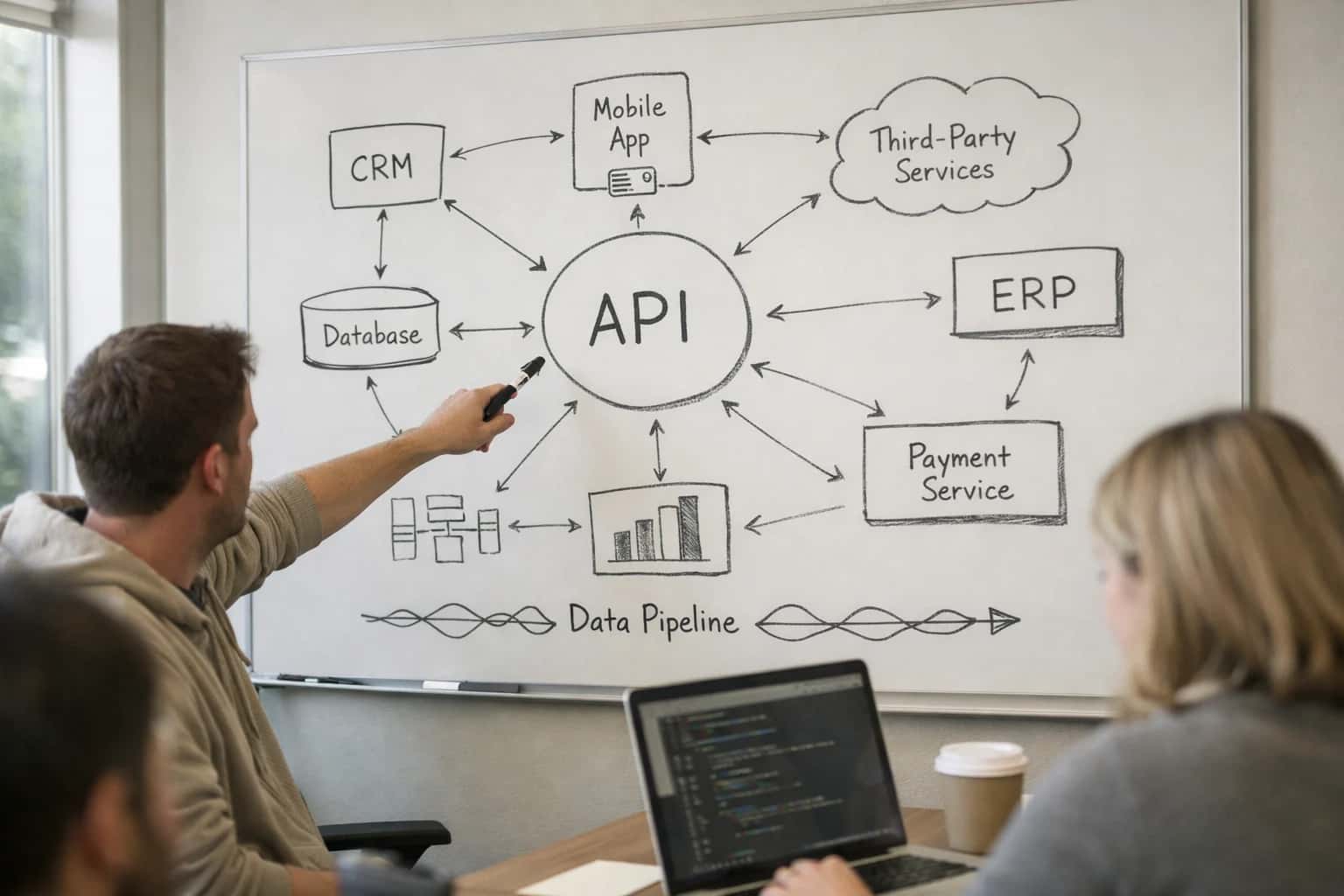
Where AI Fits in AppFolio Maintenance Operations
A practical guide to integrating AI into AppFolio's maintenance module for automated triage, prioritization, and resolution support.
Implementation typically involves a secure, event-driven pipeline: 1) A webhook listener captures new maintenance_requests from the AppFolio resident portal. 2) The request payload (description, unit, tenant history) is sent to an AI classification service. 3) The service returns enriched metadata (category, urgency, suggested notes) which is used to auto-populate fields via the AppFolio API when creating the official work order. For high-confidence, low-risk issues (e.g., a reported leak), the system can even auto-assign the ticket to a pre-approved vendor and send dispatch instructions, logging all actions for audit. The impact is operational: reducing manual triage time from minutes to seconds, ensuring emergencies are flagged immediately, and improving first-time fix rates by providing technicians with better context.
Rollout and governance are critical. Start with a pilot property, using the AI as a copilot where its suggestions require manager approval before API writes. Implement a feedback loop where property managers can correct misclassifications, continuously improving the model. Key considerations include RBAC integration to ensure the AI agent only interacts with data its service account can access, and audit logging for all AI-generated actions. This approach allows teams to scale the integration across portfolios, maintaining control while automating the repetitive cognitive load of maintenance triage. For related architectural patterns, see our guide on AI Integration for Maintenance Triage in Property Management.
Key AppFolio Surfaces for AI Integration
The Primary Entry Point
The resident-facing Maintenance Request Portal is the most critical surface for AI triage. This is where unstructured tenant descriptions, photos, and videos are submitted. An AI integration intercepts these submissions via AppFolio's webhooks or API before a ticket is officially created.
Key Integration Points:
- Webhook for
maintenance_request.created: Trigger an AI classification agent immediately upon submission. - API Endpoint
POST /maintenance_requests: Create the ticket after AI processing, populating the structured fields.
AI Workflow:
- Ingest the tenant's free-text description and any media.
- Classify the issue (e.g.,
Plumbing - Leak,Appliance - Refrigerator,Electrical - Outlet). - Assign an initial priority score based on keywords, sentiment, and historical data.
- Suggest potential fixes or required parts from a knowledge base.
- Return enriched data to create a pre-populated, prioritized work order in AppFolio.
High-Value AI Use Cases for Maintenance Triage
Integrating AI directly into AppFolio's maintenance module transforms reactive work orders into intelligent, prioritized workflows. These patterns connect to the WorkOrder API, analyze tenant-submitted descriptions and photos, and automate routing to optimize property team and vendor response.
Automated Emergency Classification
AI analyzes incoming work request text and attached images to detect keywords (flood, no heat, lock) and visual evidence of water or fire. It automatically tags the ticket as Emergency or Routine, overriding default tenant selections for accuracy, and pushes a high-priority status via the AppFolio WorkOrder API.
Vendor & Skill-Based Routing
For non-emergencies, AI reads the work description to infer required trade (plumbing, electrical, appliance). It cross-references the property's preferred vendor list in AppFolio and the vendor's service tags, then suggests or auto-assigns the ticket to the appropriate contractor, reducing manual triage calls.
Resolution Suggestion Engine
By comparing the new work order description and photos against a vector database of historical resolved tickets, AI suggests probable causes and fixes to the property manager. Example: 'Tenant reports dripping under sink' → Likely Cause: Loose P-trap. Suggested Action: Tighten connections or replace washer. This accelerates first-time fix rates.
Recurring Issue & Asset Health Detection
AI clusters work orders by unit and appliance type (e.g., Unit 203 dishwasher). It flags patterns indicating a chronic issue or failing asset, then automatically creates a follow-up Preventive Maintenance ticket or a Capital Project note in AppFolio, shifting from reactive to predictive maintenance.
Tenant Communication Automation
Upon ticket creation or status update, an AI agent drafts a context-aware message to the tenant. It confirms receipt, provides an ETA based on priority and vendor schedule pulled from AppFolio, and asks for clarifying photos if needed. All communication is logged back to the work order notes via API.
Vendor Invoice Review & Coding
When a vendor uploads a completed invoice PDF to the closed work order, AI extracts line items, amounts, and parts. It checks for consistency with the original work order scope and automatically codes the expense to the correct GL account in AppFolio, flagging any discrepancies for manager review.
Example AI-Augmented Maintenance Workflows
These workflows illustrate how AI can be integrated into AppFolio's maintenance module to automate triage, routing, and resolution support. Each pattern connects to AppFolio's APIs to read tenant requests, update work orders, and communicate status changes.
Trigger: A new maintenance request is submitted via the resident portal, email, or phone call (transcribed).
Context Pulled: The AI system calls the AppFolio API to retrieve the request description, unit number, and resident history. It may also fetch recent work orders for the same unit or appliance.
AI Action: A classification model analyzes the description and history. It scores the request for urgency using keywords (e.g., 'flooding', 'no heat', 'lock broken') and contextual clues. It also checks if similar past issues were marked as emergencies.
System Update: Based on the score:
- High urgency: The AI automatically creates a work order in AppFolio with priority 'Emergency', assigns it to the on-call vendor pool, and triggers an immediate SMS alert to the maintenance manager.
- Routine: The work order is created with priority 'Routine' and placed in the appropriate category queue (e.g., Plumbing, HVAC, Appliance).
Human Review Point: The maintenance manager receives a dashboard alert for all auto-classified emergencies with the AI's reasoning, allowing for manual override if needed.
Implementation Architecture: Data Flow & System Design
A practical blueprint for integrating an AI triage layer with AppFolio's work order system.
The integration architecture is event-driven, centered on AppFolio's Maintenance API and webhook system. When a resident submits a request via the portal or mobile app, a webhook payload containing the work_order object (with description, category, unit, priority, and attachments) is sent to a secure AI endpoint. An AI classification agent immediately analyzes the unstructured text and images to predict the correct category (e.g., Plumbing, Electrical, Appliance), assign a dynamic priority score (factoring in keywords like 'leak' or 'no heat'), and suggest a resolution template or required parts. This enriched data is then sent back via the AppFolio API to update the work order record before it hits the property manager's queue.
For production, the AI layer typically runs as a middleware service (e.g., in AWS Lambda or a containerized microservice) that handles the request flow: AppFolio Webhook → Auth & Validation → AI Model Call (LLM + Vision) → Business Logic & Enrichment → AppFolio API PATCH. Critical design considerations include implementing a fallback queue for low-confidence classifications that route to human review, idempotency keys to handle duplicate webhooks, and audit logging of all AI-suggested changes to the work order history for transparency and model tuning.
Rollout is phased, starting with a pilot property where the AI acts in a 'copilot' mode, suggesting classifications for manager approval before auto-applying them. Governance is managed through a configuration dashboard that allows operations teams to adjust priority scoring rules, review accuracy metrics, and control which property portfolios are auto-triaged. The final architecture ensures the AI augments—rather than replaces—the existing AppFolio workflow, reducing manual triage from minutes to seconds while keeping property managers in the loop for exceptions and emergencies. For related technical patterns, see our guide on Property Management Platform APIs.
Code & Payload Examples
Ingesting & Classifying New Requests
When a tenant submits a request via the AppFolio portal, a webhook can be configured to send the payload to your AI service. This endpoint receives the raw description, parses it, and uses an LLM to classify urgency and suggest a category. The response is a structured JSON object that can be used to update the work order in AppFolio via its API.
python# Example: Flask endpoint for AppFolio webhook from flask import Flask, request, jsonify import openai app = Flask(__name__) @app.route('/webhook/appfolio/maintenance', methods=['POST']) def handle_maintenance_webhook(): data = request.json tenant_desc = data.get('description', '') property_id = data.get('property_id') work_order_id = data.get('work_order_id') # Call LLM for classification prompt = f"""Classify this maintenance request. Return JSON with keys: 'urgency' (1-5, 5=emergency), 'category' (e.g., 'Plumbing', 'Electrical', 'HVAC', 'Appliance'), 'suggested_resolution' (brief text). Request: {tenant_desc}""" llm_response = openai.chat.completions.create( model="gpt-4o-mini", messages=[{"role": "user", "content": prompt}], response_format={ "type": "json_object" } ) classification = json.loads(llm_response.choices[0].message.content) # Return structured classification for AppFolio API update return jsonify({ "work_order_id": work_order_id, "ai_classification": classification })
Realistic Time Savings & Operational Impact
How AI integration for AppFolio maintenance transforms manual, reactive workflows into proactive, prioritized operations.
| Workflow Stage | Before AI | After AI | Key Notes |
|---|---|---|---|
Request Triage & Classification | Manual reading and tagging by staff (5-10 min/request) | AI auto-classifies urgency and category (<1 min/request) | Human review for edge cases; emergency tickets flagged instantly |
Emergency Detection (e.g., water leak) | Relies on resident's description or follow-up call | AI analyzes text/photo for urgency keywords and patterns | Triggers automatic high-priority ticket creation and SMS alerts |
Resolution Suggestion | Technician searches history or relies on experience | AI suggests common fixes and parts based on similar past tickets | Provides context to technician, reducing diagnostic time |
Vendor & Technician Dispatch | Manual call or email to match availability and skills | AI recommends optimal vendor based on issue type, location, and SLA | Dispatch is automated via API; acceptance is tracked |
Follow-up & Resident Communication | Manual status updates via phone or portal | AI-driven status notifications and estimated time updates | Resident portal and SMS updates are automated, reducing call volume |
Preventive Maintenance Trigger | Calendar-based or reactive after failure | AI analyzes work order history to predict and schedule preventive tasks | Automatically creates PM tickets in AppFolio before critical failures |
Reporting & Portfolio Insights | Monthly manual report compilation | Real-time dashboard on common issues, vendor performance, and cost trends | AI surfaces insights for operational improvements and budget planning |
Governance, Security, and Phased Rollout
A responsible AI integration for AppFolio maintenance triage requires a secure, governed architecture and a phased rollout plan.
A production integration is built on a secure middleware layer that sits between your AI models and AppFolio's APIs. This layer handles authentication (using OAuth tokens scoped to specific AppFolio roles), manages request queuing, and enforces strict data access controls. Incoming work order descriptions and property history are processed within your secure environment, and only the resulting classification, priority score, and suggested resolution are written back to the WorkOrder object via the AppFolio API. No raw tenant data is ever sent to a third-party AI service unless you explicitly architect for it, and all actions are logged to an immutable audit trail for compliance.
Rollout typically follows a phased, risk-managed approach:
- Phase 1: Shadow Mode & Validation. The AI classifies incoming requests but does not modify AppFolio records. Results are logged and compared against human triage decisions to measure accuracy and refine prompts.
- Phase 2: Assisted Triage. The AI suggests priority (
Emergency,Routine,Scheduled) and category (e.g.,Plumbing,Electrical,Appliance) to the maintenance coordinator within the AppFolio interface, requiring a human click to apply. - Phase 3: Conditional Automation. For high-confidence, non-emergency categories (e.g.,
Light Bulb Replacement), the system can auto-assign priority and category, and even suggest a resolution from a knowledge base, while still routing allEmergency-flagged items for immediate human review. - Phase 4: Full Integration & Agent Orchestration. The system automatically creates and routes tickets, and can be extended to trigger follow-up workflows, such as sending automated status updates to residents or generating purchase orders for common parts.
Governance is critical. Establish a review board to oversee the AI's performance, especially for edge cases and fairness. Regularly audit the system for drift—ensuring that a "leaking faucet" is consistently categorized as Plumbing and not suddenly flagged as an Emergency. Implement a clear human-in-the-loop escalation path and a kill-switch to revert to manual triage instantly if needed. This controlled, phased approach minimizes operational risk while delivering the efficiency gains of AI-powered maintenance triage. For a deeper technical dive on connecting to AppFolio's API ecosystem, see our guide on Property Management Platform APIs.
Enabling Efficiency, Speed & Accuracy
Intelligent Analysis, Decision & Execution
We build AI systems for teams that need search across company data, workflow automation across tools, or AI features inside products and internal software.
Talk to Us
Search across company data
Give teams answers from docs, tickets, runbooks, and product data with sources and permissions.
Useful when people spend too long searching or get different answers from different systems.

Automate internal workflows
Use AI to route work, draft outputs, trigger actions, and keep approvals and logs in place.
Useful when repetitive work moves across multiple tools and teams.

Add AI to products and internal tools
Build assistants, guided actions, or decision support into the software your team or customers already use.
Useful when AI needs to be part of the product, not a separate tool.
Frequently Asked Questions
Common technical and operational questions about integrating AI into AppFolio's maintenance module for automated work order triage, prioritization, and resolution support.
The integration uses AppFolio's REST API to securely read and write data. A typical architecture involves:
- Webhook Ingestion: AppFolio is configured to send a webhook payload to your AI service endpoint whenever a new maintenance request is created or updated. The payload contains the request ID and relevant metadata.
- API Data Enrichment: Upon receiving the webhook, the AI service calls back to AppFolio's API using the request ID to fetch the full context:
- Tenant's description and attached photos/videos
- Property and unit details
- Tenant history (past requests, payment status)
- Asset information (appliance type, system)
- AI Processing: The enriched data is sent to the AI model (e.g., via OpenAI, Anthropic, or a fine-tuned model) for classification and analysis.
- API Write-Back: The AI's output is used to update the AppFolio work order via API, setting fields like:
json
{ "priority": "Emergency", "category": "Plumbing - Leak", "description": "[AI-Augmented] Original: 'Water dripping from ceiling.' \n\nAnalysis: Likely supply line leak in unit above. Suggested resolution: Check bathroom fixtures in Unit 302. Urgent to prevent water damage.", "assigned_to_vendor_id": 12345 }
All API calls use OAuth 2.0 authentication and respect the property manager's existing user roles and permissions within AppFolio.

About the author
Prasad Kumkar
CEO & MD, Inference Systems
Prasad Kumkar is the CEO & MD of Inference Systems and writes about AI systems architecture, LLM infrastructure, model serving, evaluation, and production deployment. Over 5+ years, he has worked across computer vision models, L5 autonomous vehicle systems, and LLM research, with a focus on taking complex AI ideas into real-world engineering systems.
His work and writing cover AI systems, large language models, AI agents, multimodal systems, autonomous systems, inference optimization, RAG, evaluation, and production AI engineering.
Partnered with leading AI, data, and software stack.





How We Work
Custom AI workflows for your Business
One-fit-all AI don't work for modern businesses. At Inferensys, we aim to understand your business & custom requirements; which we use to define most efficient agentic workflows, the data, and the tools for your business.
01
Review the use case
We understand the task, the users, and where AI can actually help.
Read more02
Pick the right approach
We define what needs search, automation, or product integration.
Read more03
Build the first useful version
We implement the part that proves the value first.
Read more04
Improve from there
We add the checks and visibility needed to keep it useful.
Read moreThe first call is a practical review of your use case and the right next step.
Talk to Us