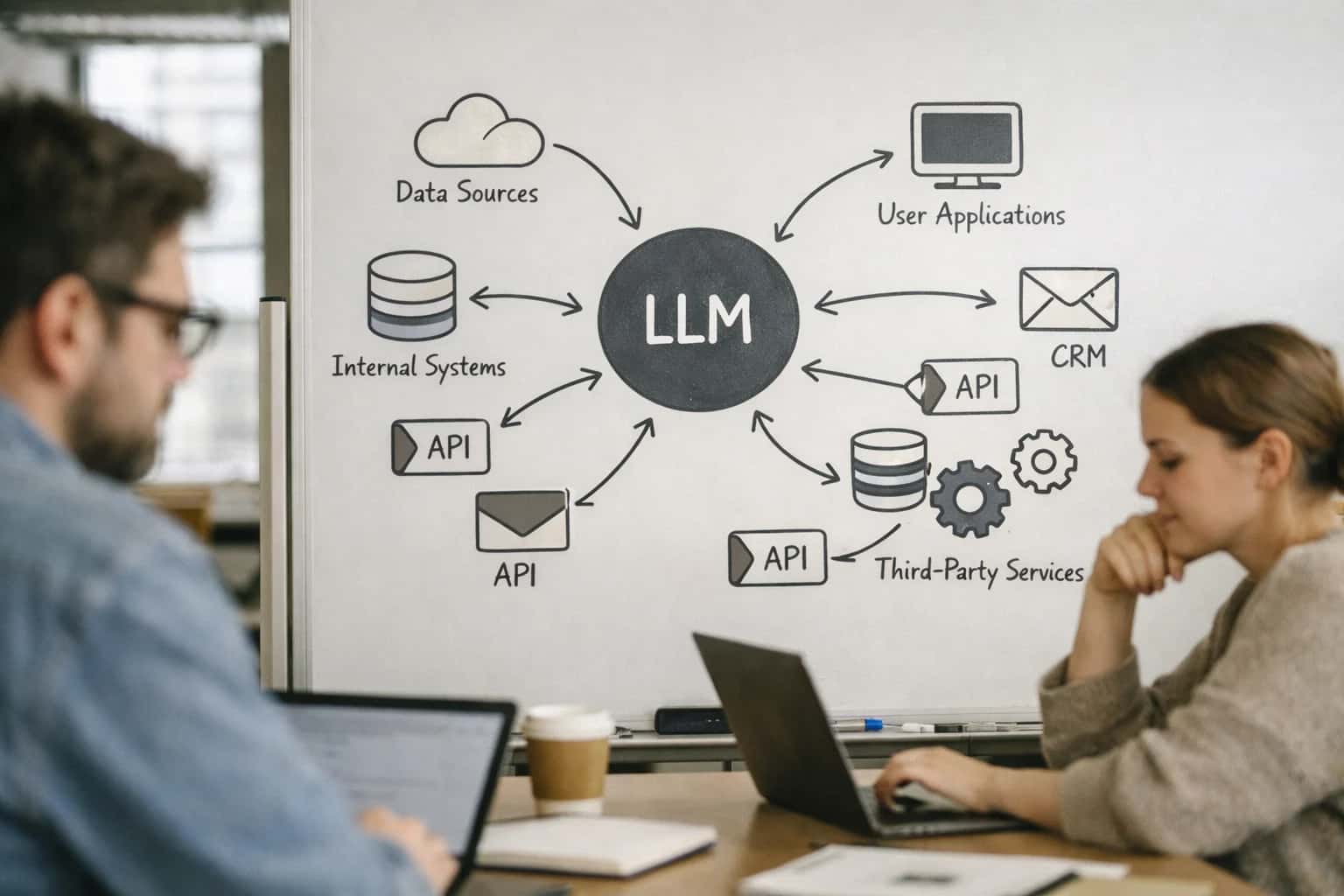
A 24/7 AI resident support agent operates as a middleware layer between your residents and your core property management platform (like AppFolio, Yardi, Entrata, or MRI). It connects to the platform's resident portal APIs to authenticate users and to its work order and account modules to perform actions. The AI's primary surfaces are a web chat widget embedded in the resident portal and SMS/email interfaces. Its core jobs are to: interpret natural language queries, retrieve context (e.g., lease balance, open tickets), execute permitted actions (e.g., create_maintenance_ticket), and provide accurate, platform-sourced answers—all without waking up a property manager.

Integration
AI Integration for 24/7 Resident Support Chatbot
A practical guide to building a secure, AI-powered resident support chatbot that integrates with AppFolio, Yardi, Entrata, and MRI. Learn the architecture, use cases, and code patterns for automated tenant communications and maintenance triage.
ARCHITECTURE AND ROLLOUT
Where AI Fits into 24/7 Resident Support
A practical blueprint for integrating an AI chatbot with your property management platform to automate resident inquiries and service requests.
Implementation requires mapping the AI's capabilities to specific platform objects and workflows. For example:
- Account Status & Payments: The agent calls the
GET /residents/{id}/balanceAPI, explains charges, and can initiate a payment via a secure link. - Maintenance Requests: Using the
POST /workordersAPI, it creates a ticket. AI triage logic classifies the issue from the resident's description (e.g., "leaking faucet" →priority: standard,category: plumbing) and suggests troubleshooting steps. - Lease & Policy FAQs: Grounded responses are pulled from a curated knowledge base of property rules, linked to the platform's document repository.
- Scheduling & Amenities: The agent checks availability via calendar APIs and creates booking requests. Impact is operational: reducing call volume for simple queries, creating structured tickets from vague descriptions, and providing instant after-hours support.
Rollout should be phased, starting with a pilot property and low-risk workflows like FAQ and balance checks. Governance is critical: implement human-in-the-loop escalation for complex issues, maintain full audit logs of all AI interactions tied to resident records, and use regular prompt and response evaluations against your platform's data to prevent hallucinations. The AI must respect the same role-based access controls as the platform—a resident should only see their own data. This integration doesn't replace your PM platform; it makes its data and functions accessible 24/7 through conversation, turning the resident portal into a proactive service channel. For technical patterns, see our guide on Property Management Platform APIs.
ARCHITECTURE BLUEPRINT
Chatbot Integration Surfaces by PM Platform
Primary User Interface Layer
The resident portal is the most direct surface for a support chatbot. This includes the web portal, mobile app, and embedded messaging widgets. The chatbot acts as the first line of defense, intercepting queries before they reach property staff.
Key Integration Points:
- Portal Widgets: Embed a secure, branded chat interface directly into the resident portal's dashboard.
- Messaging APIs: Connect to the platform's native messaging system (e.g., AppFolio Messages, Yardi ResidentCafe, Entrata Resident Portal) to send and receive messages via API, ensuring conversations are logged in the resident's communication history.
- Authentication Context: The chatbot must inherit the resident's authenticated session to securely access their lease, balance, and unit details without requiring re-login.
This layer handles FAQs, account status checks, and payment inquiries, using the PM platform as the source of truth for all resident data.
INTEGRATION PATTERNS
High-Value Use Cases for AI Resident Support
Deploying an AI chatbot for 24/7 resident support requires more than a standalone widget. These use cases detail how to securely connect AI agents to your property management platform's data and workflows, creating a seamless, automated extension of your onsite team.
01
Automated Maintenance Triage & Ticket Creation
Residents describe issues in natural language. The AI agent classifies the request (e.g., 'emergency plumbing' vs. 'routine HVAC filter'), extracts key details (location, symptom), and creates a fully-formed work order via the PM platform API. It sets priority, suggests vendor type, and provides an estimated timeline to the resident, all before human review.
Batch -> Real-time
Ticket intake
02
Account Status & Payment Inquiry Resolution
Residents ask about balance due, payment history, or scheduled autopay. The AI agent, after secure authentication, queries the PM platform's resident ledger API to retrieve real-time data. It can explain charges, confirm recent payments, and guide residents through the portal for future actions, deflecting 40-60% of common finance-related calls.
Hours -> Minutes
Query resolution
03
Lease FAQ & Policy Clarification
Handles repetitive questions on pet policies, guest rules, parking, amenity access, and renewal windows. The agent's knowledge is grounded in the property's specific lease addenda and community rules, retrieved from the PM platform's document management system or a connected vector store. It provides precise, consistent answers and can escalate complex interpretation to staff.
24/7 Coverage
Policy access
04
Move-in/Move-out Process Orchestration
Guides residents through digital checklists. For move-in, it schedules inspections, provides utility setup links, and delivers digital welcome packets. For move-out, it explains procedures, schedules final walks, and updates the unit status in the PM platform. The AI coordinates these multi-step workflows, triggering emails and updating platform records via API calls.
1 sprint
Process automation
05
Amenity Booking & Service Requests
Reserves pool cabanas, gym slots, or party rooms by integrating with the PM platform's amenity calendar API. The agent checks availability, enforces policies, and books slots. It also handles related service requests, like reporting a broken fitness machine, creating a linked maintenance ticket while managing the resident's booking expectation.
Self-service
Booking model
06
Proactive Issue Detection & Outreach
The AI agent monitors patterns across interactions. If multiple residents report similar minor issues (e.g., flickering hallway light), it can automatically create a single master work order in the PM platform, preventing duplicate tickets. It can also trigger proactive SMS/email alerts for building-wide issues (e.g., scheduled water shutoff) by pulling resident lists from the platform.
Batch -> Real-time
Alerting
24/7 RESIDENT SUPPORT
Example AI Chatbot Workflows
These workflows illustrate how an AI chatbot, integrated with your property management platform (AppFolio, Yardi, Entrata, MRI), can handle common resident requests autonomously. Each flow shows the trigger, data exchange, AI action, and system update.
Trigger: A resident sends a message like "My kitchen sink is leaking" via the resident portal or embedded web chat.
Context/Data Pulled: The chatbot's context includes the resident's unit ID and property ID from the authenticated session. It calls the PM platform API to fetch:
- Recent work orders for the same unit/appliance.
- The property's list of approved emergency vendors.
- The resident's contact and lease information.
Model/Agent Action: The LLM classifies the request:
- Urgency: Uses description to score as emergency (water leak, no heat) vs. routine.
- Category: Tags it as
Plumbing - Sink. - Suggestion: Based on historical tickets, may suggest checking the garbage disposal or providing a temporary mitigation step.
System Update: The agent uses the PM platform's API (e.g., AppFolio's POST /workorders) to create a ticket with:
json{ "property_id": "PROP_123", "unit_id": "UNIT_456", "category": "Plumbing", "priority": "High", "description": "Resident reports kitchen sink leaking. AI triaged as plumbing emergency.", "resident_id": "RES_789" }
It then confirms the ticket number and estimated response window to the resident.
Human Review Point: Tickets flagged as emergency trigger an immediate SMS/email alert to the on-call maintenance manager for oversight.
SECURE, PLATFORM-AWARE CHATBOT ARCHITECTURE
Implementation Architecture & Data Flow
A production-ready AI chatbot for property management integrates securely with your PM platform's APIs, acts on resident data, and creates structured tickets without manual intervention.
The core integration connects to your property management platform's resident portal API (e.g., AppFolio's Resident API, Yardi's Resident Services API) and maintenance/work order API. The chatbot's middleware authenticates via OAuth, queries resident context (unit, lease status, open tickets), and performs authorized actions like creating a ServiceRequest object. For common queries ("rent due date", "package policy"), the AI retrieves static knowledge from a curated property FAQ, but for actionable requests ("my sink is leaking"), it uses the resident's identity to create a ticket with a pre-populated description, unit number, and urgency score.
A typical implementation uses a multi-step workflow: 1) User Authentication & Context Retrieval: The resident initiates a chat via an embedded widget or SMS; the system validates the resident against the PM platform and fetches their profile. 2) Intent Classification & Data Enrichment: The AI classifies the query (e.g., maintenance, account, policy) and enriches it with resident context. 3) Platform Action or Knowledge Response: For informational intents, a RAG system grounds the answer in property handbooks. For transactional intents, the system calls the PM platform API—for example, posting to the MaintenanceRequest endpoint with a structured payload. 4) Confirmation & Audit: The chatbot confirms the action ("I've created maintenance ticket #4501") and logs the full interaction, including API call details, for auditability.
Rollout is phased, starting with read-only FAQ handling before enabling ticket creation. Governance is critical: the system should enforce role-based access control (RBAC) mirroring the PM platform, so a resident can only create tickets for their own unit. All generated tickets are initially flagged for human-in-the-loop review before dispatch for high-cost categories (e.g., HVAC, plumbing). The architecture must include rate limiting on API calls and a fallback queue to human agents when confidence is low or the PM platform API is unreachable, ensuring 24/7 reliability without platform degradation.
ARCHITECTING A 24/7 CHATBOT
Code & Payload Examples
Ingesting & Routing Resident Queries
When a resident sends a message via your website or resident portal, it should POST to your AI orchestration endpoint. This handler authenticates the user via the PM platform's API, classifies the intent, and decides if a service ticket is needed.
Below is a Python FastAPI example that receives a webhook, calls an LLM for classification, and uses the AppFolio API to create a work order if required. The system logs the interaction for audit and can escalate to a human agent based on confidence scores.
pythonfrom fastapi import FastAPI, HTTPException, Request import httpx from pydantic import BaseModel from typing import Optional app = FastAPI() class ResidentMessage(BaseModel): resident_id: str property_id: str message_text: str channel: str # e.g., 'web_portal', 'sms' @app.post("/webhook/resident-message") async def handle_resident_message(request: Request, payload: ResidentMessage): # 1. Authenticate & fetch resident context from PM platform resident_context = await fetch_resident_context(payload.resident_id) # 2. Classify intent using LLM classification = await classify_intent( payload.message_text, resident_context ) # 3. If intent is 'maintenance_request', create ticket if classification.get('intent') == 'maintenance_request': ticket_data = { "property_id": payload.property_id, "unit_id": resident_context.get('unit_id'), "resident_id": payload.resident_id, "description": payload.message_text, "priority": classification.get('priority', 'medium'), "category": classification.get('category') } # Call PM platform API to create work order ticket_response = await create_appfolio_workorder(ticket_data) return { "response": "A maintenance ticket has been created for you.", "ticket_id": ticket_response.get('id'), "confidence": classification.get('confidence') } # 4. Otherwise, generate a direct response else: ai_response = await generate_response(classification) return {"response": ai_response}
24/7 RESIDENT SUPPORT CHATBOT
Realistic Time Savings & Operational Impact
How an integrated AI chatbot transforms common resident service workflows by automating routine tasks and providing instant, accurate support.
| Workflow / Metric | Before AI | After AI | Implementation Notes |
|---|---|---|---|
Initial resident inquiry response | 2-4 hours (next business day) | Instant (seconds) | Chatbot provides immediate acknowledgment and first-level resolution for common questions. |
Service request creation & triage | Manual form entry & phone call (5-15 min) | Automated via chat (1-2 min) | AI classifies issue from description and auto-fills ticket fields via PM platform API. |
Rent payment & balance inquiries | Portal login or call to office | Secure self-service via chat | Chatbot authenticates resident via PM platform and retrieves account data to answer. |
Amenity booking & policy questions | Email to property manager | Automated guidance & calendar check | AI references community rules and real-time booking availability from integrated calendars. |
After-hours emergency screening | Call goes to answering service, manual paging | AI triage & direct dispatch for critical issues | AI assesses urgency from keywords, creates high-priority ticket, and alerts on-call staff via SMS. |
Lease term & renewal FAQs | Email or scheduled call with leasing agent | Instant, accurate answers from lease data | Chatbot uses RAG on uploaded lease documents to provide specific, grounded answers. |
Move-in/move-out process guidance | PDF checklists and manual follow-ups | Interactive, step-by-step digital guide | AI orchestrates the workflow, sends reminders, and updates task status in the PM platform. |
ARCHITECTING FOR PRODUCTION
Governance, Security, and Phased Rollout
A secure, governed rollout is critical for a 24/7 resident support chatbot integrated with your property management platform.
The integration architecture must enforce strict data access controls. The AI agent should operate with a service account in your PM platform (AppFolio, Yardi, Entrata, or MRI) that has least-privilege API permissions—typically read-only access to resident contact info, lease status, and unit details, with write access only to the ServiceTicket or WorkOrder object for creating tickets. All resident data retrieved for context should be held in a short-term, in-memory session cache, not written to external vector stores, to comply with data residency and privacy policies. API calls must be logged to an immutable audit trail, linking each chatbot interaction to the specific resident and property record.
A phased rollout minimizes risk and builds trust. Start with a silent pilot, deploying the chatbot to handle a small percentage of non-critical inbound web queries (e.g., FAQ about trash pickup or pool hours) while logging all its intended actions for human review. In Phase 2, enable read-only integrations, allowing the bot to answer account-specific questions (e.g., "What's my balance?") by calling the PM platform's GET APIs. Finally, in Phase 3, activate write capabilities like service ticket creation, but only after implementing a confirmation step with the resident and a secondary webhook that notifies the property manager's channel (like a Slack alert) for high-priority or unusual requests.
Governance is ongoing. Establish a prompt registry to version-control the chatbot's instructions and grounding data, ensuring consistent responses. Implement a human-in-the-loop escalation path where the bot can hand off complex or sensitive conversations to a live agent within the same chat interface, passing along the full interaction history. Regularly review conversation logs and performance metrics (escalation rate, resident satisfaction scores from post-chat surveys) to fine-tune the AI's responses and identify new training data needs. This controlled approach ensures the chatbot enhances resident service without introducing operational or compliance risk.
Enabling Efficiency, Speed & Accuracy
Intelligent Analysis, Decision & Execution
We build AI systems for teams that need search across company data, workflow automation across tools, or AI features inside products and internal software.
Talk to Us
Search across company data
Give teams answers from docs, tickets, runbooks, and product data with sources and permissions.
Useful when people spend too long searching or get different answers from different systems.
Enterprise searchRAGPermissions
Read more
Automate internal workflows
Use AI to route work, draft outputs, trigger actions, and keep approvals and logs in place.
Useful when repetitive work moves across multiple tools and teams.
AI agentsWorkflow automationGovernance
Read more
Add AI to products and internal tools
Build assistants, guided actions, or decision support into the software your team or customers already use.
Useful when AI needs to be part of the product, not a separate tool.
AI integrationDecision supportModel routing
Read moreIMPLEMENTATION BLUEPRINT
Frequently Asked Questions
Practical questions for architects building a 24/7 AI resident support chatbot integrated with AppFolio, Yardi, Entrata, or MRI Software.
The connection is established via the PM platform's REST APIs using OAuth 2.0 or API keys with strict scoping. The AI agent acts as a middleware service, never storing sensitive resident data long-term.
Typical Integration Pattern:
- Authentication: The chatbot service authenticates with the PM platform (e.g., AppFolio's OAuth, Yardi's API key) using credentials stored in a secure secrets manager.
- Contextual Query: When a resident asks "What's my balance?", the chatbot:
- Identifies the resident via a secure token or unit number from the chat session.
- Calls the PM platform's
GET /residents/{id}/ledgerorGET /units/{id}/chargesAPI.
- Structured Response: The AI formats the raw JSON API response into a natural, compliant answer: "Your current balance is $X. Your next payment of $Y is due on [Date]."
Security Controls:
- Implement role-based access control (RBAC) at the integration layer, ensuring the chatbot only has
readaccess to necessary endpoints (ledgers, work order status, lease dates). - All data in transit is encrypted (TLS 1.3). Chat logs are anonymized for model training.
- Never pass full SSNs or bank account numbers through the LLM; reference them as "on file" or mask them.

About the author
Prasad Kumkar
CEO & MD, Inference Systems
Prasad Kumkar is the CEO & MD of Inference Systems and writes about AI systems architecture, LLM infrastructure, model serving, evaluation, and production deployment. Over 5+ years, he has worked across computer vision models, L5 autonomous vehicle systems, and LLM research, with a focus on taking complex AI ideas into real-world engineering systems.
His work and writing cover AI systems, large language models, AI agents, multimodal systems, autonomous systems, inference optimization, RAG, evaluation, and production AI engineering.
LinkedIn
Limited slotsGet a Free AI Consultation
Partnered with leading AI, data, and software stack.





How We Work
Custom AI workflows for your Business
One-fit-all AI don't work for modern businesses. At Inferensys, we aim to understand your business & custom requirements; which we use to define most efficient agentic workflows, the data, and the tools for your business.
01
Review the use case
We understand the task, the users, and where AI can actually help.
Read more02
Pick the right approach
We define what needs search, automation, or product integration.
Read more03
Build the first useful version
We implement the part that proves the value first.
Read more04
Improve from there
We add the checks and visibility needed to keep it useful.
Read moreThe first call is a practical review of your use case and the right next step.
Talk to Us