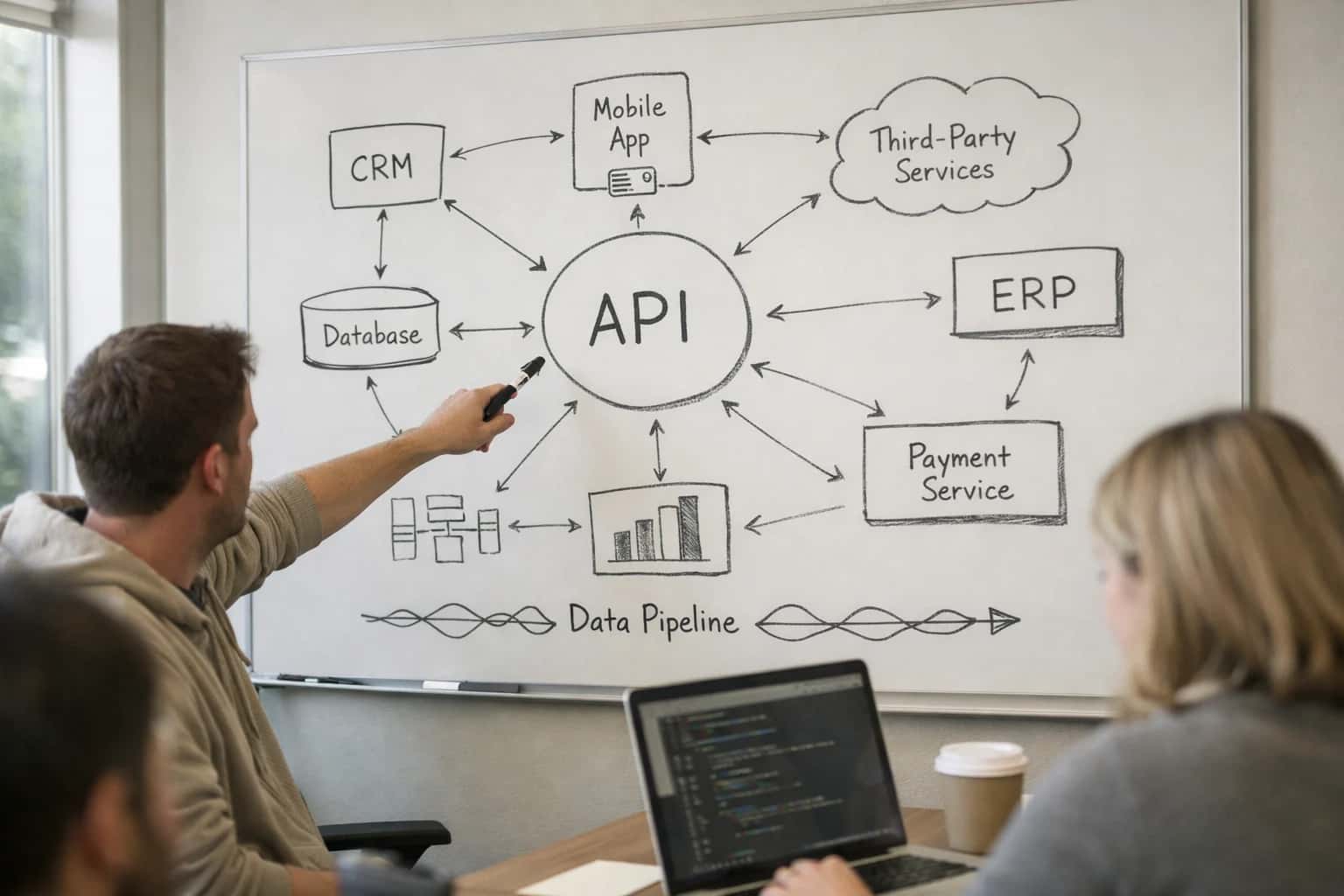
AI integration for patient communication connects at the data and event layer of McKesson EnterpriseRx. The primary touchpoints are the patient profile (demographics, Rx history, preferred contact method), the prescription status queue (e.g., Ready, On Hold, Refill Requested), and the scheduled task or outreach module. An AI agent listens for platform events—like a prescription entering the Ready for Pickup status or a refill becoming due—and triggers personalized outreach via SMS, email, or IVR, using data pulled from the patient's record to ensure context and compliance.

Integration
AI Integration for McKesson EnterpriseRx Patient Communication
A technical blueprint for embedding AI-driven patient outreach into McKesson EnterpriseRx. Automate refill reminders, adherence check-ins, and vaccine recalls by integrating with patient profiles, prescription data, and preferred communication channels.
ARCHITECTURE AND ROLLOUT
Where AI Fits into McKesson EnterpriseRx Patient Outreach
A practical blueprint for integrating AI-driven communication directly into McKesson EnterpriseRx workflows to automate and personalize patient engagement.
Implementation typically involves a middleware service that polls or receives webhooks from EnterpriseRx's API (e.g., for new Workflow events). This service calls an AI orchestration layer to generate personalized message content, manage channel delivery, and handle two-way responses. For example, an AI agent can process a patient's SMS reply of "YES" to a refill reminder, validate it against the patient's profile and refill eligibility in near real-time, and then create a corresponding refill task back in the EnterpriseRx queue for pharmacist verification, closing the loop without manual data entry.
Rollout should be phased, starting with low-risk, high-volume workflows like automated refill reminders before expanding to adherence nudges or vaccine recalls. Governance is critical: all outbound messages must be logged back to the patient's communication history in EnterpriseRx, include clear opt-out instructions, and be reviewed for clinical safety—AI should draft, but a pharmacist must oversee any clinical content. This approach turns EnterpriseRx from a system of record into a proactive engagement platform, shifting staff time from routine calls to high-value patient care.
PATIENT COMMUNICATION WORKFLOWS
Integration Surfaces in McKesson EnterpriseRx
Core Data Layer for Personalization
AI-driven patient communication begins with the rich data stored in McKesson EnterpriseRx's patient profiles. This is the primary integration surface for any outreach engine.
Key data points to access via API or database extensions include:
- Demographics & Contact Info: Preferred channel (SMS, email, IVR), phone numbers, email addresses, and language preference.
- Medication & Adherence History: Active prescriptions, refill patterns, pick-up dates, and historical adherence flags.
- Clinical & Payer Context: Allergies, disease states (for condition-specific messaging), insurance plan details, and copay amounts.
- Communication Preferences & Consent: Opt-in/opt-out status for various message types (refill reminders, clinical nudges, promotional).
Integrating here allows AI agents to segment audiences, personalize message content, and respect compliance rules before any outreach is triggered.
MCKESSON ENTERPRISERX INTEGRATION PATTERNS
High-Value AI Use Cases for Patient Engagement
Integrate AI directly into McKesson EnterpriseRx workflows to automate personalized patient outreach, improve adherence, and reduce manual follow-up. These patterns connect to patient profiles, prescription data, and communication modules via API hooks and event-driven triggers.
01
Automated Refill Reminders & Outreach
AI agents monitor the refill queue and patient fill history in EnterpriseRx to predict lapses. Automatically sends personalized SMS, email, or IVR reminders based on preferred channel and medication type, updating the platform's patient contact log. Reduces no-fill rates and manual call lists.
Batch -> Real-time
Outreach mode
02
Intelligent Adherence Check-Ins
Triggers AI-driven check-ins after a prescription pick-up by integrating with EnterpriseRx's dispensing records. Uses patient history to ask tailored questions about side effects or difficulties, escalating concerning responses to the pharmacist via a platform task. Proactively manages adherence before the next refill is due.
Same day
Intervention timing
03
Vaccine Recall & Immunization Campaigns
AI scans patient profiles for age, condition flags, and vaccine history to identify due/overdue patients. Generates and sends personalized recall messages, and can manage inbound responses to schedule appointments directly into the platform's scheduling module. Integrates with state registries for record validation.
Hours -> Minutes
List generation
04
Copay Assistance & Benefit Inquiry Support
When a high copay is detected at adjudication, an AI agent triggers. It checks the patient's eligibility record, searches manufacturer savings programs, and sends an application link or guidance via the patient's preferred channel. Logs assistance offered in the patient notes field for follow-up.
1 sprint
Typical implementation
05
Multilingual IVR & Chat for Pharmacy Q&A
Deploy a voice or chat AI agent integrated with EnterpriseRx's patient data layer to handle high-volume, simple inquiries. Patients can ask about store hours, refill status, or ready prescriptions. The agent authenticates via phone/ID, retrieves data via API, and responds, freeing up phone lines. Supports on-demand translation.
80% Deflection
Simple inquiries
06
Medication Synchronization & Sync Program Enrollment
AI analyzes a patient's medication list and fill dates to identify candidates for med sync. Automatically sends an enrollment offer with a proposed sync date, explains the benefits, and if accepted, creates a workflow task for the technician to set up the sync in EnterpriseRx. Follows up to confirm participation.
Manual -> Automated
Enrollment workflow
PATIENT ENGAGEMENT AUTOMATION
Example AI-Driven Communication Workflows
These workflows illustrate how AI agents, integrated with McKesson EnterpriseRx patient profiles and communication APIs, can automate personalized outreach. Each flow is triggered by platform events and executes multi-channel messaging while logging all interactions back to the patient record for auditability and continuity of care.
Trigger: A prescription in EnterpriseRx reaches its refill_eligible_date and has a refills_remaining > 0.
Context Pulled: The AI agent queries the patient's profile via McKesson API for:
- Preferred communication channel (SMS, email, IVR)
- Medication name and last fill date
- Pharmacy's configured reminder lead time (e.g., 7 days)
- Patient's historical pickup behavior
Agent Action:
- Generates a personalized message:
- For on-time patients: "Hi [Name], your [Medication] is ready for refill. Reply YES to confirm, or call us."
- For historically late patients: "Hi [Name], we noticed your [Medication] is due soon. To avoid a gap, please confirm your refill. We can have it ready by [Date]."
- Routes the message via the patient's preferred channel using integrated comms (Twilio, SendGrid, etc.).
System Update:
- The agent logs the outreach event (timestamp, channel, message) to a custom
ai_communication_logobject linked to the patient record. - If the patient replies "YES," the agent creates a
refill_requesttask in the pharmacy's workflow queue and sends a confirmation message.
Human Review Point: All outbound message templates are pre-approved by pharmacy management. Any patient reply indicating a problem (e.g., "having side effects") is flagged for immediate pharmacist review.
BUILDING A REAL-TIME PATIENT ENGAGEMENT LAYER
Implementation Architecture: Data Flow & APIs
A production-ready AI communication layer integrates with McKesson EnterpriseRx's patient profile and prescription data to power personalized, automated outreach.
The integration architecture is event-driven, anchored to key data objects within the McKesson EnterpriseRx platform. The primary triggers are prescription status changes (e.g., Ready, On Hold, Refill Requested), patient profile updates, and scheduled adherence review jobs. An integration service, deployed as a secure middleware layer, listens to these events via McKesson's available APIs or database change feeds. For each event, the service retrieves the relevant patient context—including medication history, preferred contact channel (SMS, email, IVR), and any communication preferences—and packages it into a structured payload for the AI agent.
The AI agent, governed by strict clinical guardrails, processes this payload to generate a personalized message. For a refill reminder, it considers the medication name, last fill date, and any noted adherence gaps. For a vaccine recall, it checks immunization history and eligibility. The generated message is then routed through the pharmacy's approved communication channels. Crucially, all outbound messages are logged back to a dedicated AI_Communication_Log object within EnterpriseRx, linked to the patient and prescription records, creating a complete audit trail for pharmacists and ensuring no duplicate or conflicting outreach.
Rollout follows a phased, pilot-first approach. We typically start with a single, high-volume workflow like automated refill-ready SMS notifications, integrating with a test store or a subset of patients. Governance is managed through a configurable rules engine within the integration layer, allowing pharmacy managers to define which patient segments receive AI communications, set daily/time-of-day limits, and mandate pharmacist review for certain message types before sending. This controlled implementation minimizes risk while demonstrating clear operational value—shifting manual phone call workloads to automated, personalized touchpoints.
AI-PATIENT OUTREACH WORKFLOWS
Code & Payload Examples
Webhook Trigger & Patient Data Payload
AI-driven communication is typically triggered by a scheduled job or a platform event, such as a prescription reaching its refill window. The integration fetches the necessary patient context from EnterpriseRx to personalize the message.
Example JSON Payload for a Refill Reminder Trigger:
json{ "event_type": "refill_window_open", "trigger_timestamp": "2024-05-15T10:00:00Z", "enterpriserx_patient_id": "PAT-789123", "rx_number": "RX-456789", "drug_name": "Atorvastatin 20mg", "remaining_days_supply": 5, "patient_preferences": { "preferred_channel": "SMS", "phone_number": "+15551234567", "language": "en", "opt_in_status": "active" }, "last_fill_date": "2024-04-15", "days_supply": 30, "pharmacy_location": "Main Street Pharmacy #042" }
This payload provides the AI agent with the specific drug, timing, patient contact details, and channel preference, enabling it to generate a relevant, compliant message.
AI-DRIVEN PATIENT ENGAGEMENT
Realistic Time Savings & Operational Impact
This table illustrates the operational impact of integrating AI agents with McKesson EnterpriseRx to automate and personalize patient communication workflows. Metrics are based on typical independent pharmacy operations.
| Workflow | Before AI | After AI | Notes |
|---|---|---|---|
Refill reminder outreach | Manual calls / texts for 50+ patients daily | Bulk personalized outreach triggered automatically | Pharmacist reviews list; AI handles channel execution (SMS/email/IVR) |
Adherence check-in for chronic meds | Sporadic manual review of refill gaps | Automated identification & outreach for patients >7 days late | AI segments list by risk; pharmacist focuses on high-priority cases |
Vaccine recall campaign execution | Manual chart review, then phone calls over 2-3 days | Same-day patient list generation & multi-channel broadcast | AI pulls eligible patients from profiles; staff handles inbound scheduling |
Copay change notifications | Reactive patient questions at pickup | Proactive alerts sent when platform adjudication updates copay | Reduces counter confusion and improves patient satisfaction |
New patient onboarding sequence | One-time verbal overview at first fill | Automated welcome series with pharmacy info, services, and refill instructions | AI sequences triggered by new profile creation in EnterpriseRx |
Medication synchronization program enrollment | Pharmacist manually identifies candidates during verification | AI screens refill history to flag ideal candidates, sends invitation | Increases program uptake; pharmacist approves final list |
Missed pickup follow-up | Visual check of will-call bin after 2 weeks | Automated call/text/email sequence starting day 3 post-ready | Reduces waste and recaptures revenue from abandoned scripts |
IMPLEMENTING AI IN A REGULATED ENVIRONMENT
Governance, Compliance, and Phased Rollout
A practical guide to deploying AI-driven patient communication within McKesson EnterpriseRx with appropriate controls and a measured rollout.
Integrating AI for patient outreach requires careful governance, as it directly touches Protected Health Information (PHI) and influences patient care adherence. The implementation must be architected to respect EnterpriseRx's existing data access controls, using its API or database extensions to pull patient profile data (contact preferences, medication lists, refill due dates) only within the context of a logged-in pharmacy user session or a secure service account. All outbound messages—whether SMS, email, or IVR—should be logged back to a dedicated audit table within the platform or a linked system, creating a clear lineage of which AI agent triggered which communication to which patient and why, based on which prescription data point.
A phased rollout is critical for managing risk and building user trust. Start with a low-risk, high-volume use case like automated refill reminders for maintenance medications. Deploy the AI agent to monitor the Refill Queue or a custom report in EnterpriseRx, sending reminders only for patients who have opted in and for medications with no recent changes. This first phase operates in a human-in-the-loop mode, where the system suggests messages and a pharmacist or technician reviews a daily digest before batch sending. Phase two introduces more complex logic, such as adherence nudges for patients with irregular pickup patterns, and moves to fully automated sending for pre-approved message templates. The final phase expands to clinical outreach, like vaccine recall messages, which may require tighter integration with immunization modules and more sophisticated patient consent management.
Compliance hinges on configurability and oversight. The AI layer should include guardrail features like message throttling per patient, time-of-day sending rules, and automatic suppression for patients marked ‘deceased’ or ‘opted-out’ in EnterpriseRx. Furthermore, the system must support prompt and model governance; the templates and logic used to generate messages should be version-controlled, and any use of an external LLM (like OpenAI) for message personalization should be configured to strip PHI before the API call or use a PHI-compliant, private instance. Regular audits should compare AI-generated contact logs against platform activity to ensure alignment. For a deeper technical look at integrating AI agents into pharmacy platform workflows, see our guide on AI Integration for Pharmacy Management Platform Workflow Automation.
Enabling Efficiency, Speed & Accuracy
Intelligent Analysis, Decision & Execution
We build AI systems for teams that need search across company data, workflow automation across tools, or AI features inside products and internal software.
Talk to Us
Search across company data
Give teams answers from docs, tickets, runbooks, and product data with sources and permissions.
Useful when people spend too long searching or get different answers from different systems.
Enterprise searchRAGPermissions
Read more
Automate internal workflows
Use AI to route work, draft outputs, trigger actions, and keep approvals and logs in place.
Useful when repetitive work moves across multiple tools and teams.
AI agentsWorkflow automationGovernance
Read more
Add AI to products and internal tools
Build assistants, guided actions, or decision support into the software your team or customers already use.
Useful when AI needs to be part of the product, not a separate tool.
AI integrationDecision supportModel routing
Read moreIMPLEMENTATION DETAILS
Frequently Asked Questions
Common technical and operational questions about integrating AI-driven patient communication workflows into McKesson EnterpriseRx.
This workflow automates outreach for patients due for a refill, reducing missed pickups.
- Trigger: A scheduled job queries the McKesson EnterpriseRx database via its API or a replicated data store, identifying prescriptions where
refill_status = 'eligible'andlast_contact_dateis beyond a configurable threshold (e.g., 3 days before run-out). - Context Pull: For each identified patient, the agent retrieves:
- Patient name, preferred contact channel (SMS/email/IVR), and opt-in status.
- Medication name, Rx number, and remaining day supply.
- Pharmacy name, phone number, and hours.
- AI Action: A language model generates a personalized message. Example prompt:
code
Generate a friendly refill reminder for [Patient First Name]. Medication: [Medication Name]. Pharmacy: [Pharmacy Name]. Phone: [Pharmacy Phone]. Remaining supply: [X] days. Tone: Professional, helpful. Include a call-to-action to reply "YES" to confirm. - System Update: The message is sent via Twilio (SMS/IVR) or SendGrid (email). The agent logs the outreach attempt, timestamp, and message content back to a dedicated
ai_communication_logtable linked to the patient's EnterpriseRx ID. - Human Review Point: Any patient reply (e.g., "NO", "QUESTION") is flagged in a dashboard for pharmacist follow-up, creating a task in the platform's internal tasking system.

About the author
Prasad Kumkar
CEO & MD, Inference Systems
Prasad Kumkar is the CEO & MD of Inference Systems and writes about AI systems architecture, LLM infrastructure, model serving, evaluation, and production deployment. Over 5+ years, he has worked across computer vision models, L5 autonomous vehicle systems, and LLM research, with a focus on taking complex AI ideas into real-world engineering systems.
His work and writing cover AI systems, large language models, AI agents, multimodal systems, autonomous systems, inference optimization, RAG, evaluation, and production AI engineering.
LinkedIn
Limited slotsGet a Free AI Consultation
Partnered with leading AI, data, and software stack.





How We Work
Custom AI workflows for your Business
One-fit-all AI don't work for modern businesses. At Inferensys, we aim to understand your business & custom requirements; which we use to define most efficient agentic workflows, the data, and the tools for your business.
01
Review the use case
We understand the task, the users, and where AI can actually help.
Read more02
Pick the right approach
We define what needs search, automation, or product integration.
Read more03
Build the first useful version
We implement the part that proves the value first.
Read more04
Improve from there
We add the checks and visibility needed to keep it useful.
Read moreThe first call is a practical review of your use case and the right next step.
Talk to Us