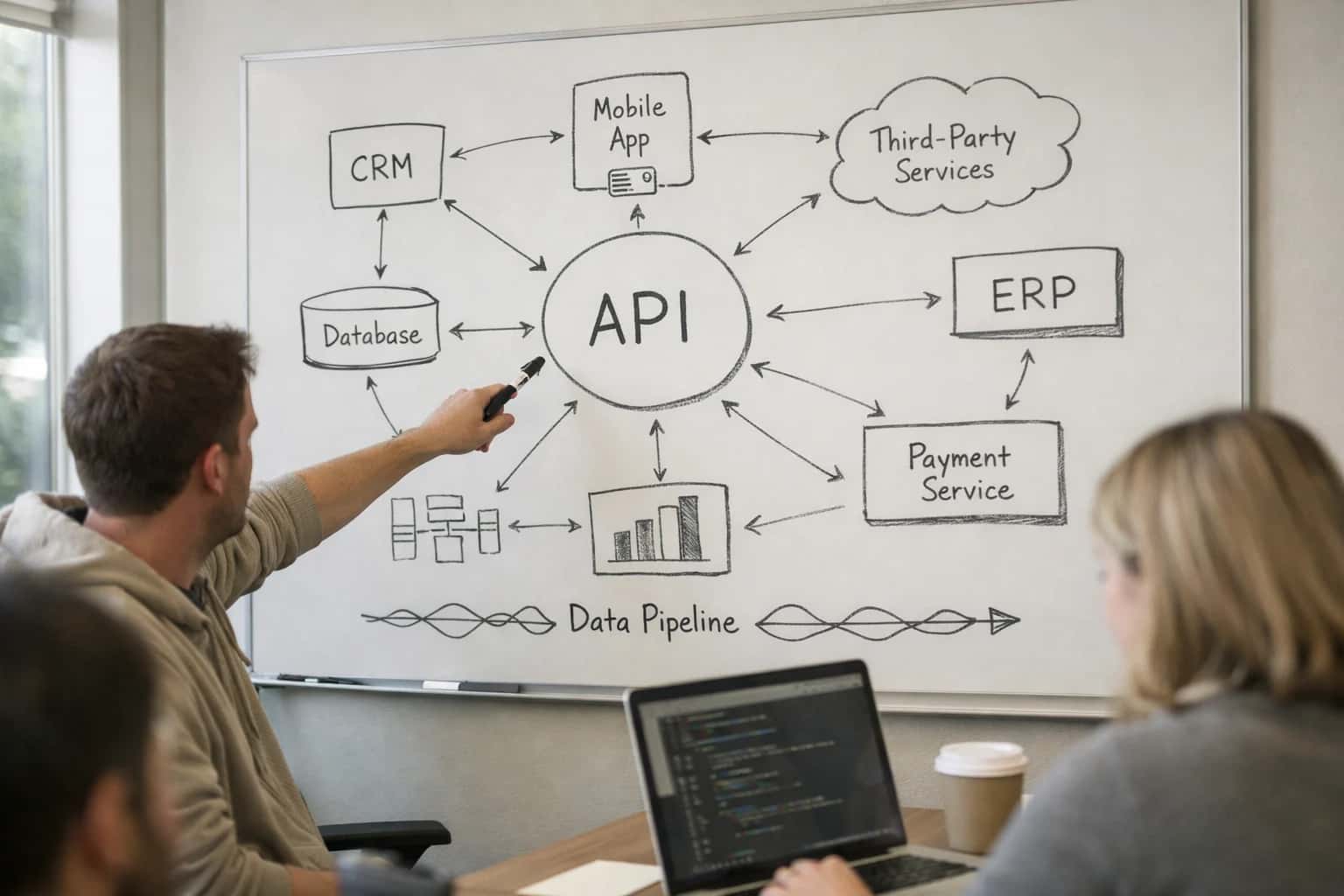
AI integration for Scalefusion MDM connects at three primary surfaces: the Device Management API for real-time command execution and telemetry, the Content Management API for digital signage and kiosk control, and the Reporting API for compliance and inventory analytics. This allows you to build AI agents that act on specific device objects—like Android, iOS, Windows, or macOS endpoints—and their associated policies, profiles, and installed applications. For example, an AI workflow can consume a device's battery health and storage metrics from the inventory report, predict a failure, and automatically push a configuration profile to limit background processes or trigger a support ticket.

Integration
AI Integration for Scalefusion MDM
Connect AI models to Scalefusion's REST API to automate digital signage scheduling, optimize device enrollment, and enforce dynamic content filtering policies for retail, education, and enterprise fleets.
ARCHITECTURE & IMPACT
Where AI Fits in Scalefusion MDM Operations
A practical blueprint for integrating AI agents and workflows with Scalefusion's APIs to automate device operations, content control, and support.
High-value use cases center on operational automation and intelligent control. In retail or education deployments, an AI layer can manage digital signage endpoints by analyzing audience footfall data (from external sensors) and using the Content API to dynamically schedule promotional content or educational material on enrolled devices. For automated enrollment, an AI orchestrator can listen for new device serial numbers from an intake system, assign the correct enrollment profile based on the user's department in your HRIS, and configure the device name and initial app set via the Device API—reducing manual setup from hours to minutes. Intelligent content filtering can be achieved by having an AI model classify web traffic logs or requested app categories, then automatically updating the web filter payloads for specific device groups to block new threat vectors or enforce acceptable use policies.
A production implementation typically involves a middleware layer (often built with tools like n8n or a custom service) that sits between your AI models and Scalefusion's REST API. This layer handles authentication, request queuing, error handling, and audit logging. Governance is critical: all AI-triggered MDM actions (like a remote lock or a profile push) should pass through an approval workflow or a confidence threshold check before execution, especially for security commands. Rollout should start with a pilot device group, monitoring the success rate of AI-initiated API calls and measuring impact through reduced manual admin tasks and faster mean-time-to-resolution for common device issues.
Inference Systems delivers this integration by providing the architectural pattern, secure middleware development, and pre-built connectors for common AI services (like OpenAI or Anthropic) to interact with Scalefusion's API surfaces. We focus on creating a system where AI agents enhance, not replace, your existing MDM workflows—making your device fleet more responsive and your IT team more proactive. For related implementation patterns, see our guides on AI-Powered Digital Signage Control via MDM and AI Integration for Automated Enrollment Workflows.
ARCHITECTURE BLUEPRINT
Scalefusion API Surfaces for AI Integration
Core Device Telemetry for AI Analysis
The /devices and /device-details endpoints provide the foundational inventory and real-time state data required for any AI-driven management layer. AI models consume this structured JSON to assess fleet health, predict failures, and trigger automated workflows.
Key data surfaces include:
- Device Metadata: Model, OS version, serial numbers, enrollment date.
- Hardware Health: Battery status, storage capacity, memory usage.
- Security Posture: Encryption status, passcode compliance, jailbreak/root detection.
- Network Info: IP address, carrier, Wi-Fi SSID for location-aware policies.
This data enables use cases like predictive battery failure alerts, where an AI agent analyzes battery health trends across similar device models to flag units needing proactive replacement, automatically creating a service ticket in your ITSM.
RETAIL AND EDUCATION DEPLOYMENTS
High-Value AI Use Cases for Scalefusion
Integrate AI with Scalefusion's APIs to automate digital signage, streamline device enrollment, and enforce intelligent content policies. These use cases focus on reducing manual IT overhead and enhancing operational intelligence for managed device fleets.
01
AI-Powered Digital Signage Control
Deploy an AI orchestrator that uses Scalefusion's Kiosk Mode and Application Management APIs to dynamically schedule content, manage playlists, and power-cycle screens based on real-time audience analytics, store traffic, or time of day. Automates what was a manual, calendar-based task.
Batch -> Real-time
Content updates
02
Intelligent Content Filtering Policies
Integrate AI content classification services with Scalefusion's Web Content Filter payloads. Dynamically update allowed/blocked site lists for student or retail associate devices based on real-time threat intelligence, curriculum needs, or acceptable use policy violations detected in logs.
Same day
Policy response
03
Automated Enrollment & Profile Assignment
Build an AI workflow that triggers upon new device serial number detection. It consumes user role data (from HRIS or SIS) via Scalefusion's REST API to automatically assign the correct enrollment profile, device group, application set, and naming convention for zero-touch setup.
1 sprint
Onboarding automation
04
Predictive Maintenance for Kiosk & POS Devices
Implement ML models that analyze device inventory telemetry (battery health, storage, uptime) from Scalefusion to predict hardware failures in retail kiosks or library catalogs. Auto-generate service tickets in your ITSM and push diagnostic scripts via Scalefusion to confirm issues.
Hours -> Minutes
Failure prediction
05
Geofenced Policy Automation
Use AI to manage Scalefusion Location-Based Actions. Analyze historical device location patterns to automatically create and adjust geofences. Trigger profile pushes (e.g., enable retail app, restrict social media) or content updates when devices enter/exit zones, optimizing for operational context.
06
AI-Enhanced Root Cause Analysis
Deploy an AI agent that ingests Scalefusion event logs and alert data via API. Correlate enrollment failures, policy non-compliance, or app crashes across devices to diagnose common root causes. Automatically suggest scripted remediations or guide IT staff through resolution steps in a help desk interface.
Hours -> Minutes
Issue diagnosis
RETAIL AND EDUCATION DEPLOYMENTS
Example AI-Driven Workflows with Scalefusion
These workflows demonstrate how to connect AI agents to Scalefusion's APIs to automate digital signage content, streamline device enrollment, and enforce intelligent content policies, reducing manual IT overhead and enhancing operational efficiency.
This workflow uses AI to dynamically manage content on Scalefusion-enrolled digital signage players based on real-time factors like audience demographics, time of day, and inventory levels.
- Trigger: A scheduled cron job or an event from an external system (e.g., POS indicating low stock, calendar for a promotion start).
- Context/Data Pulled: The AI agent calls the Scalefusion
GET /devicesAPI with filters for thedevice_type(e.g., 'signage_player') anddevice_groupto identify target screens. It may also ingest external data like weather, sales figures, or promotional calendars. - Model or Agent Action: A multi-modal AI model (e.g., GPT-4V + DALL-E) generates or selects appropriate promotional content (image/video asset and accompanying text). It validates the content against brand guidelines.
- System Update: The agent uses the Scalefusion
POST /content/deployAPI to push the new content package to the identified device group, setting a schedule for immediate display. - Human Review Point: For net-new AI-generated creative, the system can be configured to route the asset to a marketing manager's dashboard for approval via a webhook before the final API call is executed.
AI-ENHANCED DEVICE ORCHESTRATION
Implementation Architecture: Data Flow & Integration Patterns
A practical blueprint for connecting AI agents to Scalefusion's REST API to automate digital signage, enrollment, and content policy workflows.
The core integration pattern uses Scalefusion's Device Management and Dashboard Management APIs as the primary execution layer. AI agents act as an orchestration tier that consumes operational data (device status, location, app inventory) and business logic (campaign schedules, compliance rules) to make decisions, then executes via API calls. Key data objects include:
- Device Profiles & Policies: For dynamic configuration based on AI-calculated risk or context.
- Applications & Content: For intelligent distribution and scheduling on kiosks or digital signage groups.
- Commands & Actions: To remotely execute scripts, lock/wipe, or reboot devices based on AI-triggered events.
- Geofences & Locations: To trigger location-aware policy adjustments.
A typical workflow for AI-powered digital signage control follows this pattern:
- An AI agent ingests a content calendar and real-time audience analytics (e.g., foot traffic data).
- The agent evaluates the context and selects the optimal media file and display schedule.
- It uses the
POST /api/v1/devices/{device_id}/commandsendpoint to push the new content package to the target device group in Scalefusion. - The agent then monitors device status via
GET /api/v1/devicesto confirm successful deployment and triggers a fallback workflow if a device goes offline. This reduces manual scheduling from hours to minutes and enables day-parting or event-driven signage without admin intervention.
For rollout and governance, we recommend a phased approach:
- Phase 1: Read-Only Monitoring. Deploy AI agents that only poll Scalefusion APIs (
GETmethods) to build analytics and anomaly detection (e.g., predicting device failures from battery health trends). - Phase 2: Supervised Automation. Introduce agents that can execute non-destructive commands (content pushes, profile adjustments) but require human approval in a queue (like an IT ticket) before the API call is made.
- Phase 3: Conditional Autonomy. For mature workflows, agents execute automatically within a tightly scoped policy guardrail (e.g., "only manage devices in the 'Digital Signage' group"). All actions are logged to a separate audit trail, and rollback scripts are pre-defined. This controlled progression mitigates risk while delivering incremental value, allowing IT teams to build trust in the AI layer's decision-making.
SCALEFUSION MDM API INTEGRATION
Code Examples: API Calls & Payload Patterns
Retrieving Device Context for AI Decisions
Before an AI agent can act, it needs context. Use Scalefusion's GET /v1/devices and GET /v1/devices/{device_id}/details endpoints to fetch device state, enrollment status, installed apps, and location data. This data forms the grounding for AI decisions about policy enforcement, content pushes, or support actions.
A common pattern is to query for devices matching a specific profile or tag, then pass their details to an LLM for analysis. For example, an AI workflow might retrieve all devices in a "Retail_Floor_Kiosk" group to assess their digital signage app health.
pythonimport requests # Fetch devices in a specific group for analysis def get_devices_by_group(api_key, group_id): headers = {'Authorization': f'Bearer {api_key}'} params = {'group_id': group_id, 'limit': 50} response = requests.get('https://api.scalefusion.com/v1/devices', headers=headers, params=params) devices = response.json().get('devices', []) # Enrich each device with detailed status for device in devices: detail_resp = requests.get( f'https://api.scalefusion.com/v1/devices/{device["id"]}/details', headers=headers ) device['details'] = detail_resp.json() return devices # Pass device list to an LLM for summarization or anomaly detection device_context = get_devices_by_group('YOUR_API_KEY', 'retail_kiosks_group') # ... LLM call to analyze device health ...
AI INTEGRATION FOR SCALEFUSION MDM
Realistic Time Savings & Operational Impact
This table illustrates the operational impact of integrating AI agents with Scalefusion's APIs to automate key device management workflows, particularly for retail and education deployments.
| Workflow | Before AI | After AI | Notes |
|---|---|---|---|
Digital Signage Content Scheduling | Manual calendar updates per device group | AI-driven dynamic scheduling based on audience analytics | Content rotates based on foot traffic patterns and time of day |
Device Enrollment & Profile Assignment | Manual group selection and profile push | Automated role-based assignment via AI orchestration | AI uses HR data or student information systems to assign correct policies |
Compliance Policy Violation Review | Daily manual report review for 1000+ devices | AI-powered anomaly detection with prioritized alerts | IT staff review only flagged, high-risk exceptions |
Kiosk Mode Application Management | Static app whitelists, manual updates for new software | Dynamic whitelisting based on AI analysis of app usage & threats | Reduces attack surface; updates automatically with new app versions |
Content Filtering Policy Updates | Manual updates to blocklists based on IT tickets | AI-classified content triggers automatic filter rule updates | Integrates with threat intelligence feeds for real-time protection |
Root Cause Analysis for Enrollment Failures | Manual log review, trial-and-error troubleshooting | AI correlates logs & device attributes to suggest probable cause | Cuts average resolution time from hours to minutes |
Predictive Maintenance for Rugged Devices | Reactive repairs after device failure in the field | AI analyzes battery, storage, and usage telemetry to flag at-risk devices | Enables proactive replacement before critical field operations are disrupted |
ARCHITECTING CONTROLLED AI FOR ENTERPRISE MDM
Governance, Security & Phased Rollout
Integrating AI with Scalefusion requires a security-first architecture and a deliberate rollout to manage risk and ensure operational continuity.
Production AI integrations with Scalefusion should treat the MDM console as a control plane, not a direct data lake. A secure middleware layer (often a dedicated microservice) acts as a policy-enforcing broker. This layer authenticates to Scalefusion's REST API using scoped service accounts, fetches only the necessary device, policy, or content data for a specific AI task, and passes it through a data anonymization and filtering pipeline before any LLM call. All AI-initiated actions—like pushing a new digital signage playlist or updating a content filtering rule—are executed as idempotent API calls from this middleware, which logs every request, response, and payload for a complete audit trail. This pattern ensures the AI system operates with the principle of least privilege.
A phased rollout is critical for managing change and measuring impact. Start with a read-only pilot focused on analytics and recommendation. For example, deploy an AI agent that analyzes device battery health and app usage reports from Scalefusion to generate weekly summaries and predictive failure alerts for your IT team—with no automated actions. Phase two introduces human-in-the-loop automation for low-risk workflows. An AI could draft a new geofenced content filtering policy for a retail location based on historical violations, but require admin review and a single click in the Scalefusion dashboard to deploy it. The final phase enables guarded autonomous actions for high-volume, repetitive tasks, such as an AI that automatically adjusts kiosk device timeouts during off-hours to conserve power, with clear rollback procedures and daily oversight reports.
Governance focuses on explainability and reversibility. Every AI-driven policy change or command sent to Scalefusion must be tagged with a reason code and reference the source data (e.g., 'Device Group: Store_12, Trigger: High data usage anomaly'). Implement a mandatory cooldown period and notification system for any action that affects more than 5% of the fleet. Use Scalefusion's own grouping and tagging features to create AI sandbox groups—a subset of test devices—where new automation logic is validated before broader deployment. This controlled approach minimizes disruption while allowing teams to capture the efficiency gains of AI-powered device operations. For related architectural patterns, see our guide on AI Integration with Microsoft Intune which details similar broker-layer designs.
Enabling Efficiency, Speed & Accuracy
Intelligent Analysis, Decision & Execution
We build AI systems for teams that need search across company data, workflow automation across tools, or AI features inside products and internal software.
Talk to Us
Search across company data
Give teams answers from docs, tickets, runbooks, and product data with sources and permissions.
Useful when people spend too long searching or get different answers from different systems.
Enterprise searchRAGPermissions
Read more
Automate internal workflows
Use AI to route work, draft outputs, trigger actions, and keep approvals and logs in place.
Useful when repetitive work moves across multiple tools and teams.
AI agentsWorkflow automationGovernance
Read more
Add AI to products and internal tools
Build assistants, guided actions, or decision support into the software your team or customers already use.
Useful when AI needs to be part of the product, not a separate tool.
AI integrationDecision supportModel routing
Read moreSCALEFUSION MDM INTEGRATION
Frequently Asked Questions (FAQ)
Common technical and strategic questions about implementing AI agents and workflows with Scalefusion's APIs for digital signage, enrollment, and content filtering.
Secure integration requires a service account with scoped API permissions and a robust authentication flow.
Implementation Steps:
- Create a Dedicated API Key: In your Scalefusion dashboard, generate an API key for a service account (e.g.,
AI-Orchestrator). Assign the minimum required permissions (e.g.,Device Management,Policy Management,Content Management). - Secure Credential Storage: Store the API key in a secrets manager (e.g., Azure Key Vault, AWS Secrets Manager). Never hardcode it.
- Implement Token Refresh: Use the API key to generate a short-lived access token via Scalefusion's OAuth endpoint. Your AI service should handle token refresh automatically.
- API Gateway & Rate Limiting: Route all AI-initiated calls through an API gateway to enforce rate limits, log requests, and provide an additional security layer.
Security Best Practices:
- Use IP allowlisting for your AI service's outbound IPs in Scalefusion, if supported.
- Implement detailed audit logging for all API calls made by the AI system, recording the action, target device/group, and timestamp.
- Regularly rotate API keys as part of your security policy.

About the author
Prasad Kumkar
CEO & MD, Inference Systems
Prasad Kumkar is the CEO & MD of Inference Systems and writes about AI systems architecture, LLM infrastructure, model serving, evaluation, and production deployment. Over 5+ years, he has worked across computer vision models, L5 autonomous vehicle systems, and LLM research, with a focus on taking complex AI ideas into real-world engineering systems.
His work and writing cover AI systems, large language models, AI agents, multimodal systems, autonomous systems, inference optimization, RAG, evaluation, and production AI engineering.
LinkedIn
Limited slotsGet a Free AI Consultation
Partnered with leading AI, data, and software stack.





How We Work
Custom AI workflows for your Business
One-fit-all AI don't work for modern businesses. At Inferensys, we aim to understand your business & custom requirements; which we use to define most efficient agentic workflows, the data, and the tools for your business.
01
Review the use case
We understand the task, the users, and where AI can actually help.
Read more02
Pick the right approach
We define what needs search, automation, or product integration.
Read more03
Build the first useful version
We implement the part that proves the value first.
Read more04
Improve from there
We add the checks and visibility needed to keep it useful.
Read moreThe first call is a practical review of your use case and the right next step.
Talk to Us