A predictive compliance system integrates with Microsoft Intune via the Microsoft Graph API, continuously consuming signals from the deviceManagement/managedDevices and deviceManagement/deviceCompliancePolicies endpoints. The AI model analyzes trends in device health attributes—such as encryption status, OS version drift, jailbreak/root detection, and failed conditional access checks—alongside user behavior patterns like login locations and app installation rates. This creates a real-time risk score for each device, forecasting which endpoints are likely to fall out of compliance in the next 7-14 days based on historical patterns and peer-group analysis.

Integration
AI Integration for Predictive Compliance Violations with Intune
Architect AI models that analyze Intune device and user compliance trends to predict future violations, enabling proactive policy adjustments and targeted user communications.
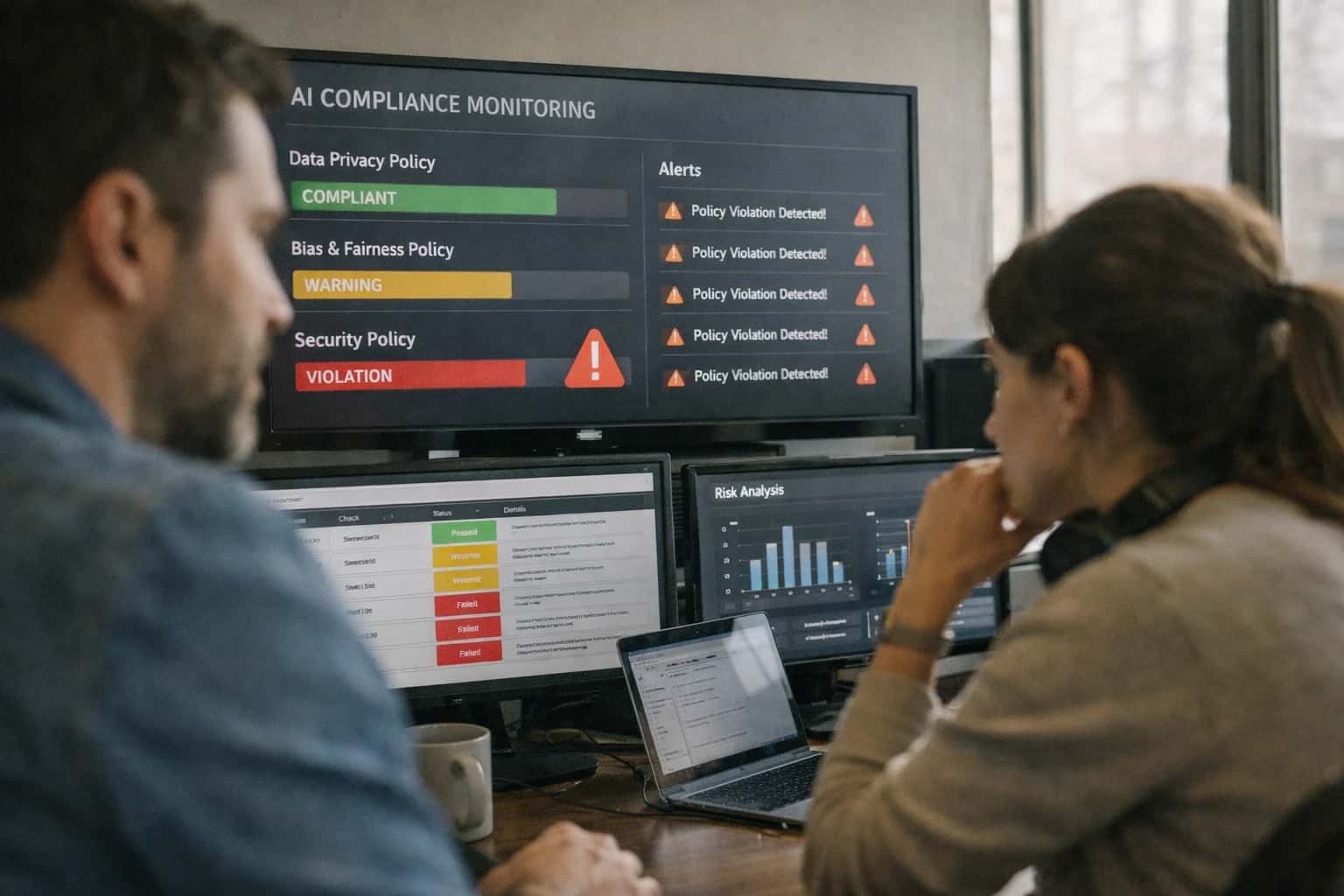
ARCHITECTURE & ROLLOUT
From Reactive Audits to Proactive Compliance with Intune
How to architect an AI layer that predicts compliance violations before they happen, using Microsoft Intune as the policy enforcement engine.
The implementation detail lies in the feedback loop. When the AI predicts a high likelihood of violation (e.g., a device's disk encryption is likely to fail), it can trigger automated workflows via Intune's APIs before the violation occurs. This might involve: 1) Proactive remediation scripts pushed to the device to fix the underlying issue, 2) Dynamic group membership changes to apply stricter policies or monitoring, or 3) Automated communications to the end-user via Microsoft Teams or email with guided self-service steps. The goal is to shift the action from a post-audit ticket in ServiceNow to a pre-emptive correction logged in Intune's audit trail, often resolving issues without IT analyst intervention.
Rollout requires a phased, governance-first approach. Start with a pilot group of non-critical devices, using Intune's device filters and Azure AD groups to scope the AI's automated actions. Implement a human-in-the-loop approval step for any policy changes during the initial phases, which can be automated later as confidence grows. Key to governance is maintaining a clear audit log that traces the AI's prediction, the evidence it used, and the automated action taken—ensuring accountability for compliance officers. This system doesn't replace Intune's native compliance engine; it layers predictive intelligence on top, turning a binary pass/fail dashboard into a prioritized, actionable forecast of device estate health.
ARCHITECTURE BLUEPRINT
Intune Data Surfaces for Predictive AI Models
Core Telemetry for Risk Scoring
The Microsoft Graph API surfaces rich device and user inventory data essential for building predictive models. Key entities include:
- Managed Devices (
/deviceManagement/managedDevices): Provides hardware details (model, manufacturer), OS version, enrollment type, ownership (corporate vs personal), and last check-in time. - Device Compliance (
/deviceManagement/deviceCompliancePolicies&/deviceManagement/managedDevices/{id}/deviceCompliancePolicyStates): Delivers the compliance state of each device against assigned policies, including reasons for non-compliance (e.g.,osVersionNotLatest,bitlockerNotEnabled). - Device Health (
/deviceManagement/managedDevices/{id}/deviceHealthScriptStates): Exposes results from Proactive Remediation scripts, offering signals on performance, configuration drift, and security posture.
AI models consume this structured inventory to establish baselines, identify outliers, and predict which device-user combinations are most likely to violate future compliance policies based on historical patterns and attribute correlations.
MICROSOFT INTUNE
High-Value Predictive Compliance Use Cases
Move beyond reactive compliance monitoring. These AI-powered workflows analyze Intune device, user, and policy data to predict violations before they occur, enabling proactive remediation and policy refinement.
01
Predictive Conditional Access Drift
AI models analyze historical device compliance states, user location patterns, and network access logs to predict which devices are likely to fall out of Conditional Access policy requirements. Automatically triggers pre-emptive user notifications or temporary policy adjustments to maintain access without last-minute admin intervention.
Batch -> Real-time
Monitoring shift
02
Automated Root Cause Analysis for Non-Compliance
When Intune reports a device as non-compliant, an AI agent ingests the device's configuration, installed apps, script logs, and recent policy changes. It correlates this data to identify the most probable root cause (e.g., a specific script failure, registry drift, conflicting policy) and suggests or executes a targeted remediation via Intune's remediation scripts.
Hours -> Minutes
Diagnosis time
03
Dynamic Policy Assignment Based on Risk Forecast
Instead of static group-based policy assignment, an AI layer assigns Intune configuration and compliance policies dynamically. It evaluates a real-time risk score for each device—based on OS version, patch level, user role, and historical violation frequency—and applies stricter or more lenient policies accordingly, optimizing security and user experience.
Static -> Dynamic
Policy logic
04
Proactive Encryption Health Monitoring
Predicts BitLocker or device encryption failures before they cause a compliance breach. Analyzes trends in TPM health reports, recovery key storage errors, and disk encryption events from Intune to flag at-risk devices. Automatically initiates recovery key backup workflows or triggers hardware diagnostics for IT review.
Reactive -> Proactive
Failure prevention
05
Compliance Violation Clustering & Trend Detection
AI clusters similar compliance violations across the Intune estate to uncover systemic issues—like a flawed baseline policy affecting a specific device model or a recurring script error in a department. Provides IT leaders with prioritized insights, enabling policy fixes that prevent hundreds of future violations at once, rather than addressing them individually.
1 sprint
Insight lead time
06
Automated Audit Evidence Synthesis
For regulated industries, AI continuously synthesizes compliance evidence from Intune's reporting surfaces. It correlates device compliance states, policy assignments, administrative change logs, and user acknowledgments to auto-generate narrative audit trails and evidence packs for standards like HIPAA or GDPR, dramatically reducing manual preparation for audits.
Days -> Same day
Evidence compilation
IMPLEMENTATION PATTERNS
Example Predictive Compliance Workflows
These workflows illustrate how AI models consume Intune Graph API data to predict and act on compliance violations before they impact users or security. Each pattern includes the trigger, data context, AI action, and system update.
Trigger: Daily batch analysis of Intune device compliance and diagnostic reports.
Context/Data Pulled:
- Device compliance state (last check-in, jailbreak/root status, encryption, OS version).
- Diagnostic data (battery health < 70%, storage > 90% full, frequent crashes in last 7 days).
- User and device risk tags from Microsoft Defender for Endpoint (if integrated).
- Historical pattern: Devices with 2+ of these signals have an 85% likelihood of falling out of compliance within 5 days.
Model or Agent Action: A lightweight classification model scores each device on a 0-100 "failure probability" scale. Devices scoring above 75 trigger an automated workflow.
System Update or Next Step: The AI agent uses the Microsoft Graph API to:
- Add the high-risk device to a dedicated Azure AD security group (
Intune-HighRisk-Prevent). - A pre-configured Conditional Access policy attached to that group automatically enforces stricter controls (e.g., require compliant device + MFA for all cloud apps).
Human Review Point: An automated email is sent to the device's primary IT contact with the risk score, contributing factors, and a link to override the group assignment if the prediction is a false positive.
FROM REACTIVE ALERTS TO PROACTIVE POLICY
Implementation Architecture: Data Flow & Model Layer
A production-ready architecture for predicting compliance violations before they impact users, using Microsoft Intune as the system of record and enforcement.
The core integration pattern connects three layers: Intune's Graph API as the data source, a predictive model layer hosted in your cloud, and Intune's policy and remediation surfaces as the action layer. The workflow begins by ingesting device compliance states, configuration profiles, and audit logs via the deviceManagement and reports endpoints in Microsoft Graph. This raw telemetry is enriched with user context from Entra ID and historical violation patterns to create a time-series dataset for model training. The critical objects are managedDevices, deviceCompliancePolicies, deviceConfigurationProfices, and auditEvents. A nightly batch job or a near-real-time stream (using Graph change notifications) updates the feature store.
The predictive model layer, typically a set of classifiers (e.g., XGBoost, Random Forest) or a lightweight neural network, runs inference on this enriched data. It outputs a risk score and a predicted violation type (e.g., "encryption likely to fail," "OS version will fall out of compliance") for each device, along with a confidence interval and a predicted timeframe (e.g., "within 7 days"). High-confidence predictions are queued for automated action. For example, a device predicted to fail encryption compliance might trigger an automated Intune remediation script or a proactive notification to the user via the Company Portal app, guiding them to reboot or check settings before the formal compliance check runs.
Governance is wired into the action layer. Predictions do not directly change Intune compliance policies. Instead, they feed into Azure Logic Apps or a custom orchestration service that executes a pre-approved workflow. This might involve creating a temporary Azure AD group for "at-risk devices," which an Intune configuration profile targets to apply a corrective setting, or auto-generating a ticket in ServiceNow for IT review. All actions are logged back to the auditEvents endpoint, creating a closed-loop audit trail. Rollout follows a phased approach: start with a monitoring-only phase to validate model accuracy against actual violations, then introduce user notifications, and finally enable automated, low-risk remediations for high-confidence predictions. This architecture ensures control remains with Intune's RBAC while AI provides the predictive signal.
This approach shifts compliance operations from a reactive, ticket-driven model to a proactive, maintenance-oriented one. Instead of IT chasing violations after they lock users out of resources, the system identifies patterns—like a specific OS build consistently causing encryption issues—and enables policy adjustments or user communications before access is impacted. The result is fewer emergency support calls, higher compliance rates, and more stable conditional access policies, as Intune administrators gain foresight into the factors driving non-compliance across their Windows, iOS, and Android fleets.
INTUNE COMPLIANCE WORKFLOWS
Code & Payload Examples
AI Scoring Endpoint for Device Risk
This example shows a Python call to an Inference Systems-hosted AI model that consumes Intune device compliance and diagnostic data to generate a predictive risk score. The model analyzes trends in policy violations, hardware health, and user behavior to flag devices likely to fall out of compliance in the next 7-14 days.
pythonimport requests import json # Payload built from Intune Graph API data device_payload = { "device_id": "a1b2c3d4-e5f6-7890-g1h2-i3j4k5l6m7n8", "compliance_history": [ {"date": "2024-10-01", "status": "compliant"}, {"date": "2024-10-08", "status": "noncompliant", "policy": "encryption"}, {"date": "2024-10-15", "status": "compliant"} ], "diagnostic_signals": { "battery_health": 78, "storage_free_percent": 15, "os_build_age_days": 45, "last_scan_success": True }, "user_risk_factors": { "department": "Field Sales", "high_risk_app_count": 2 } } # Call the predictive model response = requests.post( "https://api.inferencesystems.com/v1/intune/predict", headers={"Authorization": "Bearer YOUR_API_KEY"}, json=device_payload ) # Response includes score, confidence, and likely violation types prediction = response.json() print(f"Risk Score: {prediction['risk_score']} / 100") print(f"Predicted Violation: {prediction['likely_violation']}") print(f"Confidence: {prediction['confidence']}%")
The API returns a structured risk assessment, enabling automated workflows to target proactive remediation.
AI-PREDICTIVE COMPLIANCE FOR INTUNE
Realistic Time Savings & Operational Impact
How integrating AI with Microsoft Intune transforms reactive compliance monitoring into a proactive, predictive function. This table shows typical operational shifts for a 5,000-device enterprise environment.
| Metric | Before AI | After AI | Notes |
|---|---|---|---|
Mean Time to Identify High-Risk Device | 7-14 days (next audit cycle) | Same day (continuous scoring) | AI analyzes Intune compliance trends and telemetry in real-time to flag devices likely to violate policy. |
Compliance Report Generation for Audits | Manual aggregation, 2-3 days | Automated synthesis, 2-4 hours | AI auto-generates narrative reports with root-cause analysis from Graph API data, ready for auditor review. |
Policy Exception Review & Triage | Manual ticket review, 15-30 mins each | AI-assisted prioritization, <5 mins each | AI pre-scores exception requests based on user role, device history, and security context for faster decisioning. |
Proactive User Communication for Non-Compliance | Broad, post-violation emails | Targeted, pre-violation nudges | AI predicts which users/devices will fall out of compliance and triggers personalized Intune notifications via Company Portal. |
Root Cause Analysis for Compliance Drift | Manual log correlation, 1-2 hours per incident | Automated correlation & suggestion, 10-15 minutes | AI correlates Intune configuration changes, app installs, and user actions to identify the likely cause of drift. |
Policy Configuration Testing & Validation | Manual pilot group testing, 1-2 weeks | AI-simulated impact analysis, 2-3 days | AI models predict policy conflict and user impact on a sample device group before broad Intune deployment. |
Time Spent on Weekly Compliance Review Meetings | 2-3 hours of manual data prep & discussion | 1 hour focused on AI-highlighted exceptions | AI preps the briefing, highlighting only anomalous devices and trends requiring human judgment. |
ARCHITECTING FOR PRODUCTION
Governance, Security, and Phased Rollout
A predictive compliance system must be deployed with strict controls to maintain trust and operational stability.
Implementation begins by establishing a secure data pipeline. Your AI models consume Intune data via the Microsoft Graph API, specifically the /deviceManagement/managedDevices and /deviceManagement/deviceCompliancePolicies endpoints. All data flows through a dedicated service principal with least-privilege DeviceManagementManagedDevices.Read.All and DeviceManagementConfiguration.Read.All permissions. Predictions are generated in an isolated environment, and the resulting risk scores or violation alerts are written back to Intune as custom device properties or sent to a secure webhook endpoint for action. This creates a closed-loop system where the AI informs Intune's native compliance engine without directly modifying core policy states.
Rollout follows a phased, risk-managed approach. Phase 1 targets a pilot group of non-critical devices. The AI system runs in 'monitor-only' mode, generating predictions and reports without triggering automated remediations. This validates model accuracy against real-world compliance drift. Phase 2 introduces automated, low-risk actions, such as flagging devices for review in a dedicated Azure AD security group or sending targeted notifications to users via Microsoft Teams or email. Phase 3 enables conditional automation, where high-confidence predictions can trigger Intune remediation scripts or temporary conditional access blocks, but always with a human-in-the-loop approval step for the first 30 days.
Governance is enforced through three layers: 1) Model Oversight: Regular audits of prediction accuracy and bias, with a rollback plan to a rules-based baseline if model drift exceeds thresholds. 2) Action Logging: Every AI-generated recommendation and automated action is logged with full context—device ID, user, predicted violation, confidence score, and admin override—to an immutable audit trail in Azure Log Analytics. 3) Role-Based Access Control (RBAC): Define clear roles, such as Compliance AI Viewer and Compliance AI Operator, to separate who can see predictions from who can approve automated policy changes. This ensures the system augments your team's workflow without creating ungoverned, autonomous policy changes.
Enabling Efficiency, Speed & Accuracy
Intelligent Analysis, Decision & Execution
We build AI systems for teams that need search across company data, workflow automation across tools, or AI features inside products and internal software.
Talk to Us
Search across company data
Give teams answers from docs, tickets, runbooks, and product data with sources and permissions.
Useful when people spend too long searching or get different answers from different systems.
Enterprise searchRAGPermissions
Read more
Automate internal workflows
Use AI to route work, draft outputs, trigger actions, and keep approvals and logs in place.
Useful when repetitive work moves across multiple tools and teams.
AI agentsWorkflow automationGovernance
Read more
Add AI to products and internal tools
Build assistants, guided actions, or decision support into the software your team or customers already use.
Useful when AI needs to be part of the product, not a separate tool.
AI integrationDecision supportModel routing
Read moreIMPLEMENTATION & WORKFLOWS
Frequently Asked Questions
Practical questions for architects and compliance teams planning AI integration with Microsoft Intune to predict and prevent compliance violations.
The integration uses the Microsoft Graph API with appropriate DeviceManagementManagedDevices.Read.All and DeviceManagementConfiguration.Read.All permissions. Data is pulled on a scheduled basis (e.g., hourly) and includes:
- Device compliance states from
/deviceManagement/deviceCompliancePolicies - Device health status (OS version, encryption, jailbreak status)
- User and group assignments for context
- Historical compliance trend data for each device
This data is transformed and fed into a time-series machine learning model that looks for patterns preceding a violation, such as gradual configuration drift or repeated temporary non-compliance before a permanent failure.

About the author
Prasad Kumkar
CEO & MD, Inference Systems
Prasad Kumkar is the CEO & MD of Inference Systems and writes about AI systems architecture, LLM infrastructure, model serving, evaluation, and production deployment. Over 5+ years, he has worked across computer vision models, L5 autonomous vehicle systems, and LLM research, with a focus on taking complex AI ideas into real-world engineering systems.
His work and writing cover AI systems, large language models, AI agents, multimodal systems, autonomous systems, inference optimization, RAG, evaluation, and production AI engineering.
LinkedIn
Limited slotsGet a Free AI Consultation
Partnered with leading AI, data, and software stack.





How We Work
Custom AI workflows for your Business
One-fit-all AI don't work for modern businesses. At Inferensys, we aim to understand your business & custom requirements; which we use to define most efficient agentic workflows, the data, and the tools for your business.
01
Review the use case
We understand the task, the users, and where AI can actually help.
Read more02
Pick the right approach
We define what needs search, automation, or product integration.
Read more03
Build the first useful version
We implement the part that proves the value first.
Read more04
Improve from there
We add the checks and visibility needed to keep it useful.
Read moreThe first call is a practical review of your use case and the right next step.
Talk to Us