AI integration connects to the Meraki Dashboard API, ingesting telemetry from Systems Manager-managed IoT endpoints—such as sensors, kiosks, digital signage, and medical devices—alongside network data from MX security appliances and MR access points. The primary surface areas are device inventory objects, security policy assignments, and network access control (NAC) events. An AI layer can automate the classification of new, unknown devices by analyzing their traffic patterns, DHCP fingerprints, and associated user behavior, then dynamically assign them to pre-configured Systems Manager groups with appropriate application restrictions and compliance policies.

Integration
AI Integration for Meraki AI for IoT Device Management
Extend Cisco Meraki Systems Manager with AI to automate classification, policy assignment, and anomaly detection for non-traditional IoT endpoints like sensors, cameras, and industrial controllers.
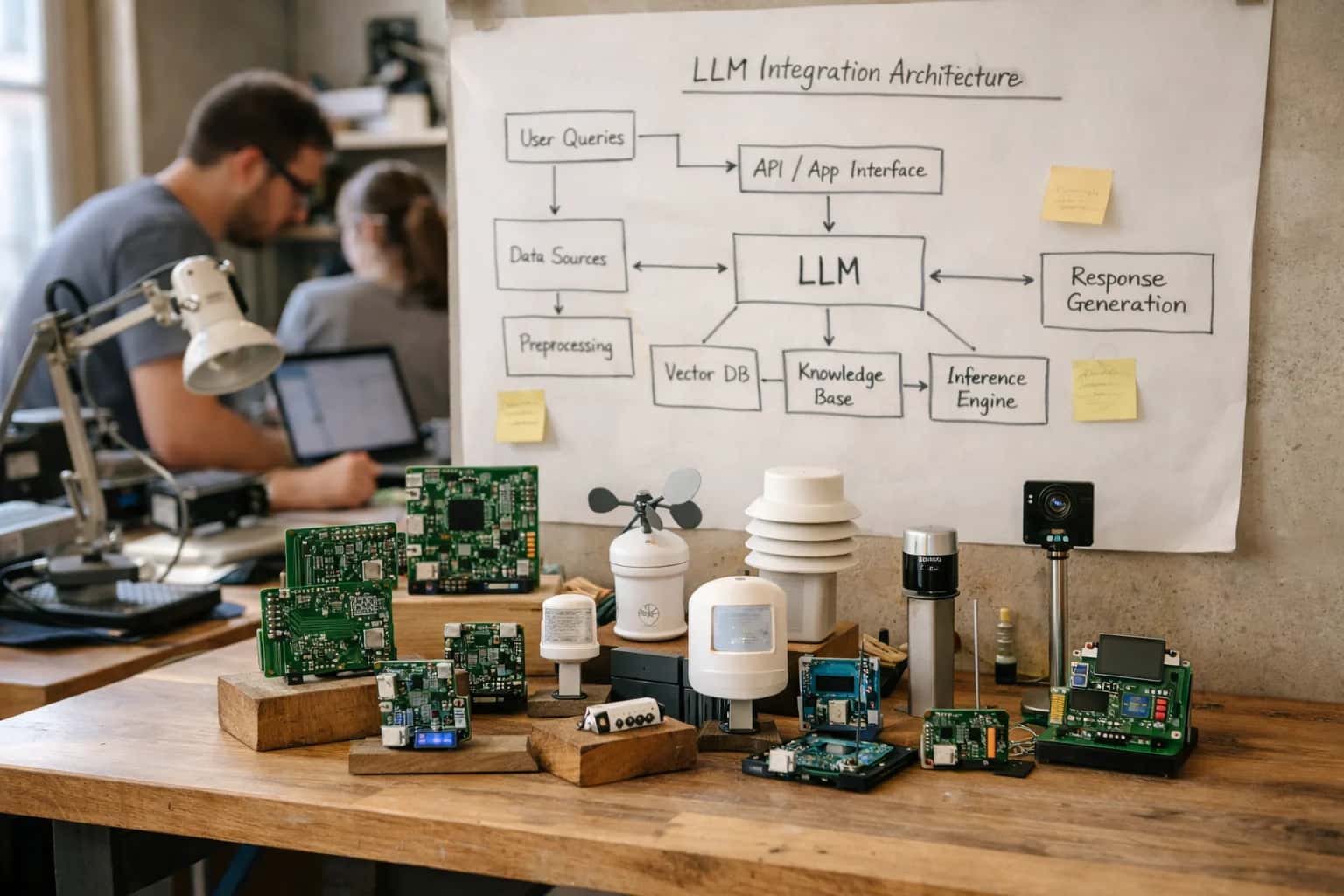
EXTENDING SYSTEMS MANAGER FOR NON-TRADITIONAL ENDPOINTS
Where AI Fits in Meraki IoT Device Management
Integrating AI with Cisco Meraki Systems Manager transforms IoT device oversight from manual classification and reactive security to automated policy orchestration and predictive operations.
High-value workflows include anomaly detection for IoT device traffic, where AI models baseline normal communication patterns (e.g., a building sensor polling every 5 minutes) and flag deviations that may indicate compromise or failure, triggering automated quarantine via Meraki Group Policies or Firewall rules. Another critical use case is predictive maintenance scheduling; by correlating device uptime, signal strength, and error logs from the Meraki inventory, AI can forecast hardware failures and auto-generate work orders in connected ITSM systems before critical IoT endpoints go offline.
A production implementation typically involves a middleware agent that polls the Meraki API for device lists and event logs, enriches this data with external threat intelligence, and runs inference through hosted or fine-tuned models. Decisions are executed back through the API—such as moving a device to a "Quarantine" network VLAN or pushing a new SM profile—with all actions logged in Meraki’s Event log for audit trails. Rollout should start with a pilot group of non-critical IoT devices, using Meraki’s network-wide device tags for easy segmentation, and incorporate a human-in-the-loop approval step for high-risk actions like automatic blocklisting.
AI FOR IOT DEVICE MANAGEMENT
Key Meraki Surfaces for AI Integration
The Core Device Orchestration Layer
The Meraki Dashboard API provides programmatic access to the Systems Manager (SM) module, which is the primary surface for managing IoT and mobile endpoints. This API allows an AI agent to query real-time device inventories, push configuration profiles, and execute remote actions.
Key endpoints for AI integration include:
/organizations/{orgId}/sm/devices: Retrieve a full list of managed devices with attributes like model, OS, IP, and last check-in time./networks/{networkId}/sm/devices/{deviceId}/deviceProfiles: Apply or remove configuration profiles (e.g., Wi-Fi, VPN, restrictions) dynamically./devices/{serial}/sm/lockor/wipe: Execute security commands like remote lock or wipe based on AI-driven risk assessments.
An AI layer can consume this telemetry to classify device types, detect anomalies in check-in patterns, and automate policy assignment for heterogeneous IoT fleets.
INTELLIGENT DEVICE MANAGEMENT
High-Value AI Use Cases for IoT in Meraki
Extend Cisco Meraki Systems Manager beyond traditional laptops and phones to manage diverse IoT endpoints. Use AI to automate classification, enforce dynamic security policies, and detect anomalies in device behavior and network traffic.
01
Automated IoT Device Classification & Profiling
AI analyzes MAC addresses, DHCP fingerprints, and traffic patterns from Meraki access points and switches to automatically identify and tag unknown IoT devices (HVAC, cameras, sensors). This populates Systems Manager inventory with accurate device types, enabling role-based policy assignment without manual discovery.
Days -> Hours
Discovery time
02
Dynamic Network Access Control (NAC) Enforcement
Integrate AI risk scoring with Meraki Group Policies and MX firewall rules. Automatically segment IoT devices into appropriate VLANs or apply traffic shaping based on real-time behavior. A medical IoT sensor behaving anomalously can be dynamically quarantined, updating NAC policies via the Meraki dashboard API.
Static -> Adaptive
Policy model
03
Predictive Anomaly Detection for IoT Traffic
Continuously monitor IoT device telemetry and network flows from Meraki MR and MS devices. AI models establish behavioral baselines and flag deviations—like a smart printer exfiltrating data or an industrial sensor communicating on unexpected ports—triggering alerts in Meraki Security Center or creating ServiceNow tickets.
Reactive -> Proactive
Security stance
04
Automated Firmware & Configuration Compliance
Use AI to parse vulnerability reports and vendor advisories, then cross-reference with IoT device inventories in Systems Manager. Automatically generate and stage firmware update campaigns or push configuration changes via Meraki's MDM APIs for vulnerable device groups, ensuring compliance with security policies.
Manual -> Automated
Patch workflow
05
Intelligent Operational Health Monitoring
Correlate Meraki device client health metrics (latency, packet loss) with IoT endpoint performance data. AI predicts failures in connected IoT infrastructure, like a failing building access controller, and auto-generates work orders in facility management systems (/integrations/facility-management-platforms) before critical outages occur.
Break-fix -> Predictive
Maintenance model
06
AI-Powered IoT Security Incident Response
Orchestrate automated containment workflows when AI detects a compromised IoT device. Trigger Meraki API calls to isolate the device (disable switch port, update firewall rule), revoke its Systems Manager certificate, and log the incident. This integrates with broader security orchestration (/integrations/security-information-and-event-platforms) for a unified response.
Hours -> Minutes
Containment time
FOR CISCO MERAKI SYSTEMS MANAGER
Example AI-Driven IoT Management Workflows
These workflows demonstrate how AI agents can extend Meraki Systems Manager's capabilities to manage non-traditional IoT endpoints—like sensors, cameras, and industrial controllers—by automating classification, policy assignment, and threat response based on network behavior.
Trigger: A new, unmanaged device joins the Meraki network and appears in the Systems Manager dashboard with a generic manufacturer string (e.g., Unknown-Device-AA:BB:CC).
Context/Data Pulled:
- The AI agent consumes the new device's MAC address, observed SSID, signal strength, and DHCP fingerprint via the Meraki Dashboard API (
GET /networks/{networkId}/clients). - It queries an internal or external IoT device registry (e.g., MAC vendor database, custom fingerprint library) and correlates with traffic patterns from Meraki traffic analysis.
Model or Agent Action:
- A classifier model analyzes the fingerprint and initial traffic (destination IPs, ports, packet size) to predict device type (e.g.,
HVAC Controller,Security Camera,Medical Sensor). - The agent maps the predicted type to a pre-defined policy template (VLAN, firewall rules, bandwidth limits).
System Update or Next Step:
- The agent uses the Meraki API to:
- Create a new Systems Manager device record with a descriptive name (e.g.,
Building-3-HVAC-Zone5). - Apply a Systems Manager network access policy, assigning the device to a restricted IoT VLAN.
- Push a configuration profile with appropriate security settings.
- Create a new Systems Manager device record with a descriptive name (e.g.,
- A summary log is written to an audit trail:
Classified device AA:BB:CC as HVAC Controller; assigned to VLAN 30.
Human Review Point:
- Low-confidence classifications (e.g., <85% probability) are flagged in a daily review queue for an admin to verify in the Meraki dashboard before policy enforcement.
AI-ENHANCED IOT DEVICE ORCHESTRATION
Implementation Architecture: Data Flow & System Design
A practical blueprint for extending Cisco Meraki Systems Manager with AI to manage non-traditional IoT endpoints, from automated classification to anomaly-driven security.
The integration connects to the Meraki Dashboard API to ingest real-time data from three primary surfaces: Systems Manager device lists (for endpoint inventory), Network traffic analytics from MX security appliances (for IoT behavior), and Security Center alerts (for threat context). An AI orchestration layer processes this data to perform automated tasks: classifying unknown devices using traffic fingerprinting and DHCP fingerprints, assigning them to dynamic Systems Manager network tags, and pushing appropriate configuration profiles for security posture and network access. For example, a newly detected manufacturing sensor can be auto-tagged as iot-type-sensor, assigned a restricted VLAN via a Meraki Group Policy, and have its traffic baseline established for future anomaly detection.
The core AI workflow is event-driven, typically built on a queue (like AWS SQS or RabbitMQ) listening for Meraki webhooks on device_list_updated or alert_generated. When an unknown MAC address appears, the system extracts its traffic patterns (destinations, protocols, volumes) and correlates with Meraki client details. A lightweight classifier model—trained on known IoT profiles—suggests a device type and risk score. Based on this, the integration calls back to the Meraki API to apply tags and, if configured, trigger an automated Security Center policy to isolate the device or adjust MX firewall rules. This closes the loop from detection to enforcement in minutes, replacing manual NAC configuration.
Rollout should be phased, starting with a monitoring-only mode where AI suggestions are logged but not acted upon, using Meraki's organization-wide change log for audit trails. Governance requires defining clear rules for automated policy actions—such as only quarantining devices with a high-confidence malicious score—and maintaining a human-review queue for low-confidence classifications. The system should integrate with your existing SIEM (like Splunk) for centralized logging of all AI-driven decisions and Meraki API calls. For production resilience, implement idempotent API calls and respect Meraki's rate limits, using exponential backoff for retries during dashboard API throttling.
This architecture shifts IoT management from a reactive, manual cataloging task to a proactive, policy-driven operation. By using Meraki as the enforcement layer and AI as the decision engine, teams can maintain a real-time, accurate inventory of every connected thing, enforce least-privilege access dynamically, and detect behavioral anomalies—like a camera suddenly sending data to an external IP—before they become incidents. For related patterns on securing these workflows, see our guide on AI Integration for Meraki AI-Driven Network Access Control and cross-platform AI-Based Threat Detection on Managed Devices.
AI INTEGRATION PATTERNS FOR MERAKI SYSTEMS MANAGER
Code & Payload Examples
Automated IoT Device Classification
Use the Meraki Dashboard API to fetch device details (MAC, manufacturer, client description) and pass them to an AI model for classification. The model can categorize devices (e.g., environmental_sensor, security_camera, medical_iot) based on learned patterns. The resulting label is used to dynamically assign a pre-configured network or security policy via the API.
Example Workflow:
- Poll
/organizations/{orgId}/clientsfor newly connected devices. - Send device attributes to a classification endpoint (e.g.,
POST /classify). - Use the returned
device_typeto map to a Meraki Group Policy ID. - Update the client's policy via
PUT /networks/{networkId}/clients/{clientId}/policy.
This automates the onboarding of non-traditional endpoints, ensuring they receive appropriate network access and security controls without manual IT intervention.
AI-ENHANCED IOT DEVICE OPERATIONS
Realistic Time Savings & Operational Impact
How AI integration with Cisco Meraki Systems Manager transforms the management of non-traditional IoT endpoints, from smart sensors to industrial controllers, by automating classification, policy assignment, and threat response.
| Operational Task | Before AI | After AI | Key Notes |
|---|---|---|---|
IoT Device Onboarding & Classification | Manual inventory entry and profile assignment (30+ mins/device) | Automated classification via network fingerprinting (< 5 mins) | AI analyzes MAC OUI, traffic patterns, and DHCP requests to auto-tag and group |
Security Policy Assignment & Enforcement | Static policy groups based on manual review; updates lag device changes | Dynamic policy assignment based on real-time device behavior and risk score | Policies adjust automatically as devices move or their function changes |
Anomalous Traffic Detection & Triage | Manual review of Meraki traffic logs; reactive investigation (hours to days) | AI-powered baseline modeling with automated alerts for deviations (minutes) | Reduces mean time to detect (MTTD) for compromised or malfunctioning IoT devices |
Firmware Update Planning & Scheduling | Manual vulnerability assessment and calendar-based rollout windows | Predictive scheduling based on device criticality, network load, and patch urgency | Minimizes operational disruption by intelligently batching updates |
Compliance Reporting for IoT Fleet | Manual data aggregation from multiple Meraki dashboards (days per audit) | Automated evidence collection and report generation (hours) | AI synthesizes device posture, policy adherence, and access logs for auditors |
Incident Response for Compromised Endpoints | Manual investigation, then CLI/API commands to quarantine or block | Automated playbook execution: quarantine via group policy, alert IT, create ticket | Response time reduced from next-business-day to same-hour containment |
Lifecycle Management & Depreciation Tracking | Spreadsheet-based tracking disconnected from live device status | AI correlates Meraki inventory with purchase data to forecast refreshes and budget | Enables proactive capital planning and reduces stranded assets |
IMPLEMENTING AI FOR IOT DEVICE MANAGEMENT
Governance, Security & Phased Rollout
A practical guide to deploying AI for Meraki-managed IoT endpoints with security, auditability, and controlled impact.
Integrating AI with Cisco Meraki Systems Manager for IoT device management introduces new automation surfaces but also requires careful governance. Key architectural considerations include:
- API Access & Rate Limits: AI agents interact with the Meraki Dashboard API to fetch device lists, client details, and security events. Implement robust token management and respect API rate limits to avoid service disruption.
- Data Flow & Enrichment: The AI layer typically consumes telemetry from Meraki (device type, traffic patterns, security alerts) and enriches it with external threat feeds or business context (e.g., device location, criticality) before making classification or policy decisions.
- Action Execution: Approved AI decisions—like tagging a new IoT sensor, assigning a restrictive network policy, or triggering an alert—are executed back through the Meraki API. All actions should be logged with a clear audit trail linking the AI decision to the API call and the admin service account used.
A phased rollout is critical to manage risk and validate AI logic in a production IoT environment.
- Phase 1: Discovery & Baseline (Read-Only): Deploy AI agents in a monitoring-only mode. They analyze Meraki device inventories and network traffic to build a baseline of "normal" IoT behavior and propose device classifications without making any configuration changes. This phase builds trust in the AI's accuracy.
- Phase 2: Assisted Governance (Human-in-the-Loop): Enable the AI to suggest policy actions, such as moving an unclassified device to a restricted VLAN or creating a new group tag. These suggestions are presented to a network administrator via a dashboard or ticketing system (e.g., ServiceNow) for manual review and approval before the Meraki API executes the change.
- Phase 3: Conditional Automation (Guarded): For high-confidence, low-risk workflows—like applying a standard "IoT-Sensor" tag to a device matching a known manufacturer MAC OUI—implement fully automated execution. Establish clear guardrails, such as allowing automation only for non-critical network segments and maintaining a real-time kill switch.
Security and operational governance must be designed in from the start. Implement role-based access control (RBAC) for the AI system itself, ensuring only authorized processes can trigger Meraki API actions. Use a dedicated service account with the minimum necessary Meraki dashboard permissions (e.g., org:read and sm:write). All AI-driven policy changes should be written to an immutable audit log, capturing the input data, the AI's reasoning (e.g., the classification confidence score), and the resulting Meraki configuration. Regularly review these logs and the performance of automated policies to catch drift or unintended consequences, ensuring the AI integration remains an asset, not a liability, for your IoT security posture.
Enabling Efficiency, Speed & Accuracy
Intelligent Analysis, Decision & Execution
We build AI systems for teams that need search across company data, workflow automation across tools, or AI features inside products and internal software.
Talk to Us
Search across company data
Give teams answers from docs, tickets, runbooks, and product data with sources and permissions.
Useful when people spend too long searching or get different answers from different systems.
Enterprise searchRAGPermissions
Read more
Automate internal workflows
Use AI to route work, draft outputs, trigger actions, and keep approvals and logs in place.
Useful when repetitive work moves across multiple tools and teams.
AI agentsWorkflow automationGovernance
Read more
Add AI to products and internal tools
Build assistants, guided actions, or decision support into the software your team or customers already use.
Useful when AI needs to be part of the product, not a separate tool.
AI integrationDecision supportModel routing
Read moreAI FOR IOT DEVICE MANAGEMENT
Frequently Asked Questions
Practical questions for teams extending Cisco Meraki Systems Manager with AI to manage IoT endpoints, from security policy automation to traffic anomaly detection.
This workflow automates the onboarding and securing of new IoT endpoints.
-
Trigger: A new, unclassified device joins the network and appears in Meraki Systems Manager inventory.
-
Context/Data Pulled: An AI agent queries the Meraki dashboard API for the device's attributes:
- MAC address (OUI vendor prefix)
- Hostname
- Connected SSID/VLAN
- Observed DHCP requests and DNS queries
- Traffic patterns (destinations, ports, protocols)
-
Model or Agent Action: The agent sends this data to a classification model (e.g., a fine-tuned LLM or classifier) which compares it to known IoT device profiles. It returns a predicted device type (e.g.,
"Building Sensor - HVAC Temperature") and a risk score. -
System Update: Based on the classification, the agent uses the Meraki API to:
- Apply a pre-configured Group Policy or Security Policy tag to the device.
- Move the device to the appropriate Network Access Control (NAC) policy group, restricting it to necessary VLANs and ports.
- Update the device's Notes field in Systems Manager with the classification rationale.
-
Human Review Point: If the model's confidence score is below a set threshold, the device is tagged for
"Review - Unclassified IoT"and an alert is sent to the network admin queue.

About the author
Prasad Kumkar
CEO & MD, Inference Systems
Prasad Kumkar is the CEO & MD of Inference Systems and writes about AI systems architecture, LLM infrastructure, model serving, evaluation, and production deployment. Over 5+ years, he has worked across computer vision models, L5 autonomous vehicle systems, and LLM research, with a focus on taking complex AI ideas into real-world engineering systems.
His work and writing cover AI systems, large language models, AI agents, multimodal systems, autonomous systems, inference optimization, RAG, evaluation, and production AI engineering.
LinkedIn
Limited slotsGet a Free AI Consultation
Partnered with leading AI, data, and software stack.





How We Work
Custom AI workflows for your Business
One-fit-all AI don't work for modern businesses. At Inferensys, we aim to understand your business & custom requirements; which we use to define most efficient agentic workflows, the data, and the tools for your business.
01
Review the use case
We understand the task, the users, and where AI can actually help.
Read more02
Pick the right approach
We define what needs search, automation, or product integration.
Read more03
Build the first useful version
We implement the part that proves the value first.
Read more04
Improve from there
We add the checks and visibility needed to keep it useful.
Read moreThe first call is a practical review of your use case and the right next step.
Talk to Us