
Inferensys

Integration

AI Integration for GE HealthCloud Imaging

A technical blueprint for connecting AI models and agents to GE HealthCloud Imaging, detailing cloud APIs, zero-footprint viewer extensions, and data lake connectivity to deploy and manage AI applications across a distributed enterprise imaging network.
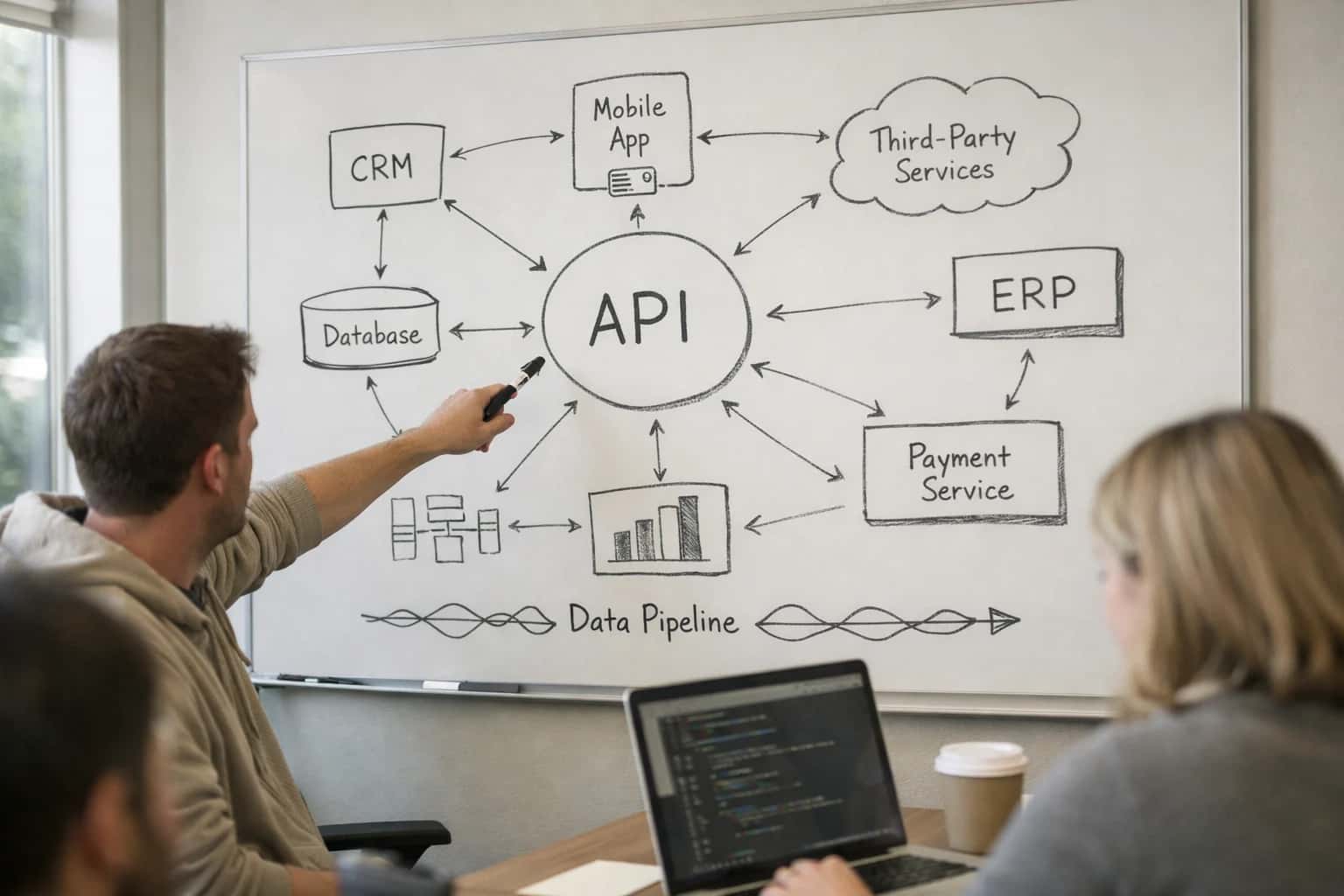
Enterprise integration architect reviewing API connections on laptop, diagram showing systems connecting, modern office setup.
ARCHITECTURE BLUEPRINT

Where AI Fits into the GE HealthCloud Imaging Stack

A practical guide to embedding AI into GE HealthCloud Imaging's cloud-native services, APIs, and zero-footprint viewer to automate analysis and enhance diagnostic workflows.

Integrating AI into GE HealthCloud Imaging means connecting to its cloud-native data fabric and modular services. The primary architectural touchpoints are:

  • GE HealthCloud Data Lake & APIs: Ingest DICOM studies and patient context via secure REST APIs and DICOMweb for AI processing. Return structured results (DICOM SR, FHIR Observations) to enrich the imaging record.
  • Zero-Footprint Universal Viewer: Embed AI findings as interactive overlays, measurements, or side-panel annotations within the web-based review workflow. Use the viewer's extension framework to surface AI-powered tools like automated segmentation or lesion tracking.
  • Edison AI Platform Services: For validated AI applications, deploy and orchestrate containerized models using GE's managed inference services, leveraging its built-in validation, monitoring, and clinical workflow integration hooks.
  • Workflow Manager & Eventing: Subscribe to HL7 ADT and ORM messages or use cloud-native event streams to trigger AI analysis on newly arrived studies, enabling automated triage and prioritization before a radiologist opens the case.


A typical implementation wires these components into a secure, event-driven pipeline:

  1. A new CT chest arrives in the HealthCloud Data Lake, triggering a cloud event.
  2. An orchestration service (e.g., Azure Logic Apps, AWS Step Functions) routes the study to a dedicated AI inference endpoint—hosted either within the Edison platform or your own secure VNET.
  3. The AI model processes the study, generating a structured report indicating a high probability of pulmonary nodules with locations and measurements.
  4. This report is posted back to the HealthCloud API as a DICOM Structured Report object, linked to the original study.
  5. The Universal Viewer automatically highlights the AI findings when the radiologist opens the study, allowing for rapid verification and incorporation into the final report. This shifts detection from a manual, search-intensive task to a focused review, reducing cognitive load and potential oversight.

Rollout requires a phased, governance-first approach. Start with a non-interruptive, second-read workflow where AI findings are visible but not blocking. Use HealthCloud's audit trails to track radiologist interactions with AI suggestions, building a feedback loop for model refinement and clinician trust. For enterprise-scale deployments, leverage HealthCloud's inherent scalability to deploy AI across a distributed imaging network, ensuring consistent performance whether a study is read at the hub or a spoke facility. The goal is not to replace the radiologist but to embed AI as a context-aware copilot within the familiar GE ecosystem, turning advanced analytics into a routine part of the diagnostic workflow.

CLOUD-NATIVE AI DEPLOYMENT PATTERNS

Key Integration Surfaces in GE HealthCloud Imaging

Core Cloud APIs and Data Fabric

GE HealthCloud Imaging provides a cloud-native data fabric for scalable AI integration. The primary surfaces are the HealthCloud Data Lake (a managed DICOM store on AWS/Azure) and the HealthCloud API Gateway.

Key Integration Points:

  • DICOMweb Services: Use STOW-RS to ingest studies and WADO-RS to retrieve images for AI inference. This is the standard path for cloud-based AI model containers.
  • FHIR API: For structured clinical context. Retrieve patient demographics, prior reports, and lab data to enrich AI analysis via the Patient, Observation, and DiagnosticReport resources.
  • Event Notification Service: Subscribe to HL7v2 or FHIR-based events (e.g., ORM^O01 for new orders, ORU^R01 for completed reports) to trigger AI workflows automatically when studies arrive or reports are finalized.

This architecture enables AI to run as a serverless microservice, processing studies from the data lake and writing results back as DICOM Structured Reports (SR) or FHIR Observations.

CLINICAL AND OPERATIONAL INTEGRATION PATTERNS

High-Value AI Use Cases for GE HealthCloud

Practical integration patterns for connecting AI models to GE HealthCloud Imaging via its cloud APIs, zero-footprint viewer, and data lake to automate workflows, enhance diagnostic confidence, and improve operational efficiency across the imaging network.

01

AI-Powered Study Triage & Prioritization

Integrate AI detection algorithms (e.g., for ICH, PE, pneumothorax) with the GE HealthCloud worklist API. Automatically analyze incoming CT and X-ray studies, assign a criticality score, and re-prioritize the radiologist's reading list. Critical cases surface first, reducing time-to-diagnosis for stroke, trauma, and other urgent findings.

Minutes Saved
Per Critical Case
02

Structured Report Drafting & Data Capture

Connect AI quantification models (e.g., lung nodule volumetry, coronary calcium scoring) to the reporting module via DICOM Structured Report (SR). AI-generated measurements and observations auto-populate draft reports within the GE HealthCloud reporting interface. Reduces manual dictation/typing and ensures structured data is captured for registries and downstream analytics.

Structured Data
Auto-Captured
03

Zero-Footprint Viewer AI Overlays

Embed AI results as interactive overlays within the GE HealthCloud Universal Viewer. Using its extension framework, display AI segmentations (e.g., organ contours, tumor volumes), detection markers, and confidence scores directly on the web-based images. Referring physicians and on-call radiologists see AI insights without switching applications.

Context
Within Workflow
04

Longitudinal Analysis & Comparison

Leverage the GE HealthCloud Imaging Data Lake to run AI models across historical studies for a patient. Automatically retrieve prior exams, perform AI-driven change detection (e.g., tumor growth, interval new findings), and present a comparative summary. Integrates with the clinical timeline to support faster, more consistent follow-up assessments.

Batch → Automated
Prior Comparison
05

Operational Quality & Protocol QA

Use AI to analyze DICOM headers and image metadata ingested via cloud APIs for operational intelligence. Automatically flag protocol deviations, dose outliers, or suboptimal image quality. Generate alerts for technologist coaching and integrate findings with GE HealthCloud dashboards for QA program management.

Proactive Alerts
For Protocol Drift
06

Cross-Modality Context & Enrichment

Orchestrate multiple AI models via GE HealthCloud's orchestration services to enrich a single study. For a chest CT, sequentially run nodule detection, emphysema quantification, and coronary calcium scoring. Consolidate all AI outputs into a unified report annex or visualization panel, providing comprehensive context from a single acquisition.

Multi-Model
Orchestration
GE HEALTHCLOUD IMAGING

Example AI-Enhanced Workflows

These concrete workflows illustrate how AI models and agents connect to GE HealthCloud Imaging's cloud APIs, zero-footprint viewer, and data lake to automate high-value clinical and operational tasks.

Trigger: A new DICOM study (e.g., Non-Contrast Head CT) is received by the GE HealthCloud Imaging PACS via its DICOM receiver.

Context/Data Pulled: The integration service (listening via DICOM MWL or a cloud event) retrieves the study's metadata and images from the HealthCloud Imaging Data Lake using the GET /studies API. It extracts key DICOM tags (Modality, Body Part, Study Description).

Model or Agent Action: A pre-trained AI model (e.g., for intracranial hemorrhage or large vessel occlusion) runs inference on the image series. The agent generates a DICOM Structured Report (SR) containing the finding (e.g., "Positive for ICH"), a confidence score, and an urgency level (STAT, Routine).

System Update or Next Step: The agent posts the SR back to the HealthCloud Imaging archive via DICOMweb STOW-RS. It then calls the HealthCloud Workflow Manager API to update the study's priority flag in the radiologist's reading worklist. A STAT-priority study is pushed to the top of the list in the zero-footprint viewer.

Human Review Point: The radiologist is presented with the AI finding as an overlay or sidebar note in the viewer. They confirm, reject, or modify the finding before finalizing the report, providing implicit feedback to the AI governance system.

CLOUD-NATIVE AI ORCHESTRATION

Implementation Architecture: Data Flow & APIs

A production-ready integration for GE HealthCloud Imaging connects AI models to cloud-native data pipelines, viewer extensions, and clinical workflows.

The core integration pattern uses GE HealthCloud's Open APIs and DICOMweb services. AI-triggering events—such as a new study arrival in the cloud PACS or a radiologist opening a case in the zero-footprint viewer—initiate a secure, serverless workflow. Study data is streamed via DICOMweb WADO-RS to a dedicated, HIPAA-aligned inference service, which can be hosted on AWS, Azure, or GCP, adjacent to the HealthCloud instance. Results are returned as DICOM Structured Reports (SR) or FHIR Observations and immediately attached to the original study, making them available for overlay in the viewer and for downstream reporting systems.

For real-time, interactive AI, we extend the HealthCloud Imaging Viewer using its JavaScript SDK. This allows AI tools—like a click-to-segment lesion tool or an auto-populate measurements widget—to run directly in the radiologist's browser session. The SDK facilitates secure communication between the viewer and containerized AI microservices, enabling sub-second inference without moving full image sets. This architecture supports both "push" (automated triage on ingestion) and "pull" (on-demand analysis during read) models, governed by configurable rules in the HealthCloud workflow manager.

Rollout is phased, beginning with a single AI application (e.g., chest X-ray triage) in a pilot department. We establish a feedback loop where radiologist corrections or confirmations within the viewer are logged as ground truth, used to retrain and monitor model performance via an LLMOps dashboard. Governance is enforced through HealthCloud's native RBAC, ensuring only authorized users can trigger AI or view preliminary results, and all AI interactions are audited in the platform's activity logs. This staged, observable approach de-risks deployment and builds clinical trust incrementally.

GE HEALTHCLOUD IMAGING

Code & Payload Examples

Fetching Studies for AI Inference

To trigger an AI analysis, you first need to retrieve the imaging study from the GE HealthCloud Imaging data lake. This Python example uses the DICOMweb WADO-RS endpoint to fetch a series for processing. The study_uid and series_uid are typically obtained from a worklist or HL7 order message.

python
import requests
from requests.auth import HTTPBasicAuth

# GE HealthCloud Imaging DICOMweb base URL
base_url = "https://your-instance.gehealthcloud.com/dicomweb"
study_uid = "1.2.840.113619.2.290.3.1762856638.123.1234567890"
series_uid = "1.2.840.113619.2.290.3.1762856638.123.1234567890.1"

# Construct the WADO-RS URL for series retrieval
series_url = f"{base_url}/studies/{study_uid}/series/{series_uid}"

# Authenticate and fetch the series metadata and instances
try:
    response = requests.get(
        series_url,
        auth=HTTPBasicAuth('api_user', 'api_key'),
        headers={'Accept': 'application/dicom+json'}
    )
    response.raise_for_status()
    series_metadata = response.json()
    
    # For each instance in the series, retrieve the pixel data
    for instance in series_metadata:
        instance_uid = instance['00080018']['Value'][0]
        instance_url = f"{series_url}/instances/{instance_uid}/frames/1"
        # Fetch the image frame (pixel data)
        # ...
        
except requests.exceptions.RequestException as e:
    print(f"Failed to retrieve series: {e}")

This pattern is foundational for building an AI pipeline that pulls studies on-demand or via a listener for new arrivals in the cloud archive.

AI-ENHANCED IMAGING WORKFLOWS

Realistic Time Savings and Operational Impact

This table illustrates the operational impact of integrating AI into GE HealthCloud Imaging workflows, focusing on time savings, workflow efficiency, and clinical support. Metrics are based on typical pilot deployments and scaled implementations within enterprise imaging networks.

Workflow / MetricBefore AI IntegrationAfter AI IntegrationImplementation Notes

Critical Finding Triage (e.g., ICH, PE)

Manual review of all studies in worklist order

AI pre-read flags critical cases for immediate review

AI results delivered via DICOM SR to worklist; radiologist retains final sign-off

Report Draft Generation

Radiologist dictates all findings from scratch

AI suggests draft findings and measurements based on image analysis

Integrated with PowerScribe 360 or native reporting; requires radiologist editing and verification

Study Prioritization for ED/Trauma

First-in, first-out or manual tech/physician flagging

AI scores and re-orders worklist based on detected urgency

Uses GE HealthCloud APIs to modify worklist priority; configurable rules for different modalities

Quality Control (Protocol Compliance, Dose)

Periodic manual audits by physicists/technologists

AI continuously monitors studies and flags outliers for review

Alerts routed via HealthCloud notifications; integrates with GE DoseWatch for trend analysis

Advanced Visualization (3D Segmentation)

Manual or semi-automated segmentation taking 15-30 minutes

AI provides one-click organ or lesion segmentation in 2-5 minutes

Results pushed to GE AW Server or zero-footprint viewer for refinement and reporting

Cross-modality Prior Comparison

Manual retrieval and side-by-side comparison of prior studies

AI automatically retrieves and aligns relevant priors, highlighting changes

Leverages HealthCloud's Universal Viewer and VNA; requires robust study linking logic

Population Health Screening Triage

Batch review of screening studies (e.g., lung cancer) in chronological order

AI pre-screens and stratifies studies by likelihood of actionable findings

Outputs structured data to analytics dashboards; enables focused reading sessions

ENTERPRISE IMAGING AI OPERATIONS

Governance, Security, and Phased Rollout

A practical framework for deploying and governing AI across GE HealthCloud Imaging with controlled risk and measurable impact.

Production AI integration requires a security-first architecture aligned with GE HealthCloud's cloud-native design. This means implementing AI inference as containerized services within your private VPC, accessing studies via DICOMweb APIs and the HealthCloud Data Lake over encrypted channels. All AI-generated findings, such as DICOM Structured Reports (SR) or annotations, must be written back with strict provenance tracking—logging the model version, inference timestamp, and confidence scores. Access is governed by the same Identity and Access Management (IAM) policies that control radiologist and technologist access to the PACS, ensuring AI only processes studies for authorized clinical contexts and users.

A phased rollout is critical for adoption and validation. Start with a non-diagnostic pilot in a single modality (e.g., Chest X-Ray) and a controlled user group. Use GE HealthCloud's workflow engine to route a copy of incoming studies to the AI service, running in parallel to the standard workflow. Radiologists review AI suggestions (like a pneumothorax detection overlay) in the zero-footprint viewer via a toggle, providing implicit feedback. This 'silent mode' operation validates accuracy, measures time-to-detection improvements, and builds clinical trust without disrupting existing diagnostic protocols. Subsequent phases can introduce AI-driven worklist prioritization, automatically bumping studies with high-confidence critical findings to the top of the list.

Governance is sustained through continuous monitoring and closed-loop feedback. Establish a dashboard tracking key operational metrics: AI inference latency, study processing volume, and the radiologist agreement rate with AI findings. Implement a simple feedback mechanism—a button within the viewer to flag false positives/negatives—which feeds a curated dataset for model retraining. This creates a virtuous cycle where the AI system improves based on real-world use. Finally, integrate AI activity into the existing audit trail, ensuring every AI-access and AI-generated result is logged for compliance, billing, and quality review, just like any other user action within the HealthCloud ecosystem.

IMPLEMENTATION AND WORKFLOW DETAILS

Frequently Asked Questions

Practical questions for architects and IT leaders planning AI integration with GE HealthCloud Imaging, focusing on cloud-native deployment, workflow automation, and enterprise governance.

AI analysis is typically triggered via a DICOMweb-based event listener or by configuring the GE HealthCloud Imaging Data Lake to publish events. A common production pattern involves:

  1. Trigger: A new DICOM study is stored in the HealthCloud Imaging Data Lake.
  2. Event: A Cloud Pub/Sub message or an event on an AWS SQS/SNS topic is generated.
  3. Orchestration: A serverless function (e.g., AWS Lambda, Google Cloud Function) receives the event, extracts study metadata (Accession Number, SOP Instance UIDs), and initiates the AI workflow.
  4. Execution: The orchestrator retrieves the study via DICOMweb WADO-RS, routes it to the appropriate AI model container (hosted on Kubernetes or AWS SageMaker), and manages the inference job.
  5. Result Storage: AI results (e.g., findings, segmentations, measurements) are written back as a DICOM Structured Report (SR) or FHIR Observation resource to a designated location in the Data Lake, linked to the original study.

This event-driven pattern ensures scalability and loose coupling from the core PACS workflow.

Prasad Kumkar

About the author

Prasad Kumkar

CEO & MD, Inference Systems

Prasad Kumkar is the CEO & MD of Inference Systems and writes about AI systems architecture, LLM infrastructure, model serving, evaluation, and production deployment. Over 5+ years, he has worked across computer vision models, L5 autonomous vehicle systems, and LLM research, with a focus on taking complex AI ideas into real-world engineering systems.

His work and writing cover AI systems, large language models, AI agents, multimodal systems, autonomous systems, inference optimization, RAG, evaluation, and production AI engineering.


