AI integration for Autopilot focuses on enhancing its core visual journey builder and contact scoring engine. The primary surfaces for integration are the Journey Canvas, where AI can generate or personalize email and SMS content blocks in real-time, and the Contact Scoring module, where AI models can append predictive engagement or meeting-readiness scores. This is typically executed via Autopilot's REST API, using webhooks to trigger AI services when a contact enters a specific journey step or when a custom field requires an AI-generated value, such as a personalized sales cadence message.

Integration
AI Integration for Autopilot
A technical guide to wiring AI into Autopilot's visual journey builder for B2B sales and marketing automation, enabling automated content generation, lead scoring, and meeting qualification.
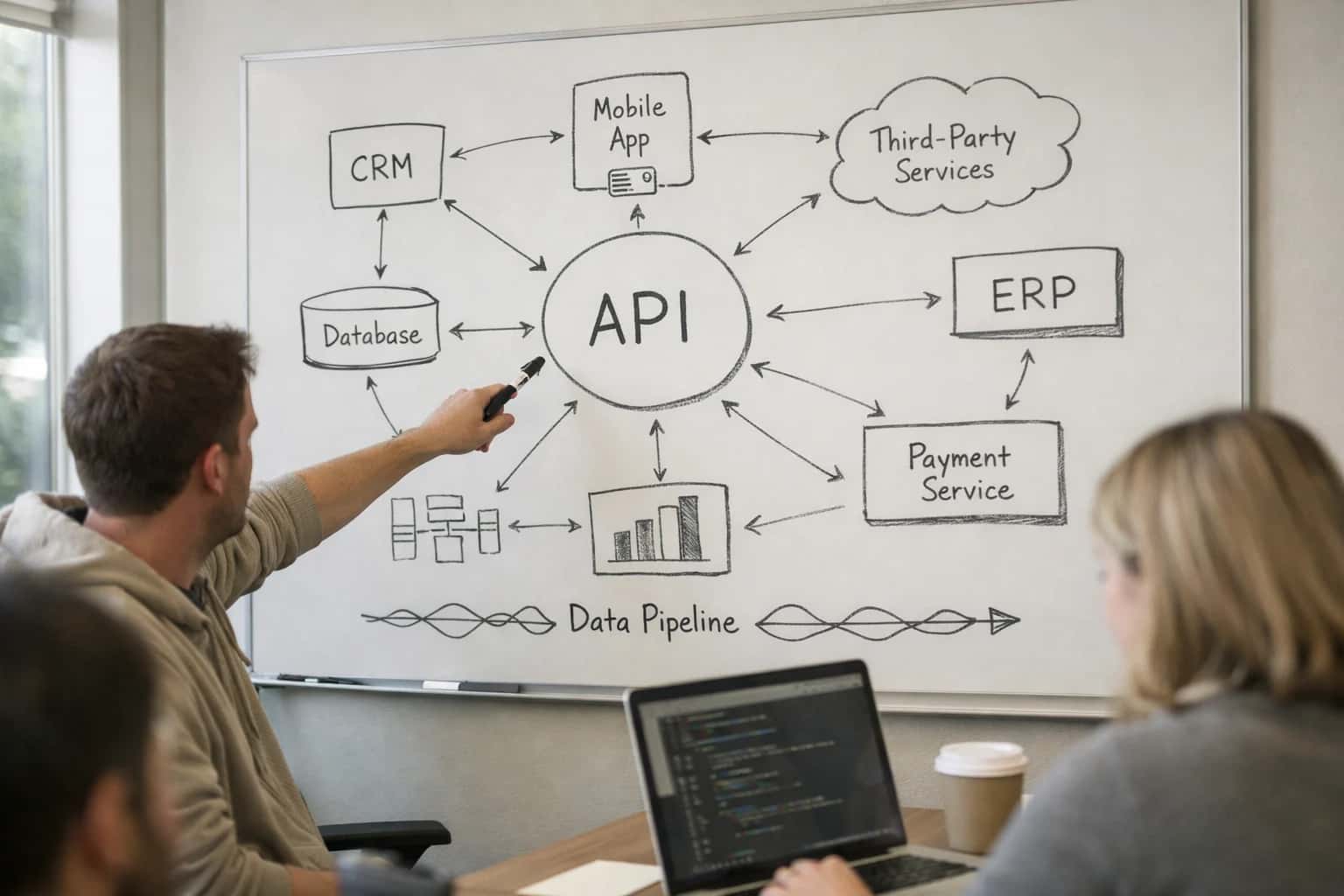
ARCHITECTURE FOR VISUAL JOURNEY ORCHESTRATION
Where AI Fits into Autopilot's B2B Automation Stack
Integrating AI directly into Autopilot's visual journey builder to automate content creation and lead qualification for B2B sales and marketing teams.
High-value use cases include automated sales cadence content, where AI drafts the next email in a sequence based on a lead's engagement history and firmographic data, and meeting qualification scoring, where an AI agent analyzes email reply content, website activity, and CRM data to predict a lead's propensity to book a meeting. This moves beyond simple lead scoring to operational intelligence, directly influencing which journey path a contact follows—for example, routing highly scored leads to a 'Sales Accepted' journey and lower-scoring leads to a nurturing track.
A production implementation wires a secure inference endpoint (hosted on your infrastructure or a managed cloud) into Autopilot's journey via API calls. Governance is critical: all AI-generated content should be logged with audit trails, and a human-in-the-loop approval step is recommended for initial rollouts. Start by piloting AI in a single, high-volume journey—like a webinar follow-up sequence—to measure impact on reply rates and meeting bookings before scaling. For teams using Autopilot for account-based motions, consider integrating AI with your CRM (like Salesforce) via our /integrations/customer-relationship-management-platforms/ai-integration-for-salesforce to ensure contact scores and generated content sync bidirectionally, creating a closed-loop system.
B2B SALES & MARKETING AUTOMATION
Key Integration Surfaces in Autopilot
The Core Orchestration Layer
Autopilot's visual journey builder is the primary surface for AI-driven decisioning. Integrations here inject intelligence into branching logic, wait steps, and goal tracking.
Key AI Touchpoints:
- Decision Nodes: Replace static "if/else" rules with dynamic LLM evaluations. For example, analyze a lead's email response to determine if they are a "hot" lead or need more nurturing, then route them down the appropriate path.
- Wait Steps: Use predictive models to determine optimal wait times between touchpoints based on individual engagement patterns, moving beyond fixed 3-day delays.
- Goal Triggers: Automatically score meeting qualification from calendar invite details or call transcripts to trigger "Meeting Booked" or "Meeting Qualified" goals, advancing leads in the cadence.
This turns static flowcharts into adaptive, context-aware sequences that respond to real-time prospect signals.
B2B SALES & MARKETING AUTOMATION
High-Value AI Use Cases for Autopilot
Integrate AI directly into Autopilot's visual journey builder to automate complex sales cadences, personalize content at scale, and intelligently score prospect engagement—transforming static sequences into dynamic, outcome-driven conversations.
01
Automated Cadence Content Generation
Dynamically generate personalized email, SMS, and LinkedIn message content for each step of a visual sales journey. AI analyzes the prospect's role, company, and prior engagement to craft relevant messaging, moving beyond static templates to context-aware communication that improves reply rates.
Batch -> Real-time
Content assembly
02
Meeting Qualification & Routing
Embed an AI scoring agent within Autopilot workflows to evaluate inbound meeting requests from Calendly or other schedulers. The agent analyzes attendee details, company fit, and stated agenda against your ICP criteria to automatically accept, decline, or route meetings to the appropriate SDR or AE, saving hours of manual review.
Hours -> Minutes
Booking triage
03
Dynamic Journey Branching
Use AI to analyze real-time engagement signals (email opens, link clicks, page visits) and automatically branch prospects into different journey paths within the Autopilot canvas. This enables intent-based nurturing, where cold leads receive re-engagement sequences while hot leads are fast-tracked to a sales touch, maximizing conversion efficiency.
Static -> Adaptive
Workflow logic
04
Lead Scoring & List Hygiene
Augment Autopilot's native scoring with an AI model that evaluates prospect fit and engagement across all channels. The model can automatically tag, segment, or suppress contacts based on predicted conversion likelihood, ensuring sales teams focus on high-potential leads and marketing budgets aren't wasted on dead contacts.
1 sprint
Implementation
05
Sales Rep Copilot Integration
Surface AI-generated insights and next-best-action recommendations from Autopilot journey data directly into a sales rep's CRM (like Salesforce or HubSpot). Provides contextual deal intelligence—such as why a lead scored highly or which content resonated—before a call, turning automation data into actionable sales enablement.
Same day
Rep readiness
06
Campaign Performance Synthesis
Connect AI to Autopilot's reporting API to automatically analyze journey performance, A/B test results, and conversion metrics. Generate executive summaries and tactical recommendations (e.g., 'Shift budget from Sequence A to B') in natural language, eliminating manual report compilation for marketing operations.
AUTOPILOT JOURNEY BUILDER
Example AI-Augmented Workflows
These workflows demonstrate how to integrate AI directly into Autopilot's visual journey builder to automate sales cadence content, score meeting quality, and personalize prospect interactions at scale.
Trigger: A new contact is added to an Autopilot list tagged for a specific sales campaign (e.g., 'Enterprise - Product X').
Context/Data Pulled: The system retrieves the contact's company name, industry (from enriched data), and the campaign-specific value proposition from a connected data store.
Model or Agent Action: An AI agent is called via webhook. It uses the context to generate a personalized 3-email sequence and 2 LinkedIn message templates. The generation is guided by:
- A prompt enforcing brand voice and campaign messaging.
- A rule to include 1-2 relevant pain points based on the industry tag.
- A check for personalization tokens (
{{company}},{{first_name}}).
System Update or Next Step: The generated content is posted back to Autopilot via its Content API, creating new email and message blocks. The contact is then automatically enrolled into a journey that uses these newly created, personalized blocks in its first steps.
Human Review Point: Optionally, the generated content can be routed to a Slack channel for a sales manager's quick approval before the journey enrollment proceeds.
AUTOMATED SALES CADENCE ORCHESTRATION
Implementation Architecture & Data Flow
A production-ready integration connects AI directly to Autopilot's visual journey builder and contact data to automate personalized content generation and meeting qualification.
The integration architecture is event-driven, typically anchored on Autopilot's webhook triggers and contact property updates. A common pattern wires AI into key journey nodes: when a contact enters a sales cadence sequence, the system calls an inference endpoint with context (e.g., contact role, company, previous engagement). The AI generates or scores the next touchpoint—a personalized email variant, a LinkedIn message draft, or a call script—which is then injected back into Autopilot via its REST API to populate a smart email block or update a contact score property. For meeting qualification, webhooks from calendar bookings (via Zapier or Autopilot's native integrations) can trigger an AI agent to analyze the invitee's profile and engagement history, scoring lead intent and populating a meeting_priority field for the sales rep.
Data flow is governed by a middleware layer (often a secure cloud function or containerized service) that manages the handoff between Autopilot and AI models. This layer handles:
- Context enrichment: Pulling additional firmographic data from a linked CRM like Salesforce or HubSpot.
- Prompt management: Applying role-specific templates for BDRs vs. AEs.
- Response validation & safety: Filtering outputs before they are sent to prospects.
- Audit logging: Recording all generated content and scores for compliance and optimization. The processed output updates Autopilot's contact records or journey variables, enabling dynamic path branching—for example, routing high-intent leads to a "hot lead" path and low-intent leads to a nurturing track.
Rollout is phased, starting with a single cadence or team to validate content quality and operational impact. Governance controls include:
- Human-in-the-loop approvals: Requiring manager sign-off on AI-generated sequences before they go live.
- Performance feedback loops: Using Autopilot's engagement analytics (opens, clicks, replies) to fine-tune generation models.
- RBAC integration: Ensuring only authorized users can modify AI prompts or scoring thresholds. This approach allows marketing and sales operations to incrementally automate repetitive content creation while maintaining brand voice and compliance, turning multi-day manual sequence builds into same-day, data-informed campaigns.
AUTOPILOT AI INTEGRATION PATTERNS
Code & Payload Examples
Injecting AI into Visual Workflows
Autopilot's visual journey builder allows you to trigger AI actions based on user behavior, such as a lead visiting a pricing page or a contact entering a nurture sequence. The core integration point is the webhook action node, which can call an external AI service to generate content or score an opportunity.
A typical pattern involves sending a contact's profile data and journey context to an Inference Systems endpoint, which returns a personalized message or a qualification score. This score can then be used to branch the journey, sending highly qualified leads directly to a sales rep while continuing to nurture others.
json{ "journey_id": "price_page_nurture", "contact": { "email": "[email protected]", "first_name": "Jane", "company": "TechCorp", "custom_fields": { "lead_score": 65, "last_viewed_page": "/enterprise-pricing" } }, "trigger": "viewed_pricing_page", "request_type": "generate_follow_up" }
This payload enables the AI to craft a context-aware follow-up email, which is then populated into an Autopilot email send node.
AUTOPILOT VISUAL JOURNEY BUILDER
Realistic Time Savings & Operational Impact
How AI integration accelerates B2B sales and marketing automation workflows within Autopilot's visual journey builder, from content creation to lead qualification.
| Workflow / Task | Before AI | After AI | Implementation Notes |
|---|---|---|---|
Sales Cadence Email Drafting | Manual copywriting per segment | Assisted generation of personalized variants | Human review and brand compliance remain; integrates with content library |
Meeting Qualification Scoring | Manual review of calendar & CRM data | Automated scoring based on intent signals & fit | Scores appended to contact records; triggers routing rules |
Audience Segment Refinement | Static rules based on firmographics | Dynamic scoring using engagement & predictive attributes | AI updates segment membership; marketer approves changes |
Journey Path A/B Testing | Manual hypothesis & variant setup | AI-suggested content variants & test parameters | Suggests based on historical performance; execution is manual |
Lead Re-engagement Trigger Logic | Time-based or simple activity rules | Predictive scoring of re-engagement propensity | Adds score-based triggers to visual canvas; reduces list fatigue |
Campaign Performance Reporting | Manual data aggregation & insight writing | Automated summary of key metrics & anomalies | Generates narrative insights; marketer reviews and edits |
Multi-touch Attribution Modeling | Last-touch or rule-based models | AI-assisted multi-touch model suggestions | Analyzes journey data to propose weighting; requires configuration |
ARCHITECTING FOR CONTROL AND SCALE
Governance, Security, and Phased Rollout
A practical framework for deploying AI within Autopilot's visual journey builder with enterprise-grade controls.
Integrating AI into Autopilot's visual journey builder requires a secure, governed approach to data access and workflow execution. Core considerations include:
- API Credential Management: Using dedicated service accounts with scoped permissions to Autopilot's REST API, ensuring AI agents only access the necessary objects like
Contacts,Journeys, andCustom Objects. - Data Flow Isolation: Processing sensitive sales and marketing data through a secure inference layer, not directly within third-party LLM prompts, to maintain data residency and compliance.
- Audit Logging: Capturing all AI-generated actions—such as content creation, lead scoring updates, or journey path changes—back to Autopilot's activity logs or a separate audit system for traceability.
A phased rollout minimizes risk and maximizes adoption. Start with a pilot in a single, high-impact journey, such as an automated sales cadence for inbound leads.
- Phase 1: Content Augmentation: Deploy AI to generate personalized email and LinkedIn message variants within a specific cadence node. Use human-in-the-loop approval via a simple webhook to Autopilot before any AI-generated content is sent.
- Phase 2: Scoring & Routing: Introduce AI-driven meeting qualification scoring. Analyze call transcripts or form responses attached to a contact, then write a score to a custom field to trigger dynamic journey branching.
- Phase 3: Autonomous Optimization: Scale to multiple journeys, enabling AI to suggest A/B test variants for subject lines or cadence timing based on performance data pulled from Autopilot's analytics endpoints.
Governance is maintained through technical guardrails and operational reviews. Implement prompt templates with strict output schemas to ensure consistency. Use a centralized vector database for grounding AI responses in your approved sales playbooks and compliance guidelines, preventing hallucination in critical communications. Regularly review AI-influenced conversion metrics and pipeline velocity within your existing BI tools to validate impact and adjust prompts or logic as needed.
Enabling Efficiency, Speed & Accuracy
Intelligent Analysis, Decision & Execution
We build AI systems for teams that need search across company data, workflow automation across tools, or AI features inside products and internal software.
Talk to Us
Search across company data
Give teams answers from docs, tickets, runbooks, and product data with sources and permissions.
Useful when people spend too long searching or get different answers from different systems.
Enterprise searchRAGPermissions
Read more
Automate internal workflows
Use AI to route work, draft outputs, trigger actions, and keep approvals and logs in place.
Useful when repetitive work moves across multiple tools and teams.
AI agentsWorkflow automationGovernance
Read more
Add AI to products and internal tools
Build assistants, guided actions, or decision support into the software your team or customers already use.
Useful when AI needs to be part of the product, not a separate tool.
AI integrationDecision supportModel routing
Read moreAUTOPILOT AI INTEGRATION
Frequently Asked Questions
Common technical and operational questions about integrating AI agents and workflows into Autopilot's visual journey builder for B2B sales and marketing automation.
A secure integration typically uses a middleware layer (like a secure serverless function or container) that acts as a bridge. This pattern ensures your Autopilot API keys and customer data are never exposed directly to a third-party LLM provider.
Typical Implementation Flow:
- Trigger: An Autopilot journey step (e.g., "Wait for webhook") sends a
POSTrequest to your secure endpoint, containing contact/company data and the action context. - Processing: Your middleware validates the request, structures the prompt with relevant context, and calls your chosen LLM API (e.g., OpenAI, Anthropic).
- Action: The AI response (e.g., a personalized email draft, a meeting qualification score) is returned to Autopilot via its REST API to update a contact property or trigger the next journey step.
Key Security Practices:
- Store Autopilot API keys in a secure secrets manager, not in code.
- Implement strict input validation and sanitization in your middleware.
- Use network-level controls (VPC, private endpoints) for cloud-hosted middleware.
- Log all AI interactions for auditability without storing full PII in vector databases.

About the author
Prasad Kumkar
CEO & MD, Inference Systems
Prasad Kumkar is the CEO & MD of Inference Systems and writes about AI systems architecture, LLM infrastructure, model serving, evaluation, and production deployment. Over 5+ years, he has worked across computer vision models, L5 autonomous vehicle systems, and LLM research, with a focus on taking complex AI ideas into real-world engineering systems.
His work and writing cover AI systems, large language models, AI agents, multimodal systems, autonomous systems, inference optimization, RAG, evaluation, and production AI engineering.
LinkedIn
Limited slotsGet a Free AI Consultation
Partnered with leading AI, data, and software stack.





How We Work
Custom AI workflows for your Business
One-fit-all AI don't work for modern businesses. At Inferensys, we aim to understand your business & custom requirements; which we use to define most efficient agentic workflows, the data, and the tools for your business.
01
Review the use case
We understand the task, the users, and where AI can actually help.
Read more02
Pick the right approach
We define what needs search, automation, or product integration.
Read more03
Build the first useful version
We implement the part that proves the value first.
Read more04
Improve from there
We add the checks and visibility needed to keep it useful.
Read moreThe first call is a practical review of your use case and the right next step.
Talk to Us