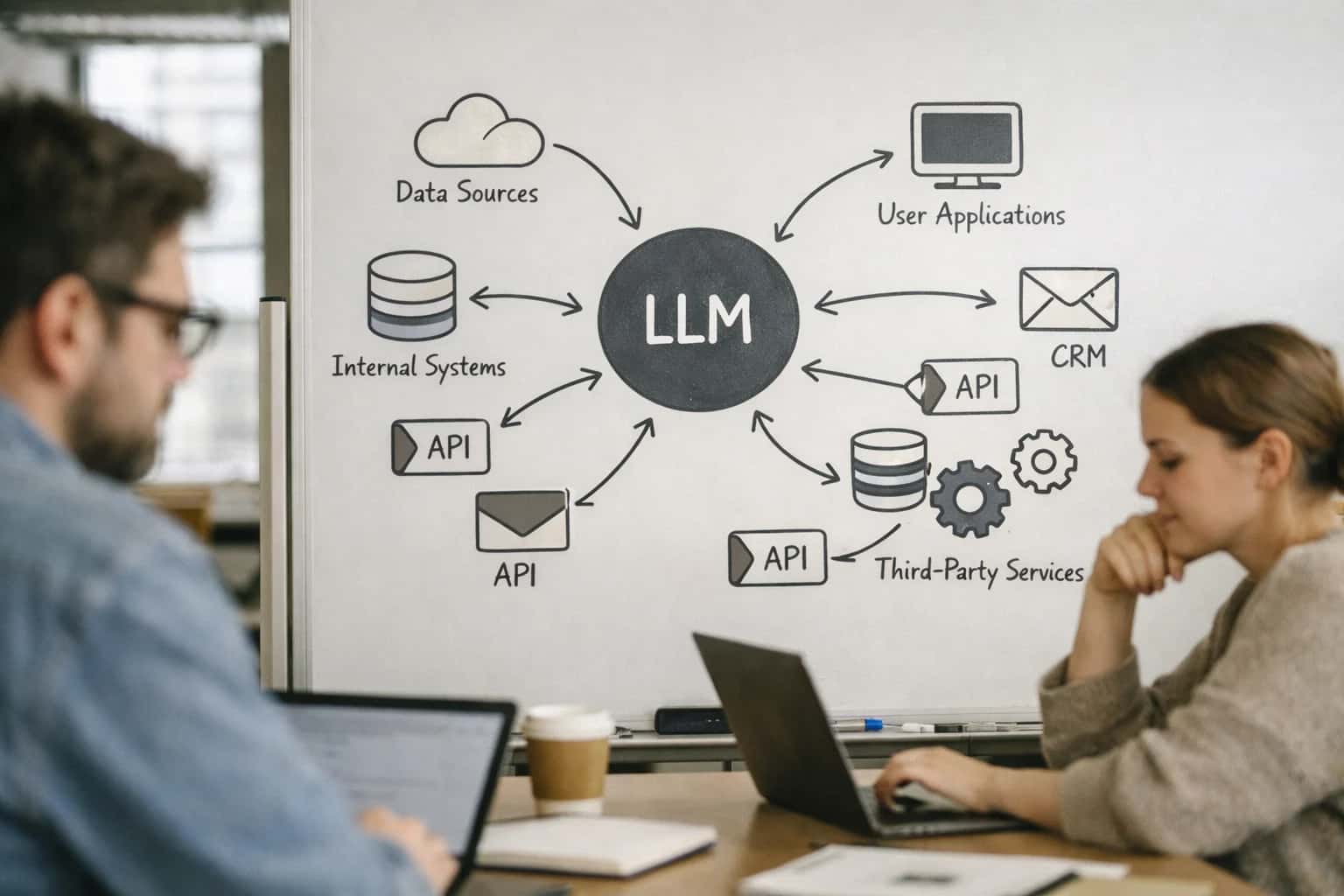
AI integration connects directly to Opcenter's core Nonconformance Report (NCR) data model, interfacing with the NC_HEADER, NC_ITEM, and NC_ACTION tables via Opcenter's OData or REST APIs. The primary integration surfaces are the NCR creation workflow, where AI can auto-classify defects from operator text or image uploads, and the disposition decision step, where AI provides scrap vs. rework cost analysis and supplier chargeback calculations by pulling real-time cost data from ERP. This allows quality engineers to move from manual data entry and lookup to reviewing and validating AI-generated insights within the same Opcenter user interface.

Integration
AI Integration with Siemens Opcenter for Nonconformance
A technical blueprint for embedding AI into Siemens Opcenter's nonconformance management module to automate defect classification, accelerate disposition decisions, and calculate supplier chargebacks.
ARCHITECTURE & ROLLOUT
Where AI Fits into Opcenter Nonconformance Management
Integrating AI into Siemens Opcenter's Nonconformance Management module transforms reactive quality workflows into proactive, data-driven operations.
A production implementation typically uses a microservice that subscribes to Opcenter's event framework (e.g., a new NCR status change) via a webhook. This service calls an AI model—often a fine-tuned LLM for text classification or a vision model for image-based defects—and posts structured results back to the NCR's custom fields or creates linked recommendation records. For governance, all AI suggestions are logged in Opcenter's audit trail with a confidence score, and a human-in-the-loop approval step is maintained for final disposition. Rollout is phased, starting with AI as an assistant that pre-fills fields, then gradually automating low-risk, high-confidence classifications for non-critical parts.
This integration matters because it directly attacks the latency in traditional quality loops. Instead of waiting days for an engineer to manually code a defect and research chargeback rules, AI provides a same-hour draft. This accelerates containment, improves cost recovery accuracy, and frees quality staff to focus on systemic root cause analysis rather than administrative triage. The architecture is designed to be additive, not disruptive, enhancing the existing Opcenter workflow your team already knows.
AI-READY WORKFLOW POINTS
Key Integration Surfaces in Opcenter's Nonconformance Module
Automating Initial Triage and Classification
The NCR creation surface is the primary entry point for quality events. AI integration here focuses on automating the initial data capture and classification to reduce manual entry and accelerate containment.
Key Integration Points:
- Inspection Data Feeds: Connect AI models to automated inspection systems (vision, gauges) or manual inspection data entry points. The AI can analyze images, measurements, or free-text operator notes to automatically generate a preliminary NCR with suggested defect codes.
- Defect Code Suggestion: Based on historical NCR data and natural language processing of the defect description, the AI can recommend the most probable defect codes from Opcenter's master data, improving consistency and reducing coding errors.
- Risk Scoring at Creation: At the moment an NCR is created, an AI model can instantly score its potential impact based on the product, customer, defect severity, and production volume, allowing for automatic prioritization in the quality queue.
SIEMENS OPCENTER QUALITY
High-Value AI Use Cases for Nonconformance
Integrate AI directly into Siemens Opcenter's Nonconformance Management module to automate manual classification, accelerate root cause analysis, and enforce consistent quality workflows. These use cases focus on augmenting the existing data model and user interfaces with intelligent agents.
01
Automated Defect Classification & Coding
AI analyzes free-text descriptions, images, or sensor data from the inspection point to automatically assign defect codes, categories, and severity within the Opcenter NC record. Reduces manual entry errors and standardizes reporting across shifts and plants.
Minutes vs. Hours
Classification time
02
Scrap vs. Rework Decision Support
An AI agent evaluates the NC record against historical data—including part cost, rework success rates, and customer requirements—to recommend a disposition (Use-As-Is, Rework, Scrap). Provides a data-driven rationale within the Opcenter workflow for quality engineer review.
Cost Avoidance
Primary impact
03
Supplier Chargeback Calculation & Drafting
For supplier-related nonconformances, AI cross-references the defect with PO terms, SLA penalties, and historical chargeback data to auto-calculate the financial impact and draft the chargeback notification. Integrates with Opcenter's supplier management data to trigger workflows.
Same-Day Processing
Workflow acceleration
04
Root Cause Suggestion Engine
Leverages RAG over past NCs, CAPAs, and process data to suggest probable root causes (4M/5-Why analysis) based on the current defect pattern. Presents ranked hypotheses with supporting evidence directly in the Opcenter investigation form, guiding engineers.
1 Sprint
Investigation cycle time
05
Containment Action Workflow Automation
Upon NC creation, AI evaluates the defect's risk and automatically triggers predefined containment workflows in Opcenter, such as placing related inventory on hold, notifying downstream operations, or generating inspection orders for suspect lots.
Batch -> Real-time
Containment trigger
06
Trend Analysis & Early Warning
Continuously monitors all NC records to detect emerging defect patterns, spatial clusters on the line, or supplier quality drifts before they exceed control limits. Generates proactive alerts and preliminary reports within Opcenter Intelligence dashboards.
Proactive vs. Reactive
Quality posture
SIEMENS OPCENTER
Example AI-Augmented Nonconformance Workflows
These concrete workflows illustrate how AI agents can be integrated into Siemens Opcenter's Nonconformance Management module to automate classification, accelerate analysis, and support critical decisions.
Trigger: An inspector logs a new nonconformance record in Opcenter, attaching images, sensor readings, or free-text descriptions.
AI Action:
- An AI agent, triggered via Opcenter's API or a configured webhook, extracts the unstructured data from the NC record.
- A vision or multi-modal model analyzes images for defect patterns (e.g., scratches, discoloration, misalignment).
- An NLP model parses the inspector's notes to extract key entities: defect type, location, severity.
- The agent cross-references this analysis against a historical database of classified NCs to find the closest match.
System Update: The agent automatically populates the Opcenter NC form with:
- Defect Code: Suggested from the standard taxonomy (e.g.,
SCRATCH-001). - Root Cause Category: Initial assignment (e.g.,
Operator Error,Tool Wear,Material Defect). - Priority: Calculated based on defect severity, part criticality, and production line data.
Human Review Point: The quality engineer reviews and confirms the AI-suggested classification, adjusting if necessary, before proceeding to containment.
NONCONFORMANCE WORKFLOW AUTOMATION
Implementation Architecture: Data Flow & System Design
A production-ready architecture for embedding AI into Siemens Opcenter's nonconformance management module, automating defect classification, decision support, and chargeback workflows.
The integration connects to Opcenter's Nonconformance Record (NCR) object via its REST or OData APIs, typically triggered by a new NCR creation event or a batch job scanning the Nonconformance table. Key data payloads include defect descriptions, images, part numbers, operation codes, supplier IDs, and inspection results. An AI service—hosted in your cloud or on-premises—processes this data to perform three core functions: automated defect coding against your internal defect taxonomy, scrap vs. rework recommendation based on historical cost and success rates, and supplier chargeback probability scoring by correlating the defect with supplier performance history and contractual terms.
The processed results are written back to designated custom fields in the NCR (e.g., AI_DefectCode, AI_DispositionRecommendation, AI_ChargebackScore) and can trigger Opcenter workflows. For example, a high-confidence scrap recommendation can auto-route the NCR to a finance approver, while a high chargeback score can trigger a draft supplier notification in the Supplier Quality module. The system maintains a full audit trail; all AI inferences are logged with confidence scores and model version IDs to a separate AI_Audit_Log table linked to the NCR for governance and model retraining.
Rollout follows a phased approach: start with a human-in-the-loop mode where AI suggestions are presented as recommendations to quality engineers within the Opcenter UI, requiring a manual accept/reject. This builds trust and generates labeled data for model improvement. Once validated, high-confidence classifications (e.g., >90% score) can be set to auto-apply, shifting engineers to exception handling. The architecture is designed for resilience, with graceful fallbacks to default routing if the AI service is unavailable, ensuring core Opcenter workflows are never blocked.
SIEMENS OPCENTER NONCONFORMANCE
Code & Payload Examples
Classify NCs from Operator Text
When an operator logs a nonconformance in Opcenter, the description is often free-text (e.g., "scratch on surface near weld", "dimension out of spec"). An AI agent can classify this into standardized defect codes, scrap/rework categories, and severity levels.
This Python example calls an LLM via an Inference Systems agent to analyze the text and return structured classification data, which is then posted back to Opcenter's NCR object via its REST API to populate the DefectCode and Disposition fields.
pythonimport requests from inference_systems import AgentClient # 1. Fetch new NCR from Opcenter API opcenter_api = "https://your-opcenter-instance/api/ncr/v1/records" ncr_response = requests.get(f"{opcenter_api}?status=New", auth=(USER, PASS)) ncr_data = ncr_response.json()[0] # 2. Extract operator description description = ncr_data.get('Description') part_number = ncr_data.get('PartNumber') # 3. Call AI Agent for classification agent = AgentClient(api_key=INFERENCE_API_KEY) classification_prompt = f""" Classify this manufacturing defect description for part {part_number}. Description: {description} Return JSON with: - defect_code: A standard code from our defect catalog (e.g., SURF-SCR, DIM-OOS). - disposition: 'Scrap', 'Rework', 'UseAsIs', or 'ReturnToSupplier'. - severity: 1 (Low) to 5 (Critical). - suggested_root_cause: A short, likely cause. """ classification = agent.complete(prompt=classification_prompt, format="json") # 4. Update the NCR in Opcenter update_payload = { "DefectCode": classification['defect_code'], "Disposition": classification['disposition'], "Severity": classification['severity'], "Notes": f"AI-suggested root cause: {classification['suggested_root_cause']}" } update_response = requests.patch( f"{opcenter_api}/{ncr_data['Id']}", json=update_payload, auth=(USER, PASS) )
AI-Enhanced Nonconformance Management in Siemens Opcenter
Realistic Time Savings & Operational Impact
This table illustrates the practical impact of integrating AI into Siemens Opcenter's Nonconformance Management module, focusing on measurable improvements in workflow speed, decision quality, and operational rigor.
| Workflow Stage | Before AI | After AI | Key Impact & Notes |
|---|---|---|---|
Initial Defect Classification & Coding | Manual entry from dropdowns; 5-15 minutes per NCR | AI suggests codes from defect description; 1-2 minutes per NCR | Reduces data entry errors and ensures consistent coding. Human review remains for final approval. |
Scrap vs. Rework Decision Support | Engineer reviews history and specs; 20-45 minute analysis | AI surfaces similar past NCRs, cost history, and success rates; 5-10 minute review | Provides data-driven recommendations, reducing costly rework attempts on non-viable parts. |
Root Cause Assignment | Brainstorming sessions and manual fishbone diagrams; 1-2 hours | AI clusters similar defects and suggests probable causes from past data; 20-30 minute focused review | Accelerates problem-solving by highlighting historical patterns and common failure points. |
Supplier Chargeback Calculation | Manual extraction of cost data from ERP and quality logs; 1-3 hours per incident | AI auto-aggregates material, labor, and downtime costs linked to supplier material lot; report generated in minutes | Ensures accurate, auditable chargebacks and improves recovery rates. Requires clean ERP/MES data linkage. |
Containment Action Triggering | Manual notification to floor supervisors and material handlers | AI automatically flags affected WIP and inventory in Opcenter, triggering electronic holds and alerts | Prevents defect propagation instantly, reducing potential scrap exposure. Actions are logged for audit. |
Corrective Action (CAPA) Drafting | Engineer writes from scratch, referencing past documents; 1-2 hours | AI drafts initial CAPA text using template and past successful actions for similar root causes; 30 minute review/edit | Standardizes documentation and leverages organizational knowledge, improving CAPA effectiveness. |
Trend Analysis & Reporting | Monthly manual report compilation; 4-8 hours per report | AI generates real-time dashboards on defect Pareto, top suppliers, and cost trends; on-demand reporting | Shifts focus from data gathering to analysis and proactive quality improvement. |
PRODUCTION-GRADE IMPLEMENTATION
Governance, Security, and Phased Rollout
Integrating AI into Siemens Opcenter's nonconformance management requires a controlled, secure approach that aligns with manufacturing compliance and IT policies.
AI integration touches critical data objects within Opcenter's Nonconformance Management (NCM) module, including NCR records, Defect codes, Disposition decisions, and linked Supplier and Material master data. The implementation architecture typically uses Opcenter's OData APIs or RESTful web services to create a secure, event-driven layer. AI models are deployed in a private cloud or on-premises container, with inference calls triggered by new NCR creation or status change events. All AI-generated suggestions—such as defect coding, scrap/rework recommendations, or chargeback calculations—are written back to Opcenter as proposed values in dedicated custom fields, never directly updating core records without human review. This creates a clear audit trail within Opcenter's native history tracking.
A phased rollout is critical for user adoption and risk management. Start with a pilot workflow, such as automating defect code suggestions for a single high-volume product line or specific work center. This limits scope, allows for accuracy benchmarking against historical human decisions, and builds trust with quality engineers. The next phase expands to disposition decision support, where the AI analyzes similar past NCRs, material cost, and rework capacity to recommend scrap, rework, or use-as-is. The final phase integrates supplier chargeback logic, correlating defect patterns with supplier performance data to suggest financial impact. Each phase includes a human-in-the-loop approval step within the Opcenter user interface, ensuring quality engineers retain final authority while productivity gains are realized.
Governance is enforced through role-based access control (RBAC) in Opcenter to determine which users can see and accept AI suggestions. All AI interactions are logged in a separate audit database, capturing the input data, model version, output, and final user action for traceability and model retraining. For regulated industries, the AI service is designed as a decision support tool, not an autonomous system, maintaining compliance with frameworks like FDA 21 CFR Part 11 or ISO 13485. Regular model performance reviews are scheduled, using Opcenter's historical NCR data to monitor accuracy drift and retrain models on newly closed cases, creating a continuous improvement loop directly tied to manufacturing quality outcomes.
Enabling Efficiency, Speed & Accuracy
Intelligent Analysis, Decision & Execution
We build AI systems for teams that need search across company data, workflow automation across tools, or AI features inside products and internal software.
Talk to Us
Search across company data
Give teams answers from docs, tickets, runbooks, and product data with sources and permissions.
Useful when people spend too long searching or get different answers from different systems.
Enterprise searchRAGPermissions
Read more
Automate internal workflows
Use AI to route work, draft outputs, trigger actions, and keep approvals and logs in place.
Useful when repetitive work moves across multiple tools and teams.
AI agentsWorkflow automationGovernance
Read more
Add AI to products and internal tools
Build assistants, guided actions, or decision support into the software your team or customers already use.
Useful when AI needs to be part of the product, not a separate tool.
AI integrationDecision supportModel routing
Read moreIMPLEMENTATION AND WORKFLOW DETAILS
Frequently Asked Questions
Common technical and operational questions about integrating AI agents and models into Siemens Opcenter's Nonconformance Management module to automate defect analysis, decision support, and chargeback workflows.
This workflow uses AI to interpret free-text defect descriptions and images from operators, then maps them to standardized nonconformance codes.
- Trigger: A shop floor operator creates a new Nonconformance Report (NCR) in Opcenter, entering a text description and optionally attaching images.
- Context Pulled: The AI agent receives the NCR payload via a webhook or listens to the Opcenter database. It extracts the unstructured description, any image file references, and context like the work center and part number.
- Model Action: A multi-modal LLM (e.g., GPT-4V) analyzes the text and images. It is prompted with your internal defect code taxonomy and historical mapping examples to classify the defect (e.g.,
SCRATCH,DIMENSIONAL,WELD_POROSITY). - System Update: The agent calls the Opcenter API (typically OData) to update the NCR record, populating the
DefectCode,Severity, andCategoryfields with the AI-suggested values. - Human Review Point: The system flags the record for a quality engineer's review. The UI displays both the operator's original entry and the AI-suggested coding, allowing for one-click acceptance or override. This creates a feedback loop to improve the model.

About the author
Prasad Kumkar
CEO & MD, Inference Systems
Prasad Kumkar is the CEO & MD of Inference Systems and writes about AI systems architecture, LLM infrastructure, model serving, evaluation, and production deployment. Over 5+ years, he has worked across computer vision models, L5 autonomous vehicle systems, and LLM research, with a focus on taking complex AI ideas into real-world engineering systems.
His work and writing cover AI systems, large language models, AI agents, multimodal systems, autonomous systems, inference optimization, RAG, evaluation, and production AI engineering.
LinkedIn
Limited slotsGet a Free AI Consultation
Partnered with leading AI, data, and software stack.





How We Work
Custom AI workflows for your Business
One-fit-all AI don't work for modern businesses. At Inferensys, we aim to understand your business & custom requirements; which we use to define most efficient agentic workflows, the data, and the tools for your business.
01
Review the use case
We understand the task, the users, and where AI can actually help.
Read more02
Pick the right approach
We define what needs search, automation, or product integration.
Read more03
Build the first useful version
We implement the part that proves the value first.
Read more04
Improve from there
We add the checks and visibility needed to keep it useful.
Read moreThe first call is a practical review of your use case and the right next step.
Talk to Us