AI connects to SAP DM's maintenance workflows through its OData APIs and event-driven architecture. Key integration surfaces include the Maintenance Order (IW31/IW32) objects, Notification (IW21) creation, and Equipment (IE01) master data. By layering AI on top of SAP DM's real-time production and sensor data, you can trigger predictive notifications, optimize spare parts reservations, and personalize maintenance procedures based on equipment history and current operating context.

Integration
AI Integration for SAP Digital Manufacturing for Maintenance
Add AI-driven predictive maintenance to SAP Digital Manufacturing. Automate work order generation, recommend spare parts, and analyze maintenance history to trigger SAP Plant Maintenance (PM) notifications.
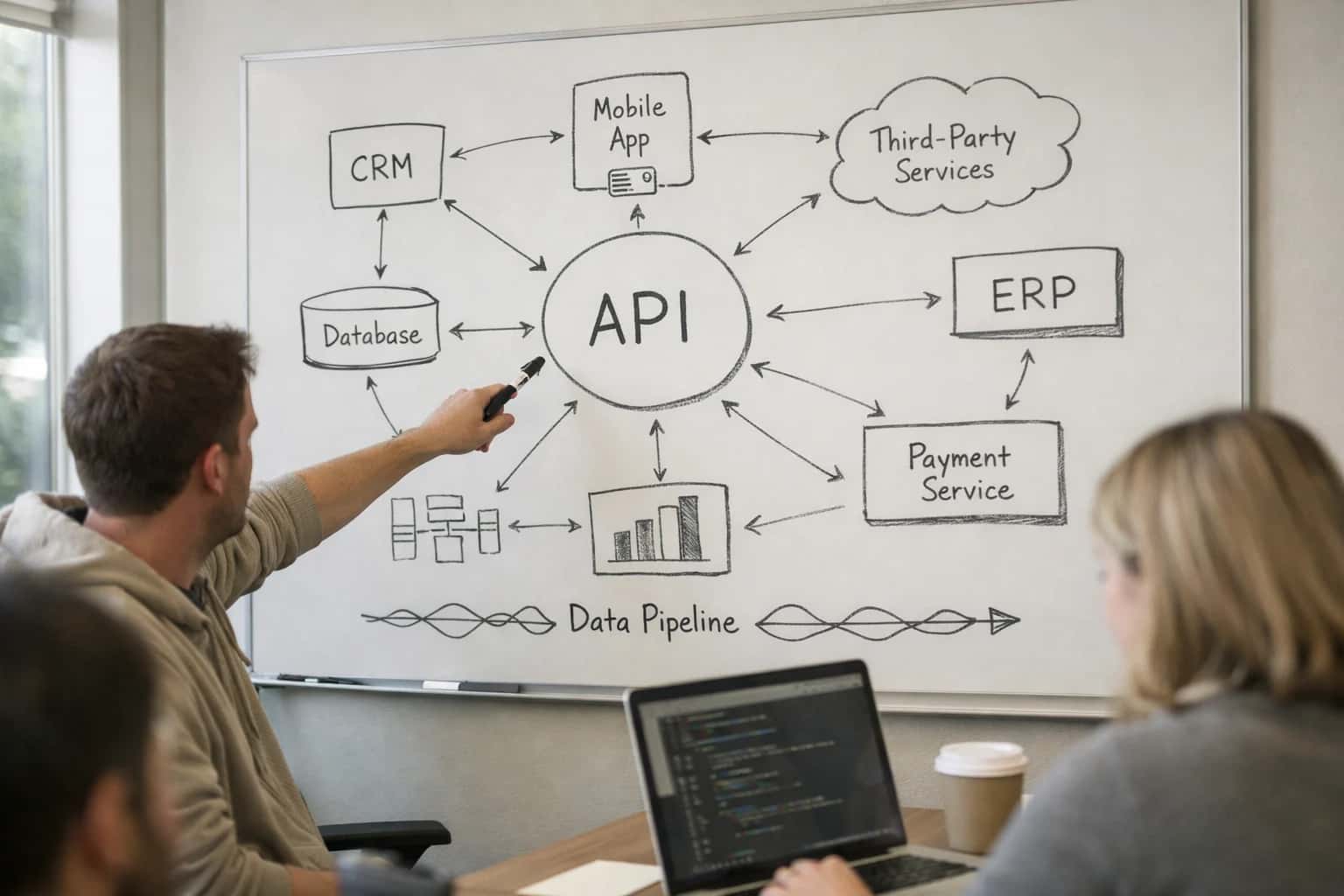
ARCHITECTURE & ROLLOUT
Where AI Fits in SAP DM for Maintenance
Integrating AI into SAP Digital Manufacturing for Maintenance transforms reactive work orders into predictive, data-driven operations.
A typical implementation involves an AI inference service subscribed to SAP DM's Manufacturing Event Bus. This service processes streaming data from connected machines and historical maintenance records to predict failures. When a threshold is crossed, it automatically creates a Maintenance Notification via API, pre-populates it with probable cause and required parts, and can even suggest an optimal schedule by checking the Production Order calendar and technician skill sets in SAP DM. This reduces mean time to repair (MTTR) by providing context before the technician arrives.
Rollout requires a phased approach, starting with a single, high-criticality asset line. Governance is critical: all AI-generated notifications should be flagged for human review and approval before automatic creation, and a feedback loop must be established where technician close-out notes in SAP DM are used to retrain the model. This ensures the AI system learns from real-world outcomes and aligns with existing SAP Plant Maintenance (PM) change management and audit trail requirements. For a deeper dive into connecting AI models to industrial data streams, see our guide on [/integrations/manufacturing-execution-platforms/ai-integration-with-ignition-for-iiot](AI Integration with Ignition for IIoT).
WHERE AI CONNECTS TO SAP DM'S MAINTENANCE DATA MODEL
Key Integration Surfaces in SAP Digital Manufacturing for Maintenance
SAP PM Notifications and Work Orders
AI integration surfaces directly with SAP Plant Maintenance (PM) notification and order objects. This is the primary trigger point for predictive maintenance workflows.
Key Integration Points:
- Notification Creation (IW21/IW22): AI models analyze real-time equipment sensor data from SAP DM's production layer to predict failures and automatically create maintenance notifications (
QMNUM). These notifications include predicted fault codes, recommended priority, and suggested components. - Work Order Generation (IW31/IW32): Based on the notification, AI assists in converting it to a detailed work order (
AUFNR). It can suggest:- Standard task lists (
PLNFL) - Required spare parts from the bill-of-material (BOM)
- Estimated duration based on historical completion times
- Optimal technician skill group for assignment
- Standard task lists (
Implementation Pattern: AI services listen to SAP DM's OData events for equipment status changes, run inference, and post back to the SAP PM API to create notifications with enriched context, reducing manual diagnosis from hours to minutes.
SAP DIGITAL MANUFACTURING
High-Value AI Use Cases for Maintenance
Integrate AI directly into SAP Digital Manufacturing's maintenance workflows to move from reactive to predictive and prescriptive operations. These use cases leverage SAP's PM notifications, equipment master data, and maintenance order APIs to deliver actionable intelligence.
01
Predictive Work Order Generation
AI models analyze real-time sensor data from connected equipment and historical failure patterns to predict asset degradation. When a threshold is crossed, the system automatically creates a preventive maintenance notification in SAP PM, complete with suggested priority, required skill set, and estimated duration, converting unplanned downtime into scheduled work.
Reactive → Predictive
Workflow shift
02
Intelligent Spare Parts Recommendation
For each generated maintenance order, an AI agent cross-references the equipment BOM, failure mode, and real-time spare parts inventory levels from SAP EWM/MM. It recommends the optimal part numbers and quantities, checks availability, and can trigger automated reservation or purchase requisitions, reducing parts-related delays.
Same-day parts readiness
Typical outcome
03
Maintenance History Analysis & Root Cause
An AI copilot embedded in the technician's mobile or Fiori interface analyzes past maintenance orders, work reports, and associated sensor data for the same asset. It surfaces recurring failure patterns and suggests the most probable root cause, helping technicians address underlying issues rather than symptoms.
1 sprint
Implementation timeline
04
Automated Maintenance Procedure Drafting
When a new failure mode is identified, AI uses the equipment technical object data, past work order texts, and a library of standard maintenance operations to draft a detailed, step-by-step maintenance task list. This draft is routed for engineer review and approval before becoming a standard job plan in SAP, accelerating knowledge capture.
05
Dynamic Maintenance Scheduling Optimization
AI evaluates a queue of SAP maintenance orders against real-time constraints: technician skills/certifications (from SAP HR), tool availability, production schedule impact (from SAP DM detailed scheduling), and parts readiness. It recommends a priority-sequenced dispatch list to the planner, maximizing wrench-on time and minimizing production disruption.
Hours → Minutes
Rescheduling time
06
Post-Maintenance Feedback & Model Retraining
After order completion, the system compares the AI's initial prediction (failure mode, parts, duration) with the as-executed data from the technician's confirmation. Discrepancies are logged and used to automatically retrain and improve the underlying models, creating a closed-loop learning system that increases accuracy over time.
IMPLEMENTATION PATTERNS
Example AI-Enhanced Maintenance Workflows
These workflows illustrate how AI agents can be integrated into SAP Digital Manufacturing for Maintenance (DMfM) to move from reactive to predictive and prescriptive operations. Each pattern connects real-time sensor data, historical maintenance records, and SAP's Plant Maintenance (PM) module to automate decision-making and reduce unplanned downtime.
Trigger: Anomaly detection model flags a deviation in vibration or temperature sensor data from a critical asset (e.g., CNC spindle).
Context Pulled:
- Real-time sensor stream via SAP DMfM's IIoT connectivity.
- Asset master data (SAP PM
EQUI), including maintenance strategy and last service date. - Historical work order (
AUFM) and notification (QMEL) data for similar failure patterns.
Agent Action:
- The AI agent correlates the sensor anomaly with known failure modes using a vector search of maintenance history.
- It calculates a Remaining Useful Life (RUL) estimate and risk score.
- If the risk exceeds a configured threshold, the agent drafts a maintenance notification.
System Update:
- The agent calls the SAP OData API for Plant Maintenance (
/sap/opu/odata/sap/API_MAINTNOTIFICATION) to create a preliminary notification (QMEL). - The notification is pre-populated with:
- Probable cause code.
- Suggested priority based on RUL and production schedule impact.
- Links to relevant sensor trend charts.
- The notification triggers a standard SAP workflow for planner review and conversion to a work order (
AUFM).
Human Review Point: The maintenance planner reviews the AI-generated notification, validates the evidence, and approves conversion to a work order, adjusting parts or labor estimates as needed.
PREDICTIVE MAINTENANCE & WORK ORDER AUTOMATION
Implementation Architecture & Data Flow
A practical blueprint for integrating AI agents with SAP Digital Manufacturing to automate maintenance workflows, from sensor data to SAP PM notifications.
The integration architecture connects real-time equipment sensor data, historical maintenance records from SAP PM (EQUI, IFLO, AUFK), and spare parts inventory (MARA, MARD) to an AI inference layer. This layer typically ingests streaming IIoT data via SAP DM's OData APIs or a message queue (e.g., Kafka, SAP Event Mesh). AI models analyze this fused data stream to predict failures, recommend specific spare parts by material number, and generate a structured payload for a new maintenance notification or order.
A high-value workflow automates the creation of a maintenance notification (QMEL). The AI agent, upon detecting a predicted failure pattern, calls the SAP BAPI BAPI_ALM_NOTIF_CREATE or triggers a pre-built SAP DM service. The payload includes the functional location (TPLNR), damage text generated by the LLM, proposed priority, and a list of recommended spare parts with quantities. For complex repairs, the system can retrieve and attach relevant historical maintenance documents (DRAD) or safety instructions to the notification, creating a richer work package for the planner.
Governance is critical. All AI-generated recommendations should route through an approval step in SAP DM's workflow engine or a custom human-in-the-loop dashboard before final creation in SAP PM. This allows a maintenance planner to review, adjust, and approve the AI's suggestion, ensuring accountability. Each prediction and its outcome are logged back to a dedicated audit table, creating a feedback loop to retrain models and improve accuracy over time. Rollout typically starts with a single, high-cost asset line to prove ROI before scaling to the entire plant floor.
SAP DIGITAL MANUFACTURING FOR MAINTENANCE
Code & Payload Examples
Triggering SAP PM Notifications from AI
Integrate AI models that analyze real-time sensor data and maintenance history to predict failures. When a high-probability event is detected, the system should create a maintenance notification in SAP Plant Maintenance (PM) via its OData API. This preempts reactive breakdowns.
Example JSON Payload for Notification Creation:
jsonPOST /sap/opu/odata/sap/API_MAINTNOTIFICATION_SRV/NotificationHeaders { "NotificationType": "M1", "NotificationText": "AI-Predicted Bearing Wear - Machine 101-Press", "Equipment": "EQ-101-PRESS-01", "FunctionalLocation": "FL-ASSEMBLY-LINE-1", "Priority": "1", "MaintNotificationLongText": { "results": [ { "Language": "EN", "FormattedText": "<p>AI model 'BearingHealth_V2' predicts 92% probability of failure within 72 hours based on vibration trend (RMS increased 45% over 8 hours). Last maintenance: 2024-01-15. Recommended action: Inspect and replace bearing assembly B-101A.</p>" } ] } }
This payload creates a structured notification with a detailed long text containing the AI's reasoning, probability, and recommendation, giving maintenance planners actionable context.
AI-ENHANCED MAINTENANCE OPERATIONS
Realistic Time Savings & Operational Impact
This table illustrates the practical impact of integrating AI agents with SAP Digital Manufacturing for Maintenance, focusing on key preventive and corrective workflows. Metrics are based on typical implementations for discrete and process manufacturers.
| Maintenance Workflow | Before AI Integration | After AI Integration | Implementation Notes |
|---|---|---|---|
Work Order Generation | Scheduled or manual trigger | Predictive trigger from equipment patterns | AI analyzes sensor & historical data to create notifications in SAP PM, reducing unplanned downtime. |
Spare Parts Recommendation | Manual lookup in SAP MM | AI-suggested kits with availability check | Model cross-references BOM, failure history, and inventory to reduce parts search time. |
Maintenance History Analysis | Manual report review for root cause | Automated trend & correlation reports | AI clusters similar failures and suggests recurring issues for engineering review. |
Priority & Technician Assignment | Dispatcher judgment based on severity | AI-assisted routing with skill matching | Considers location, certification, and current workload; human dispatcher approves. |
Procedure & Documentation Retrieval | Search across multiple systems | Contextual SOPs & manuals surfaced | AI fetches relevant documents from SAP DMS/connected systems based on work order type. |
Downtime Event Logging & Categorization | Manual entry post-event | Automated draft from Andon/PLC data | AI populates duration, reason codes, and affected equipment; operator confirms. |
Maintenance Schedule Optimization | Fixed calendar-based intervals | Dynamic intervals based on actual usage | AI adjusts PM plans in SAP based on runtime, conditions, and predicted wear, optimizing labor. |
IMPLEMENTING AI IN A REGULATED ENVIRONMENT
Governance, Security & Phased Rollout
Integrating AI into SAP Digital Manufacturing for Maintenance requires a controlled approach that prioritizes data integrity, user trust, and operational stability.
A production-ready architecture for AI in SAP DM for Maintenance typically layers AI services—like predictive failure models or parts recommendation engines—as a separate middleware tier. This tier consumes real-time equipment sensor data and historical maintenance records via SAP DM's OData APIs and event-driven architecture, then posts AI-generated insights—such as a predicted failure probability or a suggested spare part list—back into SAP Plant Maintenance (PM) notifications or maintenance order requests. This separation ensures the core MES logic remains untouched, AI models can be versioned and monitored independently, and all AI-triggered actions are logged as discrete transactions within SAP's audit trail.
Rollout follows a phased, risk-based path. Phase 1 focuses on a single, non-critical asset class and a passive use case, such as AI generating daily equipment health scores visible in a dashboard without auto-creating work orders. Phase 2 introduces semi-automation, where the system suggests maintenance tasks and spare parts within a new notification in SAP PM, requiring planner review and manual approval before order creation. Phase 3, after validation and user acceptance, enables conditional automation for high-confidence predictions, allowing the AI to automatically generate low-risk, routine preventive maintenance orders while still escalating anomalous predictions for human review. Governance is enforced through role-based access controls (RBAC) in the AI layer, ensuring only authorized planners or engineers can modify model thresholds or approve automated actions, with all inputs and outputs logged for traceability back to the original equipment and sensor data.
Security is paramount, especially when integrating with SAP's master data. All data exchanges between SAP DM and the AI service should be encrypted in transit, and the AI service should operate under a dedicated, least-privilege service account within your SAP landscape. Sensitive data, such as equipment IDs and maintenance histories, should be anonymized or pseudonymized before being used for model training outside the SAP boundary. A continuous monitoring plan tracks key metrics like model accuracy (precision/recall for failure predictions), user override rates on AI suggestions, and the business impact on mean time to repair (MTTR) and spare parts inventory turnover. This measured, governed approach de-risks the integration, builds operational confidence, and ensures the AI augments—rather than disrupts—your mission-critical maintenance workflows.
Enabling Efficiency, Speed & Accuracy
Intelligent Analysis, Decision & Execution
We build AI systems for teams that need search across company data, workflow automation across tools, or AI features inside products and internal software.
Talk to Us
Search across company data
Give teams answers from docs, tickets, runbooks, and product data with sources and permissions.
Useful when people spend too long searching or get different answers from different systems.
Enterprise searchRAGPermissions
Read more
Automate internal workflows
Use AI to route work, draft outputs, trigger actions, and keep approvals and logs in place.
Useful when repetitive work moves across multiple tools and teams.
AI agentsWorkflow automationGovernance
Read more
Add AI to products and internal tools
Build assistants, guided actions, or decision support into the software your team or customers already use.
Useful when AI needs to be part of the product, not a separate tool.
AI integrationDecision supportModel routing
Read moreAI INTEGRATION FOR SAP DIGITAL MANAGURING FOR MAINTENANCE
Frequently Asked Questions
Practical questions on implementing AI for predictive maintenance, work order automation, and parts optimization within SAP Digital Manufacturing Cloud.
This workflow uses real-time equipment data and AI inference to create proactive maintenance notifications.
-
Trigger: An AI model monitoring IIoT sensor streams (vibration, temperature, pressure) from equipment connected via SAP DM's OData APIs detects an anomaly pattern indicating impending failure.
-
Context/Data Pulled: The agent pulls the equipment master record (
EQUI), maintenance plan (IP03), and recent notification history (QMEL) from SAP S/4HANA via theMaintenanceOrderAPI to assess criticality and warranty status. -
Model/Agent Action: A multi-step agent:
- Classifies the failure mode (e.g.,
bearing_wear,motor_overheat). - Estimates time-to-failure and recommended priority.
- Queries the SAP Material Master (
MARAV) for recommended spare parts and checks availability in the plant's storage location.
- Classifies the failure mode (e.g.,
-
System Update: The agent calls the SAP Cloud Integration (CPI) service to create a Maintenance Notification (
Notification.Create) in SAP Plant Maintenance (PM). The payload includes:json{ "Equipment": "EQ-100234", "NotificationType": "M1", "ShortText": "AI-Predicted Bearing Wear - Motor M-45", "Priority": "1", "PartCause": "BEARING_FAILURE", "LongText": "Vibration analysis indicates classic inner race defect. Time-to-failure estimate: 7-10 days. Recommended parts: BEARING-678 (Stock: 5)." } -
Human Review Point: The created notification is routed to the maintenance planner's SAP Fiori inbox. The AI's confidence score and reasoning are attached for review before converting to a work order.

About the author
Prasad Kumkar
CEO & MD, Inference Systems
Prasad Kumkar is the CEO & MD of Inference Systems and writes about AI systems architecture, LLM infrastructure, model serving, evaluation, and production deployment. Over 5+ years, he has worked across computer vision models, L5 autonomous vehicle systems, and LLM research, with a focus on taking complex AI ideas into real-world engineering systems.
His work and writing cover AI systems, large language models, AI agents, multimodal systems, autonomous systems, inference optimization, RAG, evaluation, and production AI engineering.
LinkedIn
Limited slotsGet a Free AI Consultation
Partnered with leading AI, data, and software stack.





How We Work
Custom AI workflows for your Business
One-fit-all AI don't work for modern businesses. At Inferensys, we aim to understand your business & custom requirements; which we use to define most efficient agentic workflows, the data, and the tools for your business.
01
Review the use case
We understand the task, the users, and where AI can actually help.
Read more02
Pick the right approach
We define what needs search, automation, or product integration.
Read more03
Build the first useful version
We implement the part that proves the value first.
Read more04
Improve from there
We add the checks and visibility needed to keep it useful.
Read moreThe first call is a practical review of your use case and the right next step.
Talk to Us