AI integration targets LabVantage's Process Automation Manager (PAM), Workflow Designer, and underlying business rule engines to inject intelligence into sample and resource routing. This means embedding AI decision points that can analyze real-time data—like instrument status, technician availability, and incoming sample priority—to dynamically generate and adjust worklists. Instead of a fixed sequence, the system can predict bottlenecks (e.g., an HPLC queue building up) and re-route samples to alternative instruments or shifts, optimizing throughput for process engineers and lab supervisors.

Integration
AI Integration with LabVantage Process Automation
Enhance LabVantage's orchestration layer with AI to optimize worklist generation, predict instrument throughput bottlenecks, and automate follow-up testing based on initial results for process engineers.
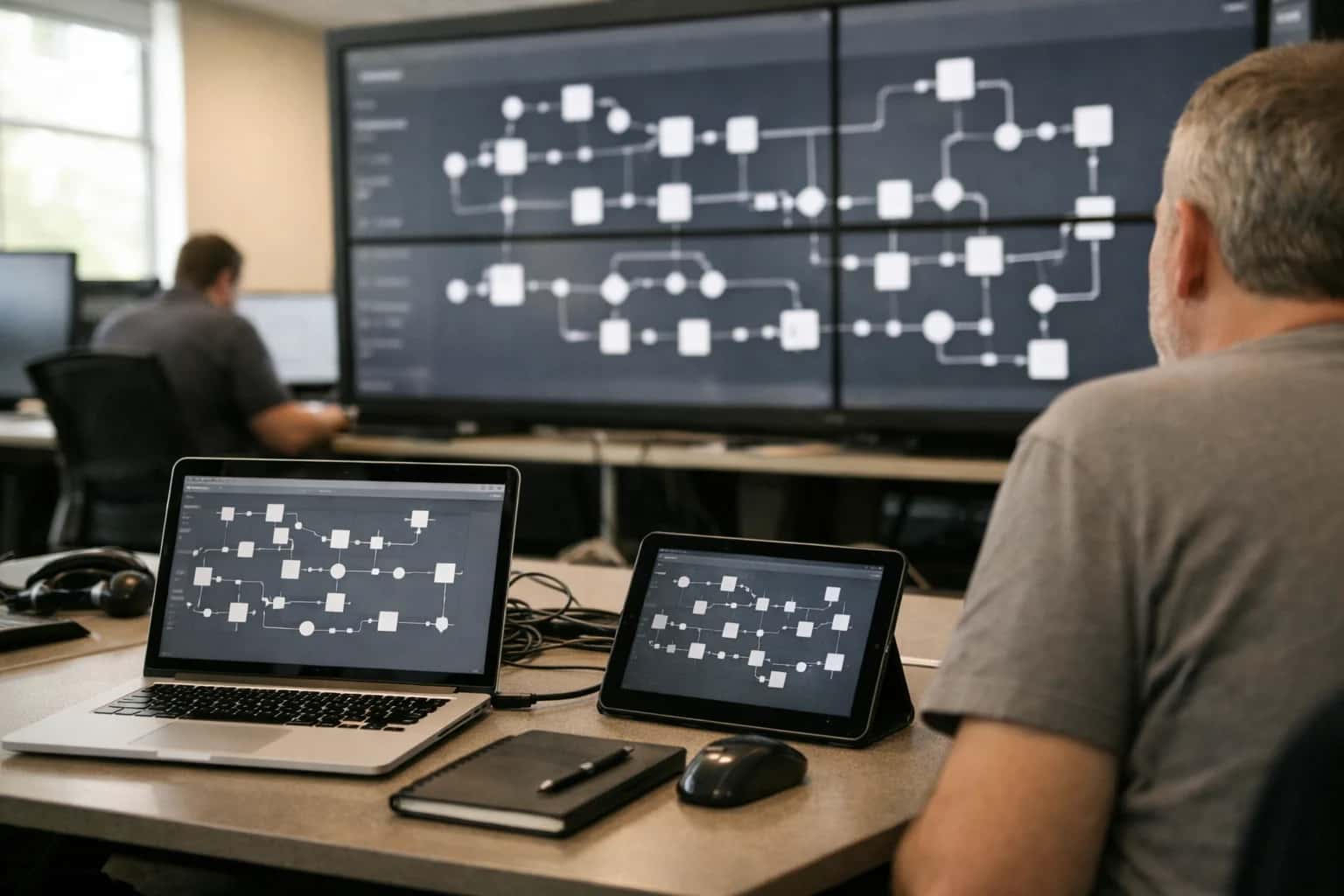
ARCHITECTING INTELLIGENT ORCHESTRATION
Where AI Fits into LabVantage Process Automation
Integrating AI into LabVantage's orchestration layer transforms static workflows into dynamic, predictive processes.
Implementation typically involves deploying lightweight AI agents that subscribe to LabVantage events via its REST API or messaging queues. These agents evaluate conditions and return optimized instructions—such as a revised worklist or a follow-up test recommendation—back into the automation layer. For example, after an initial out-of-spec (OOS) result is posted, an agent can automatically review historical data and SOP rules to recommend and trigger confirmatory testing, drafting the required deviation record in the background. This moves corrective workflows from hours to minutes while maintaining a full audit trail.
Rollout requires a phased approach, starting with a single, high-volume workflow like stability sample pull-and-test scheduling or raw material intake routing. Governance is critical; all AI-suggested actions should pass through a human-in-the-loop approval step or a supervisor dashboard before execution in GxP environments. By augmenting, not replacing, LabVantage's core automation, we ensure reliability and compliance while delivering tangible gains in lab efficiency and data-driven decision-making.
PROCESS AUTOMATION
Key Integration Surfaces in LabVantage
Dynamic Worklist Generation
The core of LabVantage's process automation is its worklist engine, which sequences tasks for technicians and instruments. AI integration here focuses on optimizing this sequencing in real-time.
AI Enhancement Points:
- Priority Recalculation: Ingest real-time data (e.g., instrument downtime, technician availability, client SLA changes) to dynamically re-prioritize the work queue.
- Load Balancing: Predict instrument throughput bottlenecks (e.g., HPLC column degradation, spectrometer calibration drift) and redistribute samples to underutilized assets.
- Predictive Scheduling: Use historical run-time data to forecast completion times more accurately, enabling proactive client communication and capacity planning.
Integrating AI at this layer transforms static, rule-based schedules into adaptive systems that maximize lab throughput and resource utilization.
LABVANTAGE PROCESS AUTOMATION
High-Value AI Use Cases for Process Automation
Enhance LabVantage's orchestration layer with AI to optimize worklist generation, predict instrument throughput bottlenecks, and automate follow-up testing based on initial results for process engineers and lab supervisors.
01
Intelligent Worklist Generation
AI analyzes sample priority, test method duration, technician skill sets, and real-time instrument status to generate dynamically optimized worklists. This moves beyond static scheduling to adapt to daily disruptions, reducing idle time and improving lab throughput.
Hours -> Minutes
Daily scheduling
02
Instrument Bottleneck Prediction
Models ingest historical run times, maintenance logs, and current queue lengths to forecast instrument capacity constraints. The system alerts process engineers to potential delays hours in advance, enabling proactive load balancing or re-routing to prevent workflow stoppages.
Proactive Alerts
Before delays occur
03
Conditional Test Triggering
Integrates AI decision points into the process automation flow. Based on real-time analysis of initial results, the system can automatically trigger follow-up tests (e.g., additional purity assays), re-runs, or hold samples for review, enforcing SOP logic without manual intervention.
Batch -> Real-time
Decision automation
04
Dynamic Resource Allocation
AI monitors the progress of automated workflows across instruments and stations, predicting resource shortages (reagents, consumables, analyst time). It generates smart reorder triggers and alerts for lab managers, integrated with inventory modules to maintain continuous operation.
Same-day
Shortage prevention
05
Exception Handling & Re-routing
When a process step fails (e.g., instrument error, QC check failure), AI evaluates the exception against predefined rules and historical data to suggest or execute automatic re-routing. It can reassign samples to alternate instruments or flag them for technician review, minimizing manual triage.
Reduce Manual Triage
For failed steps
06
Throughput Simulation & Planning
For lab supervisors planning large batches or new studies, AI uses historical process data to simulate different scheduling scenarios. It models the impact of adding instruments, changing shift patterns, or introducing new test methods, providing data-driven capacity planning insights.
1 sprint
Capacity planning cycle
FOR PROCESS ENGINEERS AND LAB SUPERVISORS
Example AI-Enhanced Workflows
These workflows illustrate how AI agents can be integrated into LabVantage's orchestration layer to automate decision-making, predict bottlenecks, and optimize laboratory throughput. Each flow is triggered by a system event, uses contextual data from the LIMS, and results in a system update or alert.
Trigger: A batch of new samples is logged into LabVantage with associated test methods and priority flags.
Context Pulled: The AI agent queries LabVantage for:
- Real-time technician availability and current workload.
- Instrument status and calibration due dates for required test methods.
- Historical throughput times for each test-technician-instrument combination.
- Sample stability requirements and hold times.
Agent Action: A multi-step reasoning model evaluates all constraints and optimizes for:
- Minimizing total turnaround time.
- Balancing workload across technicians.
- Prioritizing time-sensitive samples.
- Avoiding instruments nearing calibration.
System Update: The agent calls the LabVantage Process Automation API to:
- Generate and publish optimized worklists to individual technician dashboards.
- Reserve instrument time slots.
- Update sample status to 'Scheduled'.
Human Review Point: The lab supervisor receives a summary of the proposed schedule and can override assignments before finalization via a one-click approval in the LabVantage interface.
AI-ENHANCED PROCESS ORCHESTRATION
Implementation Architecture & Data Flow
A practical architecture for integrating AI decision-making into LabVantage's automation layer to optimize lab throughput and testing workflows.
The integration connects AI agents directly to LabVantage's Process Automation engine via its REST API and event webhooks. Key data objects include Worklists, Instrument Queues, Test Results, and Process Step records. The AI service acts as a middleware orchestrator, subscribing to events like worklist.completed or result.validated. It then applies predictive models to analyze historical throughput, current instrument status, and pending sample priorities to generate optimized recommendations. These are pushed back into LabVantage as suggested actions—such as dynamic worklist reprioritization or follow-up test triggers—for final approval by a process engineer within the console.
A typical workflow for predictive bottleneck detection involves: 1) The AI service ingests a real-time feed of instrument utilization and queue lengths from LabVantage. 2) A time-series model forecasts capacity shortfalls for the next 8-12 hours based on scheduled tests and maintenance windows. 3) The system generates an alert with a recommended mitigation (e.g., re-route 10 HPLC samples to Instrument B-02) and creates a draft Process Change record in LabVantage for review. This shifts bottleneck identification from periodic manual checks to a continuous, system-guided process.
Rollout is phased, starting with a single, high-volume instrument group. Governance is critical: all AI-suggested actions are logged in LabVantage's audit trail with a source: AI_Orchestrator tag and require a configurable approval step (either human or rule-based) before execution. This ensures the process engineer retains control while gaining an intelligent copilot. The architecture is deployed as a containerized service outside the LIMS, communicating over secure, authenticated APIs to maintain system integrity and simplify updates independent of the core LabVantage upgrade cycle.
AI-ENHANCED ORCHESTRATION
Code & Payload Examples
Optimizing Daily Run Lists with AI
AI can analyze pending samples, instrument status, and technician availability to generate an optimized worklist. This involves querying LabVantage's Process Automation API for pending tasks, applying constraints (due dates, instrument calibration), and returning a prioritized sequence.
A common pattern is to use a Python service that calls the LabVantage REST API, runs an optimization model, and posts the suggested schedule back as a worklist record. The AI model considers:
- Sample Priority: Client-defined urgency and stability timelines.
- Resource Constraints: Instrument throughput, technician skill sets, and reagent availability.
- Batch Logic: Grouping samples that use the same method or instrument to minimize changeover.
The output is a structured worklist that LabVantage's scheduler can execute, reducing manual planning from hours to minutes for lab supervisors.
AI-ENHANCED PROCESS AUTOMATION
Realistic Operational Impact & Time Savings
How AI integration transforms key LabVantage Process Automation workflows, showing realistic time savings and operational improvements for process engineers and lab supervisors.
| Workflow / Metric | Before AI | After AI | Implementation Notes |
|---|---|---|---|
Worklist Generation & Scheduling | Manual load balancing across 4-6 hours | AI-optimized assignments in 15-30 minutes | Considers instrument capacity, technician skill, and priority |
Follow-up Test Triggering | Manual review of results; next-day decisions | Automated conditional triggers within the same run | Rules-based on initial results and SOP logic |
Throughput Bottleneck Prediction | Reactive identification after delays occur | Proactive alerts 1-2 days prior based on trend analysis | Models instrument utilization and sample backlog |
Exception Handling & Re-routing | Manual investigation and re-assignment (2-3 hours) | Automated triage and re-routing suggestions (<30 min) | Agent suggests path, engineer approves |
Process Parameter Adjustment | Trial-and-error based on historical logs | Data-driven recommendations from similar runs | Integrates with MES for closed-loop suggestions |
Batch Record Pre-review | QA manual check of all parameters (3-4 hours/batch) | AI highlights anomalies for focused review (1 hour/batch) | Accelerates release; final QA sign-off remains |
Cross-Platform Data Consolidation | Manual export/import between LIMS and MES | Automated sync with mismatch resolution | AI handles format translations and flags exceptions |
CONTROLLED AUTOMATION FOR REGULATED PROCESSES
Governance, Compliance & Phased Rollout
Integrating AI into LabVantage's orchestration layer requires a deliberate approach that prioritizes control, auditability, and user trust.
AI-driven process automation in LabVantage operates within the platform's existing security and data governance model. Agents and models interact with LabVantage's orchestration APIs (e.g., the Process Execution Engine, Worklist Manager) as a controlled service account, with all actions logged to the native audit trail. This ensures every AI-suggested worklist adjustment, bottleneck prediction, or follow-up test trigger is attributable and reversible. Data used for predictions—such as instrument throughput logs, sample backlog, and historical result patterns—remains within the LabVantage data boundary or a designated, secure analytics layer, preserving data sovereignty for regulated labs.
A phased rollout is critical for adoption and risk management. A typical implementation starts with a read-only observation phase, where AI models analyze process data to generate insights and predictions visible only to process engineers via a dedicated dashboard, with no system writes. The second phase introduces assistive recommendations, where the system suggests optimized worklists or flags potential bottlenecks within the LabVantage UI, requiring engineer approval before any change is executed. The final phase enables guarded automation for low-risk, high-volume decisions—like auto-scheduling routine follow-up tests based on clear rule sets—with automated notifications and a manual override always available in the Process Automation console.
Compliance is maintained by designing AI actions as extensions of LabVantage's existing electronic signature workflows. For example, an AI-recommended change to a critical worklist can be presented as a task in a user's queue, requiring review and an electronic signature before implementation, satisfying 21 CFR Part 11 requirements. Furthermore, the logic behind AI recommendations (e.g., "instrument X is predicted to be a bottleneck based on queue length Y and maintenance schedule Z") is documented and versioned alongside other configured business rules, providing the necessary transparency for internal audits and regulatory inspections.
Enabling Efficiency, Speed & Accuracy
Intelligent Analysis, Decision & Execution
We build AI systems for teams that need search across company data, workflow automation across tools, or AI features inside products and internal software.
Talk to Us
Search across company data
Give teams answers from docs, tickets, runbooks, and product data with sources and permissions.
Useful when people spend too long searching or get different answers from different systems.
Enterprise searchRAGPermissions
Read more
Automate internal workflows
Use AI to route work, draft outputs, trigger actions, and keep approvals and logs in place.
Useful when repetitive work moves across multiple tools and teams.
AI agentsWorkflow automationGovernance
Read more
Add AI to products and internal tools
Build assistants, guided actions, or decision support into the software your team or customers already use.
Useful when AI needs to be part of the product, not a separate tool.
AI integrationDecision supportModel routing
Read moreAI + PROCESS AUTOMATION
Frequently Asked Questions
Common questions about integrating AI agents and models with LabVantage's orchestration layer to optimize worklist generation, predict bottlenecks, and automate follow-up testing.
AI integrates as a decision service that the Process Automation engine can call via secure APIs. The typical architecture involves:
- Trigger: A Process Automation workflow reaches a decision point (e.g., after initial test results are posted).
- Context Pull: The workflow calls a secure API endpoint, passing relevant context (Sample ID, Test IDs, Results, Instrument ID).
- AI Action: An AI model or agent evaluates the data. For example, it might predict instrument throughput for the next 8 hours or determine if follow-up tests are required based on historical patterns.
- System Update: The AI service returns a structured payload (e.g.,
{"action": "schedule_follow_up", "test_code": "IMP-099", "priority": "HIGH"}). - Orchestration: The Process Automation engine uses this payload to update worklists, trigger new sample creation, or adjust scheduling rules—all within LabVantage's audited workflow.
This keeps the AI as a governed 'advisor' while LabVantage retains control over the final system-of-record updates.

About the author
Prasad Kumkar
CEO & MD, Inference Systems
Prasad Kumkar is the CEO & MD of Inference Systems and writes about AI systems architecture, LLM infrastructure, model serving, evaluation, and production deployment. Over 5+ years, he has worked across computer vision models, L5 autonomous vehicle systems, and LLM research, with a focus on taking complex AI ideas into real-world engineering systems.
His work and writing cover AI systems, large language models, AI agents, multimodal systems, autonomous systems, inference optimization, RAG, evaluation, and production AI engineering.
LinkedIn
Limited slotsGet a Free AI Consultation
Partnered with leading AI, data, and software stack.





How We Work
Custom AI workflows for your Business
One-fit-all AI don't work for modern businesses. At Inferensys, we aim to understand your business & custom requirements; which we use to define most efficient agentic workflows, the data, and the tools for your business.
01
Review the use case
We understand the task, the users, and where AI can actually help.
Read more02
Pick the right approach
We define what needs search, automation, or product integration.
Read more03
Build the first useful version
We implement the part that proves the value first.
Read more04
Improve from there
We add the checks and visibility needed to keep it useful.
Read moreThe first call is a practical review of your use case and the right next step.
Talk to Us