Traditional LIMS reporting modules in LabWare, LabVantage, and SampleManager require lab directors and QA managers to build complex queries or wait for IT to generate custom reports. This integration adds a conversational AI layer directly on top of your LIMS data warehouse or operational reporting APIs. Users can ask questions in plain English like, "What was the OOS rate for product line A in Q3?" or "Show me the trend for assay turnaround time over the last six months." The AI agent parses the intent, constructs the appropriate SQL or API call against your LIMS data model (e.g., querying Test_Results, Sample_Dispositions, Instrument_Run_Logs), and returns a formatted answer with supporting charts or data tables.

Integration
AI Integration for LIMS Reporting and Analytics
Add natural language querying and automated insight generation to LIMS reporting modules, allowing lab directors to ask questions about trends, OOS rates, and turnaround times without building complex queries.
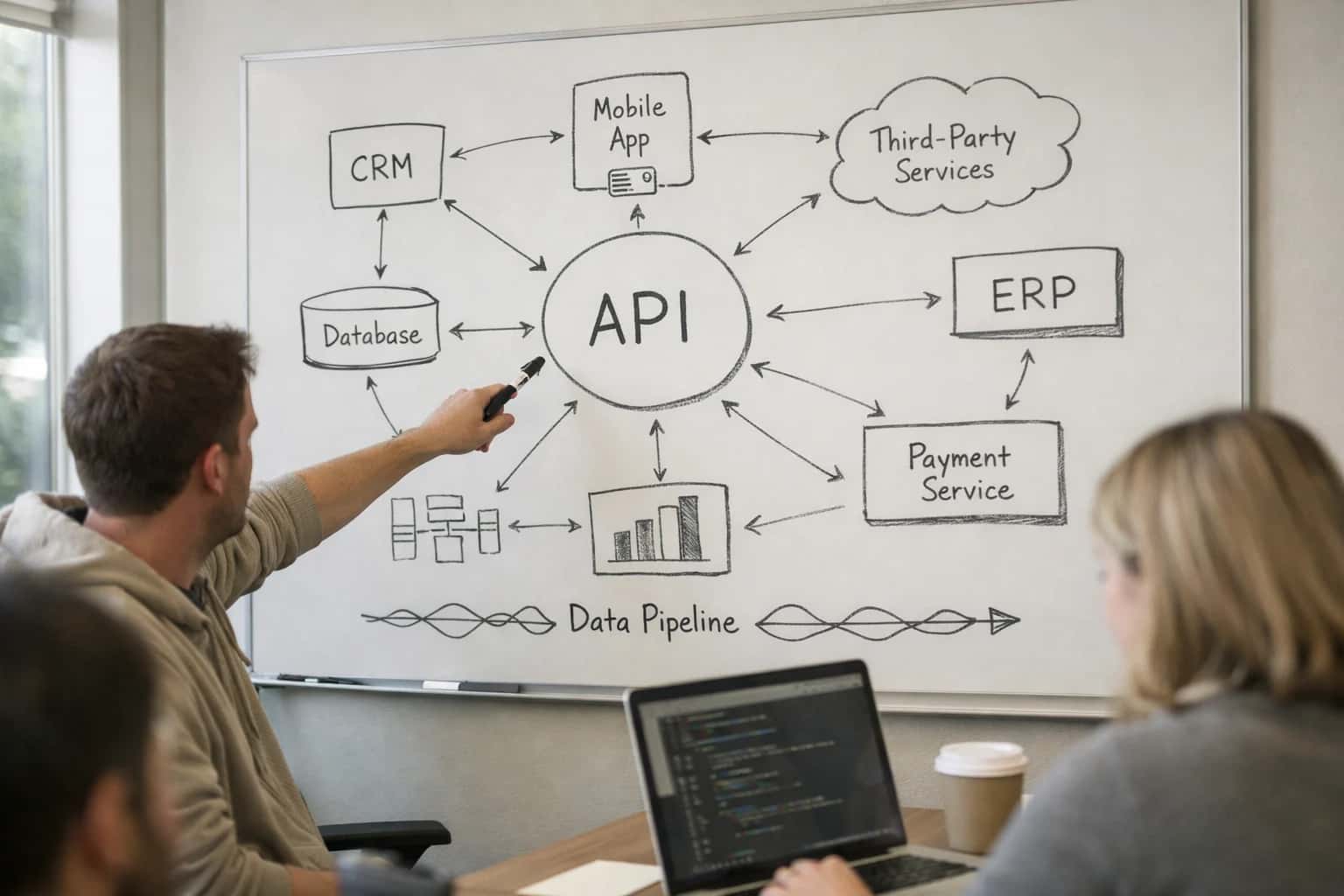
ARCHITECTING AI-DRIVEN INSIGHTS
From Static Reports to Conversational Analytics
Transform your LIMS from a static data repository into an interactive analytics engine by integrating natural language querying and automated insight generation.
Implementation involves deploying a secure, containerized service that connects to your LIMS via its native REST or GraphQL APIs (like Benchling's GraphQL endpoint) or a dedicated analytics database replica. We architect role-based access, ensuring queries respect existing LIMS security groups—a lab manager can only see data for their department. The system uses Retrieval-Augmented Generation (RAG) with a vector index of your data schema, SOPs, and past report definitions to ground its responses accurately. For example, a query about 'stability failures' will be mapped to the correct Study_Type and Specification_Limit fields in LabVantage's stability module, and the result can trigger an automated email alert if a threshold is breached.
Rollout starts with a pilot group of power users (lab directors, QA leads) focusing on high-value, repetitive reporting tasks: batch release summaries, trend analysis for key quality indicators, and audit trail reviews. Governance is critical; we implement query logging, audit trails of all AI-generated insights, and a human-in-the-loop review step for any data used in official regulatory submissions. This isn't about replacing your validated reporting system but creating a powerful copilot that accelerates insight discovery, turning what was a multi-day reporting process into a conversation that takes seconds, while keeping all data and logic securely inside your existing LIMS and analytics infrastructure. For a deeper look at connecting these insights to quality workflows, see our guide on AI Integration for LIMS Quality Assurance Review.
ARCHITECTURE BLUEPRINT
Where AI Connects to Your LIMS Reporting Stack
Dashboards, Visualizations, and Embedded Insights
AI connects directly to the reporting surfaces where lab directors and quality managers consume data. This includes:
- Native LIMS dashboards in LabWare, LabVantage, or Benchling, where AI can generate narrative summaries of KPIs like turnaround time (TAT) or Out-of-Specification (OOS) rates.
- Integrated BI tools like Power BI or Tableau connected via LIMS APIs. AI agents can be embedded here to answer natural language questions (e.g., "What was our top failure mode for Product Y last quarter?") and auto-generate visual explanations.
- Executive and compliance reports that are periodically generated. AI can draft the narrative section, highlight trends, and flag anomalies before the report is finalized for distribution or regulatory submission.
The integration point is typically a secure API call from the dashboard or report scheduler to an AI service, returning structured insights that populate a dedicated widget or report section.
FROM STATIC REPORTS TO INTERACTIVE INSIGHTS
High-Value Use Cases for AI-Powered LIMS Analytics
Move beyond rigid, pre-built reports. Integrate AI directly into your LIMS reporting modules to enable natural language querying, automated trend detection, and proactive insight generation for lab directors, QA managers, and operations leads.
01
Natural Language Querying for Lab Directors
Empower lab leadership to ask questions in plain English like 'What was our OOS rate for Product A last quarter?' or 'Show me the average turnaround time for stability tests by instrument.' An AI layer translates these queries into complex LIMS database calls, returning answers in seconds without requiring SQL knowledge or IT support.
Hours -> Minutes
Ad-hoc analysis speed
02
Automated Trend & Anomaly Detection
Continuously monitor incoming test results, instrument performance data, and environmental conditions. AI models identify statistical outliers, drifting calibration trends, and emerging failure patterns before they impact product quality. Automated alerts are routed to relevant scientists or QA with suggested investigation steps, creating a proactive quality culture.
Batch -> Real-time
Monitoring cadence
03
Predictive Analytics for Lab Capacity
Integrate AI with LIMS worklist and scheduling modules to forecast sample volumes, predict instrument bottlenecks, and model technician capacity. Use historical data, seasonal trends, and incoming project pipelines to generate 'what-if' scenarios, helping lab managers optimize resource allocation and meet service level agreements (SLAs).
1 sprint
Planning cycle reduction
04
Automated Regulatory & Executive Reporting
Automate the tedious compilation of data for batch release reports, annual product reviews (APRs), and regulatory submissions. AI agents query the LIMS, assemble required data tables (e.g., stability summary tables, OOS summaries), draft narrative summaries, and format documents per internal or agency templates, ensuring consistency and freeing up QA hours.
Same day
Report generation time
05
Root Cause Analysis & Correlation Engine
When a deviation or OOS occurs, an AI agent can instantly correlate the event across LIMS modules—checking raw material lots, instrument calibration logs, environmental data, and operator training records. It surfaces potential contributing factors and retrieves similar past investigations from the knowledge base, accelerating the root cause analysis process for QA investigators.
Hours -> Minutes
Initial RCA scoping
06
Self-Service Dashboard & Insight Generation
Deploy AI-powered dashboards that go beyond static charts. These interfaces automatically highlight key insights—like a spike in retest rates for a specific method or a supplier with declining quality scores—and explain the 'why' behind the data. Users can drill down conversationally, making analytics accessible to scientists and managers without deep data skills.
LIMS REPORTING AND ANALYTICS
Example AI Analytics Workflows
These workflows demonstrate how AI agents can be integrated into your LIMS reporting layer to automate insight generation, answer natural language questions, and surface trends without manual query building. Each flow is triggered by a user action or scheduled event, pulls relevant context from the LIMS data model, processes it with a language model, and delivers a consumable output back to the user or system.
A lab director asks a question in plain English via a chat interface or dashboard widget, triggering an automated data pull and analysis.
- Trigger: User submits query: "What was the out-of-specification rate for Product Alpha's potency tests in Q1, broken down by testing site?"
- Context/Data Pulled: The AI agent parses the query intent and constructs an API call to the LIMS (e.g., LabVantage REST API). It queries:
Test_Resultobjects for 'Potency' tests on 'Product Alpha' lots.- Filters by date range (Q1) and result status (
Final). - Joins with
SampleandSiteobjects to group by location. - Calculates OOS rate as (count of results where
result_valueoutsidespecification_range) / (total results).
- Model/Agent Action: The raw dataset is passed to an LLM with instructions to:
- Generate a concise summary of the finding (e.g., "Overall OOS rate was 2.3%").
- Identify the site with the highest deviation.
- Suggest a follow-up query (e.g., "Would you like to see the specific failing lot numbers from Site B?").
- System Update/Next Step: The agent returns a formatted response to the user interface, including:
- A natural language answer.
- A simple table or chart embed.
- Interactive buttons for suggested follow-up actions.
- Human Review Point: The initial query and generated API call are logged for auditability. The statistical calculation is performed by the agent, but the underlying data is sourced directly from the validated LIMS, ensuring traceability.
BUILDING A GOVERNED, ACTIONABLE ANALYTICS LAYER
Implementation Architecture: Data Flow, APIs, and Guardrails
A practical architecture for adding natural language querying and automated insight generation to your LIMS reporting modules.
The integration connects at the data layer of your LIMS—LabWare, LabVantage, Benchling, or SampleManager—via its native APIs or a replicated data store. For real-time querying, we deploy a secure API gateway that accepts natural language questions (e.g., "What was our OOS rate for Product A in Q3?") and translates them into optimized queries against the LIMS reporting schema, focusing on key objects like Sample, Test, Result, Batch, and Deviation. For scheduled analytics, an ETL pipeline extracts and transforms data into a dedicated analytics-ready vector store, enabling semantic search across historical trends, instrument performance, and turnaround time metrics. This dual approach ensures lab directors and QA managers get instant answers without impacting production LIMS performance.
Implementation centers on role-specific data access and workflow triggers. The system uses the LIMS's existing RBAC to govern which insights a user can see—a lab technician might query their own sample backlog, while a site director can analyze cross-departmental trends. High-value use cases are automated: nightly anomaly detection jobs scan for statistical outliers in test results and post summaries to a dashboard; a chatbot interface allows scientists to ask ad-hoc questions about stability study data. Key guardrails include: audit logging of all AI-generated queries, result validation against source system timestamps, and configurable approval steps for any automated insight that triggers a workflow (like a new deviation record).
Rollout follows a phased, governed model. We start with a read-only analytics pilot on a single data domain (e.g., sample turnaround times), using a mirrored dataset. This validates the accuracy of query translation and builds trust. Phase two introduces write-back actions, where an approved insight—like a detected trend of increasing invalid runs for an instrument—can auto-create a work order in your CMMS or draft a notification for the lab manager. Throughout, change control is managed within your existing LIMS/QMS framework, ensuring the AI layer is an auditable extension of your validated system. The final architecture delivers a self-service analytics copilot that reduces the need for complex SQL or Crystal Reports, turning days of manual report building into minutes of conversational inquiry.
IMPLEMENTATION PATTERNS
Code and Payload Examples
Query LIMS Data with Plain English
Enable lab directors and scientists to ask questions like "What was the OOS rate for product X last quarter?" without writing SQL or using complex report builders. This pattern uses a Retrieval-Augmented Generation (RAG) pipeline to translate natural language into structured queries against the LIMS data warehouse or reporting database.
python# Example: Python endpoint for natural language query from inference_systems import LIMSQueryAgent import labware_sdk # Hypothetical SDK agent = LIMSQueryAgent( lims_client=labware_sdk.Client(), vector_store_connection="redis://lims-vectors" ) # User submits a question question = "Show me stability results for batch ABC123 where pH exceeded 6.5" # Agent decomposes, retrieves schema, and executes result = agent.execute_query(question) # Returns a structured dict with data and a narrative summary print(result['summary']) # "Batch ABC123 showed pH excursions in weeks 4, 8, and 12..." print(result['data_frame'].head()) # Pandas DataFrame of raw results
This API layer sits between user interfaces (chat, dashboards) and the LIMS, enforcing data security and audit logging. For a deeper dive on RAG architecture for lab data, see our guide on Natural Language Queries in LIMS.
AI-POWERED REPORTING AND ANALYTICS
Realistic Time Savings and Operational Impact
How adding natural language querying and automated insight generation to your LIMS reporting module changes daily workflows for lab directors, QA managers, and data analysts.
| Metric | Before AI | After AI | Notes |
|---|---|---|---|
Ad-hoc trend analysis | 2-4 hours building SQL/query | Minutes via natural language | Ask 'show OOS rate by product last quarter' without IT |
Monthly quality summary report | Next-day manual compilation | Same-day automated draft | AI aggregates data, highlights anomalies; human finalizes |
Root cause investigation data pull | Manual query across multiple tables | Assisted, context-aware data retrieval | Agent fetches related samples, tests, and deviations |
Regulatory audit data preparation | Days of manual extraction and validation | Hours with automated package assembly | AI pulls compliant data sets with audit trails |
Turnaround time (TAT) dashboard update | Weekly manual refresh | Real-time, auto-refreshing view | Live connection to LIMS with anomaly alerts |
Experiment correlation discovery | Manual review of historical notebooks | Automated cross-analysis suggestions | Surfaces hidden relationships across projects in Benchling |
Data review for batch release | Sequential manual review by QA | Parallel AI pre-review with highlights | Flags inconsistencies for human focus, accelerates sign-off |
ENSURING CONTROLLED, COMPLIANT AI ADOPTION
Governance, Security, and Phased Rollout
A structured approach to deploying AI for LIMS reporting that prioritizes data integrity, user trust, and measurable impact.
Integrating generative AI into a regulated LIMS environment requires a governance-first architecture. This means implementing AI tool calls as a secured middleware layer between user queries and the LIMS database—never allowing direct model access to raw data. Queries are translated into secure, auditable API calls to the LIMS (e.g., LabVantage's REST API or Benchling's GraphQL endpoint). All generated insights, such as trend summaries or OOS rate calculations, are presented as citations linked to source records, maintaining a clear audit trail. Role-based access control (RBAC) from the LIMS is strictly enforced, ensuring a lab technician can only query data within their authorized studies or projects.
A phased rollout is critical for adoption and risk management. Start with a pilot cohort of lab directors and data scientists in a non-GxP environment, focusing on descriptive analytics like 'What was our sample turnaround time last month?'. This validates the integration's accuracy and builds trust. Phase two introduces predictive and diagnostic queries, such as identifying correlations between instrument downtime and OOS rates, for a broader group of lab managers. The final phase enables prescriptive workflows, where the AI agent suggests follow-up tests or generates draft investigation reports, but always routes these suggestions through existing approval workflows in the LIMS's deviation or CAPA modules for human sign-off.
Security is anchored in the LIMS's existing compliance framework. All AI-generated content is logged as system-generated notes within the relevant sample, batch, or study record, stamped with the user ID and timestamp to satisfy 21 CFR Part 11 requirements. For cloud-hosted LIMS like Benchling, we deploy AI inference within your VPC or use private endpoints to ensure data never leaves your controlled environment. A continuous monitoring layer tracks query patterns, model performance, and data drift, alerting administrators to any anomalous activity or degradation in answer quality, ensuring the system remains reliable and compliant over time.
Enabling Efficiency, Speed & Accuracy
Intelligent Analysis, Decision & Execution
We build AI systems for teams that need search across company data, workflow automation across tools, or AI features inside products and internal software.
Talk to Us
Search across company data
Give teams answers from docs, tickets, runbooks, and product data with sources and permissions.
Useful when people spend too long searching or get different answers from different systems.
Enterprise searchRAGPermissions
Read more
Automate internal workflows
Use AI to route work, draft outputs, trigger actions, and keep approvals and logs in place.
Useful when repetitive work moves across multiple tools and teams.
AI agentsWorkflow automationGovernance
Read more
Add AI to products and internal tools
Build assistants, guided actions, or decision support into the software your team or customers already use.
Useful when AI needs to be part of the product, not a separate tool.
AI integrationDecision supportModel routing
Read moreIMPLEMENTATION AND WORKFLOW DETAILS
Frequently Asked Questions
Practical questions and workflow examples for integrating AI into LIMS reporting and analytics modules.
The AI layer sits as a secure intermediary between users and your LIMS database. Here's the typical flow:
- User Input: A lab director or scientist asks a question via a chat interface or integrated dashboard widget (e.g., "What was our OOS rate for Product Alpha in Q3, broken down by test type?").
- Query Interpretation: An LLM (like GPT-4 or Claude) interprets the natural language, identifying key entities (Product Alpha, OOS, Q3, test type) and intent (aggregate, filter, group by).
- Query Translation: A deterministic translation layer converts the interpreted intent into a valid query for your specific LIMS:
- For LabVantage/SampleManager: Often generates optimized SQL against the reporting schema or calls a pre-built API endpoint.
- For Benchling: Typically constructs a GraphQL query to fetch records from the relevant project and entity types.
- Execution & Response: The query runs against the LIMS (with strict RBAC enforcing user permissions), and the raw results are passed back to the AI.
- Narrative Generation: The AI summarizes the data table into a concise, plain-English answer, highlighting key trends or anomalies.
Security Note: The AI agent never has direct, unrestricted database access. It uses a service account with read-only permissions scoped to specific tables/APIs, and all queries are logged for auditability.

About the author
Prasad Kumkar
CEO & MD, Inference Systems
Prasad Kumkar is the CEO & MD of Inference Systems and writes about AI systems architecture, LLM infrastructure, model serving, evaluation, and production deployment. Over 5+ years, he has worked across computer vision models, L5 autonomous vehicle systems, and LLM research, with a focus on taking complex AI ideas into real-world engineering systems.
His work and writing cover AI systems, large language models, AI agents, multimodal systems, autonomous systems, inference optimization, RAG, evaluation, and production AI engineering.
LinkedIn
Limited slotsGet a Free AI Consultation
Partnered with leading AI, data, and software stack.





How We Work
Custom AI workflows for your Business
One-fit-all AI don't work for modern businesses. At Inferensys, we aim to understand your business & custom requirements; which we use to define most efficient agentic workflows, the data, and the tools for your business.
01
Review the use case
We understand the task, the users, and where AI can actually help.
Read more02
Pick the right approach
We define what needs search, automation, or product integration.
Read more03
Build the first useful version
We implement the part that proves the value first.
Read more04
Improve from there
We add the checks and visibility needed to keep it useful.
Read moreThe first call is a practical review of your use case and the right next step.
Talk to Us