The integration layer between a Laboratory Information Management System (LIMS) like LabWare or LabVantage and an Enterprise Resource Planning (ERP) system like SAP or Oracle is a critical but fragile junction. It handles high-value, time-sensitive data objects: material lot statuses, Certificate of Analysis (COA) documents, quality hold/release flags, and inventory consumption records. Traditional middleware or direct API syncs fail when data formats mismatch, required fields are missing, or business rules conflict—creating manual work for lab supervisors and planners to reconcile.

Integration
AI Integration for LIMS and ERP Systems
Build intelligent two-way syncs between LIMS (LabWare, LabVantage) and ERP (SAP, Oracle) for material lot status, quality results, and COA issuance, using AI to handle exceptions and mismatches.
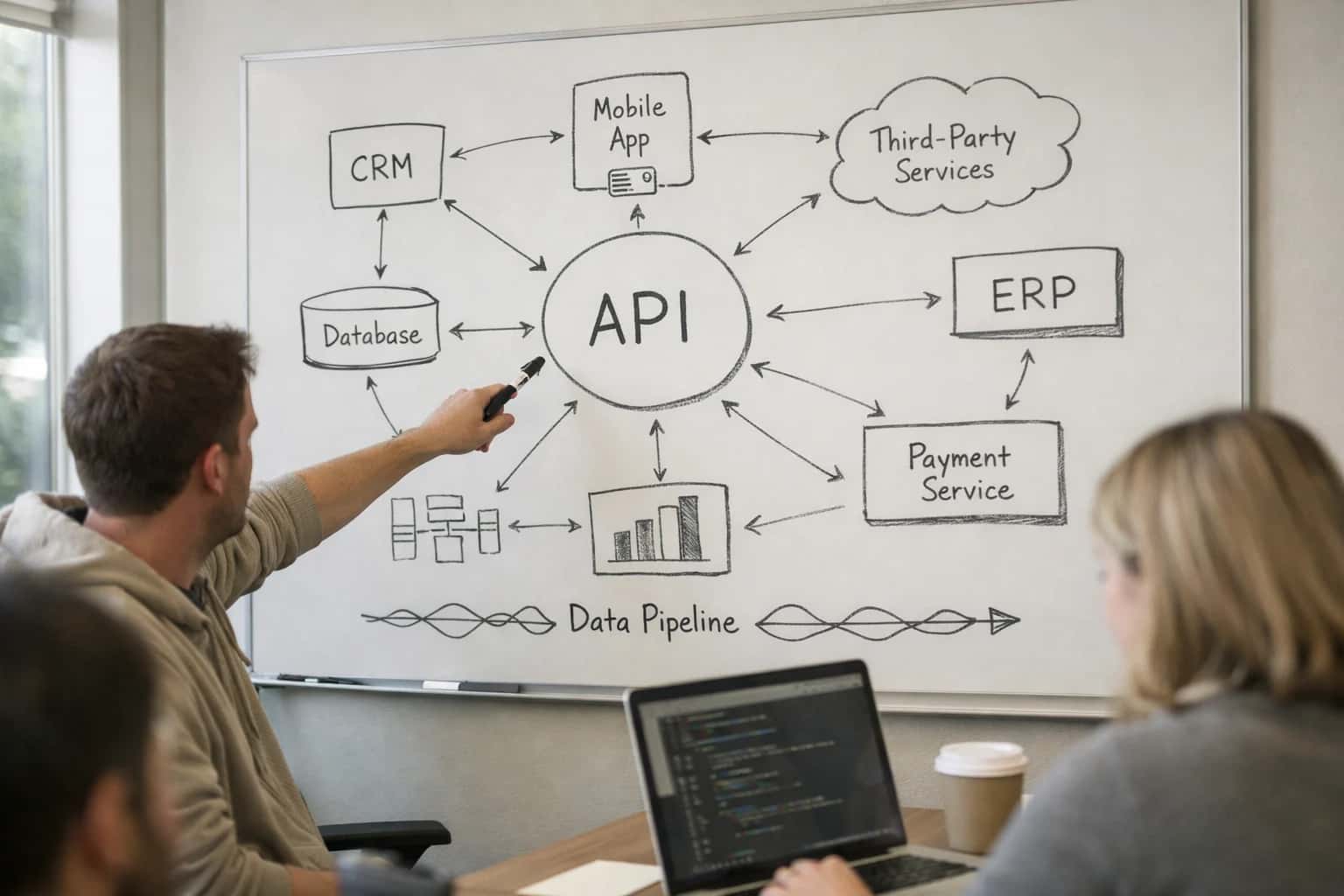
ARCHITECTING INTELLIGENT TWO-WAY SYNC
Where AI Fits in the LIMS-ERP Integration Layer
AI transforms the brittle, point-to-point connection between your laboratory and business systems into a resilient, self-correcting data fabric.
AI acts as an intelligent orchestrator within this integration layer. It doesn't replace the core ETL or API calls; it wraps them with decision-making logic. For example, an AI agent can:
- Parse and validate incoming ERP material receipts against LIMS specifications before creating sample records.
- Monitor LIMS for completed tests and, based on pass/fail results and pre-configured rules, automatically trigger ERP transactions (e.g., post goods receipt, move stock to unrestricted).
- Handle exceptions intelligently: If a COA from the LIMS is missing a required ERP field, the AI can retrieve it from a historical data store or draft a request for the lab technician, rather than failing the entire transaction.
- Maintain a real-time audit trail of all decisions, data transformations, and reconciliation actions across both systems for compliance (GxP, ISO).
Rollout is phased, starting with the highest-volume, highest-error workflows—often raw material release or finished goods quality approval. Governance is paramount: AI logic is codified into version-controlled business rules, and a human-in-the-loop approval step is maintained for critical release decisions or novel exceptions. The result is not just faster data flow, but a closed-loop quality system where the LIMS informs ERP execution and ERP constraints proactively guide lab prioritization, turning two monolithic systems into a responsive, intelligent operation.
ARCHITECTURAL BLUEPRINTS
Key Integration Surfaces in LIMS and ERP
Core Data Flow for Production
This surface orchestrates the two-way sync of material master data and lot status between ERP (SAP, Oracle) and LIMS (LabWare, LabVantage). AI agents monitor this flow to handle exceptions.
Typical Integration Points:
- ERP → LIMS: New material creation, lot release requests, and production schedules.
- LIMS → ERP: Test results (pass/fail), Certificate of Analysis (COA) issuance, and quarantine/hold status updates.
AI Use Cases:
- Mismatch Resolution: An AI agent detects discrepancies between ERP purchase order specifications and the actual material received in the LIMS. It suggests corrective actions (e.g., initiate retest, update ERP material class).
- Automated COA Generation: Upon final approval in the LIMS, an AI workflow drafts the COA by pulling structured results, formats it against a template, and posts the document reference back to the ERP lot record.
- Predictive Hold: AI analyzes historical data to flag high-risk incoming lots for enhanced testing before the ERP triggers a goods receipt, preventing downstream production delays.
LIMS AND ERP INTEGRATION PATTERNS
High-Value Use Cases for AI-Powered Sync
AI-driven sync between LIMS and ERP systems automates the flow of quality data, material status, and compliance documents, handling exceptions and mismatches that traditionally require manual review. These patterns reduce release cycle times and improve data accuracy across manufacturing and quality operations.
01
Automated Certificate of Analysis (COA) Issuance
AI monitors final test results in the LIMS (LabWare, LabVantage) and auto-generates a compliant COA document. It syncs the approved COA to the ERP (SAP, Oracle) as a material document, triggering inventory status updates from 'Hold' to 'Released' for shipping. Workflow: LIMS result validation → AI drafts COA → QA review/approval → ERP sync → inventory status update.
Same day
Release cycle
02
Real-Time Lot Status Synchronization
AI acts as an intelligent broker between ERP material masters and LIMS sample records. When a raw material lot is received, the ERP creates a purchase order item. AI parses the supplier COA, creates a corresponding sample in the LIMS, and syncs the 'Awaiting Testing' status back to the ERP, providing real-time visibility to procurement and planning teams.
Batch -> Real-time
Status visibility
03
Exception Handling for Out-of-Specification (OOS) Results
When the LIMS flags an OOS result, AI evaluates it against historical data and product specifications. It automatically creates a deviation in the LIMS, places the corresponding ERP material lot on 'Quality Hold', and notifies the relevant QA and production stakeholders via the ERP workflow system, ensuring immediate containment.
Immediate
Containment action
04
Intelligent Material Consumption & Replenishment
AI correlates LIMS test schedules and sample volumes with ERP inventory levels and production forecasts. It predicts reagent and consumable shortages, generates smart purchase requisitions in the ERP, and recommends specific lot numbers in the LIMS based on stability data, optimizing stock for lab managers and planners.
Proactive
Replenishment
05
Regulatory Batch Record Compilation
For batch release, AI aggregates all relevant data—LIMS test results, ERP manufacturing order details, equipment logs—into a structured electronic batch record. It highlights any discrepancies against the master batch record (MBR) for reviewer attention and syncs the finalized, approved record to the ERP's quality module for long-term archiving and audit readiness.
Hours -> Minutes
Record assembly
06
Supplier Quality Scorecard Automation
AI continuously analyzes LIMS incoming inspection data (defect rates, OOS frequency) and ERP performance data (on-time delivery). It calculates a rolling score for each supplier, updates the ERP vendor master record with the current rating, and can auto-trigger actions like requiring additional testing for low-scoring suppliers, integrating quality into procurement decisions.
LIMS-ERP DATA ORCHESTRATION
Example AI-Orchestrated Workflows
These concrete workflows illustrate how AI agents can automate the complex, exception-prone data flows between Laboratory Information Management Systems (LIMS) and Enterprise Resource Planning (ERP) platforms, turning manual syncs into intelligent, governed processes.
Trigger: A batch record in the LIMS (e.g., LabWare, LabVantage) reaches a 'QA Approved' status, indicating all tests are within specification.
AI Agent Actions:
- Context Retrieval: The agent calls the LIMS API to pull the finalized batch data, test results, specifications, and approved signatories.
- Document Generation: Using a structured prompt, an LLM drafts the COA text, populating fields like product name, lot number, test parameters, results, and compliance statements.
- Exception Handling: The agent cross-references the results against dynamic customer-specific requirements stored in a separate database. If a mismatch is found (e.g., a tighter purity spec for a specific distributor), it flags the COA for human review.
- System Updates: Upon successful generation and any required approvals:
- The finalized COA PDF is attached to the LIMS batch record.
- The agent calls the ERP's (e.g., SAP, Oracle) goods receipt or inventory API to update the material master record for that lot, setting the quality status to 'Released' and linking the COA document ID.
- A shipping hold on the lot in the Warehouse Management System (WMS) is automatically released.
Human Review Point: Required for any flagged exceptions or if the AI's confidence score for data extraction falls below a pre-set threshold.
BUILDING A GOVERNED, TWO-WAY SYNC
Implementation Architecture: Data Flow and Guardrails
A production-ready AI integration for LIMS and ERP systems requires a secure, event-driven architecture with clear data ownership and compliance guardrails.
The core architecture establishes a real-time event bus (e.g., Apache Kafka, AWS EventBridge) that listens for key state changes in both systems. From the LIMS (LabWare, LabVantage), we monitor events like Test_Completed, Batch_Approved, or Deviation_Created. From the ERP (SAP, Oracle), we track Material_Receipt, Production_Order_Release, and Goods_Issue. AI agents subscribe to these events, acting as intelligent orchestrators. For example, a Batch_Approved event in the LIMS triggers an agent to retrieve the Certificate of Analysis (COA), validate it against the ERP's purchase order, and then either post the Quality_Results to the ERP's material lot or flag a mismatch for human review.
Data flows through a governance layer before any AI processing or cross-system writes. This layer enforces:
- RBAC & Data Masking: Agents operate with service accounts scoped to specific data domains (e.g., raw materials, finished goods). Personally Identifiable Information (PII) in comments or batch records is masked before being sent to an LLM.
- Audit Trail Generation: Every AI-initiated action—a suggested disposition, a drafted deviation, a posted result—is logged with a full chain of evidence: the source event, the data payload sent to the model, the prompt used, and the final decision.
- Approval Gates: High-risk actions, like auto-releasing a material lot with a marginal test result, are routed through a configurable approval step in the LIMS or a dedicated workflow queue before the ERP is updated.
Rollout follows a phased, use-case-driven approach. We start with a read-only pilot, where AI agents analyze data flows and provide recommendations (e.g., 'Lot 12345 from Supplier A shows a trending pH increase') within a dashboard, without writing back. This builds trust and tunes the models. Phase two enables assisted writes for low-risk, high-volume tasks, like auto-populating ERP quality info fields from parsed COA PDFs, with a human-in-the-loop review step. The final phase activates closed-loop automation for predefined, rule-based scenarios, such as auto-holding a material lot in SAP when an LIMS Out-of-Specification (OOS) result is confirmed, with the entire workflow—from detection to hold—documented in both systems' audit logs.
This architecture ensures the integration is not just a point-to-point connector but a governed intelligence layer. It maintains the LIMS as the single source of truth for quality data and the ERP as the system of record for logistics and finance, while using AI to handle the complex logic, exception management, and data transformation in between. The result is a system where lab technicians and supply chain planners see faster, more accurate data syncs, while QA and IT maintain full visibility, control, and compliance with GxP and SOX requirements.
AI-ENABLED DATA FLOWS BETWEEN LIMS AND ERP
Code and Payload Examples
Triggering ERP Updates from LIMS Results
When a material lot passes final quality review in the LIMS, an AI agent validates the result set against the ERP's expected specifications before initiating a status change. This prevents erroneous 'Released' statuses for non-conforming lots.
Example Webhook Payload to ERP (SAP):
json{ "event_type": "LOT_RELEASE_CANDIDATE", "source_system": "LabWare_LIMS", "timestamp": "2024-05-15T14:30:00Z", "material_data": { "material_number": "MAT-100234", "batch_id": "B230987", "storage_location": "WH-01-A5", "quality_status": "PASSED", "release_by": "AI_AGENT_VALIDATION", "critical_tests": [ {"test_code": "PH-001", "result": "6.8", "spec": "6.5-7.5", "status": "PASS"}, {"test_code": "POTENCY-AA", "result": "98.7%", "spec": "95-105%", "status": "PASS"} ], "ai_confidence_score": 0.96, "validation_notes": "All critical parameters within spec. No OOS history for this supplier." } }
The ERP's API endpoint receives this payload, and the AI's confidence score and notes are logged in the ERP's quality info record for auditability.
AI INTEGRATION FOR LIMS AND ERP SYSTEMS
Realistic Time Savings and Operational Impact
This table illustrates the operational impact of integrating AI to synchronize LIMS (LabWare, LabVantage) with ERP systems (SAP, Oracle), focusing on material lot status, quality results, and Certificate of Analysis (COA) workflows.
| Workflow | Before AI Integration | After AI Integration | Key Notes |
|---|---|---|---|
Material Lot Status Sync | Manual data entry and email follow-ups (2-4 hours per lot) | Automated real-time sync with exception alerts (minutes) | AI handles format mismatches and missing fields, flags for human review only |
Certificate of Analysis (COA) Issuance | Batch creation from LIMS, manual formatting for ERP (1-2 days) | AI auto-generates and routes compliant COA documents (same day) | Ensures data alignment with ERP material masters and customer specs |
Quality Result Release to Production | Sequential approval in LIMS, then manual ERP hold release (next day) | Event-driven release with AI-gated checks (within hours) | AI validates results against specs before triggering ERP transactions |
Exception and Mismatch Resolution | Manual investigation across systems by QA/Planning (4-8 hours per incident) | AI triages, suggests root cause, and drafts resolution (1-2 hours) | Pulls from historical deviation data in LIMS and related ERP orders |
Inventory Replenishment Trigger | Planner reviews lab usage reports and manually creates PO (weekly cycle) | AI predicts reagent consumption and suggests PO lines (daily) | Integrates LIMS stock levels, test schedules, and ERP lead times |
Regulatory & Audit Data Pull | Manual query building and spreadsheet consolidation (1-2 days prep) | Natural language query for cross-system traceability (hours) | AI assembles data lineage from LIMS sample to ERP shipment |
New Material Master Creation | Manual form completion in ERP using data from scanned COAs (30+ mins each) | AI parses supplier documents and pre-populates ERP fields (<5 mins) | Reduces errors and ensures GxP data integrity from first receipt |
ARCHITECTING CONTROLLED AI FOR REGULATED DATA FLOWS
Governance, Compliance, and Phased Rollout
Integrating AI into the critical bridge between LIMS and ERP requires a deliberate approach to data integrity, auditability, and risk-managed rollout.
A production architecture for LIMS-ERP AI syncs must enforce strict governance at key junctions. This includes RBAC-gated AI tool access to LabWare or LabVantage APIs, ensuring only authorized agents can read or write sample statuses, test results, or material attributes. All AI-generated actions—like proposing a lot release or flagging a data mismatch—must be logged with a full audit trail, capturing the source record IDs, the triggering prompt or logic, and the human or system approval before any update is committed to SAP or Oracle ERP. For GxP environments, this audit trail must support electronic signatures (21 CFR Part 11), with AI serving as an assistive reviewer, not an autonomous signer.
Rollout follows a phased, value-prioritized path to de-risk implementation and demonstrate ROI. A typical sequence is:
- Phase 1: Read-Only Intelligence – Deploy agents to monitor the LIMS-ERP interface for common exceptions (e.g., missing COA, delayed results). The AI analyzes and alerts, but all corrective actions are manual.
- Phase 2: Draft & Recommend – The AI begins drafting material status updates, quality holds, or preliminary Certificate of Analysis (COA) text within a controlled sandbox. A QA manager or planner reviews, edits, and approves each draft before system posting.
- Phase 3: Controlled Automation – For pre-validated, rule-based workflows (e.g., auto-releasing a lot when all tests pass against a known profile), the AI executes the update, but with mandatory post-execution review logs and the ability to easily revert. This phase often starts with non-critical materials or internal transfers.
Compliance is designed in, not bolted on. AI models processing regulated data are hosted in a secure, compliant cloud tenant or on-premises enclave. Data flows are mapped for lineage, and any AI used for classification or decision support is validated for its intended use—documenting its accuracy, bias checks, and performance boundaries. The system is built to handle deviations: if the AI's confidence score for parsing a supplier COA is below a set threshold, the document and its extracted fields are automatically routed to a human-in-the-loop queue within the LIMS or QMS for review.
Enabling Efficiency, Speed & Accuracy
Intelligent Analysis, Decision & Execution
We build AI systems for teams that need search across company data, workflow automation across tools, or AI features inside products and internal software.
Talk to Us
Search across company data
Give teams answers from docs, tickets, runbooks, and product data with sources and permissions.
Useful when people spend too long searching or get different answers from different systems.
Enterprise searchRAGPermissions
Read more
Automate internal workflows
Use AI to route work, draft outputs, trigger actions, and keep approvals and logs in place.
Useful when repetitive work moves across multiple tools and teams.
AI agentsWorkflow automationGovernance
Read more
Add AI to products and internal tools
Build assistants, guided actions, or decision support into the software your team or customers already use.
Useful when AI needs to be part of the product, not a separate tool.
AI integrationDecision supportModel routing
Read moreIMPLEMENTATION AND WORKFLOW
Frequently Asked Questions
Practical questions and workflow examples for integrating AI between your Laboratory Information Management System (LIMS) and Enterprise Resource Planning (ERP) platform.
This workflow uses AI to bridge the gap between final quality results in the LIMS and the COA generation process in the ERP, handling exceptions automatically.
- Trigger: A batch record in the LIMS (e.g., LabWare, LabVantage) reaches a 'QA Approved' status.
- Context Pulled: An AI agent queries the LIMS API for the batch ID, all associated test results, specifications, and any linked deviations or OOS investigations.
- AI Agent Action: The agent validates all results against release specifications. For any borderline or missing data, it can:
- Query the ERP (e.g., SAP, Oracle) for material master data or previous lot history.
- Draft a summary note for any exceptions requiring human review.
- If all data is valid, it structures a COA payload in the required format (often XML or JSON).
- System Update: The structured COA data is posted via the ERP's BAPI or REST API to create a draft COA document or trigger a print workflow.
- Human Review Point: The system flags any batches where the AI detected mismatches or missing critical data for a QA specialist's review before ERP posting.

About the author
Prasad Kumkar
CEO & MD, Inference Systems
Prasad Kumkar is the CEO & MD of Inference Systems and writes about AI systems architecture, LLM infrastructure, model serving, evaluation, and production deployment. Over 5+ years, he has worked across computer vision models, L5 autonomous vehicle systems, and LLM research, with a focus on taking complex AI ideas into real-world engineering systems.
His work and writing cover AI systems, large language models, AI agents, multimodal systems, autonomous systems, inference optimization, RAG, evaluation, and production AI engineering.
LinkedIn
Limited slotsGet a Free AI Consultation
Partnered with leading AI, data, and software stack.





How We Work
Custom AI workflows for your Business
One-fit-all AI don't work for modern businesses. At Inferensys, we aim to understand your business & custom requirements; which we use to define most efficient agentic workflows, the data, and the tools for your business.
01
Review the use case
We understand the task, the users, and where AI can actually help.
Read more02
Pick the right approach
We define what needs search, automation, or product integration.
Read more03
Build the first useful version
We implement the part that proves the value first.
Read more04
Improve from there
We add the checks and visibility needed to keep it useful.
Read moreThe first call is a practical review of your use case and the right next step.
Talk to Us