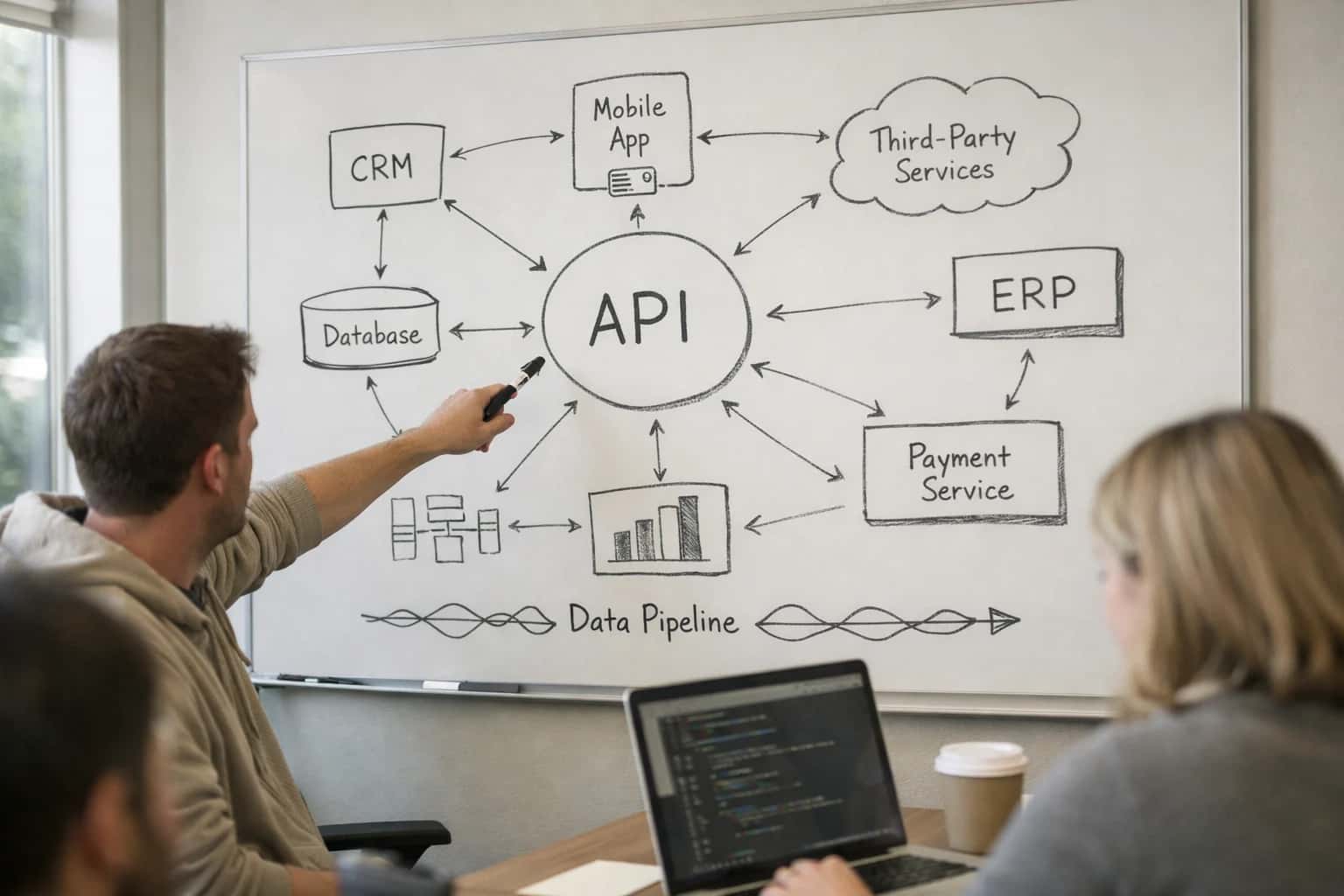
Cloud-based LIMS platforms like Benchling Cloud and LabVantage SaaS are built on modern, API-first architectures, making them ideal for AI integration. The primary integration surfaces are their managed APIs (REST, GraphQL), webhook systems, and cloud-native event streams. AI agents and models connect here to read from and write to core objects—Samples, Tests, Batches, Inventory Items, and Protocols—without disrupting the core application. This allows you to augment existing workflows with intelligence, rather than replace the system.

Integration
AI Integration for Cloud-Based LIMS Platforms
Architect secure, scalable AI integrations for SaaS LIMS (Benchling Cloud, LabVantage SaaS) using cloud-native functions, vector stores, and managed APIs, focusing on deployment and governance for IT.
ARCHITECTURE AND DEPLOYMENT
Where AI Fits into Cloud-Based LIMS
A practical blueprint for integrating AI into modern, cloud-native Laboratory Information Management Systems.
Implementation typically involves deploying serverless functions (AWS Lambda, Azure Functions) or containerized services within the same cloud region as the LIMS tenant. These functions act as middleware, handling authentication, data transformation, and secure calls to AI models. For example, an AI service can listen for a sample_registered webhook, parse the attached request PDF using a vision model, and populate the sample record's fields via the LIMS API before a technician ever sees it. This keeps data flow secure, auditable, and within the platform's governance boundaries.
Rollout and governance are critical. Start with a single, high-impact workflow like automated Certificate of Analysis (COA) review or deviation report drafting. Use the LIMS's native role-based access control (RBAC) to scope AI agent permissions, ensuring they only interact with approved data modules. All AI actions should log detailed audit trails back to the LIMS's change history. For IT teams, this cloud-native approach means managing scalability, security policies, and cost monitoring through familiar cloud consoles, not on-premise servers.
This architectural pattern delivers value by turning the LIMS from a system of record into a system of intelligence. Lab managers get accelerated review cycles, technicians are freed from manual data entry, and QA leads gain consistent, AI-assisted oversight. The integration is credible because it works with the platform's designed extensibility, ensuring long-term maintainability and compliance, especially in regulated environments.
PLATFORM SURFACES
AI Integration Surfaces in Cloud LIMS
Core Sample Management Modules
AI integrates directly into the sample lifecycle within cloud LIMS platforms like Benchling Cloud and LabVantage SaaS. Key surfaces include:
- Sample Login & Registration: AI-powered document parsing automates data extraction from emailed request forms, PDF COAs, and spreadsheets, populating fields like sample ID, test codes, priority, and client information.
- Worklist & Scheduling: AI agents analyze real-time instrument capacity, technician availability, and test due dates to dynamically optimize worklist generation and assignment.
- Result Entry & Validation: AI checkpoints flag transcription errors, unit mismatches, and statistically improbable values during analyst data entry, providing pre-validation assistance before final approval.
These integrations reduce manual data entry by lab technicians and accessioning staff, accelerating sample turnaround from hours to minutes.
CLOUD-NATIVE INTEGRATION PATTERNS
High-Value AI Use Cases for Cloud LIMS
For SaaS LIMS platforms like Benchling Cloud and LabVantage SaaS, AI integration is about connecting cloud-native functions, vector stores, and managed APIs to core lab workflows. These patterns focus on deployment, security, and governance for IT and lab operations teams.
01
Automated Sample Login via Document Parsing
Deploy serverless functions (AWS Lambda, Azure Functions) to trigger on file uploads to cloud storage. Use vision/LLM APIs to parse emailed request forms, PDF COAs, or scanned documents. Extract key fields (sample ID, test codes, priority) and auto-populate the LIMS via its REST/GraphQL API, reducing manual entry for accessioning staff.
Hours -> Minutes
Registration time
02
Real-Time Anomaly Detection in Instrument Feeds
Stream instrument data (via ASTM, HL7, or cloud connectors) to a managed service like Azure Event Hubs. Apply lightweight ML models for statistical process control to flag out-of-trend or improbable results before they are posted to the LIMS. Create automated review tasks or alerts for lab analysts.
Batch -> Real-time
Review mode
03
QA Review Copilot for Batch Release
Integrate a secure chatbot interface with the LIMS QA module. Using RAG over a vector store of SOPs and historical deviations, the agent can pre-review electronic batch records, highlight inconsistencies, and draft initial deviation reports for QA manager approval, accelerating release cycles.
Same day
Review acceleration
04
Intelligent Inventory & Reagent Forecasting
Connect the LIMS inventory module to a cloud data warehouse. Use time-series forecasting models to predict reagent and consumable usage based on scheduled tests, project pipelines, and historical burn rates. Generate smart reorder suggestions and POs, optimizing stock for lab managers.
1 sprint
Implementation lead time
05
Natural Language Querying for Lab Analytics
Implement a semantic layer over the LIMS reporting database using a managed vector database (Pinecone, Weaviate). Allow lab directors and scientists to ask questions like 'show me OOS rates for product X last quarter' via a chat interface, translating intent into complex SQL without a query builder.
Self-service
Analytics access
06
Compliance-Aware API Orchestration for AI Agents
Architect a secure API gateway layer (Apigee, Kong) in front of the cloud LIMS's native APIs. This layer manages authentication, audit logging, rate limiting, and payload validation for AI agent tool-calling, ensuring all AI-driven data modifications are traceable and compliant with GxP requirements.
Governed
AI access control
CLOUD-NATIVE IMPLEMENTATION PATTERNS
Example AI-Enhanced Workflows
These workflows illustrate how AI agents and models are integrated into SaaS LIMS platforms like Benchling Cloud and LabVantage SaaS using serverless functions, managed APIs, and secure data pipelines. Each pattern is designed for IT-managed deployment, auditability, and controlled rollout.
Trigger: A new email arrives in a dedicated lab inbox (e.g., [email protected]) with a sample submission form or COA attached.
Context/Data Pulled:
- A cloud function (AWS Lambda, Azure Function) triggered by the email event extracts the attachment.
- The function calls a document intelligence API (e.g., Azure Form Recognizer, Google Document AI) to parse structured fields (Sample ID, Test Codes, Client, Priority) and unstructured notes.
- The parsed data is validated against the LIMS master data (e.g., valid test codes from Benchling's
AssayRunschema) via a REST API call.
Model/Agent Action: A rules-based agent, potentially augmented with a small LLM for note interpretation, determines the correct sample type, required tests, and any special handling instructions.
System Update/Next Step: The agent uses the LIMS API (Benchling GraphQL, LabVantage REST) to create a new Sample or Container record, populating all parsed fields. A confirmation email with the new LIMS ID is sent to the submitter.
Human Review Point: For low-confidence parses (e.g., ambiguous test codes), the record is created in a "Pending Review" state and a task is assigned in the LIMS or a connected system like Jira for an accessioning technician.
SECURE, SCALABLE, AND GOVERNED
Cloud-Native Implementation Architecture
A blueprint for integrating AI into SaaS LIMS platforms like Benchling Cloud and LabVantage SaaS using managed cloud services, event-driven functions, and enterprise-grade controls.
A production-ready AI integration for a cloud-based LIMS is built on a decoupled, event-driven architecture. The core LIMS platform remains the system of record, while AI services operate in a dedicated cloud tenant (e.g., AWS, Azure, GCP). Key integration points are via the LIMS's native APIs—Benchling's GraphQL API or LabVantage's RESTful web services—using webhooks for real-time triggers (e.g., sample.created, result.posted) and scheduled syncs for batch operations. AI functions, deployed as serverless containers or managed services (Azure Functions, AWS Lambda), are invoked by these events to perform tasks like document parsing, anomaly detection, or generating draft deviations, returning structured payloads back to the LIMS via API calls.
Data flow and context management are critical. For Retrieval-Augmented Generation (RAG) use cases—such as an agent that answers protocol questions—relevant context (SOPs, method documents, past deviations) is pre-processed from the LIMS document repository, chunked, embedded, and stored in a managed vector database (Pinecone, Weaviate) within the same cloud region. This creates a secure, queryable knowledge layer separate from the transactional LIMS database. AI agents and copilots call this vector store via secure, private endpoints to ground their responses in approved laboratory content, ensuring accuracy and compliance.
Governance and security are architected from the ground up. All AI service calls are authenticated using the LIMS's OAuth 2.0 or API key management, with permissions scoped to specific roles and data objects (e.g., a QA agent can only read/write to deviation modules). Every AI-generated suggestion or draft is logged with a full audit trail—including the source prompt, model version, retrieved context, and user who approved it—directly within the LIMS's audit log or a linked system like Azure Monitor. A human-in-the-loop pattern is standard; AI outputs are presented as drafts in the LIMS UI (e.g., a pre-populated deviation form in LabVantage) requiring review and electronic signature by a qualified user, enforcing 21 CFR Part 11 controls.
Rollout follows a phased, value-driven approach. Phase 1 often focuses on a single, high-volume workflow like automated sample login via PDF parsing, deployed to a single lab or study. This uses a canary release pattern, routing a percentage of samples through the AI pipeline while maintaining the manual path for comparison and validation. Success metrics—reduction in manual entry time, first-pass accuracy rate—are tracked. Subsequent phases expand to other modules (QA review, inventory forecasting) and additional labs, with configuration managed as infrastructure-as-code (Terraform, CloudFormation) for consistency. This cloud-native approach ensures the integration scales elastically with lab throughput without impacting the performance or compliance posture of the core LIMS.
CLOUD-NATIVE INTEGRATION PATTERNS
Code and Payload Examples
Serverless Webhook for Real-Time AI Triggers
Cloud-based LIMS platforms like Benchling Cloud and LabVantage SaaS expose webhooks for key events such as sample creation, result entry, or deviation logging. A serverless function (AWS Lambda, Azure Function) can process these events to trigger AI workflows without polling.
This example shows a Python handler that receives a webhook payload, validates it, and enqueues a task for AI processing. The function extracts the sample ID and event type, then publishes a message to a queue for asynchronous handling by an AI agent. This pattern ensures scalability and decouples the LIMS from the AI processing latency.
pythonimport json import os from google.cloud import pubsub_v1 def benchling_webhook_handler(request): """Cloud Function to process Benchling webhook events.""" # 1. Verify webhook signature (omitted for brevity) payload = request.get_json() # 2. Validate and extract core entities event_type = payload.get('eventType') sample_id = payload.get('entityId') project_id = payload.get('projectId') if event_type not in ['sample.created', 'result.entered']: return ('Event not supported', 400) # 3. Publish to Pub/Sub for async AI processing publisher = pubsub_v1.PublisherClient() topic_path = publisher.topic_path( os.environ['GCP_PROJECT'], 'lims-ai-events' ) message_data = { 'lims': 'benchling', 'event': event_type, 'sample_id': sample_id, 'project_id': project_id, 'timestamp': payload.get('createdAt') } future = publisher.publish( topic_path, json.dumps(message_data).encode('utf-8') ) future.result() return ('Event queued for AI processing', 200)
CLOUD-NATIVE DEPLOYMENT
Realistic Time Savings and Operational Impact
This table illustrates the tangible operational improvements and time savings achievable by integrating AI into a cloud-based LIMS (e.g., Benchling Cloud, LabVantage SaaS). It focuses on deployment and governance outcomes relevant to IT and lab operations leaders.
| Workflow / Task | Before AI Integration | After AI Integration | Implementation & Governance Notes |
|---|---|---|---|
Sample Login from PDF/Email | Manual data entry: 15-20 minutes per batch | Automated parsing & population: 2-3 minutes per batch | AI model validates against LIMS master data; human review for exceptions. |
Deviation Report Drafting | QA investigator writes from scratch: 1-2 hours | AI drafts initial report with context: 20-30 minutes review | Draft includes pulled SOP references & past similar deviations; final approval remains manual. |
Instrument Data Anomaly Detection | Manual spot-check during validation: Next-day flag | Real-time analysis on data stream: Flagged within minutes | AI model runs in cloud function; alerts routed via LIMS event or Teams/Slack. |
Stability Study Trend Analysis | Scientist manually charts & reviews: 4-6 hours monthly | AI auto-generates trend reports & alerts: 1 hour review | Reports highlight out-of-trend (OOT) results; analysis stored in LIMS for audit. |
Natural Language Query for Lab Data | Build complex report in query builder: 30+ minutes | Ask question in chat, get answer with source: <1 minute | Uses RAG over indexed LIMS data; query logs and data access are RBAC-controlled. |
Cross-System Sync (LIMS to ERP) | Manual export/import or scripted sync with exception handling: Daily batch | AI-mediated sync with mismatch resolution: Near-real-time | AI resolves common data conflicts (e.g., unit mismatches); exceptions queued for human review. |
New AI Feature Rollout (Pilot) | Custom code deployment & user training: 4-6 weeks | Managed API & cloud function deployment: 2-3 weeks | Uses cloud-native CI/CD; pilot group access controlled via LIMS roles and Azure AD/Okta. |
CLOUD-NATIVE ARCHITECTURE
Governance, Security, and Phased Rollout
A secure, staged approach to integrating AI with your SaaS LIMS, designed for IT and compliance teams.
Integrating AI into a cloud-based LIMS like Benchling Cloud or LabVantage SaaS requires a cloud-native architecture that respects the platform's shared responsibility model. We deploy AI services—such as document parsers, anomaly detectors, and agent workflows—as serverless functions (e.g., AWS Lambda, Azure Functions) or containerized microservices within your VPC. These services interact with the LIMS via its managed APIs (Benchling's GraphQL, LabVantage's REST API) using OAuth 2.0 or API keys stored in a secrets manager. A dedicated vector database (Pinecone, Weaviate) in the same cloud region acts as a semantic memory layer for RAG, indexing SOPs, method documents, and historical deviation data without persisting raw data outside your environment.
Governance is enforced at every layer. All AI tool calls to the LIMS are routed through a secure API gateway that enforces strict rate limiting, payload validation, and comprehensive audit logging. User and service principals are mapped to the LIMS's native RBAC, ensuring AI agents only access data and perform actions (e.g., creating samples, drafting deviations) permitted for the associated role. For GxP workflows, AI-generated outputs—like a suggested deviation report—are staged in a draft state within the LIMS, requiring explicit review and electronic signature by a qualified user (e.g., QA Investigator) per 21 CFR Part 11, maintaining a clear, human-in-the-loop audit trail.
We recommend a three-phase rollout to de-risk implementation and demonstrate value. Phase 1 (Read-Only Intelligence) focuses on non-critical data enrichment, such as deploying a document parser to extract data from COA PDFs into a staging table for user validation before LIMS import. Phase 2 (Assistive Workflows) introduces AI agents into defined workflows, like a copilot that pre-populates stability study interim reports in LabVantage for scientist review. Phase 3 (Conditional Automation) enables closed-loop actions, such as auto-creating a deviation record in SampleManager when an AI model flags an OOS result, but only after a configurable business rule is met and with notifications sent to a supervisor queue. Each phase includes user training, performance monitoring for model drift, and a rollback plan, ensuring the integration scales with confidence.
Enabling Efficiency, Speed & Accuracy
Intelligent Analysis, Decision & Execution
We build AI systems for teams that need search across company data, workflow automation across tools, or AI features inside products and internal software.
Talk to Us
Search across company data
Give teams answers from docs, tickets, runbooks, and product data with sources and permissions.
Useful when people spend too long searching or get different answers from different systems.
Enterprise searchRAGPermissions
Read more
Automate internal workflows
Use AI to route work, draft outputs, trigger actions, and keep approvals and logs in place.
Useful when repetitive work moves across multiple tools and teams.
AI agentsWorkflow automationGovernance
Read more
Add AI to products and internal tools
Build assistants, guided actions, or decision support into the software your team or customers already use.
Useful when AI needs to be part of the product, not a separate tool.
AI integrationDecision supportModel routing
Read moreCLOUD LIMS INTEGRATION
Frequently Asked Questions
Practical questions about architecting, deploying, and governing AI integrations for SaaS-based Laboratory Information Management Systems (LIMS) like Benchling Cloud and LabVantage SaaS.
Secure integration for cloud LIMS follows a zero-trust, API-first pattern:
- Authentication & RBAC: AI services authenticate via OAuth 2.0 or API keys scoped to a dedicated service account with the minimum necessary permissions in the LIMS (e.g., read-only for sample data, write for specific result fields).
- Data Flow Architecture: AI processing occurs in a secure, isolated environment (e.g., a private cloud VPC or a dedicated Azure AI / GCP Vertex AI project). Data is never sent to public AI endpoints.
- Pattern A (Pull): A secure cloud function (AWS Lambda, Azure Function) is triggered on a schedule or by a queue. It calls the LIMS REST or GraphQL API (e.g., Benchling's GraphQL API) to fetch only the records needing processing.
- Pattern B (Push): The cloud LIMS sends a secure webhook payload to a private API endpoint when a relevant event occurs (e.g.,
sample.registered).
- Data Minimization & PII: Before sending data to the AI model, a pre-processing step redacts or masks any protected health information (PHI) or personally identifiable information (PII) not required for the task.
- Audit Trail: All AI interactions are logged with the original LIMS record ID, timestamp, user/service account, input data hash, and output. These logs are written back to an audit object in the LIMS or a separate SIEM.
This ensures data never leaves your controlled cloud environment and all access is traceable.

About the author
Prasad Kumkar
CEO & MD, Inference Systems
Prasad Kumkar is the CEO & MD of Inference Systems and writes about AI systems architecture, LLM infrastructure, model serving, evaluation, and production deployment. Over 5+ years, he has worked across computer vision models, L5 autonomous vehicle systems, and LLM research, with a focus on taking complex AI ideas into real-world engineering systems.
His work and writing cover AI systems, large language models, AI agents, multimodal systems, autonomous systems, inference optimization, RAG, evaluation, and production AI engineering.
LinkedIn
Limited slotsGet a Free AI Consultation
Partnered with leading AI, data, and software stack.





How We Work
Custom AI workflows for your Business
One-fit-all AI don't work for modern businesses. At Inferensys, we aim to understand your business & custom requirements; which we use to define most efficient agentic workflows, the data, and the tools for your business.
01
Review the use case
We understand the task, the users, and where AI can actually help.
Read more02
Pick the right approach
We define what needs search, automation, or product integration.
Read more03
Build the first useful version
We implement the part that proves the value first.
Read more04
Improve from there
We add the checks and visibility needed to keep it useful.
Read moreThe first call is a practical review of your use case and the right next step.
Talk to Us