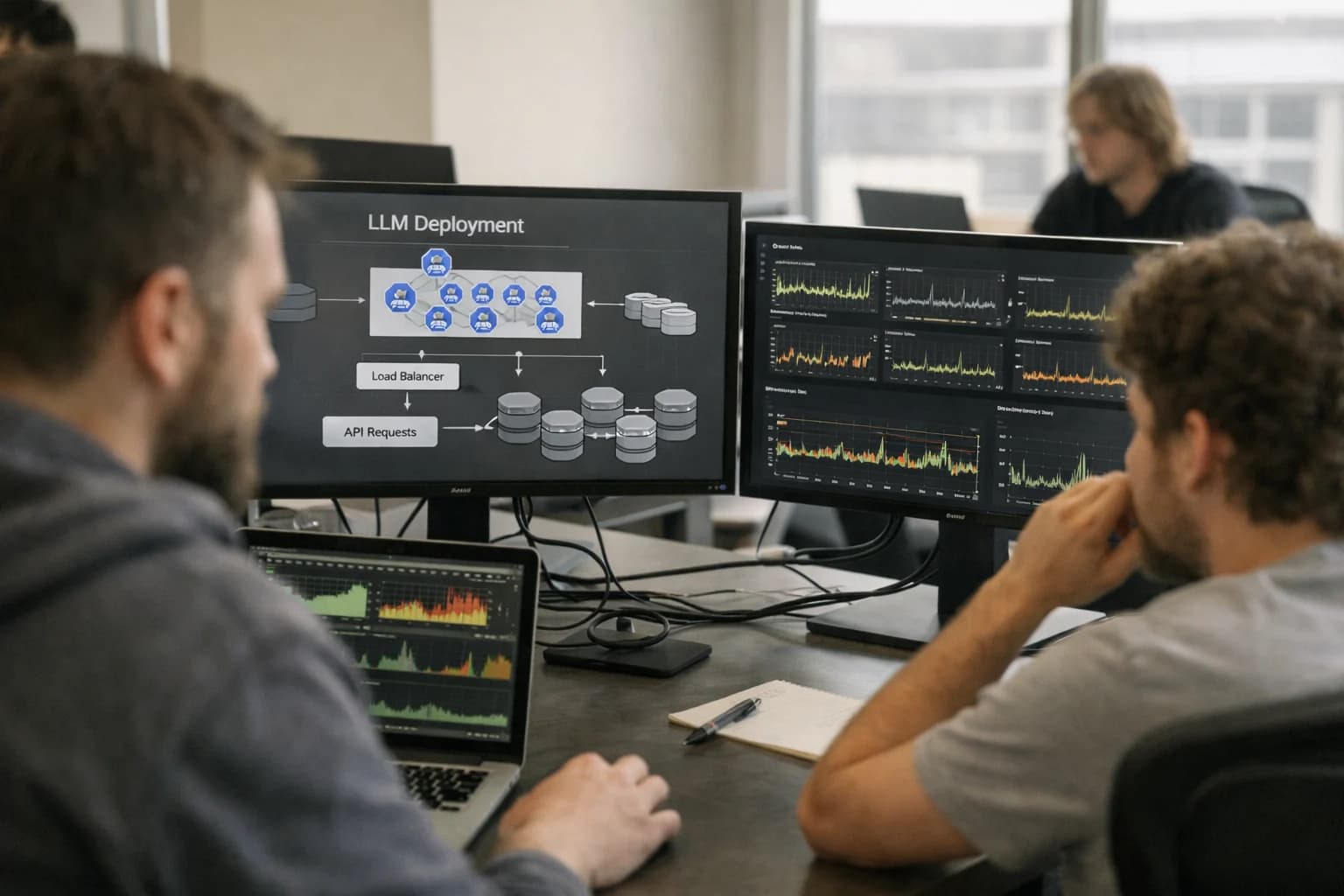
Use AI to generate, validate, and optimize Terraform code for Spectro Cloud Kubernetes cluster provisioning. Automate infrastructure-as-code creation, reduce manual configuration errors, and accelerate deployment cycles for platform engineering teams.
Where AI Fits into Spectro Cloud Terraform Workflows
Integrating AI with Spectro Cloud's Terraform provider automates the generation, validation, and optimization of infrastructure-as-code for Kubernetes cluster provisioning.
AI integration targets the Terraform provider's data model and execution lifecycle to reduce manual configuration errors and accelerate provisioning. Key surfaces include the spectrocloud_cluster and spectrocloud_cluster_profile resources, where AI can analyze existing profiles, cloud account configurations, and pack definitions to generate compliant, optimized Terraform code. This is particularly valuable for complex multi-cloud or hybrid deployments where manually calculating resource quotas, subnet CIDRs, and node pool mixes is time-consuming and error-prone.
Implementation typically involves an AI agent that sits between your version control system (like GitHub) and Spectro Cloud's APIs. The agent can be triggered via a pull request webhook to analyze proposed .tf files, checking for security misconfigurations (e.g., overly permissive IAM roles), cost inefficiencies (e.g., over-provisioned node instance types), and compatibility with your defined cluster profiles. It can then suggest specific edits, generate a summary of changes for the platform team, or even auto-apply pre-approved optimizations for non-production environments. This turns a manual code review process into an automated, policy-driven guardrail.
Rollout requires careful governance, starting with a read-only analysis phase. The AI should first audit existing Terraform state files to establish a baseline and identify common anti-patterns. From there, you can enable suggest-and-commit workflows where the AI proposes changes via PR comments, before progressing to auto-fix for low-risk changes in development clusters. Critical to this is maintaining a full audit trail—every AI-suggested change should be logged with the rationale (e.g., 'Reduced master_node count from 3 to 2 based on historical CPU utilization under 40%') and linked to the Spectro Cloud cluster ID for traceability. This ensures the platform engineering team retains oversight while delegating repetitive optimization tasks.
AI-ASSISTED INFRASTRUCTURE AS CODE
Key Integration Surfaces in the Spectro Cloud Terraform Provider
Automating Cluster Profile Definitions
The Terraform provider's spectrocloud_cluster_profile resource defines the complete stack—OS, CNI, CSI, and add-ons—for a cluster. AI can generate and validate these complex, multi-layer profiles.
AI Integration Use Cases:
Natural Language to Profile: Convert requirements like "a GPU-optimized cluster for Kubeflow on AWS with Calico and GP3 storage" into a valid cluster_profile configuration.
Version Compatibility Checking: Analyze the dependency matrix between Kubernetes versions, OS packs, and add-ons to prevent incompatible combinations in generated code.
Policy Enforcement: Ensure generated profiles adhere to organizational baselines for security (e.g., specific CSI driver) or cost (e.g., approved CNI plugins).
This integration reduces manual research and configuration errors, allowing platform teams to provision compliant, production-ready clusters from a simple description.
INFRASTRUCTURE-AS-CODE AUTOMATION
High-Value AI Use Cases for Spectro Cloud Terraform
Integrate AI with Spectro Cloud's Terraform provider to generate, validate, and optimize infrastructure-as-code for cluster provisioning, reducing manual configuration errors and accelerating deployment cycles for platform engineering teams.
01
Intelligent Cluster Blueprint Generation
Generate complete, compliant Spectro Cloud cluster profiles and pack definitions from natural language descriptions or existing YAML/Helm artifacts. AI analyzes your workload requirements (e.g., 'GPU-enabled cluster for PyTorch with Istio and Prometheus') and produces a validated Terraform module with the correct machine pools, storage classes, and add-ons.
1 sprint -> 1 day
Blueprint creation
02
Terraform Plan Analysis & Risk Prediction
Before terraform apply, an AI agent reviews the execution plan against organizational policies, historical deployment data, and cloud service limits. It flags high-risk changes (like node pool deletions), predicts potential drift based on cluster state, and suggests safer, incremental rollout strategies.
Pre-apply validation
Risk mitigation
03
Drift Detection & Auto-Remediation Code
Continuously monitor deployed Spectro Cloud clusters for configuration drift from Terraform state. AI compares live cluster settings (node labels, taints, resource quotas) with declared code, identifies the root cause of drift, and generates targeted Terraform code snippets to reconcile state without full re-provisioning.
Manual review -> Automated ticketing
Drift response
04
Cost-Optimized Machine Pool Refactoring
Analyze workload resource utilization (CPU, memory, GPU) across Spectro Cloud clusters and suggest optimized Terraform configurations for machine pools. AI recommends right-sizing instance types, mixing spot/on-demand instances, and adjusting autoscaling boundaries—then outputs the updated machine_pool blocks for review.
15-40% potential savings
Compute spend
05
Multi-Cloud Module Abstraction & Translation
Maintain a single, cloud-agnostic Terraform module for cluster definitions. An AI layer interprets the module and generates provider-specific Spectro Cloud configurations for AWS, Azure, and GCP—handling cloud-specific nuances like disk types, networking objects, and IAM roles—ensuring consistent deployments across environments.
Reduce duplicate code
Cross-cloud consistency
06
Compliance-as-Code Enforcement & Audit
Embed security and compliance guardrails directly into the Terraform workflow. AI scans proposed Spectro Cloud Terraform code for CIS benchmarks, tag policy violations, and network exposure risks. It can automatically inject required configurations (like enabling encryption) and generate audit-ready reports linking code commits to compliance status.
Pre-provisioning gates
Policy enforcement
SPECTRO CLOUD PALETTE
Example AI-Powered Terraform Workflows
Integrating AI with Spectro Cloud's Terraform provider automates the generation, validation, and optimization of infrastructure-as-code for Kubernetes cluster provisioning. These workflows reduce manual configuration errors, accelerate deployment cycles, and enforce organizational best practices.
Trigger: A developer or platform engineer initiates a request for a new Kubernetes cluster via a chat interface, service catalog, or Jira ticket.
Context/Data Pulled: The AI agent analyzes the request's natural language description and pulls relevant context from:
Existing cluster profile definitions in the organization's Git repository.
Spectro Cloud's Terraform provider schema for spectrocloud_cluster_profile.
Organizational policies (e.g., required add-ons like Linkerd, mandatory security scanners).
Cloud-specific constraints (e.g., available instance types in the target region).
Model/Agent Action: Using a structured LLM prompt, the agent generates a new or modified spectrocloud_cluster_profile resource block. It selects appropriate:
Pack Values: Configures parameters, ensuring they adhere to security baselines (e.g., podSecurityPolicy settings).
Layer Assignment: Correctly structures the profile's layers (system, infra, add-on).
System Update/Next Step: The generated Terraform code is committed as a Pull Request to the team's GitOps repository. The PR description includes a summary of changes and a link to the original request.
Human Review Point: A platform team member reviews the PR. The AI can also run a terraform plan in a sandbox environment and attach the output to the PR, highlighting any potential resource conflicts or cost implications.
FROM TERRAFORM STATE TO PRODUCTION CLUSTERS
Implementation Architecture: Data Flow and Guardrails
A secure, auditable pipeline for generating and applying AI-optimized infrastructure-as-code within Spectro Cloud's governance model.
The integration connects at two primary layers: the Spectro Cloud Terraform Provider API and the Palette GitOps repository. An AI agent, acting as a privileged service account within your Spectro Cloud organization, ingests natural language requests (e.g., "provision a GPU cluster for model training with 4 nodes, auto-scaling, and cost-optimized spot instances"). It first queries the provider's schema to understand valid arguments for spectrocloud_cluster, spectrocloud_cluster_profile, and related resources. The agent then generates a Terraform module, validates it against Spectro Cloud's cluster profile constraints and your organizational policies, and submits a Pull Request to your designated Git repository. This PR includes the generated .tf files, a plan output summary, and a compliance checklist derived from your defined guardrails.
Critical guardrails are enforced via a pre-commit validation chain before code generation and a post-generation policy check. These include: Cost Controls (capping instance types, enforcing spot instance mixes, setting max node counts), Security Baselines (validating that generated profiles enable CIS-hardened node pools and required add-ons like NeuVector), and Compliance Tagging (ensuring all resources include mandatory CostCenter and Environment tags). The AI agent references a vector store of your past successful cluster definitions and Spectro Cloud's public documentation to ground its suggestions in proven configurations, reducing drift from organizational standards. All generation activity is logged to an audit trail with the user ID, original prompt, and the final Terraform diff for compliance reviews.
For rollout, we recommend a phased approach. Start with a Dry-Run Environment where the AI agent generates plans but requires manual PR approval and apply via Spectro Cloud's GitOps engine. This builds trust in the output. Phase two introduces Automated Apply for Non-Production clusters, where low-risk changes (e.g., node count adjustments) are auto-applied after passing policy checks. The final phase enables Guarded Production Generation, where the agent can draft complex configurations, but all applies require a separate, multi-person approval workflow within Palette and are preceded by an automated run of Spectro Cloud's CIS scan against the planned cluster spec. This architecture ensures AI accelerates development while operating within the same GitOps, cost, and security controls your platform team already manages.
AI-DRIVEN INFRASTRUCTURE AS CODE
Code and Payload Examples
Analyzing Terraform Plans for Risk and Compliance
Use AI to analyze the JSON output of a terraform plan command before applying changes to your Spectro Cloud cluster definitions. This agent workflow identifies security misconfigurations, cost-impacting changes, and deviations from organizational policies.
python
# Example: AI Agent analyzing a Terraform plan for a Spectro Cloud cluster
import json
import openai
def analyze_terraform_plan(plan_json):
"""Send Terraform plan JSON to an LLM for analysis."""
prompt = f"""Analyze this Terraform plan for a Kubernetes cluster provisioned via Spectro Cloud.
Focus on:
1. Security: Overly permissive IAM roles, open security groups, missing encryption.
2. Cost: Instance type changes, new persistent volumes, increased node counts.
3. Compliance: Deviations from our tagging policy 'cost-center' and 'environment'.
4. Best Practice: Node pool sizing, availability zone distribution.
Plan JSON:
{json.dumps(plan_json, indent=2)}
Provide a summary and a list of high/medium priority findings.
"""
# Call to LLM (e.g., OpenAI, Anthropic, or a local model)
response = openai.ChatCompletion.create(
model="gpt-4",
messages=[{"role": "user", "content": prompt}]
)
return response.choices[0].message.content
# In practice, this would be triggered by a CI/CD pipeline webhook
# after `terraform plan -out=plan.json` and `terraform show -json plan.json`
This pattern enables automated governance gates, reducing manual review time for infrastructure changes from hours to minutes.
AI-ASSISTED TERRAFORM OPERATIONS
Realistic Time Savings and Operational Impact
How AI integration with Spectro Cloud's Terraform provider transforms infrastructure-as-code workflows for Kubernetes cluster provisioning, from initial design to ongoing compliance.
Metric
Before AI
After AI
Notes
Cluster Definition Drafting
Manual YAML/JSON authoring, 2-4 hours
AI-generated manifests from natural language, 15-30 minutes
Human review required for final validation and business logic
Terraform Plan Validation
Manual review of 100+ line plan outputs
AI-assisted diff analysis and risk flagging
Focuses reviewer attention on security, cost, and compatibility changes
Provider Configuration
Trial-and-error across cloud docs and examples
Context-aware snippet generation for AWS, Azure, GCP
Reduces misconfiguration leading to provisioning failures
Compliance & Policy Adherence
Post-provision CIS scan and manual remediation
Pre-flight policy checks integrated into plan stage
Provides confidence intervals for performance impact of modifications
Error Triage & Resolution
Searching logs, forums, and internal docs
AI-correlated error analysis with suggested fixes
Links Spectro Cloud logs to specific Terraform resource blocks
Team Onboarding & Knowledge
Weeks of tribal knowledge transfer
Interactive AI copilot for platform-specific patterns
Accelerates new engineer contribution to cluster definitions
ARCHITECTURE FOR CONTROLLED AUTOMATION
Governance, Security, and Phased Rollout
Integrating AI with Spectro Cloud's Terraform provider requires a security-first approach to infrastructure-as-code generation, ensuring changes are validated, traceable, and rolled out incrementally.
AI agents interact with the Spectro Cloud Terraform provider by generating and proposing Terraform configurations—clusterprofiles, packs, cloudconfigs—as pull requests or merge requests in your version control system (e.g., GitLab, GitHub). This creates a natural audit trail and gates all changes behind standard code review and CI/CD pipelines. The AI's role is to suggest optimizations, generate boilerplate for new cluster definitions, or refactor existing manifests, but the final apply is always a human or pipeline decision. This pattern ensures RBAC, change history, and the principle of least privilege are maintained, as the AI never holds direct apply credentials.
A phased rollout starts with read-only analysis, where the AI audits existing Terraform state and Spectro Cloud cluster configurations to identify security drifts, cost inefficiencies, or deviations from organizational baselines. The next phase introduces assisted generation, where the AI acts as a copilot within the developer's IDE or CI system, suggesting code completions for machinepools or storageclass definitions. The final phase enables automated remediation workflows for non-critical, repetitive tasks—like standardizing labels across all cluster resources—executed via automated commits that trigger your existing Spectro Cloud deployment pipelines. Each phase incorporates feedback loops to tune the AI's suggestions against your team's actual acceptance rates.
Security is enforced by scoping the AI's access to a dedicated service account within Spectro Cloud with granular permissions, limiting its scope to specific projects or tags. All generated code is scanned by existing SAST and Infrastructure-as-Code security tools (like Checkov or Terrascan) in the CI pipeline before any plan is executed. Furthermore, sensitive values—such as cloud credentials or private pack registries—are never exposed to the AI model; they are injected at runtime via your existing secrets management system. This architecture ensures the integration accelerates development while keeping your Spectro Cloud estate compliant and secure. For teams managing this lifecycle, our related guide on AI Governance for Kubernetes Platforms details policy enforcement and model evaluation frameworks.
Enabling Efficiency, Speed & Accuracy
Intelligent Analysis, Decision & Execution
We build AI systems for teams that need search across company data, workflow automation across tools, or AI features inside products and internal software.
AI INTEGRATION FOR SPECTRO CLOUD TERRAFORM
Frequently Asked Questions
Practical answers for platform engineers and infrastructure teams evaluating AI to automate and optimize Terraform-driven cluster provisioning with Spectro Cloud.
The integration connects to the Spectro Cloud Terraform provider's APIs and data sources. An AI agent or workflow can:
Read Existing State: Analyze your current terraform.tfstate and *.tf files to understand your cluster definitions, pack configurations, and cloud integrations.
Generate New Code: Use natural language prompts (e.g., "create a dev cluster for GPU workloads on Azure with auto-scaling") to generate valid Terraform configurations (main.tf, variables.tf, outputs.tf).
Validate & Optimize: Lint generated code against Spectro Cloud's schema, check for common misconfigurations (like insufficient node sizes for certain packs), and suggest cost or performance optimizations.
Execute Safely: The AI can prepare a plan, summarize changes in plain language for approval, and then apply the configuration via the provider, updating the Spectro Cloud Palette.
The core pattern is AI-as-a-copilot for Infrastructure-as-Code, sitting between the engineer's intent and the final, validated Terraform execution.
About the author
Prasad Kumkar
CEO & MD, Inference Systems
Prasad Kumkar is the CEO & MD of Inference Systems and writes about AI systems architecture, LLM infrastructure, model serving, evaluation, and production deployment. Over 5+ years, he has worked across computer vision models, L5 autonomous vehicle systems, and LLM research, with a focus on taking complex AI ideas into real-world engineering systems.
His work and writing cover AI systems, large language models, AI agents, multimodal systems, autonomous systems, inference optimization, RAG, evaluation, and production AI engineering.
Partnered with leading AI, data, and software stack.
How We Work
Custom AI workflows for your Business
One-fit-all AI don't work for modern businesses. At Inferensys, we aim to understand your business & custom requirements; which we use to define most efficient agentic workflows, the data, and the tools for your business.
The first call is a practical review of your use case and the right next step.