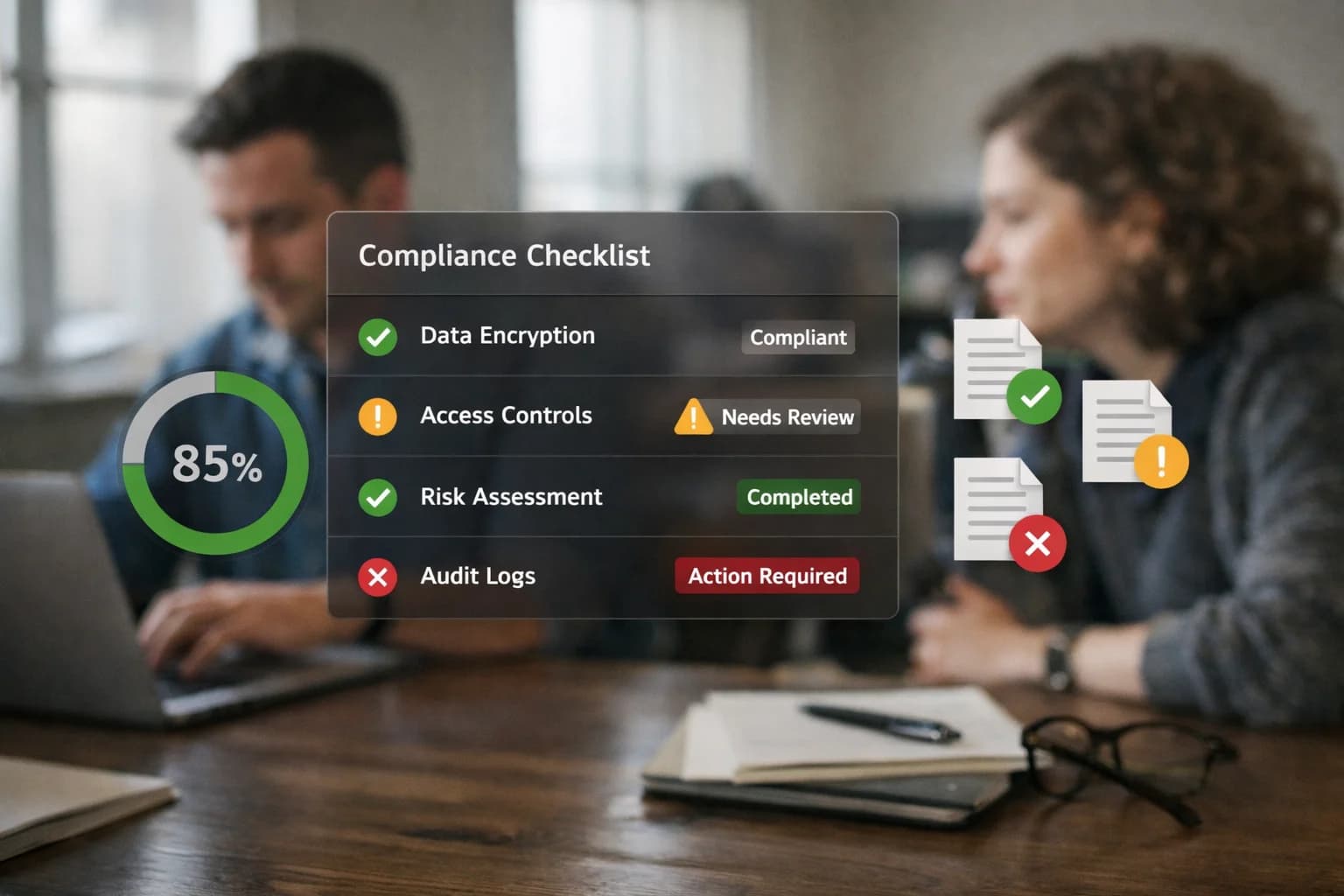
Augment the OpenShift Compliance Operator with AI to automate scan profile selection, interpret complex results, and generate actionable remediation playbooks for specific regulatory frameworks like PCI DSS, HIPAA, and SOC 2.
Integrating AI with the OpenShift Compliance Operator transforms static scan results into dynamic, actionable remediation plans tailored to your specific regulatory context.
The OpenShift Compliance Operator automates the collection of compliance data by applying SCAP (Security Content Automation Protocol) profiles like cis, e8, or stig to your clusters. However, the raw output—ComplianceCheckResult and ComplianceRemediation objects—often presents a massive, undifferentiated list of findings. AI integration acts as a force multiplier here, analyzing these results in the context of your specific regulatory framework (e.g., NIST 800-53, HIPAA, PCI-DSS), cluster configuration, and application portfolio to prioritize risks and generate context-aware fixes.
A practical implementation wires an AI agent into the operator's workflow via a webhook or a custom controller. When a scan completes, the agent ingests the ComplianceScan CR and its related objects. Using Retrieval-Augmented Generation (RAG) against your internal policy documents and past audit reports, it can: - Interpret complex, ambiguous scan rules.- Tailor generic remediation playbooks for your specific node types or cloud provider.- Generate executive summaries highlighting the most critical gaps for your auditors. The output can be new, annotated ComplianceRemediation resources or Jira tickets, moving teams from analysis to action in hours instead of days.
Rollout and governance are critical. Start with a dry-run mode where AI suggestions are logged but not applied, requiring manual approval via a GitOps pull request to the remediation repository. This creates an audit trail and allows security teams to validate the AI's logic. Over time, as confidence grows, you can automate the application of low-risk remediations (e.g., kernel parameter tuning) while escalating high-risk changes (e.g., network policy modifications) for human review. This balances speed with control, ensuring the AI augments—rather than bypasses—your existing compliance gates.
For platform teams managing compliance at scale across dozens of clusters, this integration shifts the role from manual result triage to strategic oversight. It connects the Compliance Operator's data to the broader organizational context, making compliance a continuous, integrated process rather than a periodic audit scramble. Explore related patterns for policy enforcement with our guides on AI Integration for Rancher OPA Gatekeeper and AI Integration for Spectro Cloud Compliance.
AUGMENTING SECURITY POSTURE AND AUDIT READINESS
AI Integration Touchpoints in the Compliance Operator
AI-Driven Profile Selection and Customization
The Compliance Operator uses predefined scan profiles (e.g., ocp4-cis, ocp4-cis-node). AI can analyze cluster configuration, workload types, and regulatory context (like NIST 800-53 or GDPR) to recommend or generate tailored scan profiles. This moves compliance from a generic checklist to a risk-based, context-aware activity.
Integration Touchpoints:
Profile Management API: AI agents can call the ComplianceScan and ScanSettingBinding CRDs to create or modify scans.
Cluster Context: Analyze Node, Namespace, NetworkPolicy, and SecurityContextConstraints resources to understand the environment.
Workflow: An AI agent reviews a new regulatory requirement, cross-references it with existing profiles, and generates a ScanSettingBinding YAML snippet that targets specific nodes or namespaces, optimizing scan runtime and relevance.
OPENSHIFT COMPLIANCE OPERATOR
High-Value AI Use Cases for Compliance Teams
Augment the OpenShift Compliance Operator with AI to move beyond static scanning. Use intelligent agents to interpret complex results, tailor remediation, and automate evidence collection for specific regulatory frameworks like NIST, PCI-DSS, and HIPAA.
01
Intelligent Profile Selection & Tailoring
Use AI to analyze your cluster's workload mix, deployment patterns, and risk posture to recommend the most relevant OpenSCAP profile (e.g., ocp4-cis, ocp4-pci-dss). The agent can also generate tailored rule exceptions or custom profiles based on justified business context, reducing false positives and manual tuning.
1 sprint
Profile setup time
02
Automated Remediation Playbook Generation
Transform raw Compliance Operator scan results into actionable, cluster-specific remediation playbooks. AI analyzes failed rules, cross-references your existing MachineConfigs, KubeletConfigs, and RBAC policies to generate safe Ansible playbooks, Kubernetes Job manifests, or oc command sequences, prioritizing high-risk, low-impact fixes first.
Hours -> Minutes
Playbook creation
03
Regulatory Framework Mapping & Evidence Packing
Automatically map OpenSCAP rule IDs to specific controls in frameworks like NIST 800-53 or CIS Benchmarks. An AI agent can compile a continuous evidence pack—aggregating scan results, applied remediations, and audit logs—into a structured report (JSON, PDF) for auditors, linked directly to control requirements.
Same day
Audit readiness
04
Drift Detection & Policy Enforcement
Continuously monitor for configuration drift post-remediation. AI agents can analyze periodic scan diffs, correlate with GitOps commit history and ClusterVersion changes, and trigger automated re-mediation or create ServiceNow tickets for security teams when manual review is required, enforcing a compliant baseline.
Batch -> Real-time
Drift detection
05
Root Cause Analysis for Persistent Failures
For rules that repeatedly fail remediation, use AI to perform root cause analysis. The agent can examine related resources (e.g., Operator health, node tuned profiles, network policies), cluster events, and even application deployment patterns to identify the underlying systemic issue and suggest architectural fixes.
Hours -> Minutes
Troubleshooting
06
Compliance Posture Forecasting & Risk Scoring
Predict future compliance risk by analyzing scan history alongside cluster change velocity (new Namespaces, Deployments, CRDs). AI can forecast potential rule failures based on upcoming platform upgrades or new workload types, allowing proactive policy adjustments and resource planning for the compliance team.
IMPLEMENTATION PATTERNS
Example AI-Augmented Compliance Workflows
These workflows demonstrate how AI agents can integrate with the OpenShift Compliance Operator's APIs and data to move from static scanning to dynamic, context-aware compliance management. Each pattern connects a specific trigger to an actionable outcome.
Trigger: A new compliance requirement (e.g., a new version of NIST 800-53, or a new industry-specific framework) is identified by the security team.
AI Agent Workflow:
Context Ingestion: The agent ingests the new regulatory framework document (PDF, webpage) and the organization's existing ComplianceScan custom resource definitions (CRDs).
Profile Mapping: Using an LLM, the agent analyzes the framework's controls and maps them to the closest available OpenSCAP profiles (e.g., cis, stig) and rules within the Compliance Operator's content library.
Gap Analysis & Draft Creation: The agent identifies controls with no direct mapping and drafts a new, tailored ScanSettingBinding and custom TailoredProfile. It flags unmapped controls for human review.
System Update: The agent generates a Pull Request in the team's GitOps repository with the new YAML manifests for the tailored profile and a suggested scan schedule.
Human Review Point: The security engineer reviews the PR, adjusts the agent's suggestions, and merges it. The Compliance Operator automatically applies the new profile.
Impact: Reduces profile creation from days of manual research and YAML crafting to hours of review and validation.
AUTOMATED COMPLIANCE WORKFLOWS
Implementation Architecture: Data Flow and Guardrails
A production-ready AI integration for the OpenShift Compliance Operator connects scan data to generative models for intelligent analysis and action, while enforcing strict governance for regulated environments.
The core data flow begins with the Compliance Operator'sComplianceScan and ComplianceCheckResult Custom Resources. An AI agent, deployed as a sidecar or separate service within the cluster, watches these objects via the Kubernetes API. When a scan completes, the agent extracts the raw XCCDF (SCAP) results, including rule identifiers, severity, and detailed descriptions of failures. This structured data, along with contextual cluster metadata (like node roles, namespaces, and installed operators), is packaged into a prompt for a large language model (LLM). The prompt instructs the model to interpret the finding within the context of a specific regulatory framework (e.g., NIST 800-53, CIS, HIPAA) and generate a tailored remediation playbook. This playbook is not generic; it includes cluster-specific commands, suggested MachineConfig or KubeletConfig changes, and links to relevant OpenShift documentation.
For implementation, we deploy the AI agent as a Kubernetes Operator itself, managing a ComplianceAI Custom Resource. This allows platform teams to declaratively enable AI analysis per scan profile or cluster. The agent uses OpenShift Service Accounts with fine-grained RBAC, scoped only to get and list compliance resources. Generated playbooks are stored as annotations on the source ComplianceCheckResult or as separate ConfigMaps, creating a clear audit trail. For high-volume environments, a message queue (like those backed by OpenShift Serverless) can buffer scan events, ensuring the AI service scales independently of scan frequency. The final output integrates directly into existing workflows: playbooks can trigger pre-approved Ansible Automation Platform job templates or create tracked Jira Service Management tickets via webhooks for manual review.
Critical guardrails are enforced at multiple layers. Data Minimization: The agent never sends raw cluster manifests or sensitive pod logs to external LLMs unless using a private, on-premise model served on OpenShift AI. For cloud APIs, only the rule metadata and failure descriptions are sent. Human-in-the-Loop: By default, generated playbooks are marked as draft and require approval via an OpenShift GitOps (Argo CD) pull request or a manual review in the OpenShift Console. Auditability: All AI interactions, including the prompt sent and the playbook received, are logged as Kubernetes events and can be forwarded to the OpenShift Cluster Logging (EFK) stack. This ensures every AI-suggested change can be traced back to the original compliance finding and the responsible platform engineer.
AI-ENHANCED COMPLIANCE WORKFLOWS
Code and Payload Examples
AI-Powered Profile Generation
Use AI to analyze your cluster's existing configuration and generate a tailored OpenShift Compliance Operator scan profile. This example shows a Python function that calls an LLM to interpret a generic profile (like cis) and customize rules based on your specific environment's risk tolerance and workload types.
python
import yaml
import requests
def generate_custom_profile(cluster_context: dict, base_profile: str = "cis") -> dict:
"""
Calls an AI service to tailor a compliance profile.
cluster_context includes: node_os, workload_types, regulatory_framework
"""
prompt = f"""
Given an OpenShift cluster running {cluster_context['node_os']}
with workloads: {', '.join(cluster_context['workload_types'])},
tailor the {base_profile} compliance profile for {cluster_context['regulatory_framework']}.
Return only a YAML list of tailored Rule objects for the ComplianceSuite.
"""
# Call Inference Systems' LLM gateway
response = requests.post(
"https://api.inferencesystems.com/v1/compliance/tailor",
json={"prompt": prompt, "base_profile": base_profile},
headers={"Authorization": f"Bearer {os.getenv('INFERENCE_API_KEY')}"}
)
tailored_rules = yaml.safe_load(response.json()["rules"])
# Construct the ComplianceSuite snippet
suite_spec = {
"scans": [{
"name": f"ai-tailored-{base_profile}",
"profile": {
"name": f"custom-{base_profile}",
"rules": tailored_rules
}
}]
}
return suite_spec
This integration allows platform teams to move beyond static benchmarks, creating dynamic profiles that adapt to your actual cluster architecture and compliance requirements.
AI-AUGMENTED COMPLIANCE OPERATIONS
Realistic Time Savings and Operational Impact
How AI integration transforms manual, reactive compliance tasks into proactive, automated workflows for the OpenShift Compliance Operator.
Metric
Before AI
After AI
Notes
Profile Selection & Tailoring
Manual research and trial-and-error for each framework (e.g., NIST, PCI-DSS)
AI suggests optimal scan profiles based on cluster workload and compliance goal
Reduces misconfiguration risk and ensures scans are relevant from the start
Result Triage & Prioritization
Manual review of hundreds to thousands of scan results to identify critical failures
AI categorizes failures by severity, exploitability, and business context
Focuses team effort on the 5-10% of findings that pose real risk
Remediation Playbook Generation
Engineers manually research and write Ansible playbooks or shell scripts for each failure
AI drafts context-aware remediation playbooks with cluster-specific commands
Human review required for safety, but first-draft creation time drops significantly
Evidence Collection for Audits
Manual screenshot capture, log aggregation, and report compilation across multiple clusters
AI auto-generates audit-ready summaries with linked scan results, remediations, and timestamps
Creates a continuous, verifiable compliance trail
Policy Exception Management
Ad-hoc tracking via spreadsheets or tickets; risk of exceptions expiring unnoticed
AI tracks exception requests, suggests renewal or closure, and integrates with ticketing (e.g., Jira)
Ensures governance is maintained and exceptions are formally managed
Compliance Drift Detection
Scheduled monthly or quarterly scans; issues can persist for weeks
AI analyzes configuration changes via GitOps or cluster events to flag potential drift in near-real-time
Shifts compliance from a point-in-time check to a continuous state
Team Training & Onboarding
Weeks of manual knowledge transfer on compliance frameworks and operator nuances
AI-powered copilot answers team questions about specific failures and best practices
Accelerates ramp-up for new platform and security engineers
CONTROLLED AI INTEGRATION FOR REGULATED ENVIRONMENTS
Governance, Security, and Phased Rollout
Integrating AI with the OpenShift Compliance Operator requires a security-first, phased approach to maintain auditability and control.
The integration architecture must respect the immutable, declarative nature of the Compliance Operator. AI agents interact via the Operator's APIs and custom resources—never directly modifying scan results or enforcement points. Key touchpoints include:
TailoredScan and ScanSettingBinding CRs: AI analyzes cluster context and regulatory framework to generate or suggest optimized scan profiles.
ComplianceCheckResult and ComplianceRemediation CRs: AI interprets complex scan results, prioritizes findings based on exploitability and business impact, and drafts remediation playbooks as annotated Kubernetes resources or Ansible playbooks.
Rule and Profile objects: AI assists in creating custom rules for organization-specific policies, ensuring they are expressed correctly in the Operator's SCAP-based format.
All AI interactions are logged as Kubernetes events and can be routed to the cluster's audit log for a complete chain of custody.
A phased rollout is critical for risk management and user adoption. A typical implementation follows this pattern:
Phase 1: Analysis & Drafting (Read-Only)
AI agents have read-only access to Compliance Operator resources and cluster metadata.
Use case: Analyze historical scan results to identify recurring, high-effort remediation patterns. Generate draft remediation ConfigMap objects for engineer review.
Impact: Reduces manual analysis time from hours to minutes for complex scans like PCI-DSS or HIPAA.
Phase 2: Assisted Remediation (Approval Workflow)
AI can generate ComplianceRemediation and MachineConfig objects, but they are created in a Pending state, requiring a platform engineer or security officer approval via a GitOps pull request or a dedicated approval UI.
Use case: After a scan, AI suggests a prioritized list of remediations with estimated risk reduction and potential service impact. The human-in-the-loop approves, modifies, or rejects each.
Phase 3: Closed-Loop Optimization
With sufficient trust, AI can apply low-risk, non-disruptive remediations automatically (e.g., updating a Pod Security Standard label). It monitors application health post-application and can roll back if anomalies are detected.
All automatic actions are gated by Policy-as-Code rules defined in OpenShift's ConstraintTemplate (OPA/Gatekeeper) to prevent actions outside a pre-defined safe boundary.
Security and governance are paramount. The AI service must run within the cluster under a tightly scoped ServiceAccount with RBAC rules following the principle of least privilege. All prompts, context sent to LLMs, and generated outputs should be logged to a secure, immutable system like OpenShift's internal logging stack or an external SIEM. For highly sensitive environments, consider using a private, on-premise LLM or a VPC-endpoint to a cloud model service to ensure scan data and cluster metadata never leaves the controlled network. This layered approach ensures the AI integration enhances the Compliance Operator's mission—providing actionable, auditable security—without introducing unmanaged risk or opaque decision-making.
Enabling Efficiency, Speed & Accuracy
Intelligent Analysis, Decision & Execution
We build AI systems for teams that need search across company data, workflow automation across tools, or AI features inside products and internal software.
AI INTEGRATION FOR OPENSHIFT COMPLIANCE OPERATOR
Frequently Asked Questions
Practical questions for platform, security, and compliance teams planning to augment the OpenShift Compliance Operator with AI for tailored scanning, result interpretation, and automated remediation.
The integration connects at three key API and data points:
Scan Results & Raw ARF Data: AI agents ingest the Compliance Operator's scan results, including the raw Asset Reporting Format (ARF) data from OpenSCAP. This provides the detailed, rule-level findings needed for contextual analysis.
ScanConfiguration & TailoredProfile CRDs: AI can analyze existing ScanSetting and ScanSettingBinding resources, and generate or modify TailoredProfile Custom Resource Definitions (CRDs). This allows the AI to create compliance profiles specific to your cluster's role (e.g., worker vs. master) and your target framework (e.g., PCI-DSS, HIPAA).
Remediation CRDs: The core AI workflow generates actionable ComplianceRemediation objects. The AI doesn't apply them directly but creates the detailed, reviewed remediation plans that an administrator or automated pipeline can then approve and apply.
Typical Integration Pattern:
yaml
# Example flow: AI analyzes a scan, creates a tailored remediation.
1. Compliance Operator runs a CIS scan -> Produces `ComplianceScan` result.
2. Webhook or scheduled job triggers AI agent with scan result name/namespace.
3. AI fetches ARF data, analyzes context (node roles, existing workloads).
4. AI creates a `ComplianceRemediation` CR with:
- Specific, safe `apply` YAML patches.
- A natural-language summary of the risk and fix.
- A priority score based on exploitability & cluster context.
5. Remediation is marked `Pending` for human review or auto-approved via policy.
About the author
Prasad Kumkar
CEO & MD, Inference Systems
Prasad Kumkar is the CEO & MD of Inference Systems and writes about AI systems architecture, LLM infrastructure, model serving, evaluation, and production deployment. Over 5+ years, he has worked across computer vision models, L5 autonomous vehicle systems, and LLM research, with a focus on taking complex AI ideas into real-world engineering systems.
His work and writing cover AI systems, large language models, AI agents, multimodal systems, autonomous systems, inference optimization, RAG, evaluation, and production AI engineering.
Partnered with leading AI, data, and software stack.
How We Work
Custom AI workflows for your Business
One-fit-all AI don't work for modern businesses. At Inferensys, we aim to understand your business & custom requirements; which we use to define most efficient agentic workflows, the data, and the tools for your business.
The first call is a practical review of your use case and the right next step.