
Inferensys

Integration

AI Integration for ServiceNow Salesforce Service Cloud

A technical blueprint for building bi-directional AI workflows between ServiceNow and Salesforce Service Cloud. Automate case routing, data enrichment, and resolution handoffs between IT and customer support teams.
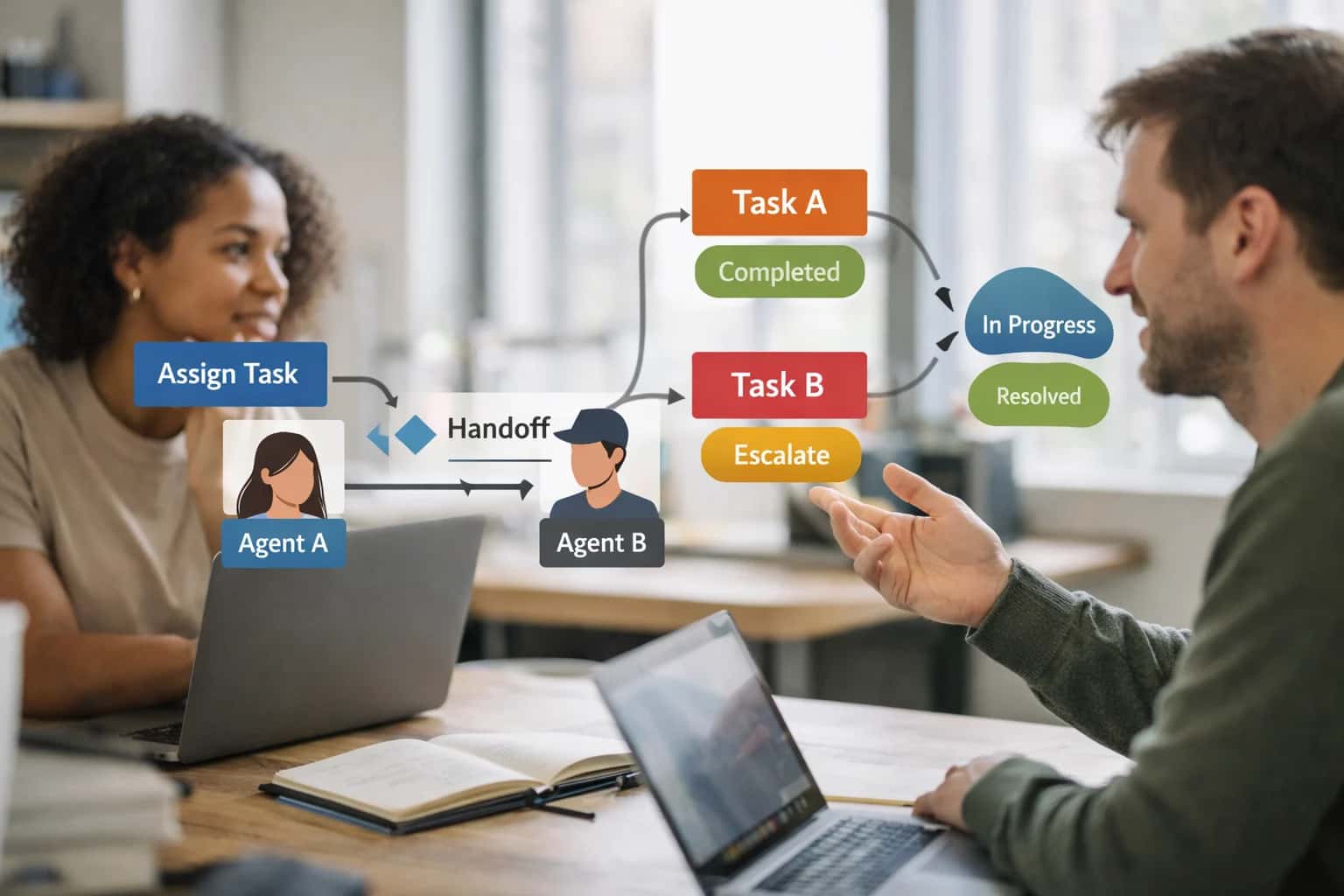
Engineer reviewing agent handoff workflow on laptop, task routing diagrams visible, technical office setup.
ARCHITECTURE FOR BI-DIRECTIONAL INTELLIGENCE

Where AI Fits in the ServiceNow-Salesforce Bridge

A technical blueprint for using AI to automate and enrich workflows between IT service management and customer support.

The integration surface between ServiceNow and Salesforce Service Cloud is rich with manual, high-volume workflows that are ideal for AI automation. Key touchpoints include:

  • Case/Object Synchronization: AI can analyze the content of a new Salesforce Case or ServiceNow Incident to determine if it should be created or updated in the linked system, populating fields like Priority, Category, and Assignment Group based on natural language analysis.
  • Cross-Platform Triage: An AI agent can read the Description and Comments from either platform to decide: "Is this a technical IT issue (route to ServiceNow) or a product/billing question (route to Salesforce)?" This reduces misrouted tickets and handoff delays.
  • Data Enrichment: When a case is synced, an LLM can summarize the thread from the source system into a concise Work Notes or Case Comment in the destination, giving the receiving agent immediate context without clicking through links.

Implementation typically involves a middleware layer (or leveraging ServiceNow Integration Hub and Salesforce Flow) that hosts the AI orchestration. A common pattern:

  1. A webhook from Salesforce (Case.created) or a scheduled job in ServiceNow (GlideSchedule) triggers the AI service.
  2. The AI model (e.g., GPT-4, Claude) receives the ticket payload—including subject, description, attachments (text extracted)—and runs a classification prompt: "Classify intent: IT Support, Sales Inquiry, Billing, Product Bug."
  3. Based on the classification and confidence score, the workflow either:
    • Creates/Updates a corresponding record in the other platform via REST API.
    • Posts an enriched summary back to the original record.
    • Flags for human review in a low-confidence queue.
  4. All actions are logged in both platforms' audit trails (sys_audit in ServiceNow, FieldHistory in Salesforce) for governance.

Rollout requires a phased, use-case-led approach. Start with a single, high-volume workflow like "Customer reports a login error" which could be an IT password reset (ServiceNow) or a customer account issue (Salesforce). Use the AI to suggest the correct routing, but keep a human-in-the-loop for the first few weeks to build confidence and refine prompts. Governance is critical: establish clear RBAC for who can modify the AI routing logic, implement regular accuracy reviews against a sample of synced tickets, and set up alerting for when the AI's confidence scores drop below a threshold, indicating potential model drift or new, unhandled issue types.

AI INTEGRATION FOR SERVICENOW SALESFORCE SERVICE CLOUD

Key Integration Surfaces in ServiceNow and Salesforce

Bidirectional Case and Incident Workflows

The core integration surface is the bi-directional sync of Case (Salesforce) and Incident or Service Request (ServiceNow) records. AI can intelligently route and enrich these records as they move between customer support and IT teams.

Key Data Objects:

  • Salesforce: Case object, with fields like Subject, Description, Priority, ContactId, AccountId.
  • ServiceNow: Incident or Service Request tables, with fields like short_description, description, urgency, caller_id, cmdb_ci.

AI Use Cases:

  • Automatic Triage & Routing: An LLM analyzes the case description to determine if it's a customer-facing issue (stay in Salesforce) or an internal IT problem (create/route to ServiceNow).
  • Field Mapping & Enrichment: AI populates corresponding fields during sync, e.g., mapping a Salesforce Account to a ServiceNow Configuration Item (CI).
  • Contextual Summarization: When a case is escalated, AI generates a concise summary for the receiving team, pulling from case notes and attachments.

Implementation Pattern: A middleware service (or ServiceNow Integration Hub) listens for webhooks on case updates, calls an LLM for classification/routing logic, and uses REST APIs to create/update records in the target system.

BI-DIRECTIONAL WORKFLOW AUTOMATION

High-Value AI Use Cases for ServiceNow + Salesforce

Integrating AI between ServiceNow and Salesforce Service Cloud creates a unified support ecosystem where customer issues and internal IT incidents are intelligently routed, enriched, and resolved. These workflows break down data silos and automate handoffs.

01

Intelligent Case Routing & Triage

An AI agent analyzes incoming Salesforce cases in real-time. Using natural language understanding, it determines if the issue is a customer support query (stays in Salesforce) or an IT infrastructure/access problem (creates a linked incident in ServiceNow). The agent auto-populates relevant fields (CI, priority, assignment group) based on the case description and user history.

Batch -> Real-time
Routing logic
02

Bi-Directional Status & Resolution Sync

When a ServiceNow incident linked to a Salesforce case is updated, an AI-powered workflow generates a customer-friendly status summary and posts it back to the Salesforce case feed. This keeps the account team and customer informed without manual copy-pasting, maintaining a single source of truth.

Same day
Visibility improvement
03

Unified Knowledge Retrieval (RAG)

A shared RAG (Retrieval-Augmented Generation) system indexes knowledge articles from both ServiceNow KB and Salesforce Knowledge. Support agents in either platform can query this unified index via a copilot. The AI retrieves and synthesizes relevant steps from both IT and customer support guides to resolve cross-functional issues.

1 sprint
Implementation scope
04

Proactive Customer Impact Analysis

For major ServiceNow incidents (e.g., VPN outage), an AI workflow automatically queries Salesforce to identify impacted customers (based on account entitlements or recent support tickets). It then drafts personalized, proactive notifications for the Salesforce account team to send, turning a reactive IT event into a proactive customer touchpoint.

Hours -> Minutes
Impact assessment
05

Automated Escalation to Tier 3

When a Salesforce case involves a complex technical issue beyond L1/L2 support, an AI agent reviews the conversation history and attached logs. It can auto-create a ServiceNow problem record with a summarized technical context, link the original case, and assign it to the appropriate engineering team, ensuring nothing falls through the cracks.

Manual -> Automated
Workflow step
06

Cross-Platform Reporting & Insights

An AI analytics pipeline aggregates ticket data from both platforms. It generates natural language insights on trends like '30% of high-priority Salesforce cases are related to pending ServiceNow access requests', enabling leadership to identify and fix systemic process gaps between support and IT teams.

BI-DIRECTIONAL SERVICE OPERATIONS

Example AI-Powered Workflows and Agent Flows

These concrete workflows illustrate how AI agents can orchestrate intelligent handoffs and data synchronization between ServiceNow (ITSM) and Salesforce Service Cloud (CSS), turning siloed support channels into a unified, intelligent service operation.

Trigger: A ServiceNow Incident is created or updated with a priority of 1 - Critical and a category matching application - customer_facing.

Agent Flow:

  1. An AI agent, triggered by a Flow Designer flow, analyzes the incident description, work notes, and CMDB data (e.g., business_service).
  2. Using an LLM, the agent generates a concise, business-impact summary (e.g., "E-commerce checkout service degraded, impacting 30% of user transactions").
  3. The agent calls the Salesforce Composite API to create a new Case in Service Cloud.
    • Payload Example:
    json
    {
      "records": [{
        "attributes": {"type": "Case"},
        "Origin": "IT Escalation",
        "Subject": "[IT Critical] E-commerce Checkout Service Degradation",
        "Description": "[AI-Generated Summary] E-commerce checkout service degraded, impacting 30% of user transactions. Linked to SN Incident INC0012345.",
        "Priority": "High",
        "AccountId": "<Salesforce Account ID mapped from ServiceNow CI>",
        "Status": "New"
      }]
    }
  4. The agent updates the ServiceNow Incident with the new Salesforce Case Number (sf_case_number) and posts a work note confirming the escalation.

Human Review Point: The AI-generated summary is reviewed by the IT agent before the API call is executed (optional approval step in Flow Designer).

SYNCING IT AND CUSTOMER SUPPORT WORKFLOWS

Implementation Architecture: Data Flow and Guardrails

A production-ready blueprint for bi-directional AI workflows between ServiceNow and Salesforce Service Cloud.

The core integration pattern establishes ServiceNow as the system of record for IT incidents and Salesforce Service Cloud for customer-facing cases. AI agents act as the intelligent routing layer between them. Key data objects are synced via platform APIs (/api/now/table/incident, Salesforce Case REST API) or middleware queues. The critical sync includes: the case/incident description, contact/user details, priority, and a dedicated Cross-Platform_Reference_ID__c custom field in Salesforce and u_salesforce_case_id in ServiceNow to maintain a bidirectional audit trail.

High-value AI workflows are triggered by field updates or platform events. For example: an AI agent monitors new Salesforce cases; if the description contains terms like "VPN error" or "login failure," it uses a classification model to determine if the issue is IT-owned. If yes, it automatically creates a linked ServiceNow incident, populates the CMDB CI, and posts a comment back to the Salesforce case with the incident number and expected SLA. Conversely, when a ServiceNow incident is resolved, an agent can update the linked Salesforce case status, generate a customer-friendly resolution summary using an LLM, and trigger a closure workflow in Service Cloud.

Governance is enforced at the API layer and within the agent framework. All automated actions are logged to the respective platform's audit logs (sys_audit in ServiceNow, SetupAuditTrail in Salesforce). A human-in-the-loop approval step can be configured for high-priority or high-risk case transfers using platform-native approval processes (sysapproval_approver table, Salesforce Approval Processes). The AI agents operate with strict RBAC, using dedicated integration users with scoped application access in ServiceNow and a permission set in Salesforce limited to necessary object and field operations.

Rollout follows a phased approach: start with a pilot group of IT and support agents, routing only specific, well-defined case types (e.g., password resets, access requests). Use this phase to calibrate the AI classification confidence thresholds and refine the prompt templates used for summary generation. Metrics like manual transfer reduction, mean time to route, and case/incident linkage accuracy should be tracked in a shared dashboard. This controlled deployment ensures the integration delivers operational lift—turning cross-team handoffs from hours to minutes—without introducing unmanaged risk into critical support processes.

BI-DIRECTIONAL AI WORKFLOWS

Code and Payload Examples

Syncing and Enriching Cases Between Platforms

A core integration pattern is using AI to analyze and enrich case data as it syncs between ServiceNow and Salesforce Service Cloud. This often involves a middleware service (like an Azure Function or AWS Lambda) triggered by platform webhooks.

When a high-priority case is created in ServiceNow, the integration can:

  1. Push the case summary and attachments to Salesforce as a new Case object.
  2. Use an LLM to analyze the ticket description and CMDB data to predict the required support tier (L1, L2, L3) and suggest an initial assignment group in Salesforce.
  3. Enrich the Salesforce Case with key entities extracted from the ServiceNow ticket, such as affected users, CI names, and error codes.
python
# Example: Webhook handler to sync & enrich a case from ServiceNow to Salesforce
import requests
import os
from openai import OpenAI

client = OpenAI(api_key=os.getenv('OPENAI_API_KEY'))

def servicenow_to_salesforce_webhook(servicenow_ticket):
    """Enrich and sync a ServiceNow Incident to Salesforce Service Cloud."""
    
    # 1. Call LLM to analyze ticket and suggest routing
    prompt = f"""
    ServiceNow Ticket Summary: {servicenow_ticket['short_description']}
    Full Description: {servicenow_ticket['description']}
    Category: {servicenow_ticket['category']}
    
    Based on this IT issue, recommend:
    - Support Tier (L1, L2, L3)
    - Primary issue category for Salesforce
    - One-line summary for Salesforce Case subject.
    Return as JSON.
    """
    
    llm_response = client.chat.completions.create(
        model="gpt-4o-mini",
        messages=[{"role": "user", "content": prompt}],
        response_format={ "type": "json_object" }
    )
    analysis = json.loads(llm_response.choices[0].message.content)
    
    # 2. Build payload for Salesforce Case creation
    salesforce_payload = {
        "Subject": f"SNOW-{servicenow_ticket['number']}: {analysis['summary']}",
        "Description": servicenow_ticket['description'],
        "Priority": servicenow_ticket['priority'],
        "Origin": "ServiceNow",
        "SuppliedEmail": servicenow_ticket['caller_email'],
        "Custom_Field__Support_Tier__c": analysis['support_tier'],
        "Custom_Field__ServiceNow_Link__c": servicenow_ticket['link']
    }
    
    # 3. Create Case in Salesforce via REST API
    sf_response = requests.post(
        f"{os.getenv('SALESFORCE_INSTANCE_URL')}/services/data/v60.0/sobjects/Case",
        headers={"Authorization": f"Bearer {os.getenv('SALESFORCE_ACCESS_TOKEN')}"},
        json=salesforce_payload
    )
    return sf_response.json()
BI-DIRECTIONAL AI WORKFLOWS

Realistic Operational Impact and Time Savings

This table outlines the tangible improvements when AI orchestrates case handoffs and data syncs between ServiceNow and Salesforce Service Cloud, focusing on reducing manual coordination and accelerating resolution.

Workflow / MetricBefore AI (Manual Process)After AI (Orchestrated Process)Implementation Notes

Case Routing from Service Cloud to ServiceNow

Agent manually reviews, tags, and forwards via email or integration. (15-30 mins)

AI analyzes description, auto-classifies as IT issue, creates linked ServiceNow incident. (<2 mins)

Requires mapping Service Cloud case types to ServiceNow CI/service models. Human review for edge cases.

Resolution Sync from ServiceNow to Service Cloud

IT agent updates ServiceNow, support agent manually checks and closes Service Cloud case. (Next business day)

ServiceNow closure triggers AI to draft customer-facing summary, auto-close linked Service Cloud case. (Same day)

AI-generated summary sent for agent approval before customer communication. Maintains audit trail.

Customer Context for IT Agents

IT agent spends 5-10 mins searching CMDB and email for customer/contract details.

AI fetches and surfaces relevant Service Cloud account, contract, SLA data within ServiceNow incident. (On-demand)

Leverages bi-directional API sync. Data is presented in a dedicated incident custom field or side panel.

Major Incident Communications

Support team manually identifies affected customers from Service Cloud, drafts individual emails. (Hours)

AI queries Service Cloud for active cases linked to affected CI, generates personalized comms batch. (30 mins)

Integrates with ServiceNow Event Management. Communications are templated but personalized; human sends.

Knowledge Article Gap Identification

Teams separately flag missing solutions. Periodic manual reconciliation. (Weeks)

AI analyzes recurring case themes across both platforms, suggests single knowledge article to fill gap. (Ongoing)

Article suggestions routed to a combined review queue. Requires a unified article taxonomy.

SLA Breach Risk Prediction

Manually monitored via separate dashboards. Escalation often reactive.

AI models analyze progress across both platforms, predict joint SLA risk, alert both teams. (Proactive)

Model trained on historical resolution times. Alerts via Slack/Microsoft Teams or platform notifications.

Pilot Rollout & Agent Enablement

Custom integration build, then weeks of training and process change management.

Phased rollout: Start with auto-classification & sync for 1-2 case types, then expand. (2-4 weeks)

Critical to co-design workflows with IT and support leads. Measure deflection rate and handle time.

ARCHITECTING A CONTROLLED, SECURE INTEGRATION

Governance, Security, and Phased Rollout

A production-ready AI integration between ServiceNow and Salesforce Service Cloud requires a deliberate approach to data governance, security, and phased adoption.

The integration architecture must enforce strict data governance, treating each platform as a system-of-record for its respective domain. AI agents should operate on a need-to-know basis, accessing only the specific Case, Incident, Contact, and Configuration Item (CI) fields required for routing or enrichment decisions. All API calls between ServiceNow's Table API and Salesforce's Composite API must be logged, with sensitive PII or operational data masked in prompts. A central vector store for RAG should be populated with sanitized, anonymized knowledge articles and resolution data to ground AI responses without exposing raw customer or system details.

A phased rollout is critical for managing risk and proving value. Phase 1 typically focuses on a single, high-volume workflow—like using AI to analyze inbound Salesforce Service Cloud cases and automatically creating linked ServiceNow Incident records for technical issues, with a human-in-the-loop approval step. Phase 2 expands to bi-directional sync, where AI monitors ServiceNow resolution notes and pushes status summaries back to the linked Salesforce case, all logged in each platform's audit trail. Phase 3 introduces predictive routing, where the AI model, trained on historical resolution data, suggests whether a new case should be owned by Customer Support (Salesforce) or IT (ServiceNow) before assignment.

Security is paramount. The integration service should run under dedicated service accounts with minimal, scoped permissions in each platform (e.g., Create on Incident table, Read/Update on Case object). All calls to external LLM APIs (like OpenAI or Anthropic) should be proxied through a secure gateway to enforce rate limiting, prompt logging, and output filtering. Finally, establish a regular review cadence to audit AI-driven decisions, measure deflection and resolution time impact, and refine the guardrails and prompts governing the cross-platform workflow. This controlled approach ensures the integration scales from a pilot to a mission-critical, trusted system.

IMPLEMENTATION AND ARCHITECTURE

Frequently Asked Questions

Common technical and strategic questions about building bi-directional AI workflows between ServiceNow and Salesforce Service Cloud.

A production integration requires a real-time, event-driven sync of key case/incident objects to provide AI agents with full context. The typical pattern uses middleware (like MuleSoft, Boomi, or a custom service) to orchestrate.

Core Sync Objects:

  • ServiceNow Incident → Salesforce Case: Sync short_description, description, urgency, impact, cmdb_ci (CI name), assignment_group, and sys_id.
  • Salesforce Case → ServiceNow Incident: Sync Subject, Description, Priority, ContactId (or related Account), CaseNumber, and Id.

Implementation Flow:

  1. Trigger: A webhook from ServiceNow's spoke-outbound-rest or Salesforce's Platform Events fires on case create/update.
  2. Orchestration Layer: Middleware receives the event, enriches data (e.g., pulls user details from CMDB or Contact object), and formats the payload.
  3. AI Context Store: The enriched payload is written to a shared context layer—often a vector database (Pinecone, Weaviate) keyed by a composite ID (e.g., SNOW-INC0012345|SFDC-5003k00002ABCDe).
  4. Idempotency: Use the source system's last_updated timestamp and a deduplication queue to prevent sync loops.

This architecture ensures the AI agent querying for "customer's latest network issue" retrieves linked records from both systems.

Prasad Kumkar

About the author

Prasad Kumkar

CEO & MD, Inference Systems

Prasad Kumkar is the CEO & MD of Inference Systems and writes about AI systems architecture, LLM infrastructure, model serving, evaluation, and production deployment. Over 5+ years, he has worked across computer vision models, L5 autonomous vehicle systems, and LLM research, with a focus on taking complex AI ideas into real-world engineering systems.

His work and writing cover AI systems, large language models, AI agents, multimodal systems, autonomous systems, inference optimization, RAG, evaluation, and production AI engineering.



