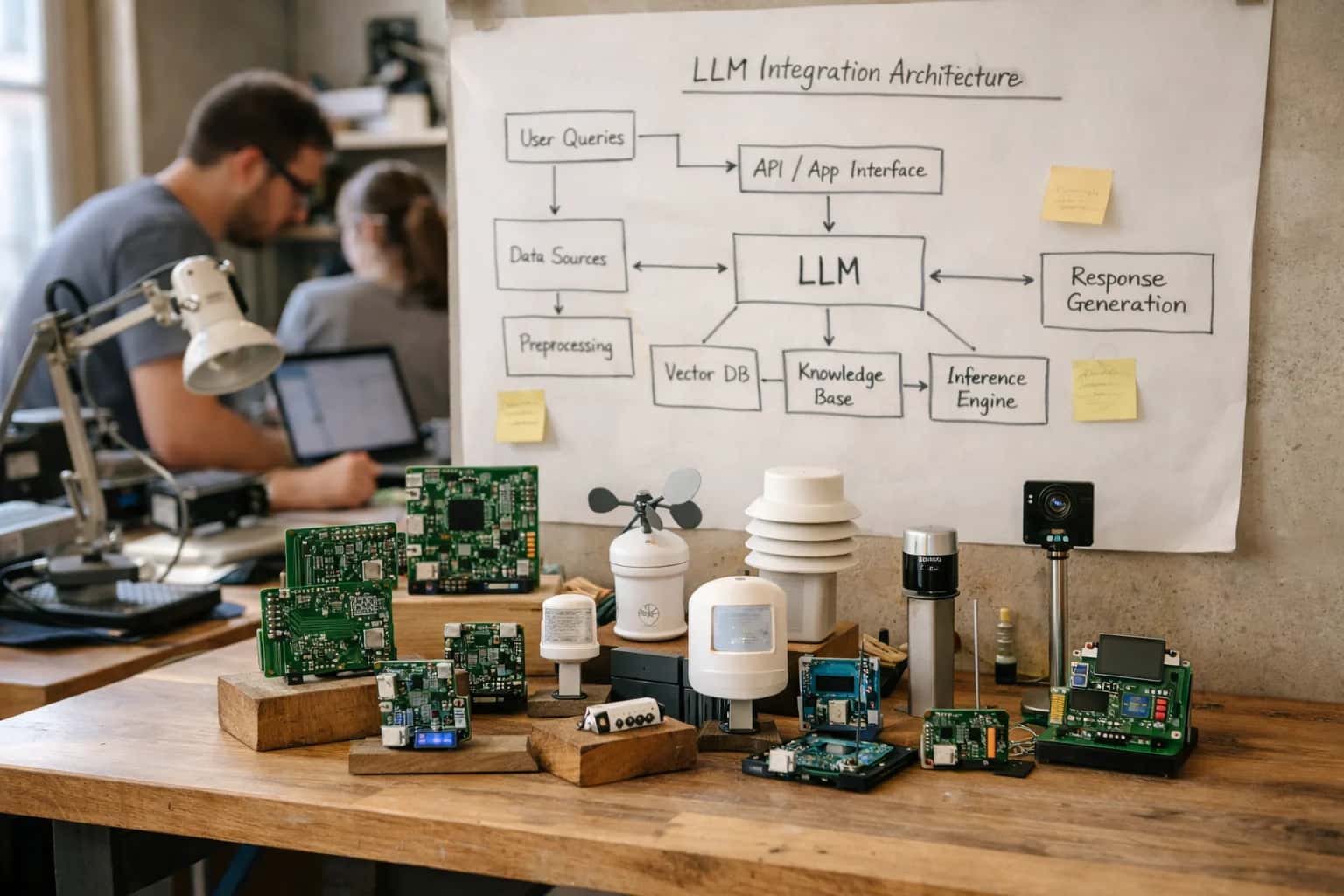
An AI-powered FNOL system acts as an orchestration layer between intake channels and your core claims platform—be it Guidewire ClaimCenter, Duck Creek Claims, or Sapiens ClaimsPro. It intercepts the initial report via IVR, web chat, mobile app, or IoT alert, performs immediate triage, and enriches the claim file before it hits the adjuster's queue. The integration is typically built on three key connections: 1) a real-time API to your claims system to create the initial claim record and party data, 2) a bi-directional sync with your policy administration system (like Guidewire PolicyCenter) for instant coverage verification, and 3) hooks into your document management system to store AI-generated summaries and extracted evidence.

Integration
AI-Powered FNOL for Insurance
A technical blueprint for integrating AI into First Notice of Loss systems to automate intake from calls, web, mobile, and IoT, reducing cycle time from hours to minutes.
ARCHITECTURE BLUEPRINT
Where AI Fits in the FNOL Workflow
A technical breakdown of how AI agents integrate with core insurance systems to automate and enhance the First Notice of Loss process.
The high-value automation surfaces are specific and sequential. For a web or mobile FNOL, an AI copilot can guide the claimant through a dynamic Q&A, using their answers and uploaded photos/videos to auto-populate the loss description, preliminary cause of loss, and suggested exposure lines. For a telephonic FNOL, real-time speech-to-text and natural language understanding extract key entities (date, time, location, involved parties, vehicle VIN) while the call is in progress, posting a structured summary to the claim file. In all cases, the AI evaluates claim complexity using pre-configured rules—factoring in loss type, coverage limits, and injury flags—to assign an initial severity score and recommend routing to straight-through processing, a frontline adjuster, or a specialized unit.
Governance is critical. Every AI-suggested field or action should be logged as a system activity with a confidence score, creating a clear audit trail. For straight-through processing of low-complexity claims (e.g., glass-only auto, minor property), the workflow can be fully automated, with the AI preparing the estimate via integration with Snapsheet or a parts database and issuing payment instructions. For all other claims, the system presents the adjuster with a pre-built, validated summary, allowing them to focus on investigation and decision-making rather than data entry. Rollout follows a phased approach: start with AI as a silent copilot populating a shadow claim file for QA, then progress to a human-in-the-loop model where adjusters review and approve AI suggestions, and finally enable full automation for defined, low-risk claim types.
This architecture turns FNOL from a manual data-capture bottleneck into a intelligent triage engine. The result is faster cycle times (initial setup in minutes, not hours), more accurate initial data (reducing downstream rework), and freed-up adjuster capacity to handle complex cases. For a deeper technical dive on connecting these AI services to a specific platform, see our guides on AI Integration for Guidewire ClaimCenter and AI Integration for Duck Creek Claims.
AI-POWERED FNOL
Integration Surfaces for Major Claims Platforms
Voice, Chat, and Mobile Entry Points
AI-powered FNOL begins by intercepting and interpreting the initial customer signal. Integration surfaces include:
- IVR/Contact Center APIs: Connect AI services to telephony platforms (e.g., Twilio, Genesys) for real-time speech-to-text, intent recognition, and dynamic question routing. The AI agent can verify policyholder identity and capture core loss details before transferring to a live agent or creating a claim draft.
- Web & Mobile Chat SDKs: Embed conversational AI directly into customer portals and mobile apps. The AI assistant guides users through structured data collection (date, location, description) and can initiate document upload (photos, police reports) via secure file transfer APIs.
- IoT & Telematics Webhooks: Configure platforms like Guidewire IoT or Snapsheet to accept automated FNOL triggers from connected devices (e.g., crash detection in vehicles, leak sensors in homes). AI services validate the event, check for prior claims, and create a preliminary claim file with severity scoring.
AUTOMATED INTAKE & TRIAGE
High-Value AI FNOL Use Cases
Integrate AI directly into your First Notice of Loss workflow to automate data capture, verify coverage in real-time, and instantly triage claims for severity and complexity—reducing manual intake from hours to minutes.
01
Voice-to-Claim FNOL
Process inbound calls through an AI-powered IVR that performs real-time speech-to-text, extracts key loss details (date, location, involved parties), and verifies policy coverage using your core system's API. Creates a structured FNOL activity in Guidewire ClaimCenter or Duck Creek Claims before the call ends.
Hours -> Minutes
Intake time
02
Chatbot-Guided Self-Service
Embed a context-aware AI chatbot in your customer portal or mobile app. It guides the claimant through a dynamic Q&A, validates uploaded photos/documents, and populates the FNOL record in Sapiens ClaimsPro or Snapsheet. Reduces call center volume and improves data accuracy.
Batch -> Real-time
Data capture
03
IoT & Telematics Auto-FNOL
Connect IoT (smart home) or telematics (connected car) alert streams to an AI service that analyzes sensor data to detect a qualifying loss event, confirms policyholder opt-in, and automatically opens a pre-populated FNOL claim in your core system, triggering proactive outreach.
Same day
Proactive outreach
04
Document Intelligence at Intake
Integrate AI document processing at the point of upload (web/mobile/email). Automatically extracts data from police reports, photos of driver's licenses, or third-party claim forms, validates it against policy data, and maps it to the correct fields in the FNOL, flagging inconsistencies for review.
1 sprint
Integration timeline
05
Instant Severity & Complexity Triage
As soon as FNOL data is captured, an AI model scores the claim for likely complexity, potential fraud indicators, and estimated severity. This score automatically routes the claim to the appropriate queue (straight-through, adjuster, SIU) and suggests initial reserve ranges in the claims platform.
Batch -> Real-time
Assignment logic
06
Multi-Channel Conversation Sync
Orchestrate AI to unify FNOL data collected across voice, chat, email, and web into a single, coherent loss narrative. Summarizes interactions, resolves conflicts, and creates a unified activity timeline in the claim file, ensuring the adjuster has complete context from day one.
Hours -> Minutes
Investigator ramp-up
IMPLEMENTATION PATTERNS
Example AI FNOL Workflows
These concrete workflows illustrate how AI integrates with IVR, web chat, mobile apps, and IoT systems to automate and enhance the First Notice of Loss process. Each pattern details the trigger, data flow, AI action, and system update.
Trigger: Inbound call to the claims hotline.
Context/Data Pulled:
- Caller's phone number is matched against policyholder records in the core system (e.g., Guidewire PolicyCenter).
- Basic policy details (policy number, coverage types, vehicle/property info) are retrieved via API.
Model or Agent Action:
- Real-time speech-to-text transcribes the caller's initial statement.
- An NLP model extracts key entities:
loss_type(e.g., collision, theft),date,location,involved_parties. - An AI agent uses this data to:
- Verify coverage for the reported loss type.
- Determine if the call requires immediate escalation (e.g., injury reported, major fire).
- Generate a dynamic, personalized question script for the IVR or live agent.
System Update or Next Step:
- A preliminary claim record is created in the claims platform (e.g., Duck Creek Claims) with extracted fields populated.
- The call is routed: complex cases to a specialized live agent with the AI-generated summary; simple cases continue with the AI-guided IVR to collect photos/video via SMS link.
- A task is created to follow up on the SMS media upload.
Human Review Point: The initial claim record and AI-determined routing are logged for QA. Supervisors can audit a percentage of calls where the AI recommended straight-through processing.
PRODUCTION-READY INTEGRATION PATTERNS
Implementation Architecture: Data Flow & Guardrails
A secure, governed architecture for connecting AI services to your core claims platform, ensuring data integrity, auditability, and human oversight.
A production AI-powered FNOL system is an orchestration layer that sits between your intake channels and your core claims platform (e.g., Guidewire ClaimCenter, Duck Creek Claims). The flow is event-driven: a webhook from your IVR, chatbot, or mobile app triggers an AI pipeline. This pipeline performs intent recognition to classify the call type, runs coverage verification via a secure API call to your policy admin system, and uses named entity recognition (NER) to extract structured data (policy number, date, location, vehicle VIN) from the caller's speech or text. This validated payload is then posted via the claims platform's REST API to create the FNOL activity and initial claim shell, populating fields like lossDescription, reportedDate, and coverageInQuestion.
Critical guardrails are implemented at each step. Before any AI processing, Personally Identifiable Information (PII) is tokenized or redacted. All AI model calls are logged with a unique session_id linked to the claim for a full audit trail. A human-in-the-loop (HITL) approval queue is automatically triggered for high-risk flags—such as a coverage mismatch, a claim exceeding a pre-set severity threshold from image analysis, or low confidence in extracted data. This queue surfaces in the adjuster's workspace within the claims platform, allowing for review and correction before the claim proceeds to assignment.
Rollout follows a phased, claims-type-specific approach. Start with low-complexity, high-volume lines like comprehensive auto glass claims, where the AI can achieve high straight-through-processing (STP) rates. Use this phase to tune confidence thresholds and refine prompts. Governance is maintained through a centralized LLMOps platform (like Arize or Weights & Biases) for monitoring model drift, prompt performance, and cost. All AI-generated actions and summaries are watermarked in the claim notes, and a weekly review of the HITL queue provides continuous feedback to improve the system's accuracy and efficiency.
AI-POWERED FNOL INTEGRATION PATTERNS
Code & Payload Examples
Real-Time Voice Processing Pipeline
Integrate AI-powered speech-to-text and intent recognition directly into your Interactive Voice Response (IVR) system to transform call-based FNOL. The typical flow involves streaming audio to a transcription service, then routing the text to an LLM for immediate analysis.
Key Integration Points:
- IVR vendor's real-time transcription API (e.g., Twilio Media Streams, Amazon Chime).
- Webhook to trigger the claims platform's FNOL creation API upon successful intake.
Example Payload to Claims System:
json{ "claim_intake_id": "FNOL-2024-05-27-001", "source_channel": "IVR", "policy_number": "AUTO-789123", "insured_name": "Jane Doe", "loss_date": "2024-05-27T14:30:00Z", "loss_type": "Collision", "ai_extracted_summary": "Single-vehicle collision into guardrail. No other parties involved. Airbags deployed. Vehicle undriveable.", "coverage_verification_flag": true, "initial_severity_score": 0.85, "next_action": "CREATE_CLAIM_AND_ASSIGN_ADJUSTER" }
This payload, generated by the AI orchestration layer, populates the core FNOL record in Guidewire ClaimCenter or Duck Creek Claims, triggering the appropriate workflow and assignment rules.
AI-POWERED FNOL
Realistic Time Savings & Operational Impact
How AI integration transforms the First Notice of Loss process, from initial report to claim file creation.
| Process Step | Before AI | After AI | Implementation Notes |
|---|---|---|---|
Initial Contact & Triage | Manual call routing & basic script | Automated intent recognition & severity scoring | AI analyzes call/chat/text to route to correct queue or trigger automated intake |
Data Capture & Policy Verification | Agent manually searches PAS, reads policy | AI auto-retrieves policy, pre-fills FNOL form | Integration with Guidewire PolicyCenter or Duck Creek Policy via API for real-time data |
Loss Description & Details | Agent types free-text notes from conversation | Structured data extracted via speech/text NLP | Key entities (date, location, involved parties, damage) mapped to claim system fields |
Document & Media Intake | Email attachments saved to DMS, manual review later | AI classifies & extracts data from uploaded photos/PDFs | Integrates with Sapiens DMS or Guidewire Document Management; auto-populates exposures |
Initial Assignment Logic | Supervisor reviews file for complexity, assigns manually | AI recommends assignment based on loss type, adjuster load, expertise | Recommendation fed into Guidewire ClaimCenter or Duck Creek workflow engine for approval |
Claim File Creation & Diary Setup | Agent creates activities, sets manual follow-ups | AI auto-generates initial task list & diary entries | Leverages platform APIs (e.g., ClaimCenter Activity API) to create structured next steps |
Customer Communication Summary | Agent writes brief summary email | AI drafts personalized, compliant acknowledgment with next steps | Integrated with Sapiens Customer Communications or Guidewire Contact Manager for sending |
ARCHITECTING FOR PRODUCTION
Governance, Security & Phased Rollout
A production AI-powered FNOL system requires deliberate governance, secure data handling, and a phased rollout to manage risk and build trust.
Architecture for Secure Data Flow: A robust FNOL integration acts as a secure orchestration layer between intake channels (IVR, web chat, mobile) and core systems like Guidewire ClaimCenter or Duck Creek Claims. Inbound audio, text, and images are processed via secure APIs. Extracted data (policyholder details, loss description, vehicle VIN) is validated against the Policy Administration System before a claim shell is created. Sensitive data like driver's license numbers or medical information is never stored in the AI service's context; it is passed directly to the secure claims platform via encrypted payloads. All AI interactions are logged with a unique session_id and claim_number for a complete audit trail.
Governance with Human-in-the-Loop (HITL): Not every FNOL can be fully automated. The system must be governed by configurable confidence thresholds and business rules. For example, claims involving injuries, high-value property, or complex liability scenarios are automatically routed to a human triage agent, with the AI-provided summary and extracted data pre-populated in the adjuster's workspace. Similarly, any AI-generated coverage recommendation or fraud score is presented as an "assist" flag within the native claims interface, requiring adjuster review and approval before affecting the claim's status or financials. This ensures final decision authority remains with licensed staff.
Phased Rollout Strategy: A successful implementation follows a controlled, value-driven rollout.
- Phase 1: Co-pilot & Enrichment: Deploy AI to listen to live agent calls or analyze web form submissions in real-time, providing the agent with an instant summary and data validation prompts. This builds trust and trains the models on your specific data without altering core processes.
- Phase 2: Straight-Through Processing (STP) for Simple Claims: Activate full automation for low-complexity, high-frequency claims (e.g., glass-only auto, minor single-vehicle incidents). Define clear STP criteria (e.g., no injuries, clear liability, estimate below $1,500) and implement a dedicated review queue for exceptions.
- Phase 3: Expansion & Optimization: Gradually expand automation to more complex loss types, integrate with IoT devices for proactive FNOL, and use the accumulated data to retrain models for higher accuracy. Continuously monitor key metrics like automation rate, average handling time reduction, and rework rates.
Why Inference Systems for Your FNOL Integration: We architect these systems with production realities first. Our approach is based on integrating AI as a governed service within your existing tech stack, not a rip-and-replace project. We provide the integration blueprints, secure API connectivity, and the operational playbooks for monitoring model performance and data quality. This ensures your AI-powered FNOL reduces manual work and cycle times while maintaining compliance, security, and ultimate human oversight. Explore our related guide on AI Integration for Claims Automation for a deeper dive into end-to-end orchestration.
Enabling Efficiency, Speed & Accuracy
Intelligent Analysis, Decision & Execution
We build AI systems for teams that need search across company data, workflow automation across tools, or AI features inside products and internal software.
Talk to Us
Search across company data
Give teams answers from docs, tickets, runbooks, and product data with sources and permissions.
Useful when people spend too long searching or get different answers from different systems.
Enterprise searchRAGPermissions
Read more
Automate internal workflows
Use AI to route work, draft outputs, trigger actions, and keep approvals and logs in place.
Useful when repetitive work moves across multiple tools and teams.
AI agentsWorkflow automationGovernance
Read more
Add AI to products and internal tools
Build assistants, guided actions, or decision support into the software your team or customers already use.
Useful when AI needs to be part of the product, not a separate tool.
AI integrationDecision supportModel routing
Read moreIMPLEMENTATION BLUEPRINT
AI FNOL Integration FAQ
Technical questions and workflow details for implementing an AI-powered First Notice of Loss system integrated with Guidewire, Duck Creek, Snapsheet, or Sapiens.
The AI FNOL system acts as a unified orchestration layer, normalizing data from disparate sources before pushing to your core claims platform.
For each channel:
- Voice Calls (IVR/Contact Center): Audio stream is processed in real-time via speech-to-text (e.g., Azure Speech, Google Speech-to-Text). An LLM performs intent recognition to identify this as an FNOL event and begins a structured dialog, extracting key facts (date, location, involved parties). Sentiment analysis flags distressed callers for priority handling.
- Web/Chat Portals: A chatbot interface, embedded via iframe or API, guides the claimant. The LLM validates inputs against policy data (coverage, deductibles) fetched in real-time from your Policy Administration System (PAS).
- Mobile App Submissions: AI processes uploaded photos/videos using computer vision to perform initial damage triage (e.g., "front-end collision, airbag deployed"). This metadata is appended to the FNOL record.
- IoT/Telematics Alerts: An automated webhook from a connected home device or telematics provider triggers the FNOL. An AI agent analyzes the payload (e.g., "water flow sensor alarm at 3 AM") and creates a preliminary claim with suggested cause of loss.
System Update: All structured data is assembled into a payload (JSON) and posted via the claims platform's FNOL API (e.g., Guidewire ClaimCenter's ClaimAPI, Duck Creek's ClaimSuiteService). The AI system logs the full interaction transcript for the claim file.

About the author
Prasad Kumkar
CEO & MD, Inference Systems
Prasad Kumkar is the CEO & MD of Inference Systems and writes about AI systems architecture, LLM infrastructure, model serving, evaluation, and production deployment. Over 5+ years, he has worked across computer vision models, L5 autonomous vehicle systems, and LLM research, with a focus on taking complex AI ideas into real-world engineering systems.
His work and writing cover AI systems, large language models, AI agents, multimodal systems, autonomous systems, inference optimization, RAG, evaluation, and production AI engineering.
LinkedIn
Limited slotsGet a Free AI Consultation
Partnered with leading AI, data, and software stack.





How We Work
Custom AI workflows for your Business
One-fit-all AI don't work for modern businesses. At Inferensys, we aim to understand your business & custom requirements; which we use to define most efficient agentic workflows, the data, and the tools for your business.
01
Review the use case
We understand the task, the users, and where AI can actually help.
Read more02
Pick the right approach
We define what needs search, automation, or product integration.
Read more03
Build the first useful version
We implement the part that proves the value first.
Read more04
Improve from there
We add the checks and visibility needed to keep it useful.
Read moreThe first call is a practical review of your use case and the right next step.
Talk to Us