AI integrates into Workday Payroll by connecting to its core Payroll Input, Payroll Calculation, and Payroll Results objects via the Workday Web Services API or Workday Extend. The primary surfaces for automation are the Payroll Input Batches for reviewing changes, the Payroll Calculation engine for pre-validation, and the Payroll Output for generating explanations and detecting anomalies. An AI agent can be deployed as a middleware service that polls the Get_Workers and Get_Payroll_Inputs APIs, processes the data, and posts back corrections or alerts through Put_Payroll_Inputs or by creating Workday Business Process tasks for human review.

Integration
AI Integration for Workday Payroll
A technical blueprint for augmenting Workday Payroll with AI to detect errors before pay runs, instantly resolve employee pay questions, and automate reconciliation, reducing manual review and improving accuracy.
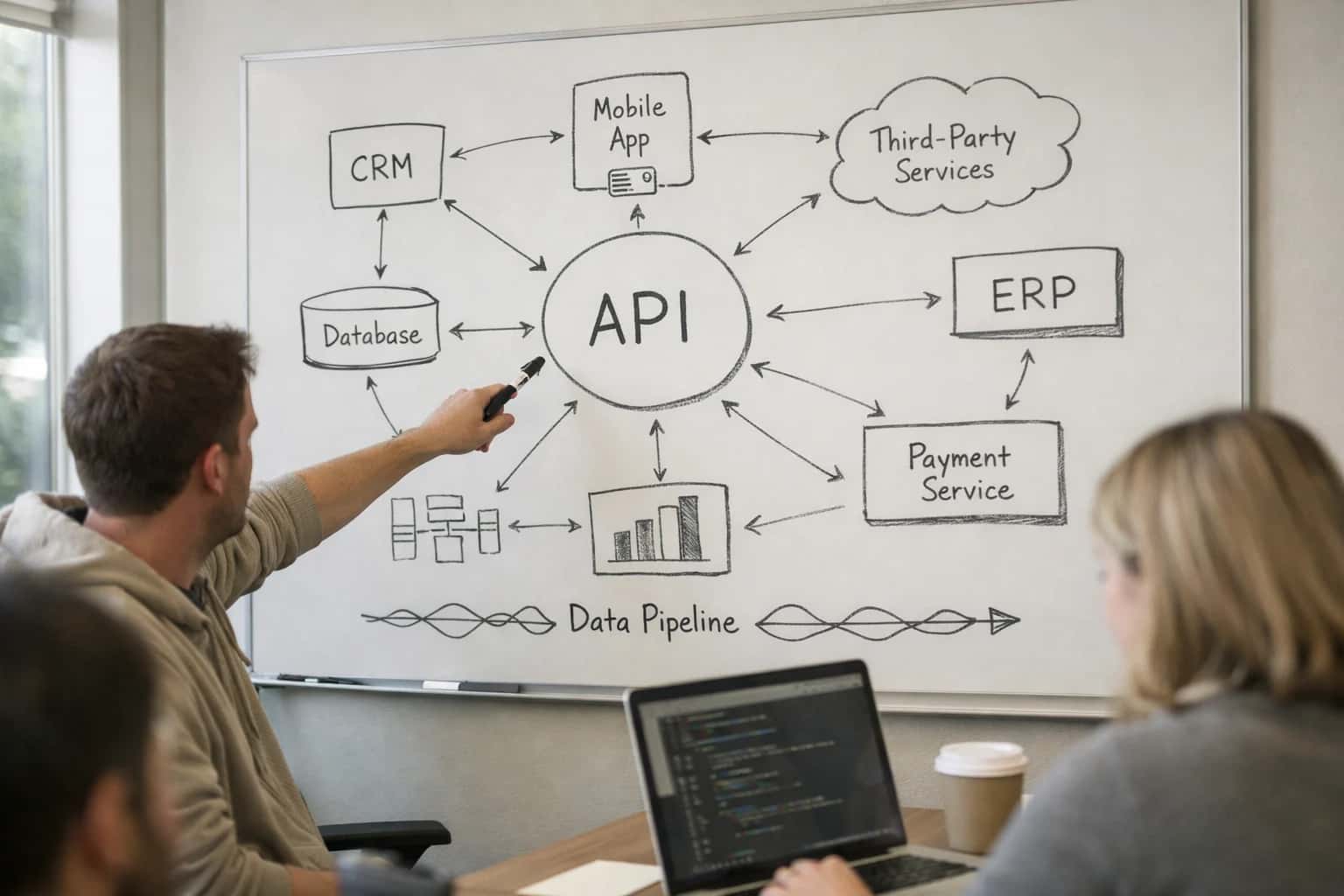
ARCHITECTURE & IMPLEMENTATION
Where AI Fits into Workday Payroll Operations
A technical blueprint for integrating AI agents and automation into Workday Payroll to reduce errors, accelerate reconciliation, and provide intelligent employee support.
High-value use cases focus on operational efficiency and risk reduction: an anomaly detection agent can scan payroll input batches for outliers in hours, deductions, or tax withholdings before final calculation, flagging potential errors for the payroll team. A self-service pay inquiry agent can be embedded in Workday's Employee Self-Service portal, using Retrieval-Augmented Generation (RAG) over secure payroll documents and an employee's own pay statement history to answer questions like "Why was my net pay different?" without involving HR. For reconciliation, an AI workflow can automatically match Bank Statement lines from an external feed to Payroll Payment records in Workday, highlighting discrepancies for faster month-end close.
A production rollout requires careful governance. The AI service should run in a secure, compliant cloud environment, with API calls logged to a dedicated audit trail and all employee data interactions respecting role-based security from Workday. Changes to payroll data should always flow through a human-in-the-loop approval step within the existing Workday business process. Start with a pilot on a single payroll group, focusing on anomaly detection for retroactive pay adjustments or tax jurisdiction changes, where manual review is most time-consuming and error-prone. This phased approach de-risks the integration while demonstrating clear ROI through reduced correction runs and fewer employee support tickets.
ARCHITECTURAL BLUEPRINT
Key Integration Surfaces in Workday Payroll
Core Payroll Objects and APIs
AI integrates directly with Workday's payroll calculation engine by reading and writing to key objects via the Workday Web Services API or Workday Extend. The primary surfaces are:
- Payroll Inputs: Time sheets, one-time payments, and deduction changes submitted via
Put_One-Time_Payment_InputorSubmit_Time_Sheetoperations. - Earning and Deduction Codes: AI can validate proposed entries against configured payroll rules before submission to prevent downstream errors.
- Payroll Run Control: Agents can trigger or monitor the status of payroll calculation cycles (
Initiate_Payroll_Calculation,Get_Payroll_Calculation_Status).
A practical use case is an AI agent that reviews proposed off-cycle payments for policy compliance, formats the correct API payload, and submits them, reducing manual data entry and error rates.
WORKDAY PAYROLL INTEGRATION
High-Value AI Use Cases for Payroll
Integrating AI directly into Workday Payroll transforms high-volume, manual operations into automated, intelligent workflows. These patterns connect to core Workday Payroll objects and APIs to deliver immediate operational value.
01
Interactive Pay Slip Assistant
Deploy an AI agent that answers employee questions about their pay statements by querying the Workday Payroll Results API. The agent explains deductions, tax withholdings, and pay calculations in plain language, deflecting 40-60% of routine payroll support tickets.
40-60% Ticket Deflection
Typical impact
02
Pre-Payroll Anomaly Detection
Run AI models against the Payroll Input and Earning and Deduction data in Workday before finalizing each pay run. Flag outliers in hours, bonuses, or tax setups for human review, preventing costly corrections and compliance issues.
Batch -> Proactive
Workflow shift
03
Automated Off-Cycle Payroll Request Routing
Use an AI agent to process natural language requests for off-cycle payments. The agent validates policy, checks Worker data, and creates a Payroll Adjustment request in Workday, routing it through the correct approval chain via Business Process Framework.
Hours -> Minutes
Request handling
04
Tax Jurisdiction & Compliance Monitoring
Continuously monitor Worker Tax Data and location changes. An AI agent identifies employees with missing or potentially incorrect tax jurisdictions, creates cases in Workday Help, and suggests updates to prevent filing errors.
Same-day Detection
Compliance risk
05
Payroll Reconciliation & Variance Explanation
After each pay run, an AI process compares totals to the general ledger and prior periods. It generates a narrative summary explaining key variances (e.g., overtime spike, new hire cohort) for finance partners, pulling data from Payroll Results and Financial Integration.
1-2 Day Acceleration
Close process
06
Multi-Country Payroll Inquiry Triage
For global teams, build an AI router that classifies complex payroll inquiries by country and policy domain. It fetches relevant local rules from a knowledge base and either answers directly or assigns the case to the correct specialist group in Workday Help.
Batch -> Real-time
Triage speed
WORKDAY PAYROLL INTEGRATION PATTERNS
Example AI-Powered Payroll Workflows
These concrete workflow examples illustrate how AI agents can connect to Workday Payroll APIs and business processes to automate high-volume tasks, detect anomalies, and provide instant support. Each pattern is designed for production implementation using Workday Extend, Web Services, and calculated fields.
Trigger: A scheduled job runs after each payroll calculation cycle but before final approval.
Context/Data Pulled: The AI agent calls the Workday Get_Workers and Get_Payroll_Inputs web services to retrieve the current payroll run data. It compares this against historical patterns and policy rules stored in a vector database.
Model or Agent Action: A classification model analyzes each worker's pay for outliers in:
- Overtime spikes vs. scheduled hours
- Tax withholding changes
- Deduction amounts or new deductions
- Gross-to-net ratio deviations
System Update or Next Step: For each high-confidence anomaly, the agent uses the Put_Event_Case API to create a case in Workday HCM. The case is pre-populated with the worker ID, anomaly details, and a link to the relevant payroll report. It is automatically routed to the designated payroll analyst team.
Human Review Point: All generated cases require human review and resolution before the payroll can be approved and submitted. The agent does not auto-correct data.
PAYROLL OPERATIONS AUTOMATION
Implementation Architecture & Data Flow
A practical blueprint for integrating AI into Workday Payroll to automate anomaly detection, answer employee inquiries, and streamline reconciliation.
The integration connects to Workday's Payroll Input and Payroll Calculation APIs to monitor transactions in near real-time. An AI agent, deployed as a secure microservice, subscribes to webhooks for key payroll events—such as a finalized pay run or a submitted off-cycle payment—and processes the associated Worker Payment, Payroll Result, and Earning data objects. This allows the system to perform immediate checks for outliers in gross-to-net calculations, tax withholdings, and deduction patterns against historical employee and company-wide benchmarks.
For employee self-service, the architecture leverages Workday's Human Resources API and Web Services to enable a conversational agent. This agent, accessible via Slack, Teams, or an embedded chat widget, can answer pay-specific questions by retrieving the employee's Paycheck details, Year-to-Date summaries, and Tax Document metadata. Crucially, the agent uses Retrieval-Augmented Generation (RAG) over the company's payroll policy documents and Workday's own data model to provide grounded, accurate explanations for pay stub line items, deduction codes, and tax calculations, deflecting tickets from the payroll team.
Reconciliation workflows are automated by having the AI agent compare output from Workday's Payroll Journal Report web service against general ledger feeds in the financial ERP. Discrepancies are flagged, and the agent can draft adjustment journal entries or create tasks in Workday's Business Process Framework for reviewer approval. All agent actions are logged with full audit trails, linking back to the source payroll transaction IDs. Rollout typically starts with read-only anomaly detection and Q&A, followed by phased enablement of automated review workflows for specific earning types, governed by strict RBAC rules defined in Workday.
WORKDAY PAYROLL INTEGRATION PATTERNS
Code & Payload Examples
Real-Time Payroll Alerting
Set up a webhook listener to process payroll calculation events from Workday. The AI agent analyzes each pay component for outliers against historical patterns and employee peer groups, then creates a Workday Payroll Audit Case for review.
Example Python Webhook Handler:
pythonfrom flask import Flask, request import openai import requests app = Flask(__name__) WORKDAY_API_TOKEN = 'your_extend_token' def analyze_payroll_anomaly(payroll_data): prompt = f"""Analyze this payroll record for anomalies: Employee: {payroll_data['employee_name']} Regular Hours: {payroll_data['regular_hours']} (Avg: 80) Overtime Hours: {payroll_data['overtime_hours']} (Avg: 5) Bonus Amount: ${payroll_data['bonus_amount']} (Peer Avg: $1200) Tax Withholding: {payroll_data['tax_rate']}% Return 'HIGH', 'MEDIUM', or 'LOW' risk with a brief reason. """ response = openai.chat.completions.create( model="gpt-4", messages=[{"role": "user", "content": prompt}] ) return response.choices[0].message.content @app.route('/webhook/payroll-review', methods=['POST']) def payroll_webhook(): data = request.json risk_assessment = analyze_payroll_anomaly(data) if 'HIGH' in risk_assessment: # Create a case in Workday for manual review case_payload = { "case_type": "Payroll_Anomaly", "employee_id": data['employee_id'], "pay_period": data['pay_period'], "risk_level": "HIGH", "ai_notes": risk_assessment } response = requests.post( 'https://your-tenant.workday.com/api/payroll/v1/audit-cases', headers={'Authorization': f'Bearer {WORKDAY_API_TOKEN}'}, json=case_payload ) return {'status': 'Case Created', 'case_id': response.json()['id']} return {'status': 'No action needed'}
AI INTEGRATION FOR WORKDAY PAYROLL
Realistic Time Savings & Operational Impact
A practical breakdown of how AI integration can streamline key payroll workflows, reduce manual effort, and improve accuracy. Metrics are based on typical enterprise implementations.
| Workflow / Task | Before AI (Manual Process) | After AI (Augmented Process) | Implementation Notes |
|---|---|---|---|
Payroll anomaly detection | Manual review of 1000+ transactions | AI flags 10-20 high-risk exceptions for review | AI scans gross-to-net calculations, tax withholdings, and unusual payment patterns |
Employee pay inquiry resolution | HR/Payroll specialist researches and responds (15-30 min per case) | AI assistant provides instant, data-grounded answers to common questions | Agent queries Workday Payroll APIs for real-time pay slip data and policy context |
Payroll reconciliation support | Finance team manually matches GL entries (4-8 hours per period) | AI pre-matches 70-80% of entries and highlights discrepancies | Integration with Workday Financials and external bank feeds for automated comparison |
Tax filing compliance check | Quarterly manual audit of filings vs. Workday data | AI continuously monitors for discrepancies and regulatory changes | Connects to Workday Payroll tax modules and external compliance data sources |
Off-cycle payment review & routing | Manager submits ticket, payroll manually validates & processes | AI validates request against policy, auto-routes for approval in Workday | Uses Workday Extend or API to create and route Business Process transactions |
Year-end reporting & W-2 prep | Manual data consolidation and error checking across systems | AI identifies inconsistent data early and generates audit-ready summaries | Processes data from Workday Payroll, Benefits, and Time Tracking modules |
Garnishments & levy processing | Specialist manually interprets court orders and configures deductions | AI extracts key details from documents and suggests Workday deduction setup | Document intelligence layer feeds structured data into Workday via API |
ARCHITECTING CONTROLLED DEPLOYMENT
Governance, Security & Phased Rollout
A pragmatic approach to deploying AI in Workday Payroll that prioritizes data integrity, role-based access, and incremental value.
A secure integration architecture is non-negotiable for payroll. Our implementations treat the Workday Payroll API as a read-first, write-later system. Initial AI agents are granted Get permissions on objects like Payroll Input, Payroll Result, Worker, and Earning and Deduction records to analyze data and answer questions. Any corrective or initiating action—like creating a One-Time Payment or a Payroll Input record—is routed through a human-in-the-loop approval queue or a tightly scoped Service Account with explicit Put/Post permissions, logged for audit in Workday's Business Process Audit Trail. This ensures AI actions are traceable back to a system-initiated business process.
Rollout follows a phased, risk-managed path:
- Phase 1: Detection & Insight. Deploy AI for anomaly detection on pre-finalized payroll runs, flagging outliers in gross-to-net calculations, tax withholdings, or unusual deduction patterns for human review. Concurrently, launch a read-only employee pay inquiry agent that answers questions about pay stubs, deduction codes, and year-to-date totals by querying the
Payroll ResultAPI, deflecting tickets from HR and payroll teams. - Phase 2: Assisted Reconciliation. Introduce AI into the post-payroll reconciliation workflow. The agent can cross-reference bank files with
Payroll Resultsummaries, highlight discrepancies, and draft reconciliation notes, but all outputs require a payroll specialist's verification before any journal entry is posted to the general ledger via theFinancialsAPI. - Phase 3: Proactive Correction & Workflow. With trust established, enable AI to suggest and, upon approval, automatically create retroactive pay calculations or corrective one-time payments to resolve underpayments, minimizing manual data entry and accelerating resolution.
Governance is embedded via Workday Security Groups and Domain Security Policies. AI service accounts are members of custom security groups, restricting data access to necessary domains (e.g., only US payroll data). All prompts and AI-generated summaries are logged in an external LLMOps platform (like Arize AI or LangSmith) for performance monitoring, drift detection, and compliance reviews. This layered approach—combining Workday's native security, phased functionality, and external observability—ensures the AI integration enhances payroll operations without introducing uncontrolled risk or compromising sensitive employee financial data.
Enabling Efficiency, Speed & Accuracy
Intelligent Analysis, Decision & Execution
We build AI systems for teams that need search across company data, workflow automation across tools, or AI features inside products and internal software.
Talk to Us
Search across company data
Give teams answers from docs, tickets, runbooks, and product data with sources and permissions.
Useful when people spend too long searching or get different answers from different systems.
Enterprise searchRAGPermissions
Read more
Automate internal workflows
Use AI to route work, draft outputs, trigger actions, and keep approvals and logs in place.
Useful when repetitive work moves across multiple tools and teams.
AI agentsWorkflow automationGovernance
Read more
Add AI to products and internal tools
Build assistants, guided actions, or decision support into the software your team or customers already use.
Useful when AI needs to be part of the product, not a separate tool.
AI integrationDecision supportModel routing
Read moreAI INTEGRATION FOR WORKDAY PAYROLL
Frequently Asked Questions
Practical answers to common technical and implementation questions about integrating AI with Workday Payroll for anomaly detection, employee support, and reconciliation workflows.
Secure integration is foundational. Typically, we use a dedicated integration service account with the principle of least privilege, granted only the specific Workday Web Services API permissions needed (e.g., GET_Payroll_Input, GET_Worker, GET_Payroll_Output).
Key steps:
- Authentication: Use Workday's OAuth 2.0 or SOAP-based WS-Security for API calls.
- Data Minimization: The AI agent or pipeline queries only the necessary payroll objects (Payroll Input, Worker, Payroll Run Results) for a specific time period or worker subset.
- Secure Channel: All data is transmitted over TLS 1.2+.
- Data Handling: Sensitive payroll data is never stored permanently in the AI system's vector database or logs; it's processed ephemerally. Audit trails log all data access by the service account.
- Governance: Access is managed via Workday's Security Groups, and all AI-initiated actions are logged back to Workday as Business Process Audit Trail entries.

About the author
Prasad Kumkar
CEO & MD, Inference Systems
Prasad Kumkar is the CEO & MD of Inference Systems and writes about AI systems architecture, LLM infrastructure, model serving, evaluation, and production deployment. Over 5+ years, he has worked across computer vision models, L5 autonomous vehicle systems, and LLM research, with a focus on taking complex AI ideas into real-world engineering systems.
His work and writing cover AI systems, large language models, AI agents, multimodal systems, autonomous systems, inference optimization, RAG, evaluation, and production AI engineering.
LinkedIn
Limited slotsGet a Free AI Consultation
Partnered with leading AI, data, and software stack.





How We Work
Custom AI workflows for your Business
One-fit-all AI don't work for modern businesses. At Inferensys, we aim to understand your business & custom requirements; which we use to define most efficient agentic workflows, the data, and the tools for your business.
01
Review the use case
We understand the task, the users, and where AI can actually help.
Read more02
Pick the right approach
We define what needs search, automation, or product integration.
Read more03
Build the first useful version
We implement the part that proves the value first.
Read more04
Improve from there
We add the checks and visibility needed to keep it useful.
Read moreThe first call is a practical review of your use case and the right next step.
Talk to Us