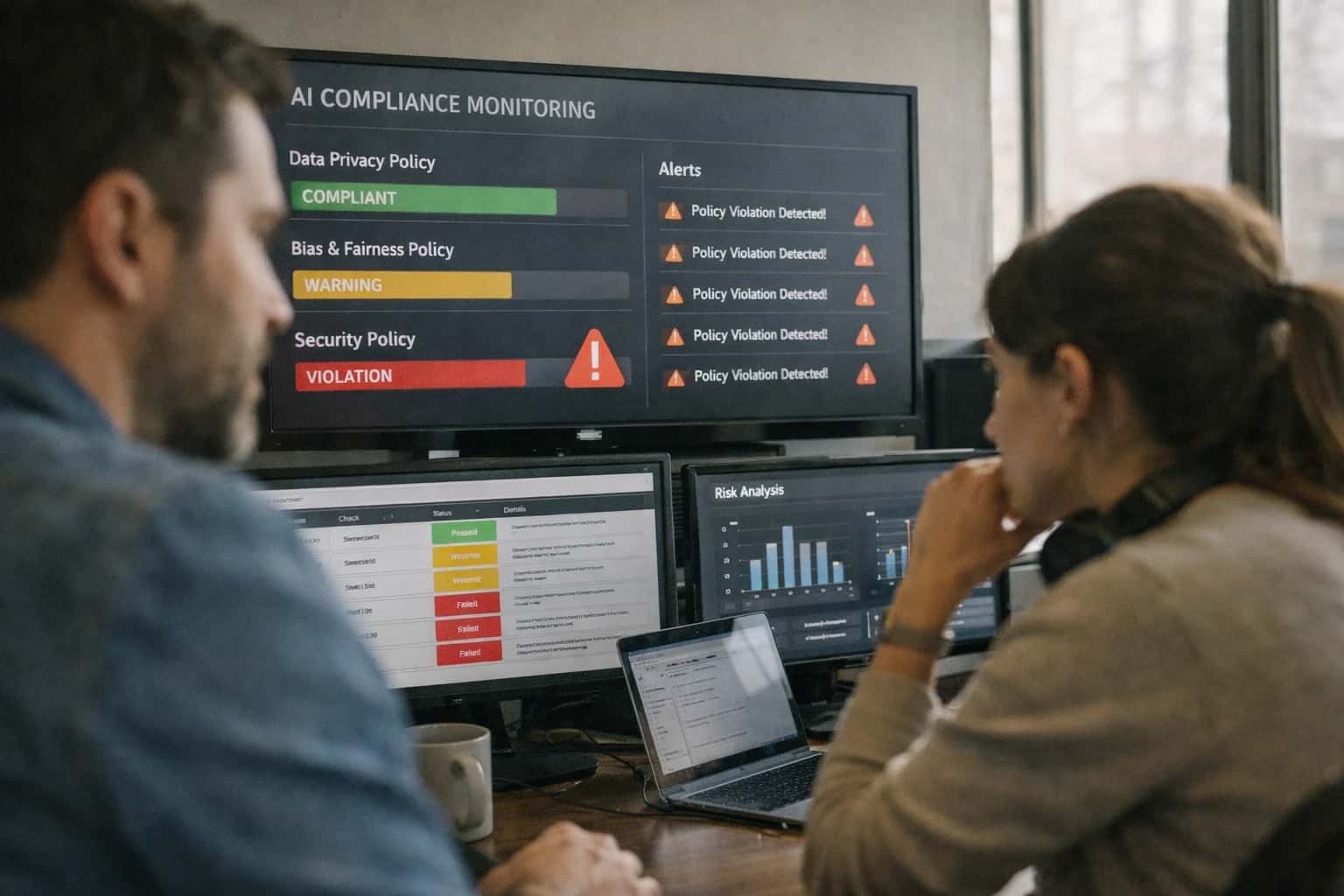
AI integration for UKG Dimensions focuses on three core surfaces: the timekeeping and scheduling engine, the compliance and policy rule sets, and the labor analytics data warehouse. The most impactful implementations connect AI to the Dimensions API to read real-time labor data (e.g., punches, schedules, accruals) and write back approved adjustments or alerts. Use cases include an AI agent that reviews timesheets for policy violations before payroll submission, a copilot that helps managers build optimal schedules by forecasting demand and balancing employee preferences, and an automated compliance monitor that scans for potential wage and hour risks across locations.

Integration
AI Integration for UKG Dimensions
A technical blueprint for adding AI-powered intelligence to UKG Dimensions for automated timekeeping review, predictive labor analytics, and compliance monitoring.
ARCHITECTURE AND ROLLOUT
Where AI Fits into UKG Dimensions
A technical blueprint for integrating AI agents and copilots into the UKG Dimensions workforce management platform.
Implementation typically involves a middleware layer that subscribes to UKG Dimensions webhooks for events like punch_in, shift_swap_request, or schedule_publish. An AI agent processes the event—for example, evaluating a shift swap against seniority rules and coverage needs—and returns a decision or enriched data via API call. For analytics, AI models can be trained on historical data from the Business Intelligence module to predict absenteeism or forecast overtime, with scores written back to custom fields for manager dashboards. This requires careful scoping of API permissions, especially for write operations, and implementing a human-in-the-loop approval step for high-risk transactions.
Rollout should be phased, starting with read-only agents for manager guidance (e.g., a scheduling copilot) before progressing to automated write-backs for low-risk tasks like meal break compliance nudges. Governance is critical: all AI-driven transactions must be logged with a full audit trail in a separate system, and prompts must be engineered to strictly reference the official, configured business rules within Dimensions to avoid policy hallucinations. Successful integrations reduce manual supervisor review from hours to minutes, improve schedule adherence, and provide a proactive defense against compliance exposure.
ARCHITECTURAL BLUEPRINT
Key Integration Surfaces in UKG Dimensions
Core Labor Data & Scheduling Surfaces
AI integration for UKG Dimensions begins with the platform's core timekeeping and scheduling modules. These surfaces provide the foundational data for intelligent forecasting, compliance automation, and operational support.
Key Integration Points:
- Timekeeping API: Real-time access to clock-in/out events, punches, and exceptions for anomaly detection (e.g., missed punches, potential overtime).
- Schedule Data Objects: Read/write access to published schedules, shift templates, and demand forecasts to enable AI-driven optimization and last-minute adjustments.
- Absence Management: Integration with leave requests and accrual balances to power predictive absence modeling and automated coverage workflows.
Example AI Use Case: An AI agent monitors real-time punch data against schedules, flags compliance risks (e.g., minor violations, meal break non-compliance), and can automatically suggest or initiate corrective actions via the UKG Dimensions API, reducing manual supervisor review.
INTELLIGENT WORKFORCE MANAGEMENT
High-Value AI Use Cases for UKG Dimensions
Integrate AI directly into UKG Dimensions to automate compliance, optimize labor, and empower managers with real-time insights. These use cases connect to Dimensions' core APIs for timekeeping, scheduling, and analytics to drive operational efficiency.
01
Automated Schedule Compliance & Fatigue Risk
An AI agent continuously monitors published schedules against configured business rules (e.g., minimum rest between shifts, overtime thresholds, credential requirements). It flags violations before shifts are finalized, suggests corrective swaps, and generates compliance audit trails. Integrates with the UKG Dimensions Scheduling API and rule engine.
Pre-Shift
Violation detection
02
Intelligent Timekeeping & Exception Triage
Deploy an AI copilot for managers to review and approve timesheets. The agent pre-scans punches for common errors (early clock-ins, missed breaks, schedule mismatches), summarizes exceptions, and can auto-approve clean submissions. It answers manager queries about pay rules via the UKG Dimensions Time & Attendance API, reducing daily administrative load.
Hours -> Minutes
Approval workflow
03
Predictive Labor Forecasting & Optimization
Enhance Dimensions' forecasting with an AI layer that ingests historical sales, foot traffic, and event data. It generates hyper-granular demand forecasts and recommends optimal labor mixes (skill, cost) for each period. Outputs feed directly into the Dimensions Scheduling module for automated shift creation, improving labor cost accuracy.
1-3%
Labor cost efficiency
04
Real-Time Manager Copilot for Labor Decisions
Provide managers with a conversational interface (chat or voice) to ask questions like "Why is my labor variance high today?" or "Who is certified to close?" The AI agent queries live data from Dimensions Analytics APIs, synthesizes insights from schedules, sales, and attendance, and delivers actionable answers, reducing time spent in reports.
Seconds
For operational insights
05
Automated Absence & Leave Management Agent
An AI-driven employee support agent handles common leave inquiries ("How much PTO do I have?"), guides self-service requests, and automates the intake and routing of FMLA or other protected leaves. It validates eligibility via the UKG Dimensions Employee Data API, updates case status, and triggers manager approval workflows, deflecting HR tickets.
80% Deflection
For common inquiries
06
Proactive Overtime & Budget Alerting
An AI monitor tracks real-time labor hours against forecasted budgets and overtime thresholds at the department or cost center level. It sends proactive alerts to managers and finance via Slack, Teams, or email when trends indicate a potential overage, enabling same-day corrective action. Built on Dimensions Payroll Data and real-time punch streams.
Same-Day
Corrective action window
UKG DIMENSIONS INTEGRATION PATTERNS
Example AI-Agent Workflows
These concrete workflows illustrate how AI agents can connect to UKG Dimensions APIs to automate high-volume tasks, provide real-time guidance, and enforce compliance. Each pattern is designed to be implemented using secure, auditable API calls and webhooks.
Trigger: An employee submits a timesheet in UKG Dimensions via the mobile app or web portal.
Agent Action:
- A webhook notifies the AI agent of the new submission.
- The agent calls the UKG Dimensions API to retrieve the detailed timesheet, along with the employee's schedule, approved PTO, and relevant labor policies (e.g., overtime rules, meal break compliance).
- The agent analyzes the entries for:
- Mathematical errors (e.g., hours exceeding 24 in a day).
- Policy violations (e.g., missed punches, working unauthorized overtime).
- Potential compliance issues (e.g., working off-the-clock, insufficient rest between shifts).
- The agent generates a summary and, if anomalies are found, creates a task in the manager's UKG Dimensions inbox or a ticket in a connected ITSM like ServiceNow.
System Update: The agent can be configured to either:
- Auto-approve clean timesheets, updating the status via API.
- Flag for review with a detailed explanation, prompting manager action.
- Send a corrective nudge directly to the employee via UKG Dimensions messaging, suggesting a correction.
Human Review Point: All flagged exceptions and any auto-approvals over a certain threshold (e.g., >10 hours of overtime) are logged to an audit dashboard for periodic supervisor review.
CONNECTING AI TO UKG DIMENSIONS DATA AND WORKFLOWS
Implementation Architecture & Data Flow
A production-ready integration connects AI agents to UKG Dimensions' APIs and event streams to automate timekeeping, predict labor needs, and enforce compliance.
The integration is anchored on UKG Dimensions' REST API and Real-Time Event streams. Core data objects include Timecards, Schedules, Employees, Pay Rules, and Accruals. AI agents are deployed as a middleware layer that subscribes to events (e.g., Timecard.Submitted, Schedule.Published) and uses the API to retrieve context, execute actions like ApproveTimecard, or post annotations. For real-time analytics, the system ingests streaming labor data into a vector-enabled data store, enabling semantic search across policy documents and historical exceptions.
High-value workflows are automated by mapping AI capabilities to specific UKG Dimensions surfaces:
- Intelligent Timekeeping: An AI agent reviews submitted
Timecardrecords againstPay RulesandScheduledata to flag potential errors (e.g., missed punches, rule violations) before manager approval, reducing corrective payouts. - Compliance Automation: The agent monitors schedule changes and published
Schedulesagainst configured labor laws and union rules, generating proactive alerts for potential violations like insufficient rest periods. - Demand Forecasting: By analyzing historical
TimecardandSalesdata (via integrated POS/ERP systems), an AI model generates predictive labor forecasts that can be written back to UKG Dimensions as suggestedScheduletemplates for manager review.
Rollout follows a phased approach, starting with a read-only agent for timecard anomaly detection that provides recommendations to managers via a side-channel (e.g., Slack, email). After validating accuracy and user trust, the agent is granted approved transactional scopes to auto-approve low-risk exceptions. Governance is critical: all agent actions are logged with a source:ai_agent audit trail in UKG Dimensions' audit logs, and a human-in-the-loop approval step is maintained for high-cost or high-risk transactions. The architecture is designed for resilience, using message queues to handle API rate limits and ensuring the AI layer is stateless, with UKG Dimensions remaining the single source of truth.
UKG DIMENSIONS INTEGRATION PATTERNS
Code & API Payload Examples
Real-Time Payroll Compliance Review
Integrate AI to audit time punches and schedules against labor rules before payroll finalization. An agent can monitor the TimeCard API for anomalies like missed punches, overtime miscalculations, or schedule violations, triggering a case in UKG HR Service Delivery for manager review.
Example Payload for Exception Detection:
jsonPOST /ai-agent/webhook { "event_type": "timecard_audit", "employee_id": "EMP-10023", "period_end": "2024-05-10", "total_hours": 43.5, "flagged_issues": [ { "type": "potential_overtime", "rule": "CA OT after 8hr/day", "details": "Worked 9.2 hours on 2024-05-08" } ], "ukg_dimensions_record_url": "https://api.ukg.com/dimensions/v1/timecards/TC-88712" }
This pattern prevents wage-and-hour violations by automating pre-payroll compliance checks.
AI-ENHANCED WORKFORCE MANAGEMENT
Realistic Time Savings & Operational Impact
This table illustrates the operational impact of integrating AI into UKG Dimensions, focusing on time savings, error reduction, and workflow acceleration for common workforce management tasks.
| Metric | Before AI | After AI | Notes |
|---|---|---|---|
Schedule Exception Review | Manual audit of 100+ shifts: 2-3 hours | AI-assisted flagging & prioritization: 15-20 minutes | AI flags policy violations and fatigue risks for human review |
Timesheet Approval & Error Detection | Manager review per employee: 5-10 minutes | AI pre-audit with anomaly alerts: 1-2 minutes | AI checks for missed punches, overtime rules, and cost center mismatches |
Labor Forecast Generation | Analyst builds forecast in Excel: 1-2 days | AI generates baseline forecast: 2-4 hours | Analyst reviews and adjusts AI output for final sign-off |
Compliance Rule Monitoring | Quarterly manual audit for new regulations | Continuous AI monitoring with weekly alerts | AI scans for rule changes and flags potential non-compliance in schedules |
Shift Bidding & Open Shift Management | Manual communication and filling: Next day | AI-powered matching and notifications: Same day | AI matches employee skills/preferences to open shifts, accelerating fill rates |
Absenteeism & Tardiness Triage | Reactive follow-up after pattern is established | Proactive AI alert after 2-3 instances | AI identifies patterns and alerts supervisors for early intervention |
Overtime Cost Analysis & Reporting | Manual data pull and analysis: 4-6 hours weekly | Automated AI report with insights: 30 minutes weekly | Report highlights drivers and suggests scheduling adjustments |
ARCHITECTING CONTROLLED DEPLOYMENT FOR UKG DIMENSIONS
Governance, Security & Phased Rollout
A practical guide to implementing AI in UKG Dimensions with enterprise-grade controls and a risk-managed rollout.
Integrating AI into a mission-critical workforce management system like UKG Dimensions requires a governance-first approach. This starts with a clear data access model, mapping which AI agents or copilots can query specific UKG objects—such as Timecards, Schedules, Employees, Pay Rules, and Labor Forecasts—via the UKG Dimensions API. Access should be scoped using service accounts with role-based permissions, ensuring AI tools only interact with data necessary for their function, like a scheduling assistant reading forecast data but not personal employee details. All AI-initiated transactions, such as a proposed schedule change or an approved timesheet exception, must write a full audit trail back to a custom object or log within UKG or an adjacent system, preserving the 'who, what, and when' for compliance reviews.
A phased rollout is critical for user adoption and risk mitigation. We recommend starting with a read-only pilot in a single department or location, focusing on a high-value, low-risk use case like AI-powered labor forecasting analysis or automated timesheet anomaly detection. In this phase, the AI provides insights and recommendations to managers via a separate dashboard or report, but no automated writes back to UKG Dimensions occur. This builds trust and validates the AI's accuracy. The next phase introduces assisted writes, where the AI suggests schedule optimizations or flags compliance issues, but a manager must review and approve each action within the UKG interface before it's committed. The final phase enables controlled automation for predefined, rule-based workflows, such as auto-approving routine schedule swaps that meet policy, with continuous monitoring for drift or unexpected outcomes.
Security extends beyond access control to data in transit and at rest. AI calls to the UKG Dimensions API should use encrypted connections, and any cached or vectorized data for retrieval-augmented generation (RAG) must be stored in a secure, isolated environment, never commingling with public models. For generative tasks like drafting manager communications or summarizing overtime trends, prompts should be engineered to avoid generating sensitive information. A human-in-the-loop escalation layer should be designed for edge cases or low-confidence AI decisions, routing them to a supervisor queue within UKG's case management or a connected system. This layered approach—combining strict API governance, phased feature release, and secure data handling—ensures the AI integration enhances UKG Dimensions' capabilities without introducing operational or compliance risk.
Enabling Efficiency, Speed & Accuracy
Intelligent Analysis, Decision & Execution
We build AI systems for teams that need search across company data, workflow automation across tools, or AI features inside products and internal software.
Talk to Us
Search across company data
Give teams answers from docs, tickets, runbooks, and product data with sources and permissions.
Useful when people spend too long searching or get different answers from different systems.
Enterprise searchRAGPermissions
Read more
Automate internal workflows
Use AI to route work, draft outputs, trigger actions, and keep approvals and logs in place.
Useful when repetitive work moves across multiple tools and teams.
AI agentsWorkflow automationGovernance
Read more
Add AI to products and internal tools
Build assistants, guided actions, or decision support into the software your team or customers already use.
Useful when AI needs to be part of the product, not a separate tool.
AI integrationDecision supportModel routing
Read moreAI INTEGRATION FOR UKG DIMENSIONS
Frequently Asked Questions
Practical answers to common technical and strategic questions about integrating AI agents and automation into UKG Dimensions for workforce management.
Secure integration requires a layered approach focused on UKG's authentication model and data governance.
- Authentication & Authorization: Use OAuth 2.0 with client credentials or user impersonation, scoping tokens to the minimal necessary permissions (e.g.,
personnel_read,timecard_write). Implement token lifecycle management and refresh logic. - API Gateway Pattern: Route all AI agent calls through a secure middleware layer. This gateway handles:
- Rate limiting and load shedding to respect UKG API limits.
- Request/response logging for full auditability.
- Masking or redaction of sensitive fields (like SSN) before data reaches the LLM context window.
- Data Context Strategy: Use Retrieval-Augmented Generation (RAG) with a vector store. Ingest relevant UKG data (policies, org charts, role definitions) into a secure index. The agent retrieves grounded context from this store instead of sending raw employee data to the model for every query.
- Execution Scope: Define clear boundaries. For example, an agent can read schedules and suggest adjustments, but any actual write (publishing a schedule, approving a punch) should trigger a human-in-the-loop approval step via a webhook back to a manager dashboard.

About the author
Prasad Kumkar
CEO & MD, Inference Systems
Prasad Kumkar is the CEO & MD of Inference Systems and writes about AI systems architecture, LLM infrastructure, model serving, evaluation, and production deployment. Over 5+ years, he has worked across computer vision models, L5 autonomous vehicle systems, and LLM research, with a focus on taking complex AI ideas into real-world engineering systems.
His work and writing cover AI systems, large language models, AI agents, multimodal systems, autonomous systems, inference optimization, RAG, evaluation, and production AI engineering.
LinkedIn
Limited slotsGet a Free AI Consultation
Partnered with leading AI, data, and software stack.





How We Work
Custom AI workflows for your Business
One-fit-all AI don't work for modern businesses. At Inferensys, we aim to understand your business & custom requirements; which we use to define most efficient agentic workflows, the data, and the tools for your business.
01
Review the use case
We understand the task, the users, and where AI can actually help.
Read more02
Pick the right approach
We define what needs search, automation, or product integration.
Read more03
Build the first useful version
We implement the part that proves the value first.
Read more04
Improve from there
We add the checks and visibility needed to keep it useful.
Read moreThe first call is a practical review of your use case and the right next step.
Talk to Us