AI integration for grant compliance focuses on three core surfaces within platforms like SmartSimple: the document repository, custom field and workflow engine, and reporting/audit modules. The primary data objects are grant agreements, financial reports, program narratives, and compliance checklists. An AI agent can be triggered via platform webhooks or scheduled jobs to scan newly uploaded documents—such as IRS 990s, interim reports, or expenditure justifications—extract key obligations, deadlines, and financial figures, and map them to the grant's custom compliance fields. This transforms unstructured PDFs and text into structured, queryable records for continuous monitoring.

Integration
AI Integration for Grant Compliance Platforms
A technical blueprint for integrating AI into grant compliance workflows within platforms like SmartSimple, Fluxx, and Foundant to automate regulation cross-referencing, evidence collection, and audit preparation.
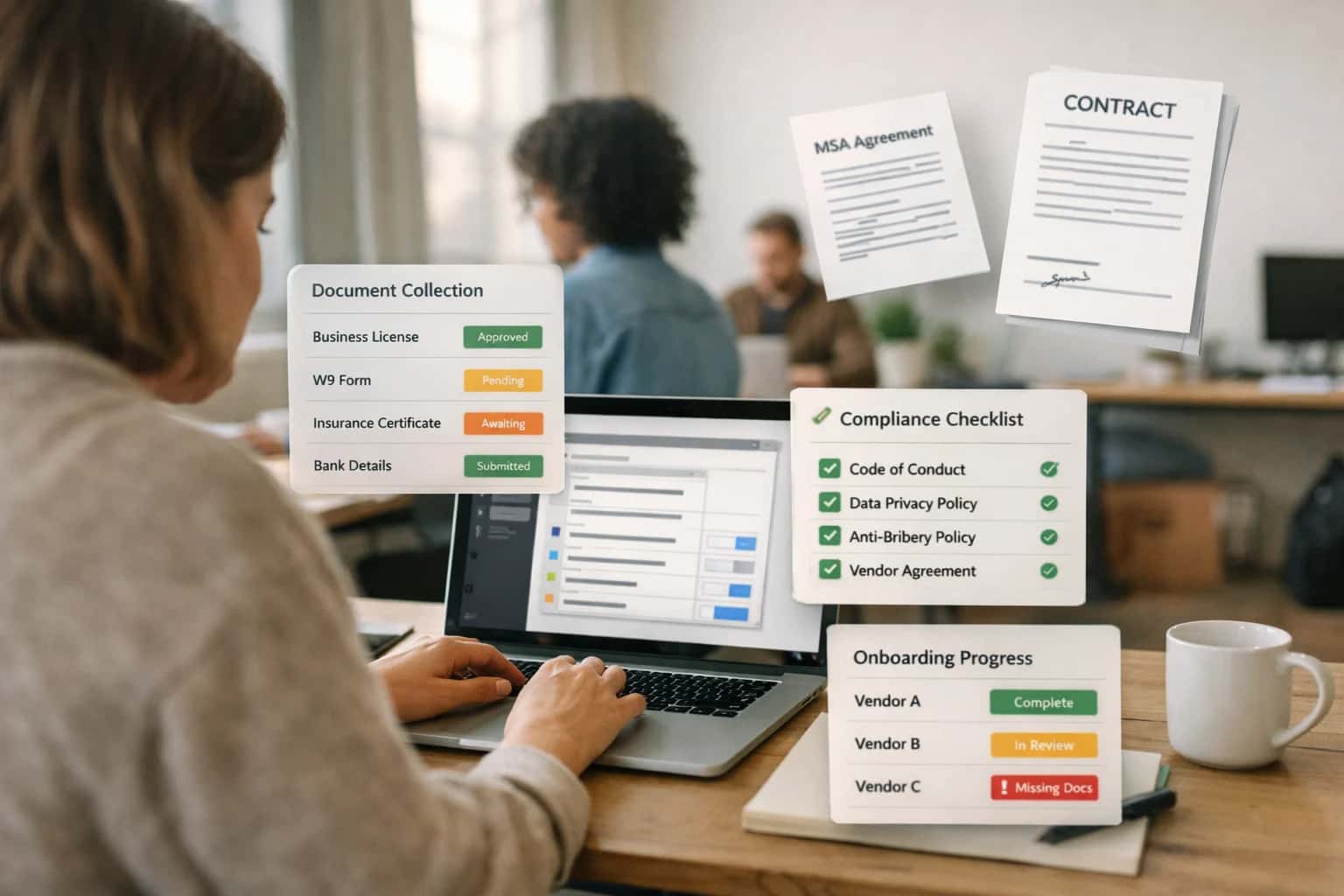
ARCHITECTURE & ROLLOUT
Where AI Fits in Grant Compliance Operations
Integrating AI into grant compliance platforms like SmartSimple automates evidence collection, cross-references regulations, and surfaces risks before they become audit findings.
A practical implementation wires an AI service to the platform's API, using a retrieval-augmented generation (RAG) pipeline grounded in the organization's specific grant policies and funder regulations. For example, when a grantee submits a progress report, the system can automatically:
- Cross-reference narrative claims against the original proposal's objectives and budget.
- Flag discrepancies in expenditure categories or outcome metrics for officer review.
- Generate a compliance summary for the grant file, highlighting satisfied requirements and pending evidence. This reduces manual review from hours to minutes per report and ensures consistency. The AI's outputs are written back to the platform as notes, updated custom field values, or tasks assigned to the compliance officer, maintaining a full audit trail within the system of record.
Rollout requires a phased approach, starting with a single grant program or funder with well-defined rules. Governance is critical: all AI-generated flags or summaries should be configured as recommendations requiring human approval before any official status change. This creates a human-in-the-loop workflow that builds trust and allows for model calibration. Implementation also involves setting up dedicated vector stores for policy documents and historical grant data, ensuring the AI's retrievals are accurate and secure. For teams managing hundreds of awards, this integration shifts compliance from a reactive, audit-season scramble to a proactive, continuous operation embedded directly into the grant management workflow.
WHERE AI CONNECTS TO AUTOMATE EVIDENCE COLLECTION AND REGULATORY CROSS-REFERENCING
Key Integration Surfaces in Grant Compliance Platforms
Centralizing and Classifying Supporting Documents
AI integration targets the document storage modules where grantees upload compliance evidence—such as IRS 990s, audit reports, insurance certificates, and diversity statements. The primary function is to automate the classification, extraction, and validation of key data points from these unstructured documents.
Typical Workflow:
- A grantee uploads a PDF audit report to the platform's document manager.
- An AI service, triggered via webhook, performs OCR and extracts entities like
audit_firm,opinion_type,fiscal_year_end, andmaterial_weaknesses. - The extracted data populates hidden form fields or a structured compliance object, flagging any discrepancies against grant requirements (e.g., an audit opinion other than "unqualified").
- The system automatically updates the grant's compliance dashboard and triggers alerts for program officers.
This transforms manual, post-submission review into a real-time validation step, ensuring evidence is complete and compliant upon upload.
AUTOMATING EVIDENCE COLLECTION & REGULATORY CROSS-REFERENCING
High-Value AI Use Cases for Grant Compliance
Integrating AI into grant compliance platforms like SmartSimple automates the manual, high-risk work of tracking requirements, collecting evidence, and cross-referencing regulations. These use cases focus on reducing audit preparation time and ensuring continuous compliance.
01
Automated Evidence Collection & Gap Detection
AI agents monitor grantee-submitted reports and documents within the compliance module, automatically extracting and filing required evidence (e.g., invoices, timesheets, photos) against specific grant requirements. The system flags missing or insufficient evidence for program officers, turning a manual evidence chase into a managed workflow.
Weeks -> Days
Audit prep cycle
02
Regulatory Change Monitoring & Impact Analysis
An AI system continuously scans official sources (CFR, agency websites) for updates to relevant regulations (e.g., 2 CFR 200). It maps changes to active grant requirements in the platform and alerts compliance officers with a summary of impacted grants and required actions, ensuring proactive rather than reactive compliance.
Batch -> Real-time
Update monitoring
03
Narrative Report Analysis for Compliance Drift
AI reads grantee narrative progress reports, identifying statements that may indicate non-compliance or risk (e.g., unapproved budget reallocations, changes in key personnel, deviations from the scope of work). It highlights these sections for officer review within the platform's reporting interface, adding a qualitative check to quantitative data.
04
Cross-Platform Compliance Reconciliation
For grantees managing multiple awards, AI connects to the grant compliance platform's API to reconcile requirements across different funders (federal, state, private). It identifies conflicting terms, overlapping reporting deadlines, and opportunities for consolidated evidence submission, presenting a unified compliance dashboard to the grantee and manager.
Hours -> Minutes
Conflict identification
05
Intelligent Audit Trail Generation & Query
AI augments the platform's native audit logs by synthesizing user actions, document versions, approval chains, and communication threads into plain-English narratives for specific compliance events. Auditors or officers can use natural language to query, "Show me all interactions regarding the cost-share requirement for Grant X," and receive a consolidated, sourced timeline.
06
Risk-Based Sampling for Site Visits & Reviews
Using data from financial reports, narrative analysis, and past compliance history within the platform, AI scores and ranks active grants by perceived compliance risk. This enables compliance officers to prioritize site visits and deep-dive reviews on the highest-risk grants, optimizing limited oversight resources and focusing human judgment where it's needed most.
AUTOMATED EVIDENCE AND REGULATORY CROSS-REFERENCE
Example AI-Powered Compliance Workflows
For grantmakers, compliance is a high-stakes, document-intensive process. These workflows show how AI agents can be integrated into platforms like SmartSimple to automate the cross-referencing of grantee submissions against funding regulations and automate evidence collection, reducing manual review from weeks to days.
Trigger: A grantee submits an interim narrative and financial report via the grant management portal.
AI Agent Action:
- Document Ingestion & Parsing: The agent retrieves the uploaded PDFs and spreadsheets via the platform's API (e.g.,
GET /api/v1/submissions/{id}/attachments). - Regulation Mapping: It cross-references the grant's stored compliance requirements (e.g., specific CFDA numbers, foundation-specific spending caps) against the submitted content.
- Evidence Extraction & Validation: Using a multi-step RAG pipeline:
- Extracts key claims (e.g., "50% of budget spent on direct services").
- Locates and validates supporting evidence from the attached financial report.
- Flags discrepancies (e.g., claimed percentage vs. calculated percentage from line items).
- System Update & Alert: The agent posts a structured JSON summary back to a custom object or comment field:
A workflow in SmartSimple is automatically triggered, assigning the grant to a compliance officer's queue with the AI summary pre-attached.json{ "compliance_check_status": "requires_review", "flagged_items": [ {"type": "budget_variance", "detail": "Claimed 50% direct services, calculated 42%", "source_page": 3}, {"type": "missing_evidence", "detail": "No vendor invoices for equipment >$5k", "requirement": "section_4b"} ], "confidence_score": 0.87 }
Human Review Point: The compliance officer reviews the AI-generated flagging, which serves as a focused briefing memo, rather than starting from a blank page.
BUILDING A COMPLIANCE-AWARE AI LAYER
Implementation Architecture: Data Flow & System Design
A practical blueprint for integrating AI into grant compliance platforms like SmartSimple, focusing on cross-referencing regulations and automating evidence collection.
The core architectural pattern involves deploying an AI agent layer that sits between your compliance platform and its data sources. This layer ingests structured data (e.g., grant terms, payment schedules from SmartSimple's UTA objects) and unstructured documents (e.g., PDF reports, scanned receipts) via platform APIs or webhooks. The AI system's first job is to map extracted obligations and deadlines to the relevant regulatory frameworks (e.g., 2 CFR 200, funder-specific guidelines) stored in a vector database, creating a live compliance knowledge graph.
For evidence collection, the AI orchestrates workflows by triggering tasks within the platform. For instance, when a quarterly financial report is due, the agent can automatically message the grantee via the platform's communication API, parse the submitted document using OCR and NLP to extract key figures, and cross-check them against the approved budget line items. Discrepancies or missing evidence are flagged in a dedicated compliance dashboard and can initiate an automated exception workflow for review by a compliance officer, all while maintaining a full audit trail.
Rollout is typically phased, starting with a single grant program or compliance area (e.g., financial reporting). Governance is critical: all AI-generated compliance flags should route through a human-in-the-loop approval step before any official action is taken. The system should be designed with explainability in mind, logging the specific data points and regulatory clauses used for each decision to support audits and appeals. This architecture ensures AI augments—rather than replaces—existing compliance controls and workflows.
AI FOR GRANT COMPLIANCE
Code & Payload Examples
Automated Regulation Mapping
This pattern uses AI to map grantee-submitted documents (e.g., budgets, work plans) against a library of regulatory text (CFR, OMB circulars, foundation bylaws). The system extracts key obligations and flags potential misalignments before human review.
Typical Integration Points:
- Document Upload Webhook: Trigger AI analysis when a new compliance document is uploaded to a grant record.
- Custom Object Field: Store extracted obligations and confidence scores as structured data linked to the grant.
- Alert Workflow: Automatically create a task or notification for the compliance officer if a high-risk misalignment is detected.
Example Payload to AI Service:
json{ "grant_id": "G-2024-789", "document_url": "https://platform.example.com/files/workplan.pdf", "regulation_context": ["2 CFR 200.430 Compensation", "Foundation ESG Policy v2.1"], "action": "extract_and_compare_obligations" }
The AI service returns a structured list of matched clauses, discrepancies, and suggested follow-up actions for the officer.
AI FOR COMPLIANCE WORKFLOWS
Realistic Time Savings & Operational Impact
How AI integration reduces manual effort and risk in grant compliance operations, focusing on cross-referencing regulations and automating evidence collection within platforms like SmartSimple.
| Compliance Workflow | Manual Process | With AI Integration | Key Impact & Notes |
|---|---|---|---|
Regulation Cross-Reference | Manual search across PDFs and websites | Automated retrieval & summarization | Reduces research from hours to minutes; flags relevant sections to specific grant terms |
Evidence Collection & Tagging | Staff download, review, and manually tag documents in the platform | AI scans attachments, extracts key data, auto-tags to compliance items | Cuts evidence gathering from days to same-day; ensures audit trail completeness |
Interim Report Compliance Check | Line-by-line review of narrative and financial reports | AI highlights discrepancies vs. approved budget and milestones | Shifts focus from detection to exception review; surfaces risks for human intervention |
Site Visit/Interview Documentation | Manual transcription and note synthesis | AI summarizes key points, extracts commitments and action items | Creates draft compliance memos in hours instead of days post-visit |
Audit Preparation & File Assembly | Manual collation of documents across emails, drives, and platform records | AI assembles a chronological, indexed evidence package per grant | Reduces prep time from weeks to days; ensures consistent, defensible audit packages |
Policy Update Impact Assessment | Manual comparison of new regulations against active grant portfolios | AI maps new requirements to affected grants and suggests action plans | Transforms a quarterly, multi-week analysis into a continuous monitoring process |
Grantees' Financial Report Variance Analysis | Excel-based comparison of submitted vs. budgeted line items | AI automatically flags significant variances and suggests follow-up questions | Enables proactive financial oversight instead of retrospective discovery |
ARCHITECTING CONTROLLED AI FOR COMPLIANCE WORKFLOWS
Governance, Security & Phased Rollout
Integrating AI into grant compliance platforms like SmartSimple requires a deliberate approach to security, auditability, and incremental adoption.
A production AI integration for compliance must operate within the existing security and data governance model of your grant platform. This means:
- API-level authentication using platform-specific OAuth or API keys, never storing credentials in plain text.
- Role-based access control (RBAC) enforcement, ensuring AI agents and tools only access applicant, award, and report data permitted for the triggering user's role (e.g., Program Officer, Compliance Manager).
- Audit trail preservation, where every AI-generated flag, summary, or recommendation is logged as a system activity within the platform's native audit log, linked to the source record and user.
- Data residency compliance, ensuring AI processing for sensitive Personally Identifiable Information (PII) or grantee financial data adheres to geographic and regulatory boundaries, often requiring on-premise or VPC-hosted model endpoints.
A phased rollout mitigates risk and builds organizational trust. A typical progression includes:
- Phase 1: Assisted Review (Read-Only). Deploy AI agents that analyze uploaded compliance documents—such as IRS 990 forms, audit reports, or diversity statements—to extract key data points and cross-reference them against grant requirements. Outputs are presented as human-in-the-loop recommendations within a SmartSimple workflow task, with no autonomous system actions.
- Phase 2: Automated Flagging & Triage. After validating accuracy, configure the AI to automatically tag applications or reports with compliance risk scores (e.g.,
HIGH,MEDIUM,LOW) based on pre-defined rules. These flags trigger workflow routing, such as sending high-risk items to a senior compliance officer's queue, while low-risk items proceed automatically. - Phase 3: Proactive Evidence Collection. In the final phase, the AI system can proactively generate and send automated data requests to grantees via the platform's communication module when it detects missing or expiring compliance evidence, creating a closed-loop system for continuous monitoring.
Governance is not an afterthought. Establish a cross-functional AI Steering Committee with representatives from Grants Management, IT Security, Legal, and Finance. This group should:
- Define and approve the allowlist of AI use cases for compliance (e.g., conflict-of-interest screening, expenditure categorization).
- Mandate regular model performance reviews to audit for drift, bias, or declining accuracy in document analysis.
- Implement a clear rollback procedure to disable AI features immediately if outputs become unreliable or if a regulatory change occurs. By designing for control from the start, you gain the efficiency of automation without compromising the integrity of your compliance operations. For a deeper technical dive on connecting these systems, see our guide on SmartSimple API Development.
Enabling Efficiency, Speed & Accuracy
Intelligent Analysis, Decision & Execution
We build AI systems for teams that need search across company data, workflow automation across tools, or AI features inside products and internal software.
Talk to Us
Search across company data
Give teams answers from docs, tickets, runbooks, and product data with sources and permissions.
Useful when people spend too long searching or get different answers from different systems.
Enterprise searchRAGPermissions
Read more
Automate internal workflows
Use AI to route work, draft outputs, trigger actions, and keep approvals and logs in place.
Useful when repetitive work moves across multiple tools and teams.
AI agentsWorkflow automationGovernance
Read more
Add AI to products and internal tools
Build assistants, guided actions, or decision support into the software your team or customers already use.
Useful when AI needs to be part of the product, not a separate tool.
AI integrationDecision supportModel routing
Read moreAI INTEGRATION FOR GRANT COMPLIANCE
Frequently Asked Questions
Common questions about integrating AI with grant compliance platforms like SmartSimple to automate regulatory cross-referencing, evidence collection, and audit workflows.
AI integration typically connects via the platform's API to read and write to specific objects and records. For grant compliance, the key surfaces are:
- Compliance Requirement Objects: Where regulations, grant terms, and reporting mandates are stored.
- Grantee Submission Objects: Where evidence documents, narrative reports, and financial statements are uploaded.
- Audit Trail & Log Tables: To record all AI actions for governance.
A common pattern is to set up a webhook in the compliance platform (e.g., SmartSimple) that triggers an AI agent when a new document is submitted or a compliance deadline is approaching. The agent fetches the relevant requirement text and the submitted evidence, performs the analysis, and posts back a compliance status flag and an analysis summary to a custom field on the grant record.

About the author
Prasad Kumkar
CEO & MD, Inference Systems
Prasad Kumkar is the CEO & MD of Inference Systems and writes about AI systems architecture, LLM infrastructure, model serving, evaluation, and production deployment. Over 5+ years, he has worked across computer vision models, L5 autonomous vehicle systems, and LLM research, with a focus on taking complex AI ideas into real-world engineering systems.
His work and writing cover AI systems, large language models, AI agents, multimodal systems, autonomous systems, inference optimization, RAG, evaluation, and production AI engineering.
LinkedIn
Limited slotsGet a Free AI Consultation
Partnered with leading AI, data, and software stack.





How We Work
Custom AI workflows for your Business
One-fit-all AI don't work for modern businesses. At Inferensys, we aim to understand your business & custom requirements; which we use to define most efficient agentic workflows, the data, and the tools for your business.
01
Review the use case
We understand the task, the users, and where AI can actually help.
Read more02
Pick the right approach
We define what needs search, automation, or product integration.
Read more03
Build the first useful version
We implement the part that proves the value first.
Read more04
Improve from there
We add the checks and visibility needed to keep it useful.
Read moreThe first call is a practical review of your use case and the right next step.
Talk to Us