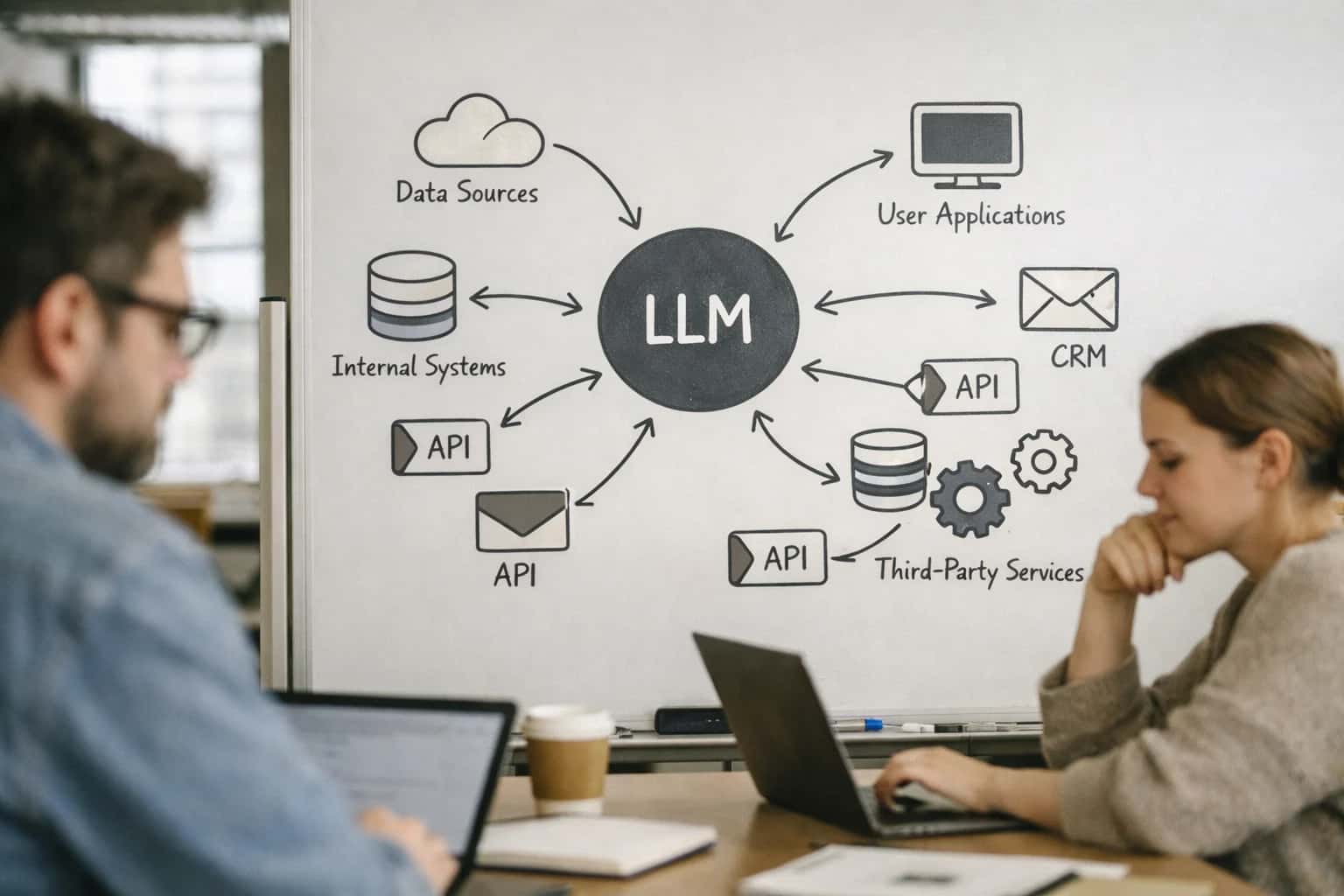
Special districts operate on a unique stack: a core ERP for fund accounting (like Tyler Munis or Infor Public Sector), a customer information and billing system (CIS) for utilities, and an enterprise asset management (EAM) platform for infrastructure. AI integration connects at three key surfaces: 1) the citizen service portal for 24/7 inquiries on bills, outages, and permits, 2) the back-office workflow engine for processing meter reads, work orders, and capital project approvals, and 3) the data layer unifying SCADA, GIS, and financial data for predictive analytics.

Integration
AI Integration with Public Sector Special District Management
A technical blueprint for integrating AI into the core ERP, billing, and asset management systems of independent special districts (water, fire, utility) to automate service requests, predict infrastructure failures, and streamline financial operations.
ARCHITECTURE FOR WATER, FIRE, AND UTILITY DISTRICTS
Where AI Fits in Special District Operations
A practical blueprint for integrating AI into the core ERP, billing, and asset management systems that power independent special districts.
Implementation focuses on high-impact, governed workflows. For a water district, this means an AI agent integrated via the CIS API to handle high-volume payment and usage inquiries, reducing call center load. For asset management, AI models consume EAM work history and sensor data to predict pump or treatment plant failures, automatically generating prioritized work orders in the system. In finance, AI assists with complex utility rate case analysis by summarizing consumption patterns and generating draft narratives for regulatory filings, all while maintaining a strict audit trail within the ERP.
Rollout is phased, starting with a non-transactional copilot for district staff to query cross-system data (e.g., "What's the status of permit #X and its associated inspection?"). Governance is critical: AI tools must operate within the district's existing RBAC (Role-Based Access Control) framework and records retention policies. A successful integration uses the district's existing integration platform or a lightweight middleware layer to broker secure, logged calls between AI services and district systems, ensuring data never leaves the approved environment and all actions are traceable back to a system or user record.
ARCHITECTING AI FOR WATER, FIRE, AND UTILITY DISTRICTS
Key Integration Surfaces in the Special District Tech Stack
Core Revenue and Constituent Interface
Special districts manage complex billing for water, sewer, fire protection, and other utility services. AI integration surfaces here are critical for operational efficiency and resident satisfaction.
Key Integration Points:
- Billing Engine APIs: Connect AI to systems like Tyler Munis Utility Billing or Infor CloudSuite Public Sector to automate dispute resolution. An AI agent can analyze meter reads, payment history, and work orders to generate explanations or initiate adjustments.
- Customer Information Systems (CIS): Embed a chatbot or voice agent into the district's payment portal and IVR system. Using APIs, the agent can authenticate residents, explain bills, set up payment plans, and log service requests directly into the CIS.
- Meter Data Management (MDM): Integrate AI with MDM platforms to detect anomalies in consumption patterns, predict potential leaks, and trigger proactive customer notifications or work orders in the asset management system.
Example Workflow: A resident calls about a high bill. The AI voice agent authenticates via phone number, retrieves the account, analyzes 24 months of usage and recent weather data, identifies a spike consistent with a leak, and offers to create a leak investigation work order while explaining payment plan options.
UTILITY, FIRE, WATER, AND PUBLIC SERVICE DISTRICTS
High-Value AI Use Cases for Special Districts
Special districts operate unique, asset-intensive services with complex billing, regulatory, and constituent needs. These AI integration patterns connect directly to core ERP, asset management, and billing modules to automate high-friction workflows and improve service delivery.
01
Automated Utility Billing & Dispute Resolution
Integrate AI agents with utility billing modules (like Tyler Munis or Infor) to handle high-volume customer inquiries. AI cross-references meter reads, payment history, and rate schedules to explain charges, process payment arrangements, and triage complex disputes to human agents. Reduces call center volume for routine questions.
Hours -> Minutes
Dispute resolution time
02
Predictive Infrastructure Maintenance
Connect AI models to Enterprise Asset Management (EAM) systems like Infor EAM or IBM Maximo. Analyze SCADA sensor data, work order history, and environmental factors to predict failures in water mains, lift stations, or treatment equipment. Automatically generates prioritized work orders and parts requests in the CMMS.
Reactive -> Predictive
Maintenance mode
03
Intelligent Permit & Inspection Workflow
Embed AI into permit processing platforms (e.g., Tyler EnerGov) to automate initial plan review. AI checks submissions against code libraries for completeness, answers applicant questions via chatbot, and uses historical data to predict review timelines. Routes complex reviews to the correct specialist, optimizing inspector schedules.
1-2 Week Sprint
Initial implementation
04
Capital Planning & Rate Modeling Assistant
Integrate AI with budgeting and capital planning modules in the district ERP. AI analyzes decades of asset depreciation, repair costs, and funding sources to model long-term infrastructure needs. Generates data-driven narratives for rate case filings and board presentations, pulling directly from financial and asset systems.
Batch -> Real-time
Scenario modeling
05
Field Service Technician Copilot
Deploy AI copilots for technicians via mobile Field Service Management (FSM) apps like ServiceTitan or integrated ERP modules. Provides hands-free access to asset repair history, schematics, and safety protocols. Uses computer vision via device camera to identify parts and log work completion notes, which sync back to the CMMS.
Same Day
Work order documentation
06
Regulatory Reporting & Compliance Automation
Automate the consolidation and submission of reports to state and federal agencies (e.g., DWR, EPA). AI agents are integrated with the ERP, LIMS, and SCADA systems to collect required data, check for anomalies against regulatory thresholds, and populate formatted reports. Flags potential compliance issues for review before submission.
Manual -> Automated
Data aggregation
SPECIAL DISTRICT MANAGEMENT
Example AI-Powered Workflows for District Operations
Special districts managing water, fire, or utility services require precise, auditable operations. These workflows illustrate how AI agents integrate with core ERP, billing, and asset management systems to automate high-volume tasks, improve constituent service, and optimize maintenance planning.
Trigger: A customer submits a high-bill inquiry via the district's online portal, IVR system, or a call center agent logs a case.
Context/Data Pulled: The AI agent retrieves the customer account from the billing system (e.g., Tyler Munis, Infor), fetches the last 3 billing cycles, pulls meter read data from the AMI/SCADA integration, and checks for any recent service work orders or known main breaks in the area.
Agent Action: The agent analyzes usage patterns, compares to historical data and neighborhood averages, and checks for estimated vs. actual reads. It drafts a plain-language explanation, identifying if the spike is due to seasonality, a leak (based on continuous flow patterns), or a meter issue.
System Update/Next Step: The agent posts a summary of its analysis to the CRM case, updates the case status, and can either:
- Automatically resolve: For clear seasonality, it sends a detailed explanation email/SMS to the customer and closes the case.
- Escalate for human review: If a potential leak or meter fault is detected, it routes the case to a field service queue with its findings and recommends a next step (leak detection visit, meter test).
Human Review Point: All proposed "leak" or "meter fault" classifications and associated recommended field visits are flagged for supervisor approval before dispatch is generated.
A PRACTICAL BLUEPRINT FOR SPECIAL DISTRICTS
Implementation Architecture: Connecting AI to District Systems
A technical guide to architecting AI integrations for water, fire, utility, and other special district management systems.
The integration architecture connects AI agents and copilots to the core operational surfaces of your district's ERP and asset management platforms. This typically involves building a secure orchestration layer that interfaces with key APIs and data objects: utility billing modules for customer inquiries and payment plans, work order management systems (like Infor EAM or IBM Maximo) for predictive maintenance and technician dispatch, asset registers for lifecycle cost analysis, and permit/licensing modules for automated application review. The AI layer acts as a middleware, processing natural language requests, analyzing structured data, and executing approved actions back into the system of record, all while maintaining a full audit trail.
Implementation follows a phased, workflow-first approach. Start with high-volume, repetitive tasks: an AI agent integrated with the customer information system (CIS) to handle 24/7 billing inquiries and payment discrepancies, reducing call center load. Next, deploy a predictive maintenance copilot that ingests SCADA sensor data and historical work orders from your CMMS to flag at-risk assets and automatically generate prioritized work orders. Finally, implement document intelligence pipelines for permits and engineering plans, using OCR and NLP to extract data, check against code, and populate backend systems like Tyler EnerGov, slashing plan review timelines from weeks to days.
Governance and rollout are critical. Deploy AI with a human-in-the-loop model for approvals (e.g., large write-offs, complex permit variances). Implement strict role-based access control (RBAC) so AI tools only interact with data and APIs permitted for the end-user's role. Use the district's existing identity provider (e.g., Okta, Entra ID) for authentication. All AI-generated actions and recommendations should be logged to the district's primary audit log system, creating an immutable record for compliance. Start with a pilot department (e.g., water billing) to validate ROI and user adoption before scaling to fire protection, solid waste, or other operational areas.
SPECIAL DISTRICT WORKFLOWS
Code and Payload Examples
Handling Rate & Usage Queries
An AI agent integrated with the district's billing module can answer common resident questions by retrieving account data via API. The agent uses the resident's account number (from a secure session) to fetch current balance, usage history, and rate tier details, then generates a natural language explanation.
Example Payload for Billing API Call:
json{ "operation": "get_account_summary", "parameters": { "account_id": "WTR-7342-2024", "include_current_cycle": true, "include_usage_history": 12 }, "auth_context": { "session_token": "eyJhbGci...", "user_role": "resident" } }
The AI formats the raw API response—including complex tiered rate calculations—into a clear summary for the resident, reducing call center volume for routine inquiries.
AI FOR SPECIAL DISTRICT MANAGEMENT
Realistic Operational Impact and Time Savings
How AI integration transforms manual, time-intensive processes for water, fire, and utility districts by connecting to core ERP, billing, and asset management systems.
| Operational Process | Before AI Integration | After AI Integration | Implementation Notes |
|---|---|---|---|
Customer Billing Inquiry Resolution | Manual lookup across billing & CRM; 15-30 min per call | AI agent provides account summary & history instantly; <2 min | Agent integrates with CIS (Customer Information System) and payment portal APIs |
Service Outage Communication | Manual call lists & generic social posts; hours to notify | AI analyzes SCADA/AMI data, auto-generates & targets comms; minutes | Triggers from operational data systems; uses pre-approved message templates |
Asset Inspection Report Writing | Field notes transcribed manually; 2-4 hours per report | AI drafts report from technician voice notes & photos; 20 min review | Integrates with EAM/CMMS; final approval required by supervisor |
Permit/Application Intake Review | Manual checklist review for completeness; next-day turnaround | AI pre-scans documents for missing data/signatures; same-day routing | Connects to permitting module; flags exceptions for staff review |
Capital Project Budget Narrative | Manual data pull from spreadsheets & ERP; 1-2 days drafting | AI aggregates cost, timeline, asset data into first draft; 2-4 hours | Pulls from project management & fund accounting modules; human edits final |
Governing Board Packet Preparation | Manual compilation of reports from 5+ systems; 8-16 hours | AI agent aggregates, summarizes, formats data into draft packet; 2 hours | Orchestrates queries across financial, operational, and CRM systems |
Regulatory Compliance Data Aggregation | Quarterly manual extraction from siloed systems; 3-5 person-days | AI monitors data sources, auto-generates compliance datasets; ongoing | Scheduled pipelines from water quality, billing, and asset systems; audit trail maintained |
ENSURING CONTROLLED DEPLOYMENT FOR CRITICAL INFRASTRUCTURE
Governance, Security, and Phased Rollout
A practical framework for implementing AI in special district management with the security, auditability, and phased approach required for public sector operations.
AI integration for special districts must be architected with zero-trust principles from the start. This means implementing strict role-based access controls (RBAC) tied to your ERP's user directory (e.g., Tyler Munis, Infor CloudSuite), ensuring AI agents and copilots only access the utility billing records, asset work orders, or financial data permitted for the user's role. All AI-generated actions—like creating a service request or adjusting a meter reading—must be logged in an immutable audit trail within the primary system of record, with a clear chain of custody linking the AI's suggestion to the human approver. For districts handling sensitive citizen data, a private inference endpoint for LLMs, deployed within your government cloud environment, ensures PII and operational data never leaves your controlled infrastructure.
A successful rollout follows a three-phase pilot-to-production model. Phase 1 targets a single, high-volume, low-risk workflow, such as automating responses to common billing inquiries via a chatbot integrated with the district's customer information system (CIS). Phase 2 expands to a more complex, cross-system process, like using AI to analyze SCADA sensor data from water treatment assets in Infor EAM and automatically generating prioritized work orders. Phase 3 operationalizes predictive models, such as forecasting peak demand from historical usage patterns in the billing module to optimize rate structures. Each phase includes a defined evaluation period measuring accuracy, user adoption, and operational impact before proceeding.
Governance is maintained through a human-in-the-loop (HITL) approval layer for all non-routine AI actions. For example, an AI recommendation to approve a large vendor payment anomaly in the procurement module would route to a finance officer for review within the existing workflow. Regular model performance reviews are scheduled against key performance indicators (KPIs) like reduction in call center volume or improvement in first-time fix rates for field crews. This controlled, incremental approach de-risks the investment, builds institutional trust, and ensures the AI augments—rather than disrupts—the reliable delivery of essential public services.
Enabling Efficiency, Speed & Accuracy
Intelligent Analysis, Decision & Execution
We build AI systems for teams that need search across company data, workflow automation across tools, or AI features inside products and internal software.
Talk to Us
Search across company data
Give teams answers from docs, tickets, runbooks, and product data with sources and permissions.
Useful when people spend too long searching or get different answers from different systems.
Enterprise searchRAGPermissions
Read more
Automate internal workflows
Use AI to route work, draft outputs, trigger actions, and keep approvals and logs in place.
Useful when repetitive work moves across multiple tools and teams.
AI agentsWorkflow automationGovernance
Read more
Add AI to products and internal tools
Build assistants, guided actions, or decision support into the software your team or customers already use.
Useful when AI needs to be part of the product, not a separate tool.
AI integrationDecision supportModel routing
Read moreIMPLEMENTATION PATTERNS
Frequently Asked Questions (FAQ)
Common technical and operational questions for integrating AI into the specialized workflows of water, fire, utility, and other independent special districts.
Secure integration typically follows a layered API architecture:
- Authentication Layer: AI agents authenticate via OAuth 2.0 or API keys managed in a secrets vault, with permissions scoped to specific data objects (e.g.,
CustomerAccount,WorkOrder,MeterRead). - Orchestration Layer: A middleware service (often deployed within the district's cloud VPC) acts as a bridge. It receives requests from AI agents, calls the district's ERP APIs (like Tyler Munis, Infor CloudSuite), and returns structured data.
- Data Governance: Implement field-level masking for sensitive data (e.g., SSN, full bank details) before data is sent to an LLM. All queries and generated actions are logged with user IDs and timestamps for a full audit trail.
Example payload for a citizen billing inquiry agent:
json{ "agent_session_id": "xyz-123", "user_intent": "explain_high_bill", "parameters": { "account_number": "WTR-78910", "bill_date": "2024-04-01" } }
The orchestration layer fetches the bill, usage history, and rate tiers, then constructs a prompt for the LLM to generate a plain-language explanation.

About the author
Prasad Kumkar
CEO & MD, Inference Systems
Prasad Kumkar is the CEO & MD of Inference Systems and writes about AI systems architecture, LLM infrastructure, model serving, evaluation, and production deployment. Over 5+ years, he has worked across computer vision models, L5 autonomous vehicle systems, and LLM research, with a focus on taking complex AI ideas into real-world engineering systems.
His work and writing cover AI systems, large language models, AI agents, multimodal systems, autonomous systems, inference optimization, RAG, evaluation, and production AI engineering.
LinkedIn
Limited slotsGet a Free AI Consultation
Partnered with leading AI, data, and software stack.





How We Work
Custom AI workflows for your Business
One-fit-all AI don't work for modern businesses. At Inferensys, we aim to understand your business & custom requirements; which we use to define most efficient agentic workflows, the data, and the tools for your business.
01
Review the use case
We understand the task, the users, and where AI can actually help.
Read more02
Pick the right approach
We define what needs search, automation, or product integration.
Read more03
Build the first useful version
We implement the part that proves the value first.
Read more04
Improve from there
We add the checks and visibility needed to keep it useful.
Read moreThe first call is a practical review of your use case and the right next step.
Talk to Us