AI agents connect directly to the data and workflow engines of your primary compliance systems—such as grant management modules in Workday, procurement controls in SAP Ariba Public Sector, or case management in Tyler Odyssey—to automate the three core compliance activities: data collection, rule validation, and corrective action tracking. Instead of quarterly manual sampling, AI models can continuously monitor 100% of transactions, documents, and activities against a dynamic rules library, flagging potential violations in real-time for officer review within the existing case or audit management interface.

Integration
AI Integration with Public Sector Compliance Systems
A practical blueprint for integrating AI agents with government compliance platforms to automate monitoring, flag potential violations, track corrective actions, and streamline regulatory reporting.
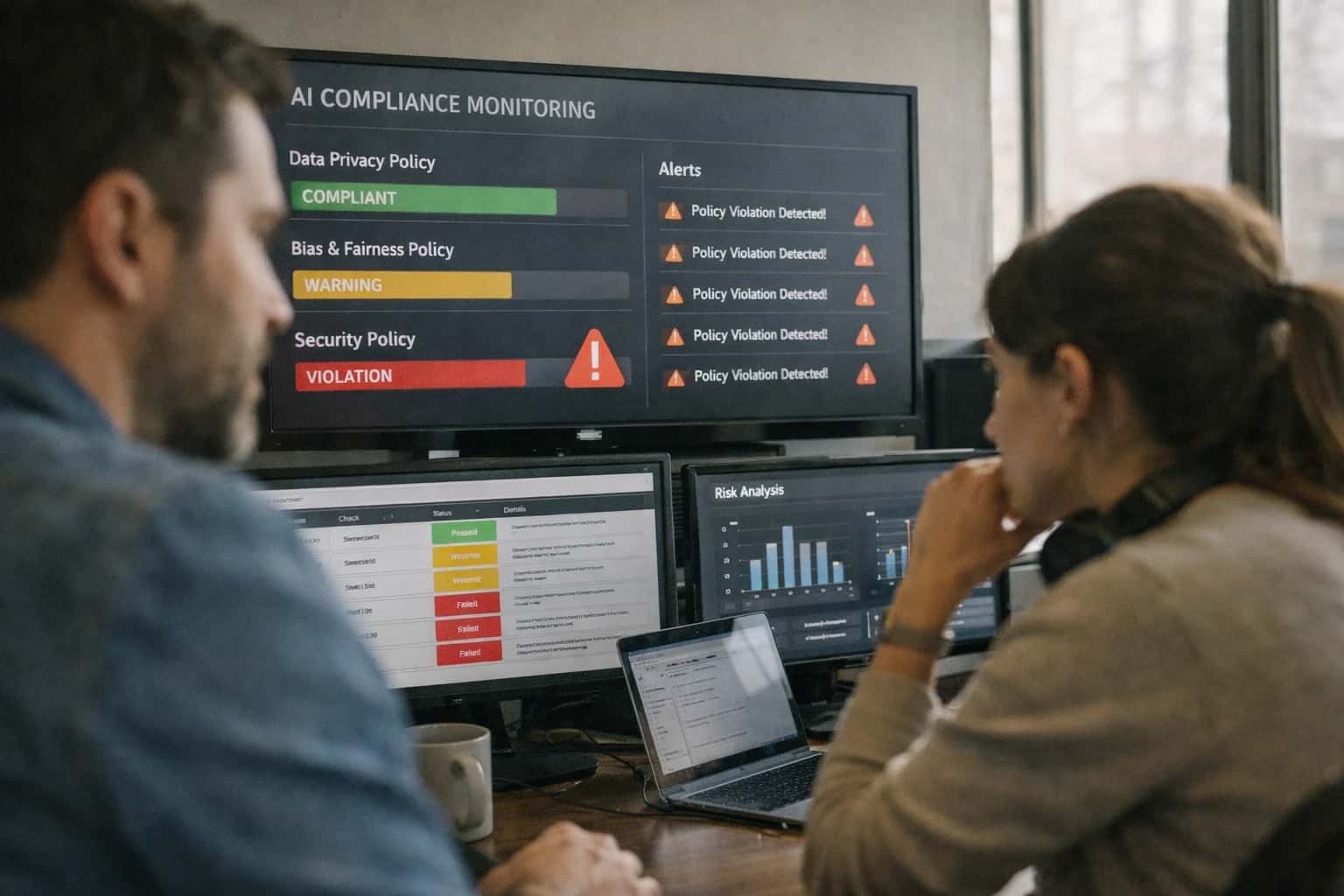
FROM REACTIVE TO PREDICTIVE OVERSIGHT
Where AI Fits in Public Sector Compliance Workflows
AI integration transforms compliance from a manual, document-heavy audit process into a continuous, intelligent monitoring system embedded within your core platforms.
The implementation centers on a secure orchestration layer that sits between your AI models and your system-of-record APIs. This layer ingests events from core platforms (e.g., a new vendor payment from the ERP, a submitted grant performance report, a change to a licensed facility's inspection record), runs them against configured compliance rules using LLMs for document analysis and classical models for anomaly detection, and then creates flagged records or tasks back in the originating system. For example, an AI monitor watching Infor CloudSuite Public Sector procurement data could automatically cross-reference new POs against debarment lists and vendor risk scores, creating a high-priority review task in the manager's workflow queue if a match is found.
Rollout requires a phased, use-case-driven approach, starting with high-volume, rule-based checks (e.g., allowable cost verification for federal grants) before moving to complex, judgment-intensive monitoring (e.g., analyzing contractor narrative reports for compliance with statement-of-work terms). Governance is critical: all AI-generated flags must route through a human-in-the-loop approval step within the existing compliance platform's audit trail, and the models themselves require continuous evaluation against a ground-truth dataset of past findings to manage drift. This architecture doesn't replace your compliance officers; it arms them with a prioritized, evidence-backed list of potential issues, turning weeks of manual review into focused hours of investigation. For a deeper look at the technical patterns for building these monitoring systems, see our guide on AI Integration for AI in Public Sector Compliance Monitoring.
AI INTEGRATION WITH PUBLIC SECTOR COMPLIANCE SYSTEMS
Key Integration Points in Compliance Platforms
Automating Mandated Data Workflows
Compliance platforms manage vast reporting obligations—from environmental permits to grant expenditures. AI integration targets the ingestion and structuring of raw data from operational systems (SCADA, ERP, case management) to populate mandated forms.
Key surfaces include:
- Report Generation Modules: AI agents can be triggered on a schedule or by a data event to pull, validate, and format data into draft reports (e.g., EPA Discharge Monitoring Reports, FEMA reimbursement claims).
- Data Validation Rules Engines: Integrate AI to perform advanced anomaly detection beyond simple threshold checks, flagging outliers in emissions data or expenditure patterns for officer review before submission.
- External Data Feeds: Connect AI to ingest and interpret unstructured regulatory updates from government websites or publications, automatically mapping new requirements to internal data points and triggering update workflows in the compliance platform.
PUBLIC SECTOR COMPLIANCE SYSTEMS
High-Value AI Use Cases for Compliance
Integrating AI with platforms like Tyler Munis, SAP Public Sector, and specialized grant management systems automates the most manual, high-risk compliance workflows. These patterns focus on continuous monitoring, proactive risk identification, and audit-ready automation.
01
Automated Grant Compliance Monitoring
AI agents continuously monitor financial transactions and project activities within grant management modules against award terms. They flag potential cost allocation errors, unapproved budget deviations, and missed reporting deadlines for officer review, turning sporadic manual checks into a real-time control layer.
Batch -> Real-time
Monitoring frequency
02
Regulatory Document & Report Assembly
Integrate AI with document management systems (e.g., Tyler Content Manager) and ERP data to automate the drafting of complex compliance reports. AI pulls data from fund accounting, procurement, and HR systems, structures narratives for A-133 audits, grant performance reports, or environmental disclosures, and routes drafts for human approval.
1 sprint
Report assembly time
03
Procurement & Contract Risk Scoring
Connect AI to procurement platforms (SAP Ariba, Jaggaer) and vendor master data. AI analyzes RFPs, bid responses, and contract clauses against policy libraries and historical performance data to automatically score vendor risk, flag restrictive terms, and highlight potential compliance issues before award.
Same day
Risk assessment
04
Continuous Internal Control Testing
Deploy AI models to perform automated, sample-based testing of key internal controls directly within the ERP environment. For example, AI can validate that purchase orders have proper approvals before payment, check that payroll aligns with timekeeping data, and detect segregation of duties conflicts, logging all tests for the audit trail.
05
FOIA & Public Records Request Triage
Integrate AI with records management systems to automate the initial processing of Freedom of Information Act (FOIA) and public records requests. AI classifies request intent, identifies potentially responsive documents across repositories, and suggests applicable exemptions for legal review, dramatically reducing manual search and review time.
Hours -> Minutes
Initial triage
06
Corrective Action Workflow Automation
When a compliance issue is flagged (from audit findings, monitoring alerts, or citizen complaints), AI integrated with case management systems can automatically draft corrective action plans, assign tasks to responsible departments, monitor completion deadlines, and compile evidence for closure—ensuring issues are tracked to resolution.
IMPLEMENTATION PATTERNS
Example AI-Powered Compliance Workflows
These workflows illustrate how AI agents can be integrated with public sector compliance platforms to automate monitoring, data collection, and corrective action tracking. Each pattern connects to core systems like Tyler Munis, SAP Public Sector, or specialized regulatory modules.
This workflow continuously audits transactions against grant terms to flag potential non-compliance before funds are disbursed.
- Trigger: A new invoice or journal entry is posted to the fund accounting system (e.g., Tyler Munis, SAP S/4HANA Public Sector).
- Context Pulled: The AI agent retrieves the associated grant ID, budget line items, approved vendor list, and period of performance rules from the Grant Management System.
- Agent Action: Using a rules engine augmented with an LLM, the agent:
- Classifies the expense against allowable cost categories.
- Checks if the vendor is pre-approved.
- Validates the expense date falls within the grant period.
- Calculates remaining budget and flags overages.
- System Update: Results are logged in a compliance dashboard. For clear violations, the transaction is routed to a "Hold" status in the ERP and an alert is sent to the grants officer.
- Human Review Point: The grants officer reviews flagged transactions in the compliance platform, adds context, and either approves with an override reason or rejects the expenditure.
Integration Touchpoints: ERP Financials API, Grant Management System API, Compliance Case Management System.
GOVERNANCE-FIRST AI INTEGRATION
Implementation Architecture: Connecting AI to Your Stack
A practical blueprint for embedding AI monitors into public sector compliance platforms to automate reporting, flag violations, and track corrective actions.
Effective AI integration for compliance systems like Tyler Munis, SAP Public Sector, or specialized platforms begins by mapping to key data objects and workflows. The primary integration surfaces are the transaction ledger (for fund accounting anomalies), vendor master and contract modules (for procurement compliance), and grant management or case management tables (for program-specific rule monitoring). AI agents are connected via secure APIs or event listeners (webhooks) to monitor these objects in near-real-time, extracting data for analysis against a configured rulebook of federal, state, and local regulations.
The implementation typically follows a dual-path architecture: a batch analysis pipeline for comprehensive monthly/quarterly report generation (e.g., Single Audit Act reporting, grant performance) and a streaming detection engine for immediate anomaly flagging. For example, an AI model can be trained to classify procurement transactions against OMB Uniform Guidance, flagging potential unallowable costs. These flags are then written back to the compliance system as a potential_violation record, linked to the source transaction, and routed via existing workflow engines to the appropriate compliance officer for review. All AI inferences are logged with full audit trails, including the source data, model version, prompt used, and confidence score, to support future audits and model retraining.
Rollout requires a phased, use-case-driven approach, starting with a single high-volume, rule-based workflow—such as automated data collection for Annual Comprehensive Financial Report (ACFR) footnotes or continuous monitoring of American Rescue Plan Act (ARPA) expenditure categories. Governance is paramount; a human-in-the-loop design ensures all AI-generated flags or reports require officer review and approval before any official action is taken. This architecture, built on secure, API-first principles, allows public sector teams to incrementally add AI intelligence to their compliance operations without replacing core systems, turning manual, periodic checks into automated, continuous assurance.
AI INTEGRATION WITH PUBLIC SECTOR COMPLIANCE SYSTEMS
Code and Integration Patterns
Connecting AI to Audit Trails and Transaction Logs
Integrate AI agents directly with the audit logs and transaction tables of your compliance platform (e.g., within SAP GRC, Workiva, or custom systems). The pattern involves subscribing to event streams or polling for new entries, then using an LLM to classify and summarize potential issues.
Key Integration Points:
- Event Hooks: Use platform webhooks or database triggers on
audit_log,transaction, orchange_historytables. - Orchestration Layer: A middleware service (often on BTP, Infor OS, or a custom microservice) receives events, enriches them with context from master data, and calls the AI model.
- Actionable Output: The AI service returns a structured JSON with
risk_score,violation_type,relevant_regulation, and asummary. This payload is posted back to the compliance platform'sfindingsoralertsAPI to create a draft issue for officer review.
This creates a continuous monitoring loop, transforming raw log data into prioritized, narrative-driven alerts.
AI FOR COMPLIANCE MONITORING AND REPORTING
Realistic Time Savings and Operational Impact
How AI integration transforms manual, reactive compliance workflows into proactive, data-driven operations within systems like Tyler Munis, SAP Public Sector, and specialized regulatory platforms.
| Compliance Workflow | Before AI | After AI | Implementation Notes |
|---|---|---|---|
Regulatory Data Collection for Reports | Manual extraction from 5+ systems, 8-16 hours per report | Automated aggregation & synthesis, 1-2 hours per report | AI connects to ERP, case management, and document systems via APIs |
Potential Violation Flagging | Monthly batch review by analyst, next-day alerts | Continuous transaction monitoring, real-time alerts for high-risk items | Models trained on historical violations; human review required for all flags |
Corrective Action Plan (CAP) Tracking | Spreadsheet-based, manual status updates from emails | Automated status pulls from work order/CRM systems, dashboard alerts | AI integrates with task management APIs to monitor CAP completion |
Audit Evidence Compilation | Manual document search and redaction, 20-40 hours per audit | Semantic search across DMS, automated redaction for common PII, 5-10 hours | Requires integration with document management systems (e.g., Tyler Content Manager) |
Grant Expenditure Compliance Check | Post-transaction sampling, quarterly review cycles | Pre-validation of 80% of transactions against grant terms prior to posting | AI reviews coding and amounts against grant rules in fund accounting module |
Public Records Request (FOIA) Review | Manual page-by-page review for exemptions | AI pre-screens documents, suggests redactions, reviewer confirms | High-stakes process; AI is an assistive tool with human-in-the-loop final sign-off |
Environmental Permit Compliance Monitoring | Scheduled site inspections, paper-based checklists | AI analyzes sensor data & self-reported logs, prioritizes inspections | Integration with IoT/SCADA feeds and permit management system required |
ARCHITECTING FOR PUBLIC SECTOR TRUST
Governance, Security, and Phased Rollout
Deploying AI within regulated compliance systems requires a deliberate, phased approach centered on auditability, data sovereignty, and human oversight.
AI integration with platforms like Cority, VelocityEHS, or Intelex must begin with a clear data governance model. This involves mapping which compliance data objects—incident reports, audit findings, corrective actions, training records—the AI will access, and establishing strict RBAC (Role-Based Access Control) via the platform's API to enforce least-privilege access. All AI-generated outputs, such as potential violation flags or draft regulatory summaries, should be written back to the system as annotated records with a full audit trail linking the source data, the AI model version, and the prompting logic used.
A secure implementation typically uses a gateway pattern, where an integration service (hosted in the agency's approved cloud or on-premises environment) acts as an intermediary. This service calls the compliance platform's APIs, retrieves and anonymizes sensitive data as needed, sends it to a governed AI model endpoint, and then routes the AI's response back into the workflow—often into a 'For Review' queue within the compliance system. This pattern keeps sensitive PII or operational data within the agency's control and ensures all AI interactions are logged for compliance officers.
Rollout should follow a phased, risk-based approach. Phase 1 might target low-risk, high-volume workflows like automating the initial triage and categorization of incoming safety observations or environmental data submissions. Phase 2 could introduce AI-assisted audit preparation, where the system analyzes past inspection reports and current permits to predict potential findings. Only after establishing trust and ironclast governance in these areas should teams consider Phase 3 applications, such as predictive models for high-consequence event risk. Each phase includes parallel human review cycles, with performance and accuracy metrics fed back to refine the AI agents, ensuring they augment—not replace—the critical judgment of compliance professionals.
Enabling Efficiency, Speed & Accuracy
Intelligent Analysis, Decision & Execution
We build AI systems for teams that need search across company data, workflow automation across tools, or AI features inside products and internal software.
Talk to Us
Search across company data
Give teams answers from docs, tickets, runbooks, and product data with sources and permissions.
Useful when people spend too long searching or get different answers from different systems.
Enterprise searchRAGPermissions
Read more
Automate internal workflows
Use AI to route work, draft outputs, trigger actions, and keep approvals and logs in place.
Useful when repetitive work moves across multiple tools and teams.
AI agentsWorkflow automationGovernance
Read more
Add AI to products and internal tools
Build assistants, guided actions, or decision support into the software your team or customers already use.
Useful when AI needs to be part of the product, not a separate tool.
AI integrationDecision supportModel routing
Read moreIMPLEMENTATION AND GOVERNANCE
Frequently Asked Questions
Common technical and operational questions about integrating AI with public sector compliance systems like Enablon, Cority, Intelex, and VelocityEHS for automated monitoring, reporting, and corrective action workflows.
AI agents connect via secure, API-first integration patterns, never storing raw compliance data. A typical architecture involves:
- API Gateway & Authentication: Agents authenticate using service accounts with strict, read-only RBAC permissions scoped to specific modules (e.g., incident reports, audit findings, corrective actions).
- Orchestration Layer: A middleware service (often on BTP, Infor OS, or a custom node) queries the compliance platform's REST/SOAP APIs to pull batches of records or listen for webhook events (e.g.,
corrective_action.created). - Context Enrichment: The orchestration layer retrieves only the necessary fields (record ID, description, dates, status, related documents) and passes a sanitized payload to the AI agent.
- Agent Execution: The agent, using a model like GPT-4 or Claude, analyzes the payload to check for completeness, flag potential violations against a rules library, or draft a summary.
- System Update: The agent's output (a flag, a score, a draft narrative) is posted back to the compliance system via API, creating a new
AI_Reviewrecord or updating a status field, maintaining a full audit trail.
This pattern ensures data never leaves the controlled environment, and all actions are logged back to the system of record.

About the author
Prasad Kumkar
CEO & MD, Inference Systems
Prasad Kumkar is the CEO & MD of Inference Systems and writes about AI systems architecture, LLM infrastructure, model serving, evaluation, and production deployment. Over 5+ years, he has worked across computer vision models, L5 autonomous vehicle systems, and LLM research, with a focus on taking complex AI ideas into real-world engineering systems.
His work and writing cover AI systems, large language models, AI agents, multimodal systems, autonomous systems, inference optimization, RAG, evaluation, and production AI engineering.
LinkedIn
Limited slotsGet a Free AI Consultation
Partnered with leading AI, data, and software stack.





How We Work
Custom AI workflows for your Business
One-fit-all AI don't work for modern businesses. At Inferensys, we aim to understand your business & custom requirements; which we use to define most efficient agentic workflows, the data, and the tools for your business.
01
Review the use case
We understand the task, the users, and where AI can actually help.
Read more02
Pick the right approach
We define what needs search, automation, or product integration.
Read more03
Build the first useful version
We implement the part that proves the value first.
Read more04
Improve from there
We add the checks and visibility needed to keep it useful.
Read moreThe first call is a practical review of your use case and the right next step.
Talk to Us