Integrating AI into SAP Ariba Public Sector focuses on three core surfaces: the Sourcing Project, the Supplier Profile, and the Contract Workspace. AI agents can be triggered via Ariba's APIs or webhooks at key workflow stages—such as when an RFP is published, a bid is submitted, or a contract is uploaded—to perform analysis, generate content, or flag risks without disrupting the existing user interface or approval chains. This approach treats AI as an augmentation layer, not a replacement, ensuring compliance with public sector procurement rules remains front and center.

Integration
AI Integration for SAP Ariba Public Sector
A practical blueprint for integrating AI agents and copilots into SAP Ariba Public Sector procurement workflows to automate vendor analysis, contract review, bid evaluation, and spend intelligence.
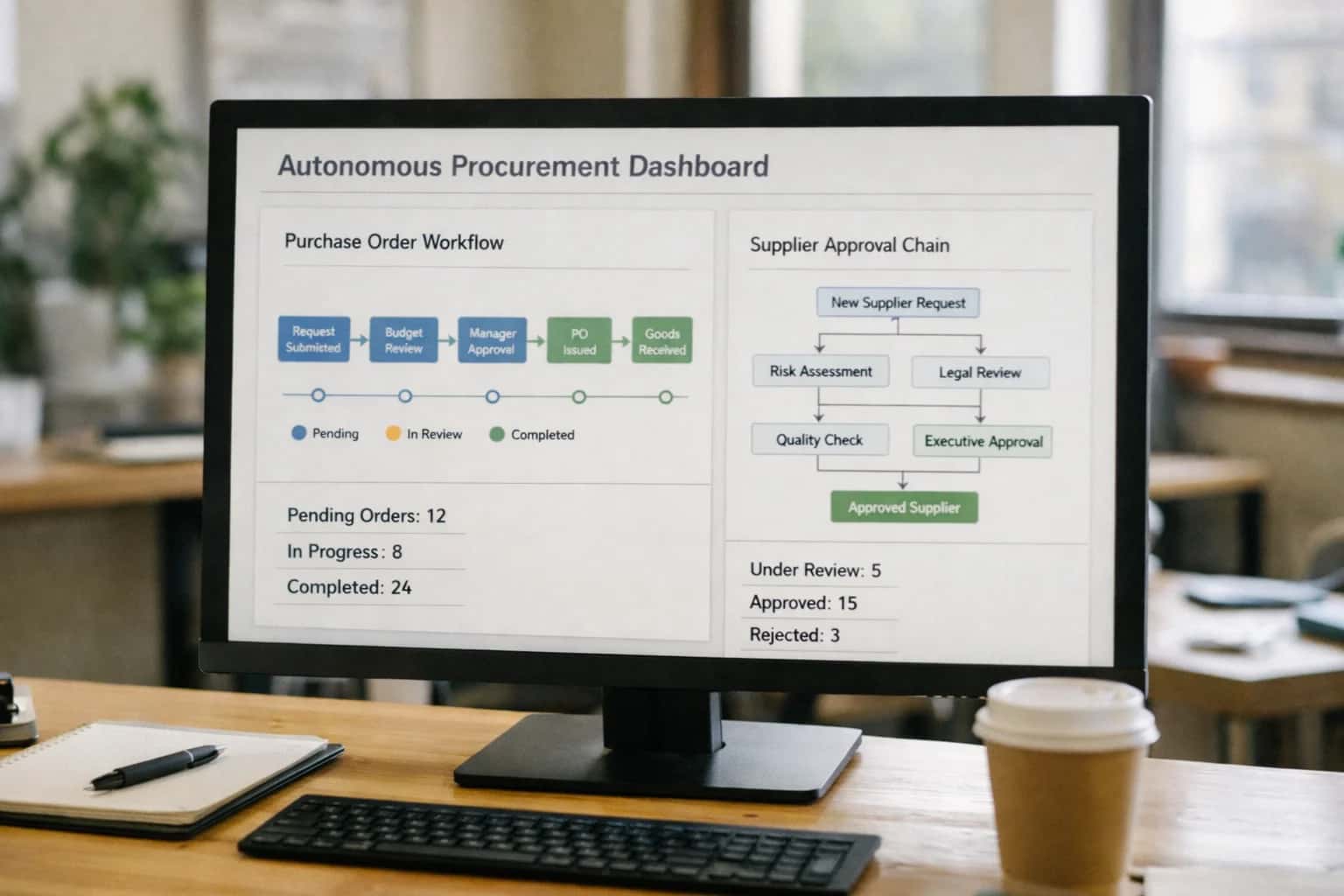
ARCHITECTURE AND ROLLOUT
Where AI Fits in Public Sector Procurement
A practical blueprint for integrating AI into SAP Ariba Public Sector to automate high-friction workflows and augment procurement officer decision-making.
For implementation, a common pattern involves deploying a lightweight orchestration service (often on SAP Business Technology Platform or a secure cloud tenant) that listens to Ariba events. This service calls AI models for specific tasks: NLP models to evaluate bid responsiveness against RFP requirements, clustering algorithms to analyze historical spend data for category intelligence, and extractive QA models to review contract clauses against a library of approved public sector language. Results are written back to Ariba as structured data in custom fields, attached analysis documents, or actionable alerts in the activity stream, creating a closed-loop, auditable system.
Rollout should be phased, starting with a single, high-volume process like automated bid compliance scoring or vendor risk profile enrichment. Governance is critical; all AI-generated outputs should be clearly labeled as 'AI-assisted' and require officer review and approval before finalization. Establish audit trails that log the source data, the AI model version, and the human reviewer, ensuring transparency for internal audit and potential public records requests. This controlled, use-case-driven integration reduces manual review from days to hours while keeping procurement officers firmly in the loop.
PUBLIC SECTOR PROCUREMENT
Key Integration Surfaces in SAP Ariba
Sourcing Projects & Contract Authoring
Integrate AI directly into Sourcing Projects and Contract Workspaces to automate high-friction, manual tasks. Use AI to draft initial RFP/RFQ language based on historical project data and public sector templates. For contract authoring, connect AI agents to clause libraries to suggest compliant language, flag non-standard terms, and perform initial risk assessments against master agreements.
Key integration points include the Ariba Sourcing API to create and update projects, and the Ariba Contracts API to pull draft documents for analysis and push back annotated versions. AI can also monitor supplier responses during bidding to flag non-responsive answers or potential compliance issues for officer review, compressing evaluation timelines.
SAP ARIBA PUBLIC SECTOR
High-Value AI Use Cases for Public Procurement
Integrate AI directly into SAP Ariba Public Sector workflows to automate high-volume tasks, enhance compliance, and deliver data-driven intelligence for procurement officers, contract managers, and budget analysts.
01
Automated Bid & Proposal Evaluation
Use AI to pre-score RFP responses against weighted criteria, extracting key commitments from vendor documents. Integrates with the Ariba Sourcing module to flag non-compliant bids and surface top candidates for officer review, reducing evaluation cycles from weeks to days.
Weeks -> Days
Evaluation cycle
02
Vendor Risk & Performance Intelligence
Continuously analyze vendor master data, past performance records, and external news feeds. AI agents connected to Ariba Supplier Management generate risk scores and alert on debarment or financial instability, enabling proactive management of the approved vendor list.
03
Spend Category Analysis & Forecasting
Apply clustering and NLP to line-item spend data from the Ariba Buying and Invoicing modules. Automatically categorize maverick spend, identify consolidation opportunities, and generate forecasts to inform category strategies and budget planning.
Batch -> Real-time
Insight generation
04
Contract Clause Extraction & Obligation Tracking
Deploy AI to parse executed contracts in Ariba Contracts, extracting key clauses, dates, and obligations into structured fields. Automatically populates obligation trackers and triggers renewal workflows, ensuring compliance and reducing manual data entry errors.
05
Invoice Anomaly & Fraud Detection
Integrate AI models with the Ariba Invoice Processing workflow to analyze line items, pricing, and GL codes against contract terms and PO history. Flags duplicates, overbillings, and suspicious patterns for auditor review before payment approval.
06
Procurement Policy Chatbot & Guidance
Deploy a secure chatbot, integrated via Ariba's user interface, that answers policy questions, guides users through requisition creation, and checks requests against delegation of authority rules. Reduces help desk tickets and improves policy adherence.
Hours -> Minutes
Policy resolution
SAP ARIBA PUBLIC SECTOR
Example AI-Powered Procurement Workflows
These workflows demonstrate how AI agents can be integrated into SAP Ariba Public Sector to automate high-friction processes, reduce manual review cycles, and enhance compliance. Each flow connects to specific Ariba modules and data objects via APIs and webhooks.
Trigger: A new vendor registration is submitted via the Ariba Supplier Portal.
AI Agent Actions:
- Context Pull: The agent retrieves the submitted application data and initiates background checks via integrated data services (e.g., SAM.gov, D&B, state debarment lists).
- Risk Analysis: Using a configured model, the agent scores the vendor across multiple dimensions: financial stability, past performance with other agencies, compliance history, and ownership disclosures.
- Document Review: The agent analyzes uploaded documents (W-9, certifications) for completeness and potential red flags using OCR and NLP.
- System Update: The agent writes a structured risk assessment and a recommended action (
Approve,Review,Reject) to a custom field in the Ariba Supplier Profile. - Workflow Routing: Based on the score, the agent triggers the appropriate Ariba workflow path—auto-approving low-risk vendors, routing medium-risk to a procurement specialist, and flagging high-risk for mandatory officer review.
Human Review Point: All medium and high-risk recommendations are presented in a consolidated dashboard within Ariba with the agent's reasoning, allowing officers to make final determinations.
HOW AI CONNECTS TO YOUR PROCUREMENT WORKFLOWS
Implementation Architecture & Data Flow
A practical blueprint for integrating AI agents and models directly into SAP Ariba Public Sector's core modules to automate high-effort tasks.
The integration connects to SAP Ariba's APIs and webhooks at key workflow stages: Sourcing Projects, Contract Workspaces, and Supplier Profile Management. For sourcing, AI agents listen for new RFx events to automatically draft solicitation documents by pulling clauses from past contracts and compliance libraries. During bid evaluation, a retrieval-augmented generation (RAG) pipeline ingests vendor responses and supporting documents from the Ariba Sourcing module, cross-references them against scoring criteria, and generates a comparative analysis for the buying team. This analysis is posted back as a comment in the project workspace, maintaining a full audit trail within the native platform.
For contract management, the architecture uses Ariba's CLM APIs to fetch agreement documents upon upload to a workspace. An AI processing layer performs clause extraction and risk scoring against a public sector compliance database, flagging non-standard terms for legal review. Approved AI suggestions—like standardizing payment terms or adding required federal clauses—can be applied via the API, with all changes attributed to a system user for governance. In the Supplier Risk module, external data on vendor financials, litigation, and news is ingested via scheduled jobs, with AI models synthesizing this information to update risk scores and trigger re-qualification workflows automatically.
Rollout is phased, starting with a single procurement category or contract type. AI outputs are initially configured as recommendations requiring buyer approval within the familiar Ariba UI. Governance is enforced through a central orchestration layer (often on SAP BTP or a secure cloud tenant) that handles prompt management, logs all AI interactions for compliance audits, and manages API rate limits. This approach ensures AI augments—rather than replaces—existing approval chains and role-based controls, allowing procurement teams to scale oversight without increasing manual review time.
SAP ARIBA PUBLIC SECTOR INTEGRATION PATTERNS
Code & Payload Examples
Automated Vendor Due Diligence
Integrate AI to analyze vendor registration documents, past performance data, and external news feeds to generate a dynamic risk score. This score can be written back to the Supplier object in Ariba to trigger workflows, such as requiring additional approvals for high-risk procurements or flagging vendors for enhanced monitoring.
Example JSON Payload for Score Update:
json{ "supplierId": "SUP-2024-78910", "riskScore": 0.82, "riskCategory": "HIGH", "keyFactors": [ "Recent negative news sentiment", "Incomplete compliance documentation", "High geographic risk index" ], "lastUpdated": "2024-05-15T14:30:00Z", "sourceSystem": "inference-ai-monitor" }
This payload can be sent via Ariba's Supplier API or posted to a custom field to enrich the supplier master record, enabling rule-based sourcing filters.
AI-ENHANCED PROCUREMENT WORKFLOWS
Realistic Time Savings & Operational Impact
This table illustrates the measurable impact of integrating AI agents and copilots into core SAP Ariba Public Sector procurement workflows, focusing on time savings, process quality, and risk reduction.
| Procurement Workflow | Before AI Integration | After AI Integration | Implementation Notes |
|---|---|---|---|
Vendor Risk & Responsibility Review | Manual web searches, spreadsheets; 2-4 hours per vendor | Automated background checks & scoring; 15-30 minute review | AI pulls from SAM.gov, news, financials; human final approval required |
Contract Clause Analysis & Redlining | Legal team manual review; 3-5 days for standard agreements | AI highlights non-standard terms & suggests edits; 1-2 day review cycle | Trained on public sector master agreements; flags compliance risks for human attorney |
Bid/Proposal Evaluation (Technical) | Cross-functional team manual scoring; 1-2 weeks for complex RFPs | AI-assisted scoring against weighted criteria; team review in 3-5 days | AI extracts and scores response alignment; human team reviews top-ranked proposals |
Spend Category Classification & Analysis | Monthly manual coding & spreadsheet analysis; 40+ hours | Continuous automated classification & anomaly detection; weekly review in 2 hours | AI maps invoices to UNSPSC; flags maverick spend & contract leakage for buyer review |
Solicitation Document Drafting (RFP/RFQ) | Copy-paste from previous documents; 8-16 hours per solicitation | AI generates first draft from templates & past awards; 2-4 hour refinement | Ensures clause consistency and inclusion of mandatory terms; buyer reviews and customizes |
Supplier Communication & Inquiry Triage | Buyer handles repetitive email questions; 5-10 hours per week | AI chatbot answers FAQs & routes complex issues; 1-2 hour weekly oversight | Integrated with Ariba Supplier Portal; escalates to human for exceptions and negotiations |
Contract Obligation & Milestone Tracking | Manual calendar reminders & spreadsheet tracking; prone to misses | AI monitors milestones & auto-generates alerts; dashboard review in 30 mins/week | Extracts dates and deliverables from executed contracts; integrates with Ariba Contract Management |
CONTROLLED DEPLOYMENT FOR PUBLIC PROCUREMENT
Governance, Security & Phased Rollout
Implementing AI in SAP Ariba Public Sector requires a controlled, audit-first approach to maintain public trust and regulatory compliance.
Start with a pilot in a low-risk, high-volume workflow like vendor responsiveness analysis for RFx events or spend category classification for historical data. Use SAP Ariba's APIs—such as the Analytics API for spend data and the Sourcing API for RFx events—to feed anonymized or synthetic data to initial AI models. This sandboxed phase validates accuracy without touching live procurement actions or sensitive vendor data. Establish a cross-functional steering committee with procurement, legal, and IT to review outputs and define success metrics, such as reduction in manual bid review time or improved spend visibility.
For production, implement a multi-layered governance model. All AI-generated recommendations (e.g., vendor risk scores, clause suggestions) should be logged as a discrete AI Recommendation object within Ariba, linked to the source record (Contract, Sourcing Project, Supplier Profile) with a full audit trail. Integrate with your existing identity provider via SAML to enforce role-based access control (RBAC), ensuring only authorized buyers or contract managers can view or act on AI insights. For critical workflows like automated bid evaluation, design a human-in-the-loop approval step within the Ariba sourcing workflow, requiring a buyer to review and accept any AI-generated shortlist before proceeding.
Adopt a phased rollout by module: 1) Spend & Category Intelligence for descriptive analytics, 2) Sourcing Support for RFx drafting and vendor analysis, and 3) Contract Management for clause lifecycle. Each phase should include change management: training for procurement staff on interpreting AI outputs and clear procedures for overriding system recommendations. Finally, ensure your AI orchestration layer (e.g., on SAP BTP or a secure cloud tenant) is configured for data residency requirements, with all processing and vector stores located within approved geographic boundaries to comply with public sector data sovereignty laws.
Enabling Efficiency, Speed & Accuracy
Intelligent Analysis, Decision & Execution
We build AI systems for teams that need search across company data, workflow automation across tools, or AI features inside products and internal software.
Talk to Us
Search across company data
Give teams answers from docs, tickets, runbooks, and product data with sources and permissions.
Useful when people spend too long searching or get different answers from different systems.
Enterprise searchRAGPermissions
Read more
Automate internal workflows
Use AI to route work, draft outputs, trigger actions, and keep approvals and logs in place.
Useful when repetitive work moves across multiple tools and teams.
AI agentsWorkflow automationGovernance
Read more
Add AI to products and internal tools
Build assistants, guided actions, or decision support into the software your team or customers already use.
Useful when AI needs to be part of the product, not a separate tool.
AI integrationDecision supportModel routing
Read moreIMPLEMENTATION AND GOVERNANCE
Frequently Asked Questions
Common technical and operational questions for integrating AI into SAP Ariba Public Sector procurement workflows.
Secure integration follows a zero-trust, API-first pattern:
- Authentication & Authorization: Use OAuth 2.0 with client credentials tied to a dedicated service account in SAP BTP or Ariba's API portal. Scope permissions to specific API families (e.g.,
SupplierManagement,SourcingProject,ContractManagement). - Data Extraction Layer: Build lightweight microservices on SAP BTP or a secure cloud environment that call Ariba APIs (like the Ariba Network API or Open APIs) to fetch data. Never store full procurement data in the AI model's training environment.
- Contextual Prompting: For tasks like bid evaluation, the microservice retrieves only the necessary context (RFP sections, scoring criteria, bidder responses) and sends it to the AI model via a secure, governed inference endpoint (e.g., Azure OpenAI, private AWS Bedrock).
- Audit Trail: Every AI call must log the source Ariba object ID (e.g., Sourcing Project ID), the user/process that triggered it, the prompt context hash, and the AI's output before any system update is made.
This pattern keeps sensitive data within your controlled environment and uses the AI model as a stateless processing service.

About the author
Prasad Kumkar
CEO & MD, Inference Systems
Prasad Kumkar is the CEO & MD of Inference Systems and writes about AI systems architecture, LLM infrastructure, model serving, evaluation, and production deployment. Over 5+ years, he has worked across computer vision models, L5 autonomous vehicle systems, and LLM research, with a focus on taking complex AI ideas into real-world engineering systems.
His work and writing cover AI systems, large language models, AI agents, multimodal systems, autonomous systems, inference optimization, RAG, evaluation, and production AI engineering.
LinkedIn
Limited slotsGet a Free AI Consultation
Partnered with leading AI, data, and software stack.





How We Work
Custom AI workflows for your Business
One-fit-all AI don't work for modern businesses. At Inferensys, we aim to understand your business & custom requirements; which we use to define most efficient agentic workflows, the data, and the tools for your business.
01
Review the use case
We understand the task, the users, and where AI can actually help.
Read more02
Pick the right approach
We define what needs search, automation, or product integration.
Read more03
Build the first useful version
We implement the part that proves the value first.
Read more04
Improve from there
We add the checks and visibility needed to keep it useful.
Read moreThe first call is a practical review of your use case and the right next step.
Talk to Us