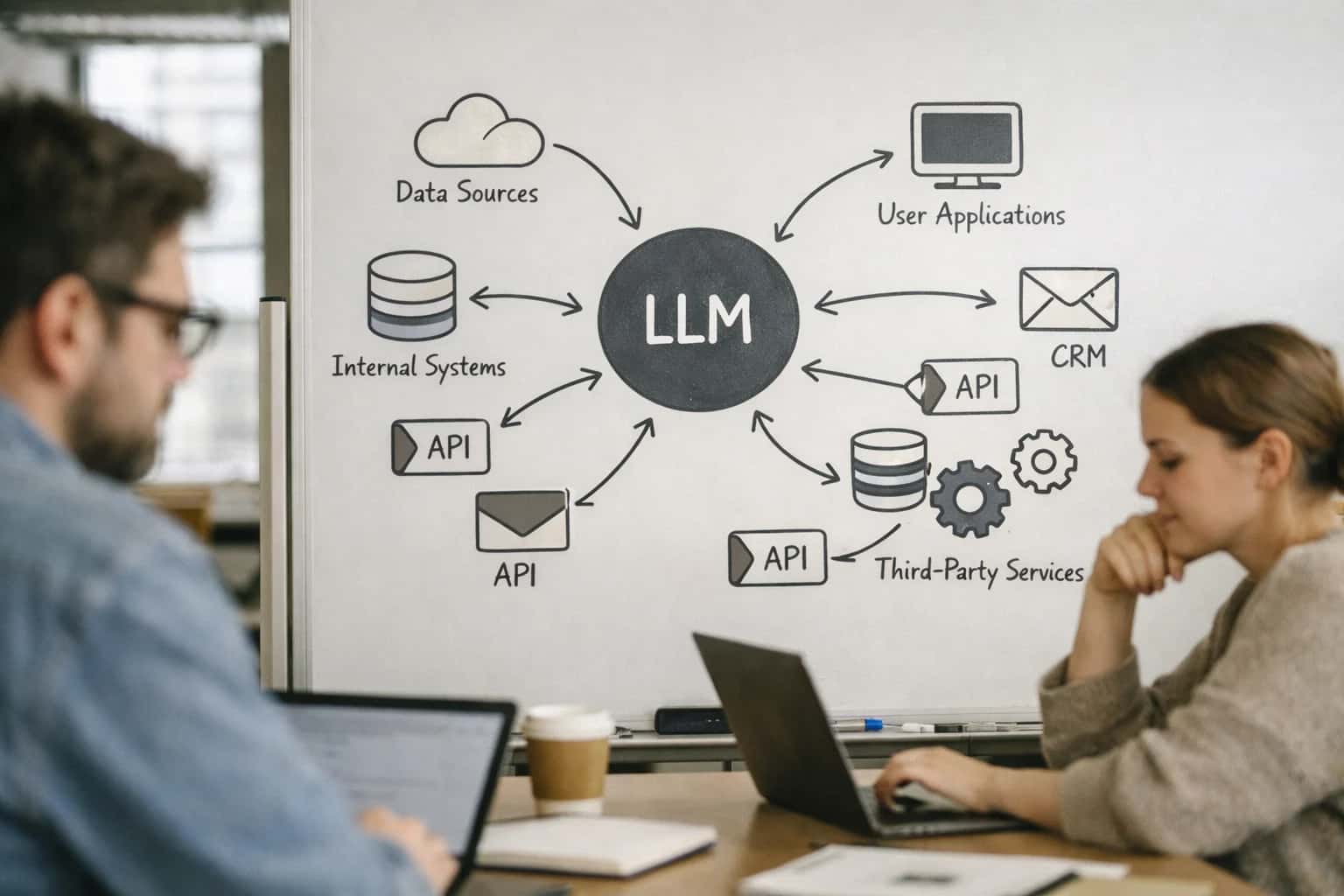
AI integration in wastewater management connects to three primary operational surfaces: the Supervisory Control and Data Acquisition (SCADA) system for real-time sensor data, the Computerized Maintenance Management System (CMMS) like Fiix or UpKeep for work orders, and the Environmental, Health, and Safety (EHS) or compliance platform (e.g., Cority, VelocityEHS) for regulatory reporting. The integration architecture typically involves an AI orchestration layer that ingests time-series data from SCADA APIs, processes it with predictive models for equipment health or inflow prediction, and then triggers prioritized work orders in the CMMS or drafts anomaly reports for the compliance system.

Integration
AI Integration for Government Wastewater Management
A technical blueprint for integrating AI into public sector wastewater systems to automate compliance, predict infrastructure failures, and optimize treatment operations.
ARCHITECTURE AND ROLLOUT
Where AI Fits in Wastewater Operations
A practical blueprint for integrating AI into wastewater management systems to optimize treatment, predict failures, and automate compliance.
High-value use cases are workflow-specific. For inflow/infiltration prediction, AI models analyze historical flow, weather, and CCTV inspection data to forecast system stress, automatically generating inspection work orders in the CMMS for high-risk segments days in advance. For treatment process optimization, real-time analysis of pH, dissolved oxygen, and chemical feed data can suggest adjustments to SCADA setpoints or flag potential permit excursions, creating preventive maintenance tasks or incident reports in the EHS platform. Regulatory reporting automation involves AI agents extracting required data points from SCADA historians, lab information systems, and maintenance logs to populate draft Discharge Monitoring Reports (DMRs) in the compliance software, reducing a multi-day manual consolidation to hours.
A production rollout should start with a single, high-impact workflow—like predictive pump failure—using a phased pilot. Governance is critical: all AI-generated work orders or report drafts should route through a human-in-the-loop approval step in the existing CMMS or EHS workflow before execution. Implement audit trails that log the AI's input data, model inference, and the human reviewer's action to maintain accountability for operational and compliance decisions. This approach allows public works departments to augment, not replace, existing systems and staff expertise, delivering measurable impact through reduced emergency repairs, lower chemical costs, and consistent, audit-ready compliance.
GOVERNMENT WASTEWATER MANAGEMENT
Key System Touchpoints for AI Integration
SCADA & Process Control
The SCADA (Supervisory Control and Data Acquisition) system is the central nervous system for plant operations. AI integration here focuses on real-time process optimization and predictive control.
Key Integration Points:
- Real-Time Sensor Data Streams: Ingest flow rates, pH, dissolved oxygen, turbidity, and chemical feed data via OPC-UA, MQTT, or historian APIs (e.g., OSIsoft PI, Ignition).
- Control Loop Optimization: Use AI models to dynamically adjust setpoints for aeration blowers, chemical dosing pumps, and return activated sludge (RAS) rates, moving from reactive to predictive control.
- Anomaly & Event Detection: Deploy models to identify sensor drift, equipment failure signatures, or process upsets (e.g., toxic inflow) faster than threshold-based alarms.
Implementation Pattern: AI models run in a sidecar service, consuming live telemetry and publishing recommended adjustments or high-confidence alerts back to the SCADA system or a dedicated operator dashboard via API.
INTEGRATION OPPORTUNITIES
High-Value AI Use Cases for Wastewater
Modern wastewater management systems generate vast operational data. Integrating AI directly into SCADA, asset management, and billing platforms transforms this data into predictive insights and automated workflows, moving from reactive maintenance to intelligent, resilient operations.
01
Predictive Inflow & Infiltration (I&I) Analysis
Integrate AI models with SCADA sensor data and weather APIs to forecast I/I events. The system analyzes flow patterns, rainfall forecasts, and historical overflow data to predict sewer system stress, automatically triggering alerts in the CMMS for pre-storm inspections or in the public notification system for potential CSO advisories.
Days -> Hours
Lead time for alerts
02
Automated Regulatory Compliance Reporting
Connect AI to lab information management systems (LIMS) and process historians. An agent automatically extracts required parameters (BOD, TSS, pH), compares against NPDES permit limits, drafts the compliance report, and flags anomalies for engineer review before submission to the document management system. Reduces manual data consolidation and audit risk.
1-2 Days
Report preparation time
03
Treatment Process Optimization Agent
Deploy an AI copilot integrated with the SCADA/DCS and chemical inventory system. It continuously analyzes real-time influent quality, weather, and plant loading to recommend adjustments to aeration, chemical dosing, and sludge wasting. Recommendations are logged in the SCADA alarm/event journal for operator review and action, optimizing for effluent quality and energy cost.
5-15%
Potential energy savings
04
Intelligent Asset Health & Work Order Prioritization
Integrate AI with the Enterprise Asset Management (EAM) platform (e.g., Infor EAM, IBM Maximo) and vibration/condition monitoring sensors. Models predict pump, blower, and valve failures from operational trends. High-probability failures automatically generate prioritized work orders with recommended parts and procedures, routed to the correct crew in the field service management system.
Reactive -> Predictive
Maintenance mode
05
Citizen & Industrial Customer Inquiry Automation
Deploy a secure AI chatbot integrated with the utility billing system and service request platform. It handles high-volume inquiries about bills, sewer backups, and pretreatment requirements, accessing account-specific data via APIs. For complex issues (e.g., suspected I/I), it can initiate a case in the CRM and schedule an inspection via the permitting/licensing system.
24/7
Constituent support
06
Biosolids Management & Beneficial Reuse Planning
Connect AI to digester process controls, lab data, and market/regulatory databases. It forecasts biosolids production volume and quality, then models optimal disposal/reuse pathways (land application, composting, thermal conversion) based on cost, logistics, and regulatory status. Outputs feed into the procurement system for hauling contracts and the GIS for land application site planning.
Cost Optimization
Disposal planning
Wastewater Management
Example AI-Powered Workflows
These workflows illustrate how AI agents and models can be integrated into core wastewater management systems to automate compliance, optimize operations, and predict infrastructure failures. Each flow connects to SCADA, asset management, billing, or regulatory reporting platforms.
Trigger: Real-time sensor data from flow meters, rain gauges, and lift stations exceeds baseline thresholds.
Context Pulled:
- Current and forecasted precipitation data from a weather API.
- Historical I&I patterns from the SCADA/Historian database.
- Asset condition scores and maintenance history from the CMMS/EAM (e.g., Infor EAM, IBM Maximo).
AI Agent Action:
- A time-series forecasting model analyzes the sensor stream against the multivariate context.
- The agent predicts the severity and location of potential sanitary sewer overflows (SSOs) or treatment plant overloads within the next 6-12 hours.
- It generates a prioritized alert with recommended actions.
System Update:
- Alert is posted to the operations dashboard in the SCADA system.
- A work order is automatically created in the CMMS for crew dispatch to targeted manholes or pump stations.
- An advisory is drafted for the public notification system if overflow risk is high.
Human Review Point: The shift supervisor reviews the AI-generated alert and action plan in the SCADA console before authorizing crew dispatch or public communication.
FROM SCADA ALERTS TO PREDICTIVE MAINTENANCE
Implementation Architecture & Data Flow
A practical blueprint for integrating AI agents with wastewater SCADA, CMMS, and regulatory reporting systems to automate operations and compliance.
A production AI integration for wastewater management typically connects three core systems: the SCADA/Historian (e.g., OSIsoft PI, Ignition, Wonderware) for real-time sensor data, the Computerized Maintenance Management System (CMMS) (e.g., Infor EAM, IBM Maximo, Fiix) for work orders, and the Environmental Reporting Platform (e.g., regulatory modules within Tyler Munis, SAP, or specialized platforms like EHS). The architecture uses an event-driven pipeline: SCADA alarms or anomalous sensor patterns (e.g., rising H2S levels, pump vibration) trigger an AI agent via a webhook or message queue. The agent analyzes the event against historical maintenance logs, weather data, and asset hierarchies pulled from the CMMS API, then generates a contextualized alert and a recommended corrective action—such as creating a prioritized work order with predicted parts needs or scheduling a CCTV inspection for suspected inflow.
For compliance and process optimization, a separate batch workflow runs against the data historian. An AI model trained on historical effluent quality, flow rates, and chemical dosing data predicts permit parameter trends (e.g., BOD, TSS) 24-48 hours ahead. These predictions are formatted into a draft regulatory report section and pushed to the reporting platform via API, flagging potential excursions for operator review. Similarly, for inflow/infiltration, AI correlates rainfall radar data with flow meter readings at lift stations to predict SSO risks, automatically generating inspection routes in the CMMS and notifying field crews via integrated dispatch systems like /integrations/field-service-management-platforms/ai-integration-for-field-service-management-platforms.
Governance is critical. All AI-generated work orders, reports, and alerts should be routed through a human-in-the-loop approval step configured within the CMMS or a dedicated workflow engine (e.g., using /integrations/ai-agent-builder-and-workflow-platforms). An audit trail logs the source sensor data, AI model version, inference rationale, and approving operator. Rollout starts with a single, high-impact use case—like predictive pump failure—piloted at one treatment plant, using a phased integration that first sends AI recommendations to a dedicated dashboard before enabling automatic CMMS ticket creation. This minimizes risk while demonstrating tangible ROI in reduced emergency repairs and chemical costs before scaling to plant-wide or district-wide deployment.
AI INTEGRATION PATTERNS
Code & Payload Examples
Ingesting Sensor Data for Predictive Analytics
AI models for inflow/infiltration (I/I) prediction require real-time sensor data from SCADA systems, flow meters, and rain gauges. A typical integration involves a secure API or MQTT listener that normalizes time-series data, enriches it with weather forecasts, and prepares it for model inference.
python# Example: Polling a SCADA REST API for sensor readings import requests import pandas as pd # API endpoint for a wastewater treatment plant's SCADA system scada_api_url = "https://api.plant-scada.internal/v1/sensors" headers = {"Authorization": "Bearer <API_KEY>", "Content-Type": "application/json"} params = { "sensor_ids": ["flow_meter_12", "rain_gauge_5", "lift_station_pressure_3"], "start_time": "2024-05-01T00:00:00Z", "granularity": "5min" } response = requests.get(scada_api_url, headers=headers, params=params) sensor_data = response.json() # Transform for AI model input df = pd.DataFrame(sensor_data["readings"]) # Enrich with lagged features, rolling averages, etc. prepared_payload = { "timestamp": df["timestamp"].iloc[-1], "features": df[["flow_rate", "rainfall", "pressure"]].tail(12).values.flatten().tolist() } # Send to inference endpoint ai_response = requests.post("https://inference.internal/predict/i2i", json=prepared_payload)
This payload feeds into models that predict sewer system stress, allowing for proactive valve adjustments or pump activation.
AI INTEGRATION FOR WASTEWATER MANAGEMENT
Realistic Operational Impact & Time Savings
This table illustrates the operational impact of integrating AI into core wastewater management workflows, focusing on measurable time savings and process improvements.
| Workflow / Metric | Before AI Integration | After AI Integration | Implementation Notes |
|---|---|---|---|
Inflow/Infiltration (I/I) Event Prediction | Reactive response after alarms or overflows | Proactive alerts 24-48 hours prior based on weather & sensor trends | Integrates SCADA, weather APIs, and historical flow models; alerts via CMMS |
Regulatory Compliance Report Drafting | Manual data aggregation and narrative writing (2-3 days monthly) | Automated data pull and first-draft generation (2-3 hours monthly) | Connects to LIMS, SCADA, and asset registers; human review required for submission |
Treatment Process Anomaly Detection | Manual review of SCADA trends during daily rounds | Real-time monitoring with prioritized alerts for operator review | AI model baseline of normal operations; flags deviations for chemical dosing, flows, or energy use |
Work Order Prioritization for Maintenance | Scheduled or break-fix; limited predictive capability | Risk-based prioritization combining asset criticality & predicted failure | Integrates CMMS with EAM asset health scores and inspection history |
Biosolids Management Planning | Manual calculation and scheduling based on tank levels | Optimized dewatering & hauling schedule predicting solids accumulation | Uses process data and hauling contractor calendars to minimize costs |
Customer Inquiry Resolution (Odor, Billing) | Call center research and manual case creation (10-15 mins per inquiry) | AI chatbot handles common inquiries; complex cases triaged with context (2-3 mins) | Chatbot integrates with billing CIS and work order system; provides case summary to staff |
Capital Planning for Infrastructure Renewal | Condition-based on last inspection; limited predictive modeling | Multi-factor risk scoring combining condition, criticality, and predicted failure cost | AI augments EAM data with external factors (soil corrosivity, growth projections) |
ARCHITECTING FOR PUBLIC TRUST AND REGULATORY COMPLIANCE
Governance, Security & Phased Rollout
Deploying AI in a regulated public utility environment requires a security-first, phased approach that prioritizes system integrity, data privacy, and operational continuity.
AI integration for wastewater management must be architected with a zero-trust security model, connecting to core systems like SCADA historians, CMMS (e.g., Infor EAM, IBM Maximo), and regulatory reporting platforms via secure APIs and service accounts. All AI agents and data pipelines operate within the agency's private cloud or VPC, with strict RBAC ensuring operators, engineers, and compliance officers only access AI tools relevant to their role. Sensitive data, such as chemical dosing levels or infrastructure vulnerabilities, is never sent to public LLM endpoints; instead, retrieval-augmented generation (RAG) is performed against a local vector store of approved operational manuals and historical reports, with all prompts and completions logged to an immutable audit trail for compliance reviews (e.g., NPDES audits).
A successful rollout follows a phased, risk-managed approach. Phase 1 focuses on non-critical, high-volume workflows like automating the first draft of Monthly Operating Reports (MORs) by pulling data from the LIMS and SCADA, or using AI to triage and categorize incoming work orders in the CMMS based on technician notes. Phase 2 introduces predictive analytics, such as training models on historical flow and weather data to predict Sanitary Sewer Overflows (SSOs) or Inflow and Infiltration (I&I) hotspots, with outputs feeding into the CMMS for prioritized inspection scheduling. Phase 3 integrates closed-loop control for optimization, like AI recommending real-time adjustments to aeration blower speeds in the DO control loop, but always with a human-in-the-loop approval step before any SCADA setpoint is changed.
Governance is established through a cross-functional AI Steering Committee with representatives from Operations, Engineering, IT, and Legal. This committee approves use cases, defines the acceptable risk profile for each phase, and reviews performance metrics against key outcomes like report preparation time, predictive alert accuracy, and mean time to resolution for maintenance events. All models undergo regular drift detection and are retrained on agency-specific data to maintain accuracy. This structured, incremental path allows public agencies to capture quick wins, build internal trust, and demonstrate tangible value—such as reducing permit report preparation from days to hours—before scaling AI to more complex, mission-critical treatment processes.
Enabling Efficiency, Speed & Accuracy
Intelligent Analysis, Decision & Execution
We build AI systems for teams that need search across company data, workflow automation across tools, or AI features inside products and internal software.
Talk to Us
Search across company data
Give teams answers from docs, tickets, runbooks, and product data with sources and permissions.
Useful when people spend too long searching or get different answers from different systems.
Enterprise searchRAGPermissions
Read more
Automate internal workflows
Use AI to route work, draft outputs, trigger actions, and keep approvals and logs in place.
Useful when repetitive work moves across multiple tools and teams.
AI agentsWorkflow automationGovernance
Read more
Add AI to products and internal tools
Build assistants, guided actions, or decision support into the software your team or customers already use.
Useful when AI needs to be part of the product, not a separate tool.
AI integrationDecision supportModel routing
Read moreIMPLEMENTATION GUIDE
Frequently Asked Questions
Practical questions and workflow blueprints for integrating AI into wastewater management systems for predictive maintenance, compliance automation, and operational optimization.
This workflow uses sensor data and weather forecasts to predict sewer system overloads, triggering proactive maintenance dispatches.
- Trigger: Scheduled batch job (e.g., nightly) or real-time streaming from SCADA/flow meter APIs.
- Context/Data Pulled: The system aggregates:
- Historical and real-time flow data from designated manholes.
- Precipitation data from the National Weather Service API.
- Ground saturation levels from soil sensors (if available).
- Recent maintenance logs for pipe condition context.
- Model/Agent Action: A time-series forecasting model (e.g., Prophet, LSTM) analyzes the data. An AI agent evaluates the prediction against predefined thresholds. If an I/I event is predicted within the next 24-48 hours, it generates an alert.
- System Update/Next Step: The alert, along with predicted location and severity, is created as a high-priority work order in the CMMS (like Infor EAM or Fiix). It automatically dispatches to the appropriate crew via the field service management platform (e.g., ServiceTitan).
- Human Review Point: The system recommends inspection points and potential root causes. The crew supervisor reviews and can adjust the priority or resource allocation before the crew is notified.

About the author
Prasad Kumkar
CEO & MD, Inference Systems
Prasad Kumkar is the CEO & MD of Inference Systems and writes about AI systems architecture, LLM infrastructure, model serving, evaluation, and production deployment. Over 5+ years, he has worked across computer vision models, L5 autonomous vehicle systems, and LLM research, with a focus on taking complex AI ideas into real-world engineering systems.
His work and writing cover AI systems, large language models, AI agents, multimodal systems, autonomous systems, inference optimization, RAG, evaluation, and production AI engineering.
LinkedIn
Limited slotsGet a Free AI Consultation
Partnered with leading AI, data, and software stack.





How We Work
Custom AI workflows for your Business
One-fit-all AI don't work for modern businesses. At Inferensys, we aim to understand your business & custom requirements; which we use to define most efficient agentic workflows, the data, and the tools for your business.
01
Review the use case
We understand the task, the users, and where AI can actually help.
Read more02
Pick the right approach
We define what needs search, automation, or product integration.
Read more03
Build the first useful version
We implement the part that proves the value first.
Read more04
Improve from there
We add the checks and visibility needed to keep it useful.
Read moreThe first call is a practical review of your use case and the right next step.
Talk to Us