
Inferensys

Integration

AI Integration for Public Sector Compliance Monitoring

Architect a continuous AI monitoring system that checks government transactions, documents, and workflows against a library of regulations, automatically flagging potential violations for officer review.
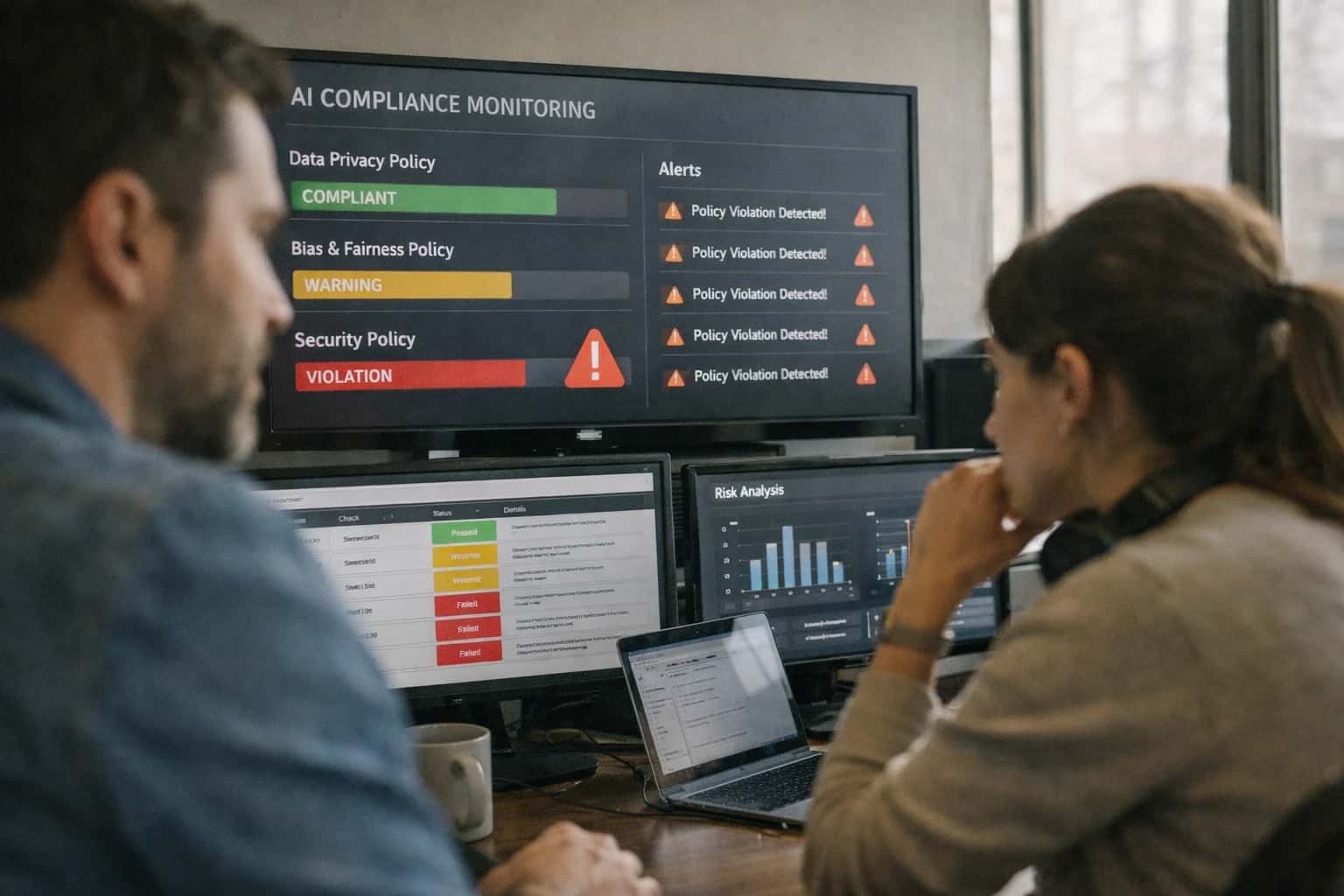
Compliance officer monitoring AI compliance agent on laptop, policy dashboards visible, modern WeWork desk setup.
ARCHITECTURE & GOVERNANCE

From Periodic Audits to Continuous AI Monitoring

How to architect an AI system that continuously monitors transactions, documents, and processes against a library of regulations, automatically flagging potential violations for review.

Traditional compliance relies on periodic manual audits, creating risk windows and operational drag. A continuous AI monitoring system connects directly to your core government ERP data—like SAP Public Sector fund accounting tables, Tyler Munis journal entries, or Workday Grants Management transaction logs—via secure APIs or event streams. The architecture typically involves:

  • A regulation ingestion pipeline that converts policy documents, grant terms, and procurement rules into structured, machine-readable logic.
  • A real-time data feed from ERP modules, document management systems, and case management platforms.
  • A rules engine and LLM layer that evaluates transactions and documents against the rule library, generating alerts with evidence citations.
  • An orchestration workflow that routes flagged items to the appropriate officer in your existing case or audit management system for review and action.


Implementation focuses on high-value, high-risk workflows first. For example, an AI monitor for public procurement could be trained on your jurisdiction's bidding laws and integrated with SAP Ariba or Jaggaer. It would automatically scan RFPs, vendor responses, and award documents for potential fairness violations or mandatory clause omissions. In grant management, connected to Workday or a specialized platform, the system could continuously compare expense postings against approved budget categories and federal cost principles, flagging questionable charges the same day they are booked, rather than months later during a single audit.

Rollout requires careful governance. Start with a pilot on a single regulation or grant program, using a human-in-the-loop design where all AI flags are reviewed. This builds trust and refines the model. Key technical considerations include:

  • Audit trails: Every AI-generated alert must be logged with the source data, rule applied, and reasoning traceable for officer review and potential appeal.
  • RBAC integration: Alert visibility and workflow permissions must inherit from your ERP's existing role-based access controls.
  • Model retraining: The rule library and detection logic need a version-controlled update process to reflect new legislation or policy changes. This shift from periodic to continuous monitoring turns compliance from a cost center into an operational intelligence layer, reducing risk exposure and freeing audit staff for higher-value investigation and analysis. For a deeper look at the underlying AI models for anomaly detection, see our guide on /integrations/government-erp-platforms/ai-integration-with-ai-for-government-anomaly-detection.
ARCHITECTURE PATTERNS

Where AI Connects: Compliance Touchpoints Across Government Systems

Core ERP & Fund Accounting Systems

AI compliance agents connect directly to the general ledger, accounts payable, and procurement modules within systems like Tyler Munis, SAP S/4HANA Public Sector, and Workday Financial Management. The integration focuses on real-time monitoring of transactions against a library of fiscal rules, grant restrictions, and purchasing policies.

Key Integration Points:

  • Journal Entry Feeds: Ingest posted journals via API or database listener to check for proper fund, department, and project coding.
  • Purchase Order & Invoice Approval Workflows: Intercept POs and invoices in the approval queue, cross-referencing vendor data, contract terms, and budget availability before routing.
  • Grant Drawdown Transactions: Monitor disbursements from grant-specific funds, ensuring expenses align with approved budgets and period-of-performance dates.

AI models flag anomalies—like a capital asset purchase charged to an operating grant—for human review, creating an audit trail within the ERP's native workflow system.

CONTINUOUS AUDIT FOR PUBLIC SECTOR

High-Value AI Compliance Monitoring Use Cases

Move from periodic, manual compliance checks to AI-driven, continuous monitoring. These use cases connect directly to your ERP, financial, and case management systems to automatically screen transactions, documents, and processes against regulatory libraries.

01

Grant Fund Transaction Monitoring

AI agents monitor disbursements from systems like Workday Grants Management or SAP Public Sector, checking each transaction against grant-specific terms (allowable costs, time periods, matching requirements). Flags potential violations for officer review before payment.

Batch -> Real-time
Monitoring cadence
02

Procurement & Contract Compliance

Integrates with SAP Ariba or Jaggaer to analyze POs, contracts, and invoices. AI checks for vendor debarment, prevailing wage clauses, small business set-asides, and budget object code compliance, creating an audit trail for each procurement action.

Same day
Violation detection
03

Automated Public Records Law Review

Connects to Tyler Content Manager or other RMS to screen documents slated for release. AI redacts legally protected information (PII, attorney-client privilege) and logs redaction rationale, accelerating FOIA/Open Records request fulfillment while ensuring compliance.

Hours -> Minutes
Document review
04

Continuous Internal Control Validation

AI models are wired into fund accounting workflows (Tyler Munis, Infor) to continuously validate segregation of duties, approval thresholds, and journal entry rules. Generates exception reports for internal audit, shifting control testing from sample-based to full-population.

Full population
Control coverage
05

Regulatory Change & Impact Analysis

AI monitors sources (Federal Register, state bulletins) for new regulations, maps them to affected departments and processes within your ERP, and generates impact assessments. Integrates findings into project portfolio management tools for remediation planning.

1 sprint
Lead time gained
06

Case Management Deadline & Mandate Tracking

For social services or child support case management systems, AI parses court orders and statutory mandates, creates tracking calendars, and alerts caseworkers of impending deadlines (home visits, court reports) to prevent compliance failures.

Proactive alerts
Preventive compliance
CONTINUOUS MONITORING PATTERNS

Example AI Compliance Monitoring Workflows

These workflows illustrate how AI agents can be integrated with public sector ERP and case management systems to automate the detection of potential compliance violations against a library of regulations, policies, and grant terms.

Trigger: A new vendor payment or procurement card transaction is posted in the fund accounting module (e.g., Tyler Munis, SAP S/4HANA).

Context Pulled: The agent retrieves:

  • Transaction details (amount, vendor, GL account, date).
  • The associated grant's master data (grantor, period of performance, approved budget categories, special terms and conditions).
  • Historical spending against the grant's budget.

Agent Action: The AI model evaluates the transaction against the grant's compliance rules:

  1. Allowability Check: Is the expense type allowed under the grant's budget categories?
  2. Timing Check: Does the expense fall within the grant's active period?
  3. Cumulative Check: Does this transaction push spending over 90% of a budget line, triggering a required notification?
  4. Vendor Check: Is the vendor on any debarment or exclusion lists (cross-referenced via an external API)?

System Update: If a potential violation is detected, the agent automatically:

  • Creates a case in the grant management or audit case management system (e.g., Workday Grants Management).
  • Tags the transaction in the ERP with a "Review Flag."
  • Sends a secure alert to the designated grants officer via the agency's collaboration platform (e.g., Microsoft Teams).

Human Review Point: The grants officer reviews the flagged case, the agent's reasoning, and the source transaction. They can then mark it as a false positive, request more information, or initiate a formal corrective action process, all within the connected case system.

CONTINUOUS COMPLIANCE FOR PUBLIC SECTOR ERPs

Implementation Architecture: Building the AI Monitoring Layer

A technical blueprint for deploying an AI-powered compliance engine that monitors transactions, documents, and processes in real-time against a library of regulations.

The core architecture is a sidecar monitoring service that connects to your government ERP's data layer—whether Tyler Munis, SAP S/4HANA Public Sector, Workday Financials, or Infor CloudSuite. It operates by subscribing to key event streams: new journal entries in the general ledger, updated procurement requisitions, modified grant award records, or submitted permit applications. For each event, the service extracts the relevant data payload and contextual metadata (like fund code, department, and user) and runs it through a rules-based classifier and a fine-tuned LLM configured with your specific regulatory corpus (e.g., GAAP, GASB, Uniform Guidance, state procurement codes). The system flags transactions for potential violation based on pattern matching and semantic analysis of supporting documents.

Implementation requires mapping the critical control points within your ERP workflows. For financial compliance, this means monitoring the GL_JE_BATCH table in SAP or the Journal Entry object in Workday for unusual account combinations or amounts exceeding grant thresholds. For procurement, the service ingests Purchase Order and Contract objects to check for sole-source justifications or vendor debarment status. The AI layer outputs structured findings—such as {rule_id: "GAAP-107", confidence: 0.92, transaction_id: "JE-2024-00123", suggested_action: "Review for capital vs. expense classification"}—which are posted to a dedicated Compliance_Alert queue. This queue can integrate with your existing case management system or a dedicated dashboard for officer review, creating a closed-loop audit trail.

Rollout should be phased, starting with a single, high-risk regulation module (e.g., time-and-effort reporting for federal grants) before expanding. Governance is critical: the system must log all AI decisions, support human-in-the-loop review for medium-confidence alerts, and undergo regular model validation against updated regulatory texts. This architecture does not replace human auditors but shifts their focus from manual sampling to investigating high-probability exceptions, turning compliance from a quarterly scramble into a continuous, managed operation. For a deeper dive on connecting this layer to specific financial modules, see our guide on AI Integration for Fund Accounting Software.

ARCHITECTURE FOR CONTINUOUS COMPLIANCE

Code & Integration Patterns

Ingesting and Structuring the Rulebook

The first step is converting unstructured regulations, statutes, and policy manuals into a queryable knowledge base. This involves a multi-stage pipeline:

  • Source Connectors: APIs or scheduled scrapers pull updates from official sources like the Federal Register, state code repositories, and internal policy portals.
  • Document Chunking: Regulations are split into semantically meaningful sections (e.g., by clause, requirement, or defined scope) using NLP libraries or layout-aware parsers.
  • Embedding Generation: Each chunk is converted into a vector embedding using a model like text-embedding-3-small, capturing its semantic meaning for retrieval.
  • Vector Storage: Embeddings and metadata (source, effective date, jurisdiction) are indexed in a vector database (e.g., Pinecone, Weaviate) with metadata filters for precise retrieval.
python
# Example: Chunking and embedding a regulation document
from langchain.text_splitter import RecursiveCharacterTextSplitter
from openai import OpenAI

client = OpenAI()
text_splitter = RecursiveCharacterTextSplitter(chunk_size=1000, chunk_overlap=200)
chunks = text_splitter.split_text(regulation_text)

for chunk in chunks:
    response = client.embeddings.create(input=chunk, model="text-embedding-3-small")
    vector = response.data[0].embedding
    # Store vector + metadata in your vector DB

This creates the "source of truth" library against which transactions and documents are continuously checked.

COMPLIANCE MONITORING WORKFLOWS

Realistic Time Savings & Operational Impact

How AI-powered continuous monitoring changes the cadence and accuracy of compliance checks against a library of regulations, from manual sampling to automated, full-population review.

Compliance WorkflowTraditional Manual ProcessAI-Integrated ProcessOperational Impact

Transaction Audit for Grant Fund Use

Monthly sample-based review (2-3 days)

Continuous, full-population monitoring with daily exception reports

Shifts from reactive detection to proactive prevention of misuse

Document Review Against New Regulation

Manual keyword search & analyst review (5-10 hours per doc set)

Automated semantic analysis & violation flagging (1-2 hours for triage)

Enables same-day impact assessment vs. next-week analysis

Procurement Compliance (e.g., Davis-Bacon, Buy American)

Post-award manual checklist verification

Pre-award automated clause analysis & vendor scoring

Moves compliance gate earlier, reducing corrective action costs

Public Meeting Minute & Agenda Compliance

Clerk review for posting deadlines & content requirements

Automated deadline tracking & content completeness checks

Eliminates manual calendar tracking, reduces risk of procedural errors

Environmental Permit Condition Monitoring

Quarterly manual check of self-reported data

Continuous data ingestion with automated deviation alerts

Transforms intermittent compliance to real-time operational intelligence

Contractor Performance & Reporting Obligations

Manual due date tracking & follow-up for late reports

Automated report ingestion, completeness scoring, & alerting

Reduces administrative chase time, improves contractor accountability

Public Records Request (FOIA) Redaction Review

Attorney line-by-line review of responsive documents

AI pre-screening for PII/privileged info, attorney validates

Cuts initial review time by 60-80%, accelerates citizen response

Cross-System Data Consistency Check (e.g., SIS to ERP)

Annual reconciliation project with significant manual effort

Scheduled automated validation jobs with discrepancy dashboards

Provides ongoing assurance vs. annual audit surprise

ARCHITECTING FOR PUBLIC TRUST AND REGULATORY ADHERENCE

Governance, Security, and Phased Rollout

Deploying AI for compliance monitoring in the public sector requires a governance-first architecture that prioritizes security, auditability, and controlled, measurable rollout.

A production architecture for compliance monitoring must be built on a policy-aware data layer. This involves creating secure, read-only API connections to source systems like SAP Public Sector (FI/CO modules), Tyler Munis (GL, AP), or Workday Grants Management to extract transactions, documents, and process logs. AI models operate on this isolated data layer, never directly on live production databases. Each query and analysis run is logged with a full audit trail, tagging the source record ID, the regulation clause checked, the AI model version used, and the confidence score. This traceability is non-negotiable for FOIA requests, internal audits, and potential legal review.

Rollout follows a strict, risk-based phased approach. Phase 1 targets a single, high-volume, low-risk regulation—such as automated checks for procurement card policy violations against transaction data. This is deployed in a human-in-the-loop mode where the AI flags potential violations in a dedicated queue within the existing case management or GRC platform (e.g., ServiceNow, or a module within the ERP itself), requiring officer review and confirmation before any official action is taken. Phase 2 expands the regulatory library and begins monitoring more complex, cross-module workflows, like ensuring grant expenditures align with approved budget categories across financial and project systems. Phase 3 introduces predictive elements, such as identifying processes with a high probability of future non-compliance based on historical patterns.

Security and access control are paramount. AI agents and orchestration services (hosted on SAP BTP, Infor OS, or a secure cloud tenant) must integrate with the agency's existing Identity and Access Management (IAM) system (e.g., Okta, Microsoft Entra ID). This ensures AI tools respect the same role-based permissions (RBAC) as human users—a budget analyst's AI copilot only accesses data their role permits. All prompts, model outputs, and data movements are encrypted in transit and at rest, with the entire system designed to meet FedRAMP Moderate or equivalent state-level security requirements. This governance framework ensures the AI acts as a controlled, auditable extension of existing compliance office workflows, building trust through transparency and incremental value delivery.

GOVERNMENT ERP PLATFORMS

AI Compliance Monitoring: Technical & Commercial FAQs

Practical answers for public sector leaders implementing AI to monitor transactions, documents, and processes against a library of regulations. Focused on integration with systems like Tyler Munis, SAP Public Sector, Workday Grants Management, and Infor CloudSuite.

The standard pattern is a read-only, event-driven integration layer that does not touch core transaction processing.

Primary Architecture:

  1. Event Capture: Use platform-specific APIs or database change-data-capture (CDC) tools to stream relevant transactions, journal entries, or document uploads to a secure staging area. For example:
    • Tyler Munis: Subscribe to the Munis API for new GL_JOURNAL_ENTRY records.
    • SAP Public Sector: Use SAP BTP Event Mesh or OData services for FI_DOCUMENT items tagged with specific funds.
    • Workday: Configure Report-as-a-Service (RaaS) or use Workday Extend to push Financial_Transaction data upon posting.
  2. Orchestration: A lightweight middleware service (often deployed in your cloud) receives these events, enriches them with master data (e.g., vendor, grant, project info), and formats them for the AI model.
  3. AI Processing: The formatted payload is sent to your AI compliance service (hosted by Inference Systems). The service checks the transaction against configured rules (e.g., "Grant 2024-001 funds cannot be used for equipment over $10k") and returns a risk score and rationale.
  4. Action Routing: Results are written to a compliance_alerts table or pushed via webhook to your case management system (e.g., ServiceNow, a dedicated module in your ERP) for officer review.

Key Safeguards:

  • Read-Only: The AI system never writes back to the core ERP. It only generates alerts.
  • Queueing: Implement dead-letter queues to handle API failures without data loss.
  • Audit Trail: Every check is logged with a unique correlation ID, linking the source transaction, the AI analysis, and any resulting human action.
Prasad Kumkar

About the author

Prasad Kumkar

CEO & MD, Inference Systems

Prasad Kumkar is the CEO & MD of Inference Systems and writes about AI systems architecture, LLM infrastructure, model serving, evaluation, and production deployment. Over 5+ years, he has worked across computer vision models, L5 autonomous vehicle systems, and LLM research, with a focus on taking complex AI ideas into real-world engineering systems.

His work and writing cover AI systems, large language models, AI agents, multimodal systems, autonomous systems, inference optimization, RAG, evaluation, and production AI engineering.


