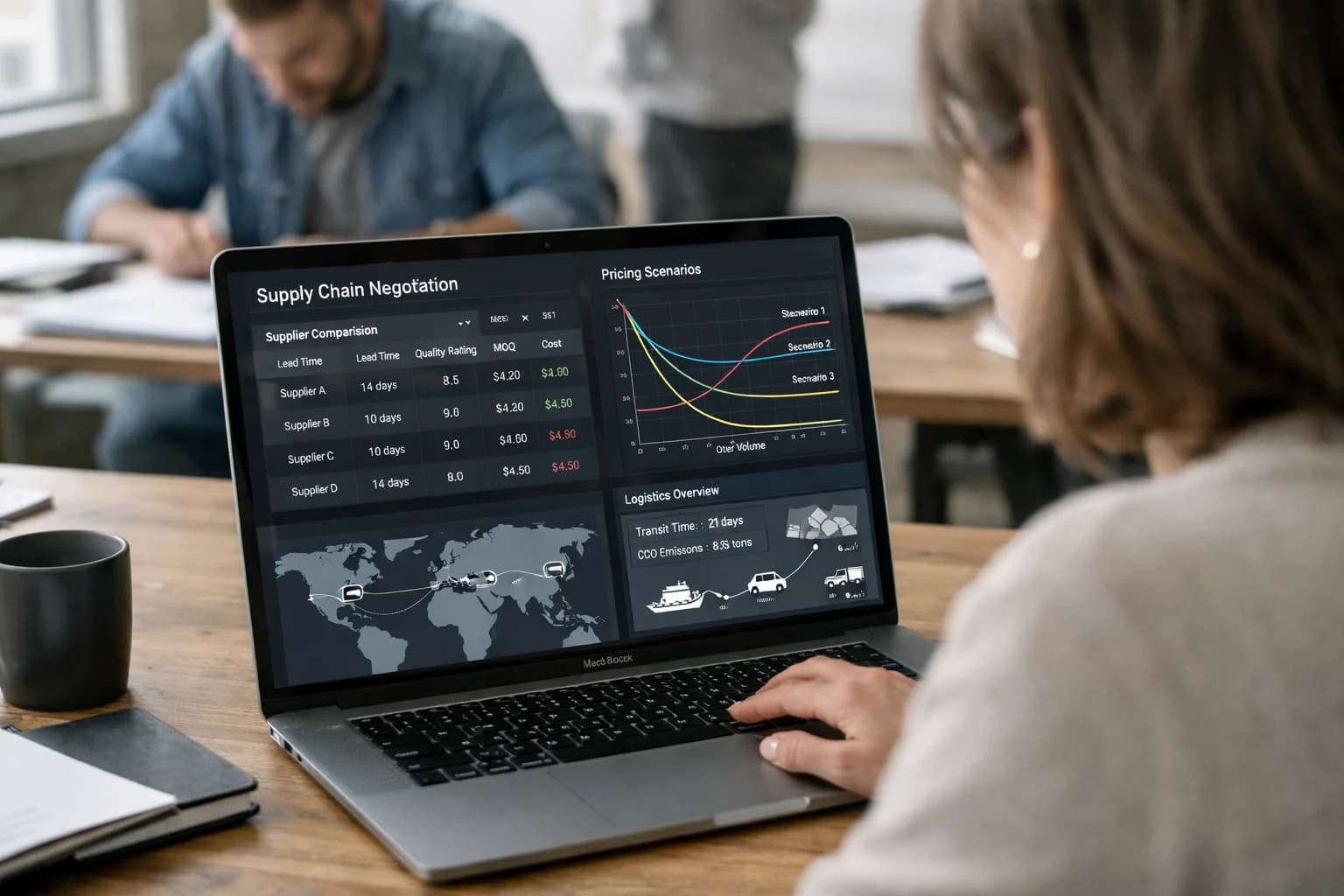
Where AI Fits into Safefood 360's Supply Chain Visibility
Integrating AI into Safefood 360's supply chain maps transforms static data into a dynamic risk intelligence layer, predicting disruptions and automating response workflows.
AI integration connects to Safefood 360's supply chain visibility module through its REST APIs and webhook system, acting as a real-time analytics engine. The AI system consumes data from key objects: Supplier records, Purchase Orders, Lot/Batch genealogy, and Shipment Tracking events. It enriches this data with external signals—like weather APIs, geopolitical risk feeds, and port congestion data—to build a live risk score for each node and link in your supply map. This creates a new, actionable data layer within Safefood 360, visible as custom dashboards or alert queues for your procurement and logistics teams.
Implementation focuses on high-impact, automated workflows. For example, an AI agent can be configured to monitor for a supplier's risk score exceeding a threshold. When triggered, it automatically:
Queries Safefood 360 for approved alternate suppliers and their current lead times.
Drafts a mitigation plan with cost and timeline impacts.
Creates a Corrective Action record in Safefood 360's non-conformance module and assigns it to the relevant sourcing manager.
Sends an alert via the platform's notification system or a connected channel like Microsoft Teams. This moves teams from reactive firefighting to proactive scenario planning, often reducing response time from days to hours.
Rollout requires a phased, governance-first approach. Start by connecting AI to a single high-value commodity line to validate risk models and user workflows. Use Safefood 360's role-based access control (RBAC) to pilot the AI insights with a core team of planners. Establish an audit trail by logging all AI-generated recommendations and user actions back to relevant Lot or Supplier records. This controlled integration ensures the AI augments—rather than disrupts—existing food safety and quality processes, building trust and demonstrating clear ROI before scaling across the entire supply network.
SUPPLY CHAIN VISIBILITY
Key Safefood 360 Surfaces for AI Integration
Lot & Batch Tracking
This is the core data model for supply chain mapping. AI integration surfaces include the Lot/Batch object API, which contains fields for raw material source, production dates, receiving records, and parent/child lot relationships.
AI can be wired here to:
Predict disruption risk by analyzing lot origin against real-time weather, geopolitical, or port congestion data.
Suggest alternates by querying similar lots from other suppliers based on specifications and available inventory.
Simulate contamination spread by traversing the lot genealogy graph to prioritize containment actions.
Implementation typically involves subscribing to lot creation/update webhooks, enriching records with external risk scores, and writing recommendations back to custom fields or linked tasks.
SAFEFOOD 360 INTEGRATION PATTERNS
High-Value AI Use Cases for Supply Chain Visibility
Transform Safefood 360 from a compliance record-keeper into a proactive supply chain intelligence system. These AI integration patterns connect to the platform's APIs, lot data, and supplier network to predict disruptions, automate risk workflows, and provide actionable visibility.
01
Predictive Supplier Risk Scoring
An AI agent continuously analyzes Safefood 360 supplier records, integrating external data feeds (weather, geopolitics, port delays). It generates a dynamic risk score for each supplier and material, triggering automated re-qualification workflows or suggesting alternates within the platform's supplier network.
Batch -> Real-time
Risk monitoring
02
Automated Certificate of Analysis (COA) Validation
A document intelligence pipeline ingests inbound COA PDFs/emails, extracts key data (lot numbers, test results, dates), and validates them against material specifications in Safefood 360. Discrepancies automatically flag the lot for hold and initiate a non-conformance, while clean data auto-populates the platform, eliminating manual entry.
Hours -> Minutes
Document processing
03
AI-Enhanced Lot Trace & Impact Simulation
When a quality hold is logged, an AI model uses Safefood 360's bill-of-material and lot genealogy data to simulate contamination spread. It predicts impacted finished goods and downstream customers in minutes, providing a data-driven scope for withdrawal management and regulatory reporting.
1 sprint
Implementation timeline
04
Dynamic Shelf-Life & Waste Prediction
AI models integrate real-time storage condition data (from IoT sensors) with product formulations and initial quality results in Safefood 360. They predict and dynamically adjust 'best by' dates, triggering automated workflows to prioritize lot usage, reducing waste and maximizing yield.
Same day
Waste reduction insights
05
Anomaly Detection in Production & Quality Data
AI monitors stream Safefood 360 for anomalies across production schedules, environmental monitoring results, and quality checks. Unusual patterns (e.g., drifting pH levels, atypical micro counts) trigger automated investigations and corrective action workflows before they escalate to non-conformances.
Proactive → Reactive
Issue resolution
06
FSMA 204 Compliance & Reporting Automation
An AI agent orchestrates data from across Safefood 360 modules to assemble FSMA 204-compliant traceability records. It validates Key Data Elements (KDEs), generates the required one-up/one-back reports for regulators in seconds, and manages the submission lifecycle, ensuring audit-ready compliance.
Minutes vs. Days
Regulatory report generation
SUPPLY CHAIN RISK & VISIBILITY
Example AI-Enhanced Workflows
These workflows demonstrate how to connect AI models to Safefood 360's supply chain maps and event data to predict disruptions, assess risk, and automate response actions. Each flow is triggered by platform events and uses AI to enrich decision-making.
Trigger: A new purchase order is logged in Safefood 360 for a raw material flagged as 'critical' in the specification management module.
AI Action:
An agent retrieves the supplier's location, primary shipping lanes, and alternate sources from the platform's supplier and product records.
The agent calls external APIs (e.g., weather, geopolitical risk feeds, port congestion data) and internal performance data (on-time delivery history from Safefood 360).
A risk-scoring model analyzes this combined context to generate a disruption probability score and a confidence interval for the upcoming shipment.
System Update:
If the score exceeds a configured threshold, the agent creates a Risk Alert in Safefood 360's corrective action module, tagged to the specific PO and lot.
The alert includes the predicted risk factors and suggests pre-emptive actions (e.g., "Consider activating alternate supplier X in region Y").
The platform's workflow engine notifies the procurement manager and updates the supply chain map visualization with a risk overlay.
Human Review Point: The procurement manager reviews the AI-generated alert and suggested actions within Safefood 360 before deciding to adjust orders.
BUILDING A PREDICTIVE RISK LAYER FOR SUPPLY CHAIN MAPS
Implementation Architecture: Data Flow and System Design
A practical architecture for injecting AI-driven risk analytics into Safefood 360's supply chain visibility modules.
The integration connects at two primary surfaces within Safefood 360: the Supplier & Materials module for static risk profiles and the Supply Chain Map/Lot Traceability data for dynamic, shipment-level analysis. An external AI service acts as a middleware layer, consuming Safefood 360's APIs to pull supplier records, facility locations, and active shipment data. This data is enriched in real-time with external risk signals—such as severe weather forecasts from NOAA, geopolitical event feeds, port congestion data, and supplier performance history from internal ERP systems—to calculate a composite Disruption Risk Score for each node and link in the supply chain.
The core workflow is event-driven: when a high-risk event is detected (e.g., a typhoon predicted near a key port), the AI service calls back into Safefood 360 via its Webhook or REST API to create a Risk Alert record, which is attached to the relevant supplier, material, or lot. For suggested alternates, the system queries Safefood 360's Approved Supplier List and Material Specifications, applying constraints like allergen profiles, certifications, and lead times to rank viable substitutes. These recommendations are pushed as actionable insights into a custom dashboard or directly into the Corrective Action workflow for procurement team review.
Rollout follows a phased approach: start with read-only risk scoring for a single high-value ingredient category, using a human-in-the-loop to validate AI suggestions before automating alert creation. Governance is critical; all risk scores and alternate suggestions must be logged with an audit trail showing the source data and logic, and key thresholds (e.g., "high risk") should be calibrated and approved by the supply chain risk committee. This architecture doesn't replace Safefood 360's core traceability but layers predictive intelligence on top, turning static maps into proactive risk management tools.
AI-ENHANCED SUPPLY CHAIN VISIBILITY
Code and Payload Examples
Ingest External Data for Risk Scoring
To predict supply chain disruptions, you need to enrich Safefood 360's internal supplier and lot data with external intelligence. This example shows a Python function that calls a risk scoring service, merges the results, and posts the updated risk profile back to a custom object in Safefood 360 via its REST API.
python
import requests
import pandas as pd
from safefood360_client import Safefood360Client # Hypothetical SDK
# Initialize clients
sf_client = Safefood360Client(api_key=os.getenv('SF360_KEY'))
risk_service_url = 'https://api.riskservice.com/v1/score'
# Fetch active suppliers from Safefood 360
suppliers = sf_client.get_suppliers(status='active')
supplier_df = pd.DataFrame(suppliers)
# Prepare payload for external risk service
risk_payload = {
'entities': [
{
'id': s['id'],
'name': s['name'],
'location': s['primary_address'],
'category': s['material_category']
} for s in suppliers
],
'risk_factors': ['geopolitical', 'weather', 'financial', 'performance']
}
# Call external risk API
risk_response = requests.post(
risk_service_url,
json=risk_payload,
headers={'Authorization': f'Bearer {os.getenv("RISK_API_KEY")}'}
).json()
# Map scores back and update Safefood 360
for score in risk_response['scores']:
update_data = {
'supplier_id': score['entity_id'],
'overall_risk_score': score['score'],
'risk_factors': score['factors'],
'last_scored': pd.Timestamp.now().isoformat()
}
# Post to a custom 'supplier_risk' object
sf_client.update_object('supplier_risk', update_data)
SUPPLY CHAIN RISK MANAGEMENT
Realistic Operational Impact and Time Saved
How AI integration transforms reactive monitoring into proactive risk management within Safefood 360, reducing manual analysis and accelerating response times.
Metric
Before AI
After AI
Notes
Supplier Risk Scoring
Monthly manual review of static data
Dynamic, real-time scoring updated with news/weather feeds
Shifts from periodic audits to continuous monitoring
Disruption Alert Triage
Manual review of 100+ daily alerts
AI prioritizes top 5-10 high-likelihood alerts
Focuses analyst effort on actionable threats
Alternate Supplier Sourcing
Days of manual research and qualification
AI suggests pre-vetted alternates within hours
Leverages existing supplier network and compliance data
Impact Analysis for Weather Events
Post-event manual assessment of affected nodes
Pre-event predictive mapping of at-risk facilities and shipments
Enables proactive inventory shifts and routing changes
Geopolitical Risk Reporting
Ad-hoc reports compiled weekly by analysts
Automated briefings generated daily with flagged changes
Provides consistent, auditable risk intelligence
Supply Chain Map Updates
Static maps updated quarterly during business reviews
Dynamic maps reflect real-time node status and risk scores
Improves visibility for logistics and procurement planning
Regulatory Compliance Check (e.g., FSMA 204)
Manual traceability exercise takes 4-6 hours
AI simulates traceback/traceforward in minutes using platform data
Dramatically reduces time to provide records to regulators
ARCHITECTING FOR SCALE AND COMPLIANCE
Governance, Security, and Phased Rollout
Integrating AI into Safefood 360 requires a governance-first approach that respects food safety's zero-tolerance for error.
A production AI integration for Safefood 360 supply chain visibility must be built on three layers: secure data access, auditable decision logic, and human-in-the-loop controls. This starts with API service accounts scoped to read-only access for supplier, lot, shipment, and geographic data objects, ensuring the AI system cannot inadvertently alter core compliance records. All AI-generated risk scores, disruption predictions, and alternate supplier suggestions are written to a dedicated ai_insights custom object or external audit log, creating a clear lineage from source data to recommendation.
Rollout follows a phased, risk-based model. Phase 1 focuses on read-only monitoring and alerting, where AI models analyze historical and real-time data to produce risk dashboards without triggering automated actions. This builds trust in the predictions. Phase 2 introduces guided workflows, where high-confidence AI suggestions (e.g., "consider Supplier B for ingredient X due to port congestion") are presented to planners within Safefood 360's interface via embedded widgets or task assignments, requiring manual approval. Phase 3, only after extensive validation, enables low-risk automations, such as auto-flagging a supplier record for review or generating a draft contingency plan.
Governance is managed through a cross-functional review board (Quality, Supply Chain, IT) that regularly audits the AI's performance against key metrics: false positive/negative rates on disruption predictions, planner adoption rates of suggestions, and impact on key operational metrics like lead time variability. All prompts, model configurations, and data sources are version-controlled. For high-stakes recommendations—like rerouting a shipment of sensitive raw materials—the system is configured to escalate to a designated approver based on Safefood 360's existing role-based access control (RBAC), ensuring the final decision always rests with a qualified human operator accountable under your food safety plan.
Enabling Efficiency, Speed & Accuracy
Intelligent Analysis, Decision & Execution
We build AI systems for teams that need search across company data, workflow automation across tools, or AI features inside products and internal software.
AI INTEGRATION FOR SUPPLY CHAIN VISIBILITY
Frequently Asked Questions
Common questions about enhancing Safefood 360's supply chain maps with AI-driven risk analytics and predictive disruption workflows.
The integration pulls data from multiple sources to build a comprehensive risk profile:
Internal Safefood 360 Data: Supplier records, lot traceability logs, delivery performance history, and quality non-conformance reports via API.
External APIs: Real-time and forecast data from services like:
Weather feeds (e.g., NOAA, OpenWeatherMap) for storm, flood, or temperature risks.
Geopolitical and port congestion indices (e.g., Bloomberg, S&P Global).
Supplier financial health and news sentiment aggregators.
Custom Feeds: Your own logistics tracking (GPS, ELD), ERP production schedules, or commodity price indices.
The AI agent normalizes this data, correlates it with your specific supplier locations and shipping lanes in Safefood 360, and runs predictive models to flag potential disruptions.
About the author
Prasad Kumkar
CEO & MD, Inference Systems
Prasad Kumkar is the CEO & MD of Inference Systems and writes about AI systems architecture, LLM infrastructure, model serving, evaluation, and production deployment. Over 5+ years, he has worked across computer vision models, L5 autonomous vehicle systems, and LLM research, with a focus on taking complex AI ideas into real-world engineering systems.
His work and writing cover AI systems, large language models, AI agents, multimodal systems, autonomous systems, inference optimization, RAG, evaluation, and production AI engineering.
Partnered with leading AI, data, and software stack.
How We Work
Custom AI workflows for your Business
One-fit-all AI don't work for modern businesses. At Inferensys, we aim to understand your business & custom requirements; which we use to define most efficient agentic workflows, the data, and the tools for your business.
The first call is a practical review of your use case and the right next step.