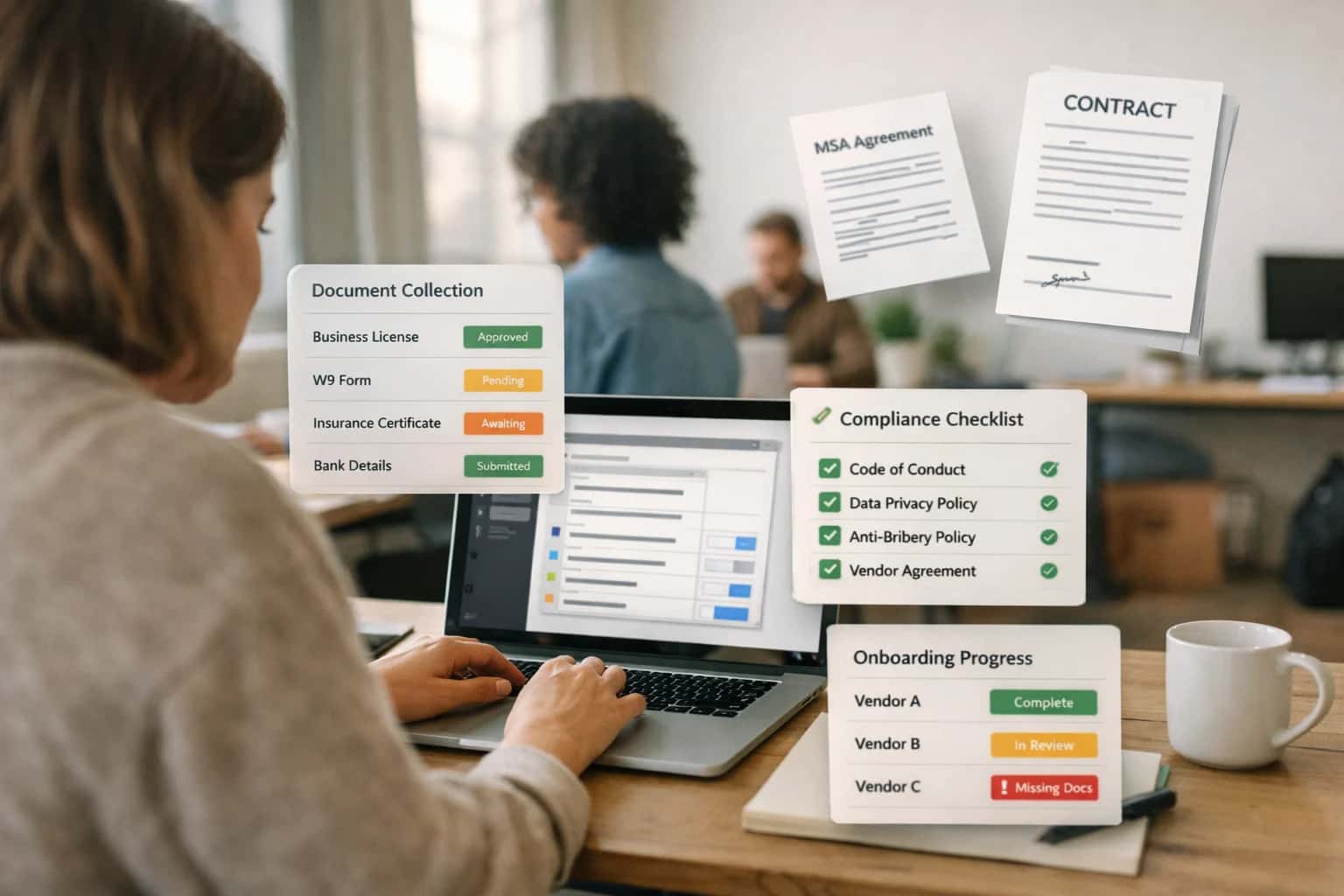
AI integration for supplier documentation targets the manual, error-prone process of ingesting and validating documents like Certificates of Analysis (COAs), specification sheets, audit reports, and insurance certificates. In platforms like TraceGains, FoodLogiQ, and Safefood 360, this typically involves a multi-step workflow: 1) document receipt via email or portal, 2) manual review for completeness, 3) data entry into platform fields (e.g., lot number, test results, expiry dates), and 4) discrepancy flagging for supplier follow-up. AI fits directly into this workflow by acting as an automated layer between the document intake point and the platform's data model, parsing unstructured PDFs and images to extract structured data ready for system entry.

Integration
AI Integration for Food Traceability Platform Supplier Documentation
Where AI Fits into Supplier Documentation Workflows
A practical guide to integrating document intelligence AI into food traceability platforms to automate supplier data ingestion, validation, and compliance workflows.
The implementation centers on a document processing pipeline that uses vision and language models to read documents, entity recognition to map extracted data to platform-specific objects (like Supplier, RawMaterial, COA Record), and validation logic to check values against master specifications. For example, an AI agent can be triggered by a webhook when a new document is uploaded to a supplier portal in TraceGains. It extracts the microbiological_results from a COA, compares them against the specification_limits stored in the platform for that ingredient, and automatically populates the COA record while flagging any out_of_spec results for a quality engineer's review. This reduces manual triage from hours to minutes per document.
Rollout requires a phased approach, starting with high-volume, standardized documents like COAs for top-tier suppliers. Governance is critical: implement a human-in-the-loop review queue for low-confidence extractions and maintain a full audit trail linking the original document, the AI's extracted data, any human overrides, and the final platform record. This ensures data integrity for audits. The architecture typically involves a secure processing service that calls platform APIs (like TraceGains' Connect API or FoodLogiQ's REST API) to create and update records, ensuring the AI acts as a controlled extension of the existing compliance workflow, not a replacement.
Key Integration Surfaces by Platform
Automating Supplier Document Intake
The first integration surface is the point of entry for supplier documents—typically email inboxes, supplier portals, or API endpoints. AI agents can be configured to monitor these sources, classify incoming documents (COA, Spec Sheet, Audit Report), and validate basic metadata like supplier name, lot number, and document date against existing platform records.
Key workflows include:
- Email Parsing: Using AI to extract attachments and key details from supplier emails, moving beyond simple keyword matching to understand context.
- Portal Monitoring: Automating the login and download of documents from supplier-managed portals where APIs are not available.
- Initial Validation: Cross-referencing extracted lot numbers and dates with open purchase orders or inbound shipments in the traceability platform to flag mismatches before data entry.
High-Value AI Use Cases for Supplier Documentation
For quality and procurement teams managing thousands of supplier documents, AI document intelligence can transform manual review into automated compliance workflows. This page details practical integration patterns for platforms like FoodLogiQ, TraceGains, Safefood 360, and Icicle.
Automated COA & Spec Sheet Ingestion
Implement a document AI pipeline that ingests supplier PDFs via email or portal uploads. The system extracts key fields (lot numbers, test results, expiry dates, specifications) and auto-populates the corresponding platform records, flagging missing or mismatched data for review. This turns a multi-hour manual data entry task into a minutes-long validation step.
Real-Time Specification Compliance Checking
Connect AI to the platform's specification management module. As new Certificate of Analysis (COA) data is ingested, the AI instantly compares results against approved raw material specs. Non-conforming lots are automatically placed on hold in the system, and a supplier corrective action (SCAR) workflow is initiated via the platform's API, ensuring no out-of-spec material moves forward.
Supplier Risk Scoring from Document Freshness
Build an AI agent that monitors the supplier document repository. It analyzes document expiration dates, update frequency, and completeness against regulatory and customer requirements. The agent calculates a dynamic risk score for each supplier, which is written back to the platform's supplier profile. High-risk scores can trigger automated re-qualification tasks in the platform's workflow engine.
Audit Report Summarization & Gap Analysis
For third-party and internal audit reports uploaded to the platform, use an LLM to summarize findings, extract non-conformances, and map them to specific platform records (e.g., HACCP plans, SOPs). The AI can suggest relevant corrective actions from a historical library and auto-create CAPA records within the platform, slashing audit response time.
Multi-Language Document Translation & Key Field Extraction
For global supply chains, implement AI that first translates non-English supplier documents (e.g., COAs, safety datasheets) and then performs the same structured data extraction. This ensures all documentation in the platform is searchable and actionable in a primary language, breaking down a major barrier in supplier onboarding and ongoing compliance.
Automated Document Request & Follow-Up
Deploy an AI agent integrated with the platform's supplier communication tools. The agent monitors the document library for upcoming expiries or missing required docs. It automatically drafts and sends personalized requests to supplier contacts via email or portal message, logs the outreach, and escalates overdue requests to a buyer—turning a manual chase list into a closed-loop workflow. Learn more about automating supplier workflows in our guide on AI Integration with TraceGains Supplier Risk Management.
Example AI-Powered Workflows
These concrete workflows show how document intelligence AI connects to your traceability platform's supplier modules, turning manual document review into automated, auditable data flows. Each example outlines the trigger, data context, AI action, and system update.
Trigger: A supplier email with a COA PDF attachment is received by a dedicated inbox or uploaded via a portal.
Context/Data Pulled: The system retrieves the relevant raw material specification and the supplier's profile from the traceability platform (e.g., FoodLogiQ's Supplier module, TraceGains network).
AI Action:
- A document AI agent extracts key fields: lot number, test parameters (e.g., moisture, microbial counts), results, dates, and lab accreditation.
- The agent validates the extracted data against the platform's specification limits for that material.
- It flags any out-of-spec results, missing required tests, or expired lab certifications.
System Update/Next Step:
- The validated data is mapped and pushed via API to create or update the COA record in the platform, linked to the specific lot.
- For compliant COAs, the system can auto-approve the lot for use, updating its status.
- For non-compliant COAs, the system creates a non-conformance record, assigns it to a quality engineer, and triggers a supplier communication workflow.
Human Review Point: All flagged discrepancies and any low-confidence extractions are routed to a human reviewer via a queue in the platform before final rejection.
Implementation Architecture: Data Flow & Guardrails
A practical blueprint for integrating document intelligence AI into your traceability platform's supplier documentation workflows.
The integration architecture connects to your traceability platform's supplier and specification modules via their REST APIs and webhook systems. Inbound documents—COAs, spec sheets, audit reports—arrive via email, supplier portals, or SFTP drops. An AI processing queue (e.g., AWS SQS, RabbitMQ) manages the flow, feeding documents to a multi-stage pipeline: first, optical character recognition (OCR) for scanned PDFs; then, a fine-tuned document AI model extracts structured fields like lot_number, test_result, expiration_date, and specification_limit. The extracted payload is validated against existing platform data (e.g., matching the lot to a purchase order in the system) before the API call is made to create or update the supplier document record, populating custom fields with the extracted data.
Critical guardrails are built into the data flow. A human-in-the-loop validation step is triggered for low-confidence extractions or discrepancies (e.g., a test result outside specification limits), routing the document and AI suggestion to a quality analyst's dashboard within the traceability platform for review. All AI actions are logged with a full audit trail, including the original document, extracted data, confidence scores, and the user who approved or corrected the entry. This ensures compliance with GFSI and FDA record-keeping requirements. The system is designed to fail gracefully: if the platform API is unavailable, documents are held in a dead-letter queue with alerts to IT support, preventing data loss.
Rollout follows a phased, supplier-tiered approach. Start with a pilot group of strategic suppliers for high-volume document types (e.g., COAs for raw materials). Use this phase to tune extraction models and refine validation workflows. Governance is maintained through a centralized prompt and model management layer (e.g., using LangChain or a custom LLMOps platform), allowing your team to update extraction logic for new document formats without redeploying code. The end result is a system that reduces manual data entry from hours to minutes per document, improves data accuracy for compliance audits, and frees your quality team to focus on exception handling and supplier development rather than clerical work.
Code & Payload Examples
Automating COA and Spec Sheet Intake
The first step is to create a pipeline that ingests supplier documents from emails, portals, or SFTP drops, parses them with a document intelligence model, and validates the extracted data against your platform's data model.
A typical workflow uses a serverless function triggered by a new document upload. The function calls a vision-language model (like GPT-4V or Claude 3) via an orchestration layer to extract structured fields. The extracted JSON is then validated against expected schemas before being sent to the traceability platform's API.
python# Example: Parse a Certificate of Analysis PDF def parse_coa_pdf(file_bytes: bytes) -> dict: """Extract key fields from a COA PDF using a multimodal LLM.""" # Encode file for API base64_file = base64.b64encode(file_bytes).decode('utf-8') prompt = """Extract the following from this Certificate of Analysis: - supplier_name - material_name - lot_number - test_parameters (list of dicts with name, result, unit, specification) - date_of_analysis - expiration_date Return as JSON.""" # Call to vision-capable LLM endpoint response = client.chat.completions.create( model="gpt-4-vision-preview", messages=[ {"role": "user", "content": [ {"type": "text", "text": prompt}, {"type": "image_url", "image_url": {"url": f"data:image/jpeg;base64,{base64_file}"}} ]} ], response_format={ "type": "json_object" } ) return json.loads(response.choices[0].message.content)
Realistic Time Savings & Operational Impact
This table shows the typical impact of integrating document intelligence AI into a food traceability platform's supplier documentation workflows, based on real-world implementations for quality and procurement teams.
| Workflow | Before AI | After AI | Notes |
|---|---|---|---|
COA & Spec Sheet Review | Manual extraction (15-30 min/doc) | AI-assisted extraction (2-5 min/doc) | Human validation required; AI flags missing fields and discrepancies |
Supplier Onboarding Document Intake | Email/portal triage, manual filing | Automated ingestion & classification | AI parses attachments, routes to correct platform module |
Lot Acceptance/Rejection Decision | Manual data comparison against specs | AI pre-scores lot conformance | Provides decision support; final approval remains with QC |
Discrepancy & Non-Conformance Triage | Manual review of all flagged items | AI prioritizes by severity & supplier risk | Routes critical issues first, reduces triage backlog |
Audit Evidence Compilation | Manual search across document repositories | AI retrieves relevant docs by query | Cuts prep time for internal audits and regulatory inspections |
Specification Update Workflow | Manual review of supplier change notices | AI highlights material changes & impacts | Triggers reformulation or re-approval workflows automatically |
Data Entry for Compliance Fields | Full manual entry from paper/PDF | AI auto-populates with human-in-loop QA | Eliminates 70-90% of keystrokes; ensures data consistency |
Governance, Security, and Phased Rollout
A practical guide to deploying document intelligence AI for supplier documentation with appropriate controls, security, and a low-risk rollout plan.
Integrating AI into a food traceability platform's supplier documentation workflow requires a security-first architecture. Supplier documents like Certificates of Analysis (COAs), spec sheets, and audit reports contain sensitive commercial and compliance data. A production implementation should use a dedicated, secure processing queue. Documents are ingested via platform webhooks (e.g., from FoodLogiQ's document module or TraceGains' network) or scheduled syncs, encrypted in transit and at rest, and sent to a private AI processing endpoint. The AI service extracts structured data—lot numbers, test results, expiration dates, specification values—and returns it via a secure API call back to the platform to auto-populate the corresponding supplier, material, or lot records. All document access, extraction attempts, and data writes are logged to the platform's native audit trail for a complete lineage, crucial for GFSI audits and FSMA 204 compliance.
Governance is built around a human-in-the-loop validation layer before critical data is committed. For example, extracted values that fall outside pre-configured specification tolerances or that have low confidence scores can be routed to a designated quality analyst's queue within the traceability platform for review. This creates a controlled feedback loop where the AI's suggestions improve over time while maintaining human accountability. Role-based access control (RBAC) from the core platform should govern who can configure extraction rules, view validation queues, and approve AI-populated data, ensuring only authorized quality and procurement team members can influence the automated workflow.
A phased rollout minimizes operational risk. Phase 1 (Pilot): Start with a single, high-volume document type (e.g., COAs for a key raw material) and a small group of trusted suppliers. Use this phase to tune extraction models, define validation workflows, and measure baseline accuracy and time savings. Phase 2 (Controlled Expansion): Expand to additional document types (spec sheets, audit summaries) and a broader supplier set, incorporating learnings from the pilot. Phase 3 (Scale & Automation): Roll out to all relevant suppliers and document flows, enabling fully automated ingestion and population for high-confidence extractions, while maintaining validation queues for exceptions. This incremental approach allows teams to build trust in the system, adapt internal processes, and demonstrate clear ROI—like reducing manual data entry from hours to minutes per document—before full-scale deployment.
Enabling Efficiency, Speed & Accuracy
Intelligent Analysis, Decision & Execution
We build AI systems for teams that need search across company data, workflow automation across tools, or AI features inside products and internal software.
Talk to Us
Search across company data
Give teams answers from docs, tickets, runbooks, and product data with sources and permissions.
Useful when people spend too long searching or get different answers from different systems.

Automate internal workflows
Use AI to route work, draft outputs, trigger actions, and keep approvals and logs in place.
Useful when repetitive work moves across multiple tools and teams.

Add AI to products and internal tools
Build assistants, guided actions, or decision support into the software your team or customers already use.
Useful when AI needs to be part of the product, not a separate tool.
Frequently Asked Questions
Common technical and operational questions about integrating document intelligence AI into food traceability platforms for supplier documentation.
We implement a secure, multi-channel ingestion pipeline that connects to your existing document flows:
- API & Webhook Integration: Connect directly to your platform's (e.g., FoodLogiQ, TraceGains) APIs to process documents attached to supplier records or received via supplier portals.
- Email Parsing: Deploy a secure mailbox listener that uses AI to parse incoming emails from suppliers, extracting attachments like COAs, spec sheets, and audit reports.
- Secure File Transfer: Integrate with your SFTP or cloud storage (e.g., S3, Azure Blob) where suppliers or procurement teams upload documents.
Security & Governance:
- All processing occurs within your VPC or a dedicated, isolated environment.
- Documents are never used for model training.
- A full audit trail logs the source document, extraction results, user who validated, and the final platform record update.
- Access is controlled via your platform's existing RBAC; AI actions are performed under a service account with permissions scoped to specific data objects.

About the author
Prasad Kumkar
CEO & MD, Inference Systems
Prasad Kumkar is the CEO & MD of Inference Systems and writes about AI systems architecture, LLM infrastructure, model serving, evaluation, and production deployment. Over 5+ years, he has worked across computer vision models, L5 autonomous vehicle systems, and LLM research, with a focus on taking complex AI ideas into real-world engineering systems.
His work and writing cover AI systems, large language models, AI agents, multimodal systems, autonomous systems, inference optimization, RAG, evaluation, and production AI engineering.
Partnered with leading AI, data, and software stack.





How We Work
Custom AI workflows for your Business
One-fit-all AI don't work for modern businesses. At Inferensys, we aim to understand your business & custom requirements; which we use to define most efficient agentic workflows, the data, and the tools for your business.
01
Review the use case
We understand the task, the users, and where AI can actually help.
Read more02
Pick the right approach
We define what needs search, automation, or product integration.
Read more03
Build the first useful version
We implement the part that proves the value first.
Read more04
Improve from there
We add the checks and visibility needed to keep it useful.
Read moreThe first call is a practical review of your use case and the right next step.
Talk to Us