AI integration for fleet dispatch focuses on three core surfaces within platforms like Samsara and Motive: the dispatch board/interface, the real-time alerting system, and the driver mobile app. The primary data objects are jobs, drivers, vehicles, routes, and geofences. AI agents act as a middleware layer, consuming webhooks for new orders and telematics alerts (e.g., driver_delay, geofence_exit, harsh_event), then executing logic against the platform's REST APIs to reassign loads, update ETAs, or trigger communications.

Integration
AI-Powered Dispatch Support for Fleet Management
A technical blueprint for operations managers to automate and optimize dispatch workflows within fleet management platforms using AI agents, real-time telematics, and generative communication.
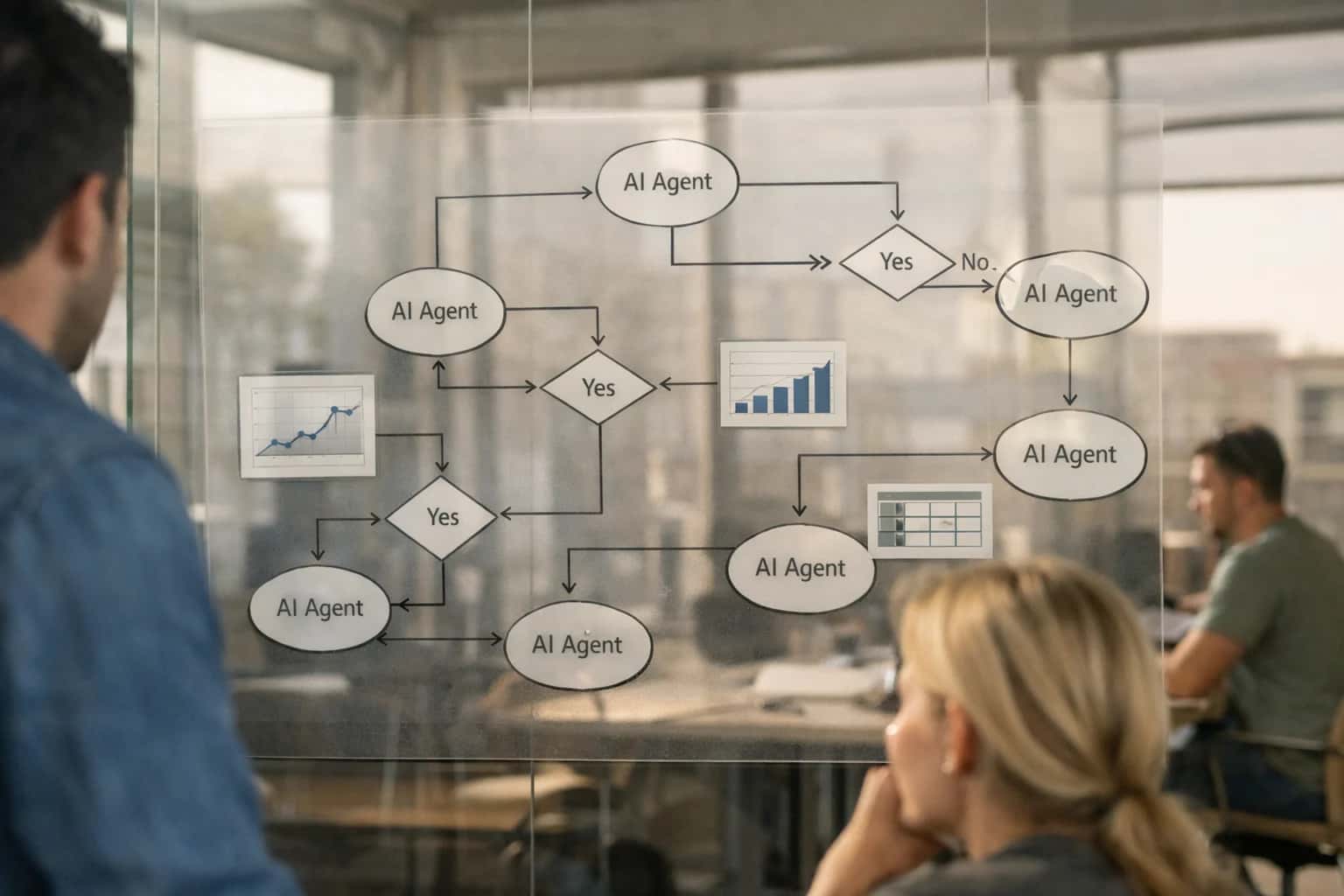
ARCHITECTURE AND ROLLOUT
Where AI Fits into Fleet Dispatch Operations
A practical guide to integrating AI agents into the dispatch workflow of platforms like Samsara and Motive to automate load matching, exception handling, and real-time communications.
A typical high-value workflow is automated load matching and exception triage. When a delay alert fires from the telematics platform, an AI agent evaluates: the driver's remaining Hours of Service, the priority of the impacted job, nearby available drivers/vehicles, and historical on-time performance for the customer. It can then execute a pre-approved action via API, such as reassigning the load in the dispatch board or automatically generating a customer notification using a templated message populated with the new ETA. This reduces manual radio calls and spreadsheet tracking, turning reactive alert monitoring into a closed-loop, exception-based workflow.
Rollout should be phased, starting with a single exception type (e.g., estimated_delay > 60 minutes) and a single dispatcher pod. Governance is critical: all AI-initiated changes to job assignments or route schedules should be logged to a separate audit trail and, for major changes, require a human-in-the-loop approval step via Slack or Teams before the API call is executed. This balances automation speed with operational control, allowing dispatchers to oversee and refine AI logic before scaling to the entire fleet.
ARCHITECTURE BLUEPRINT
Dispatch Touchpoints in Fleet Management Platforms
Core Dispatch Surfaces for AI Integration
The dispatch console is the primary command center. AI integration here focuses on augmenting human decision-making with predictive intelligence.
Key Integration Points:
- Load Matching Algorithms: AI agents can analyze real-time telematics (vehicle location, capacity, driver HOS) from Samsara or Motive alongside load board APIs (DAT, Truckstop) to suggest optimal matches, considering deadhead reduction and driver preferences.
- Exception Dashboards: Instead of raw alert floods, AI can triage and contextualize geofence exits, delays, or vehicle faults. It surfaces only high-priority exceptions with recommended actions (e.g., "Trailer 45 delayed at shipper; contact site manager at 555-0123").
- Automated Communications: Integrate with the platform's notification engine to auto-generate and send ETA updates to customers via SMS or email, using real-time GPS data and traffic conditions from the telematics provider.
This layer turns the console from a reactive monitoring tool into a proactive co-pilot.
FLEET OPERATIONS AUTOMATION
High-Value AI Dispatch Use Cases
Integrate AI directly into your Samsara, Motive, or Geotab dispatch workflows to automate routine decisions, handle exceptions, and keep drivers and customers informed—without manual intervention.
01
Intelligent Load Matching & Assignment
AI agents analyze incoming load details (pickup/delivery windows, weight, dimensions, required equipment) against real-time driver HOS availability, vehicle location, and trailer type from your fleet platform. Automatically suggests or assigns the optimal driver, reducing manual load board scanning and phone calls.
Batch -> Real-time
Assignment speed
02
Proactive Exception Handling & Re-routing
Monitor real-time telematics for delays (traffic, weather, breakdowns). An AI workflow automatically evaluates the impact on downstream appointments, calculates new ETAs, and can trigger pre-approved re-routes or communicate delays to customers via SMS/email—all before a dispatcher is alerted.
Same day
Issue resolution
03
Automated Customer & Shipper Communications
Using real-time ETA data from Samsara or Verizon Connect, an AI agent generates and sends personalized status updates at key milestones (loaded, enroute, 1-hour out, delayed). Integrates with your TMS or CRM to pull contact info, keeping customers informed 24/7 without dispatcher overhead.
Hours -> Minutes
Communication workload
04
Dynamic Capacity & Backhaul Optimization
For each empty leg, an AI model scans integrated load boards and internal order systems. It evaluates profitability, driver schedule, and route efficiency, then surfaces the top 2-3 recommended backhaul opportunities directly within the dispatcher's console in your fleet platform.
05
Driver HOS & Availability Forecasting
AI continuously projects driver available hours for the next 1-3 days by analyzing current logs, planned routes, and mandatory break patterns from Motive or Samsara ELD data. Dispatchers see a predictive availability dashboard, preventing last-minute HOS violations during assignment.
06
Multi-Stop Route Sequencing
For local delivery or service fleets, an AI optimizer ingests a day's worth of stops from your FSM platform. It sequences stops dynamically based on real-time traffic, time windows, and driver location—updating the route in the driver's mobile app to maximize completions per day.
1 sprint
Typical implementation
AUTOMATED OPERATIONS
Example AI Dispatch Workflows
These concrete workflows illustrate how AI agents can be integrated into platforms like Samsara, Motive, or Verizon Connect to automate dispatch decisions, handle exceptions, and maintain communication—without replacing the human dispatcher.
Trigger: A new load tender appears in the Transportation Management System (TMS) via API.
AI Agent Action:
- Context Retrieval: The agent pulls the load's details (pickup/delivery windows, weight, required equipment) and queries the fleet platform's live API for:
- Available drivers within a geofence of the pickup location, considering Hours of Service (HOS) status and home time preferences.
- Available tractors and trailers matching the equipment requirements.
- Decision & Assignment: Using a configured rules engine (e.g., prioritize minimizing deadhead, then driver preference), the agent selects the optimal driver-asset pair.
- System Update: The agent automatically:
- Accepts the load in the TMS.
- Creates a dispatch in the fleet platform (Samsara/Motive) and assigns it to the driver.
- Sends the load details and documents to the driver's mobile app.
Human Review Point: The agent flags any tender with unusual requirements (hazmat, extreme dimensions) or if no suitable driver is found, escalating it to a human dispatcher's queue with a summary of the search results.
FROM REAL-TIME DATA TO ACTIONABLE DISPATCH
Implementation Architecture: Data Flow & Agent Orchestration
A practical blueprint for connecting AI agents to your fleet management platform's data streams to automate dispatch decisions and communications.
The core of AI-powered dispatch is a real-time data pipeline that ingests events from your Samsara, Motive, or Geotab platform via their streaming APIs or webhooks. Critical data points include vehicle location, status (en route, at stop, delayed), ETA updates, driver HOS availability, and sensor-triggered exceptions (like geofence_exit or harsh_event). This raw telematics data is enriched with contextual information—such as customer details from your TMS and traffic/weather from third-party APIs—before being queued for AI agent processing.
Orchestration is handled by specialized AI agents that subscribe to these enriched events. A Load Matching Agent analyzes available drivers, vehicle specs, and proximity to new loads, suggesting optimal assignments. A Real-Time Exception Agent monitors for delays or incidents, automatically triaging severity and triggering predefined workflows: for a minor delay, it might generate a customer update; for a major incident, it could create a preliminary report and alert a human dispatcher. These agents use a RAG system grounded in your company's SOPs and historical dispatch logs to ensure recommendations are compliant and contextual.
Governance is built into the workflow. Every AI-suggested action—a load assignment, a delay notification—is logged with a full audit trail linking back to the source telematics event. For high-stakes decisions, the architecture supports a human-in-the-loop approval step, where a dispatcher reviews the agent's recommendation within their familiar Samsara or Motive interface before it's executed via the platform's REST API. This creates a closed-loop system where dispatchers manage by exception, focusing on complex problems while AI handles routine coordination and communication, turning hours of manual tracking and calling into automated, real-time operations.
AI-DISPATCH WORKFLOWS
Code & Payload Examples
Automated Load-to-Driver Matching
This workflow uses an AI agent to evaluate incoming loads from a TMS against real-time driver availability and location data from Samsara or Motive. The agent scores each potential match based on HOS remaining, vehicle specs, driver preferences, and historical on-time performance.
Example Python Payload to Dispatch API:
python# Payload for AI agent to recommend load assignment dispatch_recommendation = { "load_id": "ORD-78910", "driver_candidates": [ { "driver_id": "D-556", "vehicle_id": "V-223", "current_location": {"lat": 40.7128, "lon": -74.0060}, "hours_remaining": 6.5, "vehicle_capacity": "53ft Dry Van", "preferred_lanes": ["Northeast", "Mid-Atlantic"], "otp_score": 0.94 # On-Time Performance } ], "load_details": { "pickup": {"address": "Boston, MA", "window": "2024-05-15T14:00:00Z"}, "delivery": {"address": "Philadelphia, PA", "window": "2024-05-16T10:00:00Z"}, "requirements": {"trailer_type": "53ft Dry Van", "hazmat": false} }, "ai_score": 0.87, # Agent's confidence in this match "rationale": "Driver within 50 miles, sufficient HOS, matches preferred lane and equipment." } # Post recommendation to Samsara Dispatch API response = requests.post( 'https://api.samsara.com/fleet/dispatch/assignments', json=dispatch_recommendation, headers={'Authorization': 'Bearer YOUR_API_KEY'} )
The agent can be configured to auto-assign high-confidence matches or present ranked options to a dispatcher for final approval.
AI-POWERED DISPATCH SUPPORT
Realistic Time Savings & Operational Impact
This table illustrates the tangible operational improvements when integrating AI agents into dispatch workflows within platforms like Samsara and Motive. It compares manual processes to AI-assisted workflows, focusing on measurable efficiency gains and enhanced decision-making.
| Dispatch Workflow | Before AI | After AI | Implementation Notes |
|---|---|---|---|
Load Matching & Assignment | Manual review of boards, calls to drivers (30-60 mins per load) | AI suggests top 3 matches in <2 mins | Agent uses vehicle location, HOS, driver preferences, and load specs. Human dispatcher makes final assignment. |
Exception Handling & Re-routing | Reactive; dispatcher manually checks traffic/weather after driver call (15-30 mins) | Proactive alerts with 1-click re-route options (<5 mins) | AI monitors real-time feeds, predicts delays, and proposes optimized alternatives via platform API. |
Driver ETA Communications | Manual calls/texts to customers for updates (5-10 mins per stop) | Automated, personalized status messages sent via SMS/email | Agent triggers messages using real-time GPS data and pre-configured templates; dispatcher reviews exceptions. |
Document & Proof-of-Delivery (POD) Chase | End-of-day calls and emails (45+ mins daily) | Automated reminders and digital collection via driver app | AI identifies missing PODs, sends prompts to driver mobile app, and files documents in the platform. |
Post-Trip Settlement & Data Entry | Manual entry of trip details into TMS/accounting (20-30 mins per trip) | AI auto-populates 80% of fields from ELD and geofence data | Agent extracts miles, stops, and delays; dispatcher verifies and submits. Integrates with systems like QuickBooks. |
New Driver Onboarding for Dispatch | Manual profile setup and route briefing (1-2 hours) | AI generates briefing packet and suggests initial runs in 15 mins | Agent pulls data from HRIS, creates safety/route overview, and loads preferences into the fleet platform. |
Daily Dispatch Briefing Preparation | Manual compilation of reports and issues (45-60 mins) | AI-generated summary with prioritized alerts and KPIs in 10 mins | Natural language report sent 30 mins before shift start, highlighting yesterday's exceptions and today's hotspots. |
ARCHITECTING FOR CONTROL AND SCALE
Governance, Permissions, and Phased Rollout
A practical guide to deploying AI-powered dispatch support with the security, oversight, and incremental value delivery that enterprise fleet operations require.
Effective AI integration respects the existing role-based access control (RBAC) and data segmentation of your fleet platform. In Samsara or Motive, this means your AI agents should inherit permissions from the user or service account that calls them. For example, a dispatch AI generating load recommendations should only access data for vehicles and drivers within the dispatcher's assigned region or division. We architect integrations to authenticate via OAuth or API keys with scoped permissions, ensuring AI actions like sending a revised ETA or creating a work order are logged in the platform's native audit trail, maintaining a clear chain of accountability.
A phased rollout is critical for managing change and proving value. We recommend starting with a 'copilot' phase for a single dispatch team. In this phase, the AI analyzes real-time data from the Samsara Driver App and GPS feeds to suggest optimal load matches or flag exceptions, but all actions require human approval within the dispatch console. This builds trust and provides a feedback loop for tuning. The next phase introduces 'supervised automation' for high-confidence, repetitive tasks—like automatically sending delay notifications to customers when a geofence exit is detected. The final phase enables 'closed-loop automation' for specific workflows, such as the AI agent directly reassigning a load in the TMS when a vehicle breakdown is predicted, but only after notifying the primary dispatcher via an in-app alert.
Governance extends to the AI's decision-making logic. We implement guardrails and approval queues within the integration layer. For instance, any AI-suggested route change that increases drive time by more than 15% or violates a driver's Hours of Service (HOS) limits is automatically routed for manual review. Furthermore, we design integrations to support a human-in-the-loop escalation at any point, allowing a dispatcher to override an AI decision with a single click, which then retrains the underlying model to avoid similar suggestions. This controlled approach minimizes risk while systematically capturing efficiency gains, turning AI from a black box into a reliable, auditable team member. For related architectural patterns, see our guide on AI-Powered Workflow Automation for Fleet Platforms.
Enabling Efficiency, Speed & Accuracy
Intelligent Analysis, Decision & Execution
We build AI systems for teams that need search across company data, workflow automation across tools, or AI features inside products and internal software.
Talk to Us
Search across company data
Give teams answers from docs, tickets, runbooks, and product data with sources and permissions.
Useful when people spend too long searching or get different answers from different systems.
Enterprise searchRAGPermissions
Read more
Automate internal workflows
Use AI to route work, draft outputs, trigger actions, and keep approvals and logs in place.
Useful when repetitive work moves across multiple tools and teams.
AI agentsWorkflow automationGovernance
Read more
Add AI to products and internal tools
Build assistants, guided actions, or decision support into the software your team or customers already use.
Useful when AI needs to be part of the product, not a separate tool.
AI integrationDecision supportModel routing
Read moreAI-POWERED DISPATCH SUPPORT
FAQ: AI Dispatch Integration
Practical answers for operations managers and technical leaders implementing AI to automate and optimize dispatch workflows within platforms like Samsara, Motive, and Geotab.
An AI dispatch agent monitors your Transportation Management System (TMS) or dispatch board and fleet telematics platforms in real-time.
Typical Workflow:
- Trigger: A new load is posted in the TMS, or a live shipment exception (e.g., delay, trailer issue) is detected via a Samsara/Geotab webhook.
- Context Pull: The agent retrieves:
- Load details (pickup/drop windows, weight, required equipment).
- Real-time driver/asset status (location, Hours of Service remaining, current assignment) from the fleet platform.
- Historical performance data for drivers on similar routes.
- Agent Action: An LLM-powered agent evaluates the load against available capacity, considering constraints like HOS, geofences, and asset type. For exceptions, it assesses severity and available rerouting or recovery options.
- System Update: The agent either:
- Recommends a top match to the dispatcher via the platform's UI or a sidecar dashboard.
- Automatically assigns the load to a qualified driver (if rules-based automation is approved).
- For exceptions, creates a prioritized alert with a suggested action plan in the dispatch console.
- Human Review Point: High-value loads, complex multi-stop routes, or severe service failures are always flagged for dispatcher approval before final assignment.

About the author
Prasad Kumkar
CEO & MD, Inference Systems
Prasad Kumkar is the CEO & MD of Inference Systems and writes about AI systems architecture, LLM infrastructure, model serving, evaluation, and production deployment. Over 5+ years, he has worked across computer vision models, L5 autonomous vehicle systems, and LLM research, with a focus on taking complex AI ideas into real-world engineering systems.
His work and writing cover AI systems, large language models, AI agents, multimodal systems, autonomous systems, inference optimization, RAG, evaluation, and production AI engineering.
LinkedIn
Limited slotsGet a Free AI Consultation
Partnered with leading AI, data, and software stack.





How We Work
Custom AI workflows for your Business
One-fit-all AI don't work for modern businesses. At Inferensys, we aim to understand your business & custom requirements; which we use to define most efficient agentic workflows, the data, and the tools for your business.
01
Review the use case
We understand the task, the users, and where AI can actually help.
Read more02
Pick the right approach
We define what needs search, automation, or product integration.
Read more03
Build the first useful version
We implement the part that proves the value first.
Read more04
Improve from there
We add the checks and visibility needed to keep it useful.
Read moreThe first call is a practical review of your use case and the right next step.
Talk to Us