AI integration transforms waste fleet management by connecting three critical data streams: bin sensor fill-level data (via IoT integrations), vehicle telematics (GPS, engine data, weight sensors), and external operational data (landfill wait times, traffic, weather). The integration surface is the fleet management platform's API layer—Samsara's REST API or Geotab's MyGeotab—where AI agents ingest this data to make real-time decisions. Key objects to enrich include vehicles, routes, drivers, and work orders, enabling dynamic adjustments based on actual service need rather than fixed schedules.

Integration
AI for Fleet Waste Management and Recycling Operations
A technical blueprint for integrating AI with platforms like Samsara and Motive to optimize waste collection routes using bin sensor IoT data, automate driver performance analysis, and reduce landfill queue times.
FROM REACTIVE COLLECTION TO PREDICTIVE OPERATIONS
Where AI Fits into Waste and Recycling Fleet Operations
A technical blueprint for integrating AI with platforms like Samsara and Geotab to optimize waste collection, reduce costs, and meet sustainability targets.
High-value use cases center on predictive collection routing. An AI model analyzes historical fill rates, current sensor readings, and truck capacity to generate an optimal daily route that skips empty bins and prioritizes full ones, reducing miles and fuel by 15-25%. For recycling operations, computer vision agents integrated with onboard cameras can analyze material composition at the curb, providing real-time feedback to drivers on contamination and automating quality reporting back to municipal clients. AI also automates landfill and transfer station coordination, predicting queue times and rerouting trucks to minimize idle fuel burn and driver wait periods.
A production rollout starts with a pilot on 5-10% of the fleet. Data pipelines are built to stream sensor and telematics data into a vector store for the AI's retrieval-augmented generation (RAG) context. AI agents, governed by rules (e.g., "never extend a driver's shift beyond HOS limits"), call the fleet platform's APIs to update routes in the dispatcher's console and push new instructions to the in-cab tablet. Success is measured by cost per collected ton, on-route efficiency, and customer service complaints. Governance requires clear human-in-the-loop checkpoints for major route overhauls and continuous monitoring for model drift against seasonal waste generation patterns.
WASTE & RECYCLING OPERATIONS
Key Integration Surfaces in Your Fleet Platform
Core Routing & Dispatch APIs
Integrate AI directly with the platform's route planning and dispatch modules. The primary surfaces are the Route API for generating plans and the Dispatch API for sending assignments to drivers' mobile apps.
AI Use Case: Inject real-time fill-level data from IoT bin sensors (via platform webhooks) and predicted landfill wait times into the routing algorithm. The AI agent can call the platform's API to dynamically re-optimize collection sequences mid-day, prioritizing overflowing bins and avoiding congested disposal sites.
Implementation Pattern:
python# Pseudocode for AI-enhanced route update fill_level_alert = receive_webhook(samsara_bin_sensor) landfill_wait = call_ai_model(traffic, historical_wait_times) updated_route = fleet_platform_api.optimize_route( route_id=active_route, constraints={ 'priority_stops': fill_level_alert['bins'], 'disposal_delay': landfill_wait } ) fleet_platform_api.update_dispatch(updated_route)
SPECIALIZED OPERATIONS
High-Value AI Use Cases for Waste Fleets
Integrating AI with platforms like Samsara, Motive, and Geotab transforms static telematics data into dynamic operational intelligence for waste and recycling fleets. These use cases focus on reducing costs, improving service, and ensuring compliance.
01
Dynamic Collection Route Optimization
AI agents analyze real-time bin sensor fill-level data (via IoT integrations), historical collection patterns, traffic, and landfill wait times to dynamically re-route trucks. This moves planning from a static weekly schedule to a daily, asset-aware dispatch that reduces miles, fuel, and overtime.
10-20%
Route efficiency gain
02
Automated Driver Vehicle Inspection Reports (DVIR)
Integrate AI with dash cam imagery and pre-trip sensor data from the fleet platform. An AI agent reviews images for defects (e.g., leaking hydraulics, damaged lids) and sensor status, automatically populating the DVIR in the driver app. Defects are flagged and a work order is created in the CMMS.
Batch -> Real-time
Inspection workflow
03
Landfill & Transfer Station Wait Time Intelligence
An AI model ingests GPS pings from all fleet assets at disposal sites, calculating real-time and predicted queue times. This intelligence is fed back into the dispatch/routing AI to sequence trucks, reschedule breaks, and provide accurate ETAs to customers, smoothing daily peaks.
Hours -> Minutes
Queue time savings per truck
04
Predictive Maintenance for Compaction & Lift Systems
Go beyond engine fault codes. AI models analyze hydraulic pressure sensor data, cycle counts, and load weights from the telematics platform to predict failures in packer blades, lift mechanisms, and valves. Automatically generates prioritized work orders in the CMMS before roadside breakdowns occur.
>50%
Reduction in unplanned downtime
05
Contamination Detection & Customer Education
Using AI dash cam video analysis at the point of collection, the system identifies non-compliant materials in recycling streams. The AI logs the incident with location/time, and can trigger an automated, personalized customer notification via email or postcard with guidance, supporting diversion goals.
Same day
Feedback to customer
06
Automated IFTA & Weight-Mile Tax Reporting
AI workflows automatically compile jurisdictional mileage (from GPS geofences), fuel purchases, and vehicle-specific data from the fleet platform each quarter. The agent calculates taxes due, prepares the filing, and generates the audit trail, eliminating manual spreadsheet work.
1-2 days
Instead of 1-2 weeks
SPECIALIZED WASTE FLEET AUTOMATION
Example AI-Powered Workflows for Recycling Operations
These concrete workflows demonstrate how AI agents, integrated with platforms like Samsara and Geotab, can automate high-impact tasks for waste collection and recycling operations, turning IoT sensor data and telematics into actionable intelligence.
Trigger: A scheduled nightly planning job or a real-time alert from bin IoT sensors (e.g., Compology, Enevo) indicating a container is >85% full.
Context/Data Pulled:
- Bin sensor fill-level, location, and waste type from IoT platform APIs.
- Vehicle location, capacity, and current scheduled stops from the Fleet Management Platform (e.g., Samsara Routes).
- Historical collection times, traffic patterns, and landfill/processing facility wait times.
- Driver hours-of-service (HOS) status from the ELD.
Model/Agent Action: An AI routing agent evaluates the new priority stop against the existing route. It uses a cost function that balances:
- Fuel efficiency and mileage.
- Avoiding service failures (overfull bins).
- Minimizing total route time, including predicted landfill queue times.
- Remaining compliant with HOS rules.
System Update/Next Step: The agent generates an optimized route sequence and pushes the updated route and turn-by-turn navigation directly to the driver's in-cab tablet via the Samsara Driver App API. A dispatcher receives a notification of the change with the rationale.
Human Review Point: Major route deviations or conflicts (e.g., a driver nearing HOS limits) are flagged for dispatcher approval before being sent to the vehicle.
FROM SENSOR TO SCHEDULE
Implementation Architecture: Data Flow and System Design
An AI integration for waste fleet management connects IoT bin sensors, telematics platforms, and dispatch systems into a closed-loop optimization engine.
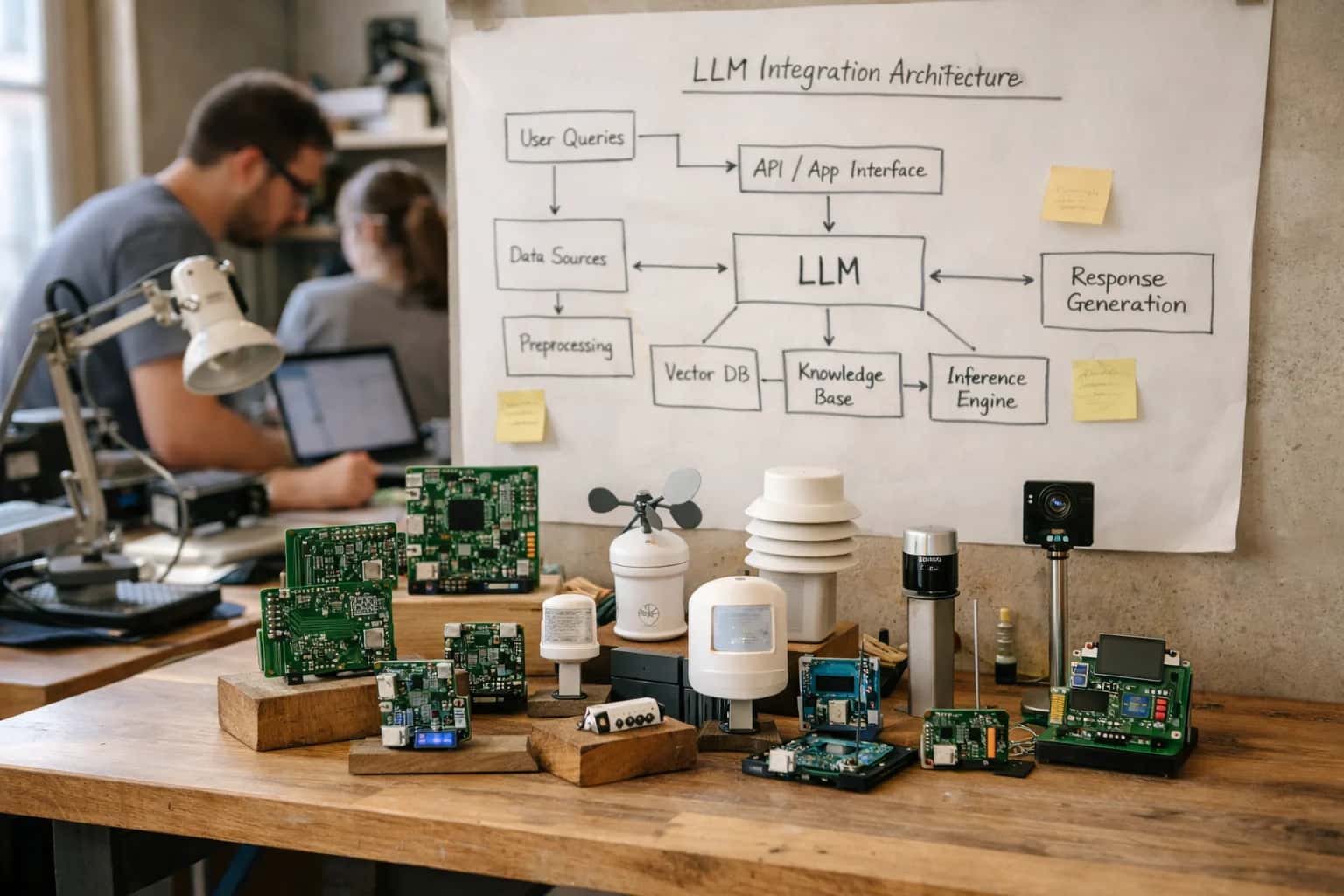
The core data flow begins with IoT bin-level sensors (e.g., fill-level, weight, temperature) streaming real-time status to a central aggregation layer. This data is enriched with vehicle telematics from Samsara, Geotab, or Motive—including real-time location, traffic conditions, and landfill scale wait times—and historical service records. An AI orchestration agent processes this unified stream to dynamically re-optimize collection routes. It outputs optimized stop sequences and schedules directly into the dispatch module of your fleet platform (e.g., Samsara Routes) and updates the driver's in-cab tablet or mobile app.
System design requires a resilient middleware layer to handle the data pipeline: 1) A real-time ingestion service for sensor and telematics APIs/webhooks, 2) A vector database for RAG over historical service maps and municipal regulations, 3) An optimization engine (LLM + classical algorithms) that respects constraints like vehicle capacity, driver hours, and landfill operating hours, and 4) An integration service that pushes the final plan and real-time adjustments back to the fleet platform and notifies customers of any service window changes. This architecture runs as an overlay, not a replacement, ensuring the existing fleet platform remains the system of record for compliance and reporting.
Rollout is typically phased, starting with a pilot route where AI suggestions are reviewed by a dispatcher before being applied. Governance focuses on audit trails for every AI-recommended route change and a human-in-the-loop approval step for exceptions (e.g., missed pickups, road closures). The final stage enables fully autonomous re-routing for a subset of vehicles, with performance measured by key operational metrics: reduction in miles driven per ton collected, decrease in overtime hours, and improvement in landfill throughput.
AI FOR WASTE FLEET OPERATIONS
Code and Payload Examples
Dynamic Route Generation with Bin Sensor Data
This example shows how an AI agent calls a routing API, integrating real-time fill-level data from IoT sensors on waste containers. The payload includes constraints like landfill hours, vehicle capacity, and driver HOS status pulled from the fleet platform.
pythonimport requests # Example payload to AI routing service def optimize_waste_collection(fleet_data, sensor_data): payload = { "vehicle_id": "TRK-789", "driver_id": "DRV-456", "current_location": fleet_data["last_known_gps"], "planned_stops": [ { "stop_id": "BIN-001", "location": sensor_data["BIN-001"]["coordinates"], "fill_level_percent": sensor_data["BIN-001"]["fill_level"], "priority": "high" if sensor_data["BIN-001"]["fill_level"] > 85 else "standard" } # ... additional stops from sensor feed ], "constraints": { "landfill_hours": {"open": "07:00", "close": "17:00"}, "vehicle_capacity_kg": 12000, "driver_hos_remaining_minutes": fleet_data["hos_remaining"], "must_return_to_yard": True } } # Call AI routing engine response = requests.post( "https://api.inferencesystems.com/routing/waste", json=payload, headers={"Authorization": f"Bearer {API_KEY}"} ) return response.json() # Returns optimized sequence and ETAs
The AI model processes this to generate a cost- and time-optimal sequence, potentially skipping low-fill bins and adjusting for predicted landfill wait times.
AI FOR WASTE FLEET OPERATIONS
Realistic Operational Impact and Time Savings
How AI integration with fleet platforms like Samsara and Geotab transforms key waste and recycling workflows, based on real-time sensor data and predictive analytics.
| Metric | Before AI | After AI | Notes |
|---|---|---|---|
Daily Route Optimization | Static routes based on zones; 1-2 hours of manual planning | Dynamic routes based on bin fill-level sensors; 15-20 minutes of AI-assisted review | AI suggests optimal sequences, dispatcher approves. Reduces miles driven by 8-15%. |
Landfill/Transfer Station Wait Time | Driver reports via radio/call; delays often discovered after the fact | AI predicts queue times using historical telematics and real-time feeds; provides ETA alerts | Enables proactive rerouting or schedule adjustments. Reduces idle time at sites by 20-30%. |
Driver Safety & Coaching | Monthly review of harsh event reports; generic safety talks | AI generates personalized weekly scorecards using dash cam and telematics, flagging specific behaviors | Coaching is data-driven and contextual. Can reduce preventable incidents by 15-25%. |
Preventive Maintenance Scheduling | Time-based intervals (e.g., every 10k miles); unexpected breakdowns occur | Condition-based predictions using engine data, load cycles, and compaction metrics | AI triggers work orders in CMMS. Aims to reduce unplanned downtime by 25-40%. |
Customer Service Inquiry (Missed Pickup) | Manual lookup of truck GPS and driver logs; 30+ minute resolution | AI agent cross-references service tickets with vehicle location history; provides instant answer | Integrated with service platforms like Zendesk. Resolves 80% of common inquiries automatically. |
Regulatory Reporting (Weight Tickets, Mileage) | Manual collection from paper/digital logs; days to compile at month-end | Automated extraction and synthesis from ELD, scale, and route data | AI prepares draft reports for review. Cuts compilation time from days to hours. |
Recycling Contamination Identification | Spot checks at the MRF; feedback loop to drivers is weeks long | AI analyzes onboard camera images of collected material; alerts dispatcher to potential issues | Enables same-day feedback to drivers. Aims to improve material purity and reduce rejection fees. |
IMPLEMENTING AI IN REGULATED WASTE OPERATIONS
Governance, Security, and Phased Rollout
Deploying AI for waste and recycling fleets requires a controlled, audit-ready approach that respects data privacy, operational safety, and regulatory compliance.
AI governance for waste fleets starts with data access controls. Sensor data from bin fullness monitors, on-board scales, and landfill wait-time feeds must be tagged with appropriate metadata (e.g., customer ID, route, asset) and access restricted via role-based permissions within platforms like Samsara or Geotab. AI models processing this data should operate within a secure, isolated environment, with all prompts, inferences, and data retrievals logged to an immutable audit trail. This is critical for demonstrating compliance with waste handling regulations, customer data agreements, and internal safety policies.
A phased rollout minimizes disruption. Phase 1 typically focuses on a single, high-impact workflow like dynamic route optimization based on bin sensor data. Here, an AI agent consumes IoT payloads from connected compactors or smart bins via the fleet platform's API, predicts collection needs, and suggests optimized stop sequences. This is deployed in a 'shadow mode' for a pilot route, where AI-generated routes are compared against dispatcher-planned routes without affecting driver instructions. Phase 2 introduces AI-driven driver coaching for safety and efficiency, analyzing dash cam footage and driving behavior from the telematics platform to generate personalized feedback reports. Phase 3 expands to predictive maintenance by correlating engine data with load data from on-board scales to forecast component failures, automatically generating work orders in your CMMS.
Security extends to the integration layer itself. Webhooks from Samsara or Motive that trigger AI workflows must be authenticated and validated. AI-generated instructions—like a revised route or a maintenance alert—should pass through a human-in-the-loop approval step (e.g., dispatcher or maintenance manager review) within the fleet platform's interface before being enacted. For sensitive operations, such as adjusting routes for hazardous waste collection, the system should enforce a mandatory review and document the rationale. This controlled, phased approach ensures AI augments waste operations safely, providing measurable gains in fuel efficiency, asset utilization, and regulatory reporting without introducing unmanaged risk.
Enabling Efficiency, Speed & Accuracy
Intelligent Analysis, Decision & Execution
We build AI systems for teams that need search across company data, workflow automation across tools, or AI features inside products and internal software.
Talk to Us
Search across company data
Give teams answers from docs, tickets, runbooks, and product data with sources and permissions.
Useful when people spend too long searching or get different answers from different systems.
Enterprise searchRAGPermissions
Read more
Automate internal workflows
Use AI to route work, draft outputs, trigger actions, and keep approvals and logs in place.
Useful when repetitive work moves across multiple tools and teams.
AI agentsWorkflow automationGovernance
Read more
Add AI to products and internal tools
Build assistants, guided actions, or decision support into the software your team or customers already use.
Useful when AI needs to be part of the product, not a separate tool.
AI integrationDecision supportModel routing
Read moreAI INTEGRATION WORKFLOWS
Frequently Asked Questions for Waste Fleet Managers
Practical questions and detailed workflow walkthroughs for integrating AI with platforms like Samsara, Geotab, and Motive to optimize waste collection and recycling operations.
This workflow uses IoT sensor data from smart bins (e.g., fill-level sensors) integrated via your fleet platform's auxiliary IoT inputs (like Samsara's Sensor Gateway or Geotab's GO9).
- Trigger: A scheduled nightly job or a real-time webhook from the bin sensor network indicates bins are nearing capacity.
- Context/Data Pulled: The AI agent calls the fleet platform API to pull:
- Bin location and current fill percentage.
- Vehicle location, capacity, and current assigned routes from the TMS or dispatch module.
- Historical collection times and traffic patterns for the area.
- Model/Agent Action: An optimization model (like a vehicle routing algorithm) processes this data. It dynamically re-sequences stops, skipping low-fill bins and adding high-priority ones, while respecting weight limits, driver hours, and landfill operating hours.
- System Update: The optimized route is pushed back to the dispatch console in the fleet platform (e.g., Samsara's Routes) and sent to the driver's mobile tablet.
- Human Review Point: The dispatcher reviews the AI-suggested route changes for any service exceptions or special customer instructions before final approval and driver notification.

About the author
Prasad Kumkar
CEO & MD, Inference Systems
Prasad Kumkar is the CEO & MD of Inference Systems and writes about AI systems architecture, LLM infrastructure, model serving, evaluation, and production deployment. Over 5+ years, he has worked across computer vision models, L5 autonomous vehicle systems, and LLM research, with a focus on taking complex AI ideas into real-world engineering systems.
His work and writing cover AI systems, large language models, AI agents, multimodal systems, autonomous systems, inference optimization, RAG, evaluation, and production AI engineering.
LinkedIn
Limited slotsGet a Free AI Consultation
Partnered with leading AI, data, and software stack.





How We Work
Custom AI workflows for your Business
One-fit-all AI don't work for modern businesses. At Inferensys, we aim to understand your business & custom requirements; which we use to define most efficient agentic workflows, the data, and the tools for your business.
01
Review the use case
We understand the task, the users, and where AI can actually help.
Read more02
Pick the right approach
We define what needs search, automation, or product integration.
Read more03
Build the first useful version
We implement the part that proves the value first.
Read more04
Improve from there
We add the checks and visibility needed to keep it useful.
Read moreThe first call is a practical review of your use case and the right next step.
Talk to Us