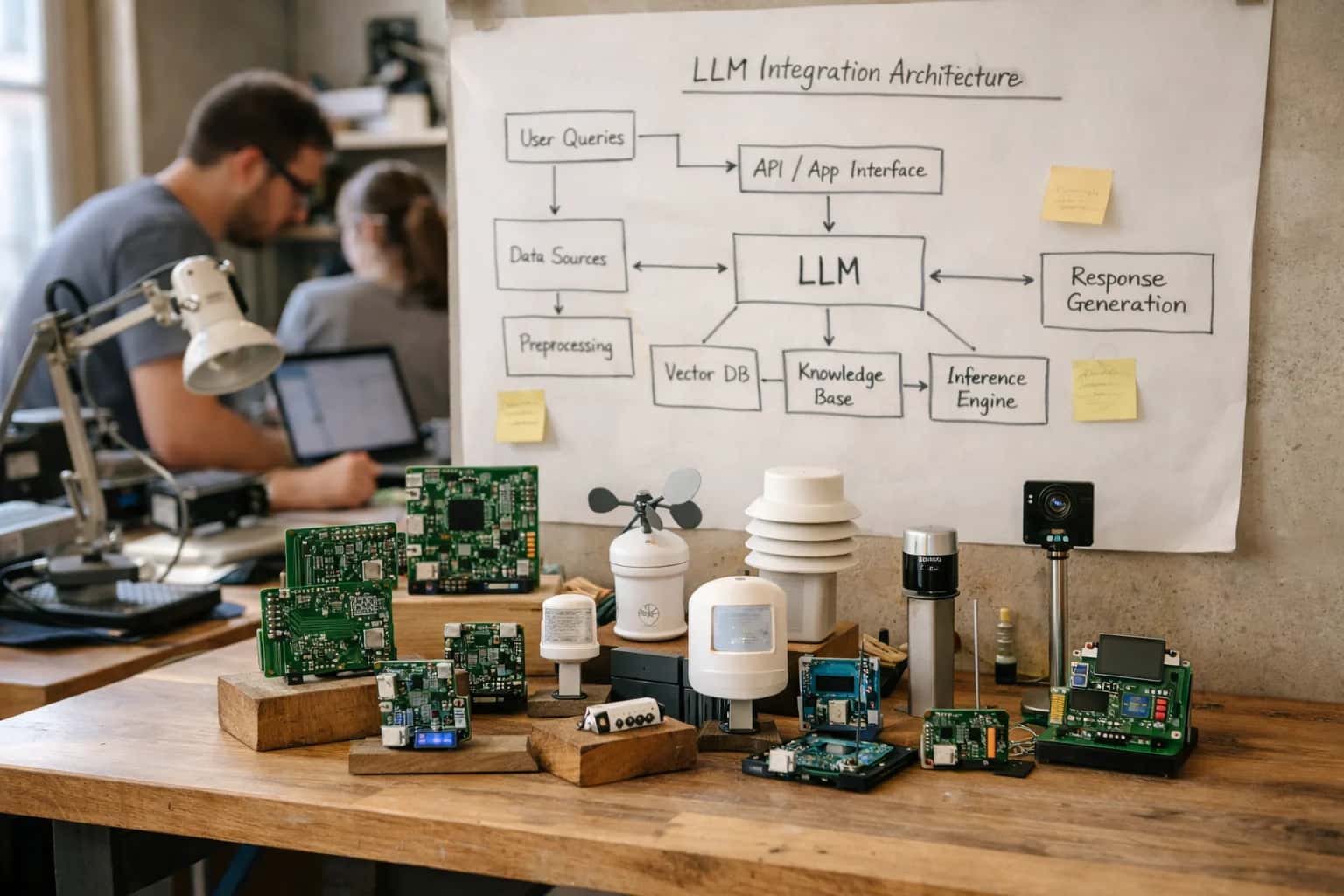
The integration architecture typically sits between your fleet management platform (Samsara, Geotab, Motive) and your planning systems (spreadsheets, ERP, specialized TCO tools). AI agents consume key data objects via API: vehicles (VIN, specs, age), trips (daily mileage, stop patterns, idle time), fuel transactions, and maintenance records. This forms the baseline for modeling EV suitability. External APIs for electricity rates, public charging station locations, and vehicle incentive programs are then layered in to create a complete planning dataset.

Integration
AI for Fleet Electrification Planning and Management
A technical blueprint for integrating AI with fleet management platforms (Samsara, Motive, Geotab, Verizon Connect) to automate EV transition planning, optimize charging, forecast TCO, and manage range anxiety.
ARCHITECTURE AND ROLLOUT
Where AI Fits in the EV Fleet Transition
AI integration for fleet electrification connects telematics data, vehicle specs, and external market data to model the operational and financial impact of replacing ICE vehicles with EVs.
Implementation focuses on high-impact workflows. For vehicle replacement prioritization, AI models score each asset based on route predictability, daily energy needs, and available depot or on-route charging. For charge scheduling and cost optimization, agents simulate charging against time-of-use rates and vehicle duty cycles to minimize kWh costs. For range anxiety mitigation, RAG systems grounded in vehicle manuals and historical telematics can power driver-facing copilots in mobile apps, answering questions like 'Can I make this 200-mile trip with a 20% buffer given the current temperature and load?'
Rollout is phased. A pilot often starts with a static TCO analysis for a subset of vehicles, producing a prioritized replacement list. The next phase adds dynamic charge management for newly deployed EVs, integrating with charge station management systems (CSMS) via webhooks. Governance is critical: AI recommendations for vehicle retirement or charging must flow into existing approval workflows in your ERP or procurement system, with clear audit trails. The final phase operationalizes real-time range and route planning within the dispatch console, requiring tight integration with the fleet platform's routing engine and real-time state-of-charge data.
ELECTRIFICATION PLANNING
AI Integration Points Across Fleet Platforms
Core Telematics for EV Suitability Analysis
The foundational integration point for electrification planning is the vehicle and route data stream. AI models consume high-fidelity telematics from platforms like Samsara, Geotab, or Verizon Connect to build a digital twin of your current diesel fleet.
Key Data Objects:
- Vehicle Master Records: VIN, year, make, model, gross vehicle weight (GVW), engine specifications.
- Trip Histories: Start/end times, GPS breadcrumbs, stop durations, geofence entries/exits.
- Sensor Streams: Engine hours, idle time, fuel consumption (to calculate equivalent energy demand), PTO usage for auxiliary equipment.
- Route Attributes: Terrain elevation data, average speeds, traffic patterns, and seasonal weather impacts.
AI uses this data to simulate each vehicle's duty cycle as an EV, identifying which routes are within range, where charging stops would be required, and estimating the total daily energy consumption (kWh). This analysis flags vehicles with duty cycles unsuitable for current EV technology, preventing costly mis-matches.
PLANNING & MANAGEMENT
High-Value AI Use Cases for Fleet Electrification
Transitioning a fleet to electric vehicles requires precise analysis of routes, charging infrastructure, and total cost of ownership. These AI integration patterns connect telematics data from platforms like Samsara and Geotab with external datasets to automate and optimize the electrification journey.
01
AI-Powered EV Suitability Analysis
AI models analyze historical route data from telematics platforms (daily mileage, stop frequency, dwell times) against EV specifications (range, charge time) to score which vehicles and routes are best suited for electrification. Outputs a prioritized replacement list and ROI forecast.
Weeks -> Days
Analysis timeline
02
Dynamic Charging Schedule Optimization
Integrates real-time vehicle state of charge (SoC) from telematics with utility rate schedules and depot/shared charger availability. An AI agent creates optimal charging plans to minimize energy costs while ensuring vehicles are ready for their next scheduled dispatch.
15-30%
Potential energy cost reduction
03
Range Anxiety Mitigation & Route Assurance
For each dispatched EV, an AI workflow checks the planned route (from TMS or dispatch software) against real-time factors like weather, traffic, and elevation. It calculates energy consumption, identifies required charging stops, and provides contingency plans to dispatchers and drivers via mobile app integrations.
04
Predictive Grid Load & Infrastructure Planning
AI forecasts future depot-level electricity demand by simulating fleet-wide charging based on planned routes and vehicle utilization. This helps operations teams proactively engage with utilities for service upgrades and plan for on-site solar/storage, preventing costly grid constraints.
1-2 Year
Planning horizon visibility
05
Public Charger Availability & Payment Automation
An AI agent monitors real-time status of public charging networks (via APIs like PlugShare or ChargePoint) and correlates with vehicle location and schedule from telematics. It suggests available chargers en route, and can automate authentication and payment, logging transactions back to the fleet platform for reconciliation.
06
EV-Specific Maintenance & Battery Health Forecasting
Goes beyond standard telematics. AI models analyze EV-specific data streams (battery temperature, charge cycles, regenerative braking patterns) from the telematics platform to predict battery degradation and component failures. Automatically generates preventive work orders in the CMMS and flags vehicles for warranty review.
FLEET OPERATIONS AUTOMATION
Example AI-Powered Electrification Workflows
Transitioning a fleet to electric vehicles introduces new operational variables: charging time, range anxiety, utility rates, and total cost of ownership. These workflows show how AI agents, integrated with platforms like Samsara, Geotab, and Motive, automate the planning and management tasks that overwhelm manual processes.
Trigger: A dispatcher finalizes the next day's delivery routes in the TMS or dispatch board.
AI Agent Action:
- Pulls the planned routes, stops, and required vehicle specs from the dispatch system.
- Queries the fleet platform (e.g., Samsara) for real-time state-of-charge (SoC) and location of all eligible EVs.
- Ingests real-time electricity pricing data from the utility API and known depot/charging station capacities.
- Runs an optimization model that:
- Ensures each vehicle has sufficient charge to complete its route with a safety buffer.
- Schedules charging sessions at depots or public stations to minimize energy cost, considering time-of-use rates.
- Adjusts route sequences if necessary to align with charging station proximity.
System Update: The AI pushes an optimized charging schedule to the fleet platform's asset report and sends the final route plan with charging stops back to the TMS. Alerts are sent to drivers via the mobile app (e.g., Samsara Driver) with instructions: "Vehicle 203 – Plug in at Bay 3 by 10 PM for optimal rates."
FROM TELEMATICS TO ACTIONABLE ELECTRIFICATION PLANS
Implementation Architecture: Data Flow & AI Layer
A practical blueprint for integrating AI into your fleet management platform to automate and optimize the transition to electric vehicles.
The core integration pattern involves a middleware AI layer that sits between your fleet telematics platform (Samsara, Geotab, Motive, Verizon Connect) and your operational planning systems. This layer ingests structured data via API or webhook, including: vehicle specifications, historical route GPS traces, stop durations, real-time state of charge (for existing EVs), and energy consumption rates. It also pulls in external data feeds for public charging station locations, dynamic electricity pricing, and weather forecasts. The AI models—a combination of predictive routing algorithms, cost simulators, and constraint optimizers—process this data to generate actionable plans.
High-value outputs are delivered back into the fleet platform or adjacent systems through automated workflows. For example, an AI agent can push a prioritized vehicle replacement schedule to your asset management module, create optimized daily charging schedules as calendar events in your dispatch console, and generate pro-forma TCO reports that attach to specific vehicle records. For real-time operations, the system can monitor active EVs, predict range anxiety based on traffic and climate control usage, and automatically suggest charging stops or reroutes to dispatchers via in-app alerts or SMS.
Rollout is typically phased, starting with a pilot group of vehicles and routes. Governance is critical: AI recommendations for capital expenditures (like vehicle purchases) should flow into existing approval workflows in your ERP or procurement system, while operational directives (like charging commands) require clear human-in-the-loop checkpoints, especially during initial deployment. All AI-generated plans and decisions should be logged with a full audit trail in your platform's native activity logs or a dedicated vector database, enabling post-hoc analysis and model refinement. This architecture ensures AI augments your existing fleet operations stack without creating a fragile, black-box dependency.
ELECTRIFICATION WORKFLOWS
Code & Payload Examples
Analyzing a Route for EV Suitability
This AI workflow consumes a planned route and vehicle specifications to assess feasibility for an electric vehicle, identifying charging stops and potential range issues. It typically integrates with the fleet platform's routing API and a charging station database.
Example Python Payload for Analysis Request:
pythonanalysis_request = { "vehicle_id": "VH2023-45", "vehicle_specs": { "battery_capacity_kwh": 350, "efficiency_kwh_per_mile": 2.1, "current_soc_percent": 85 }, "route": { "stops": [ {"address": "123 Warehouse Dr", "service_time_mins": 60}, {"address": "456 Retail Ave", "service_time_mins": 45} ], "departure_time": "2024-05-15T08:00:00Z" }, "constraints": { "min_return_soc_percent": 20, "preferred_charging_networks": ["ChargePoint", "EVgo"] } } # Send to AI service for feasibility scoring and stop planning response = ai_client.analyze_ev_route(analysis_request)
The AI returns a scored plan with recommended charging stops, estimated energy consumption per segment, and total trip time including charging.
AI FOR FLEET ELECTRIFICATION
Realistic Operational Impact & Time Savings
This table illustrates the tangible operational improvements and time savings achievable by integrating AI models with fleet management platforms like Samsara, Geotab, and Verizon Connect for electrification planning.
| Metric | Before AI | After AI | Notes |
|---|---|---|---|
Route Suitability Analysis | Manual review of maps & vehicle specs (2-4 hrs/vehicle) | Automated scoring of historical routes (15-30 min/fleet) | AI evaluates terrain, distance, and stop frequency against EV range and charging network |
Total Cost of Ownership (TCO) Modeling | Spreadsheet analysis with static assumptions (Days) | Dynamic scenario modeling with real telematics data (Hours) | Integrates live energy costs, projected maintenance, and residual value forecasts |
Charging Infrastructure Planning | Site surveys and manual capacity calculations (Weeks) | AI-optimized placement based on route clusters and grid load (Days) | Considers depot location, utility rates, and future fleet expansion |
Daily Charge Scheduling | Fixed overnight charging or manual dispatcher input | Dynamic scheduling based on electricity prices & vehicle assignments | AI pulls real-time rates and next-day trip plans from the TMS or dispatch board |
Range Anxiety Mitigation for Drivers | Reactive support calls and manual rerouting | Proactive in-cab alerts with backup charging options | AI monitors state-of-charge vs. planned route, suggests adjustments via driver app |
Emissions Reporting & Compliance | Monthly manual data aggregation from fuel cards & logs | Automated carbon calculation & report generation | AI synthesizes telematics (kWh/mile, idle time) into audit-ready reports for ESG platforms |
EV Maintenance Forecasting | Reactive repairs based on mileage intervals | Predictive alerts for battery health & EV-specific components | Models analyze charging patterns, thermal data, and fault codes from the telematics platform |
ARCHITECTING FOR SCALE AND CONTROL
Governance, Security, and Phased Rollout
Deploying AI for fleet electrification requires a secure, governed architecture that integrates with your existing telematics and operational data.
A production-ready integration connects AI models to your Samsara, Geotab, or Motive telematics data via secure APIs and webhooks. The core architecture typically involves:
- Data Ingestion Layer: Secure pipelines that pull real-time vehicle state of charge (SoC), route history, weather feeds, and charging station APIs into a vector database for RAG.
- Orchestration Engine: AI agents that execute multi-step workflows—like checking a vehicle's current range against its next scheduled job and available chargers—using tool-calling frameworks.
- Action Layer: Approved recommendations are pushed back to the fleet platform (e.g., creating a
Preventive Maintenancework order in Samsara for a battery health check) or to driver mobile apps via secure notifications.
Governance is built into the workflow. All AI-generated charging plans or vehicle assignments should route through a human-in-the-loop approval step within your existing dispatch or operations console before execution. Audit trails log every model inference, the data points used (e.g., VIN, route ID, timestamp), and the final user action. Access is controlled via the fleet platform's existing RBAC, ensuring only authorized planners or managers can override AI suggestions. Data never leaves your designated cloud region, and PII from driver profiles is masked before model processing.
A phased rollout minimizes risk and builds trust. Start with a pilot group of 5-10 EVs on predictable routes. Use AI to generate and compare "shadow mode" recommendations against planner decisions, measuring alignment on cost and feasibility. Phase two automates non-critical workflows, like nightly charging schedule optimization sent to drivers via the Samsara Driver app. The final phase integrates AI into real-time dynamic routing in your TMS, where the system automatically re-sequences stops for vehicles with low charge, considering live traffic and station occupancy. Each phase includes feedback loops where dispatcher overrides are used to retrain and improve the models.
Enabling Efficiency, Speed & Accuracy
Intelligent Analysis, Decision & Execution
We build AI systems for teams that need search across company data, workflow automation across tools, or AI features inside products and internal software.
Talk to Us
Search across company data
Give teams answers from docs, tickets, runbooks, and product data with sources and permissions.
Useful when people spend too long searching or get different answers from different systems.
Enterprise searchRAGPermissions
Read more
Automate internal workflows
Use AI to route work, draft outputs, trigger actions, and keep approvals and logs in place.
Useful when repetitive work moves across multiple tools and teams.
AI agentsWorkflow automationGovernance
Read more
Add AI to products and internal tools
Build assistants, guided actions, or decision support into the software your team or customers already use.
Useful when AI needs to be part of the product, not a separate tool.
AI integrationDecision supportModel routing
Read moreAI FOR FLEET ELECTRIFICATION
Frequently Asked Questions (FAQ)
Practical questions for operations, finance, and sustainability leaders planning the transition to electric vehicles.
An AI model analyzes your historical telematics data from Samsara, Geotab, or Verizon Connect to create a prioritized replacement list. Key factors include:
- Daily Route Profiles: Vehicles with consistent, predictable daily mileage within the range of available EV models.
- Dwell Time Patterns: Identifying vehicles with long, predictable stop times (e.g., at a depot or customer site) suitable for opportunity charging.
- Energy Consumption: Calculating current fuel costs per vehicle and comparing them to projected electricity costs based on local utility rates.
- Duty Cycle Analysis: Flagging vehicles used for towing, high-idle applications, or in extreme climates that may require specialized EV models or delay electrification.
The output is a ranked dashboard within your fleet platform, showing each asset's Electrification Priority Score, estimated Total Cost of Ownership (TCO) delta, and recommended EV model alternatives.

About the author
Prasad Kumkar
CEO & MD, Inference Systems
Prasad Kumkar is the CEO & MD of Inference Systems and writes about AI systems architecture, LLM infrastructure, model serving, evaluation, and production deployment. Over 5+ years, he has worked across computer vision models, L5 autonomous vehicle systems, and LLM research, with a focus on taking complex AI ideas into real-world engineering systems.
His work and writing cover AI systems, large language models, AI agents, multimodal systems, autonomous systems, inference optimization, RAG, evaluation, and production AI engineering.
LinkedIn
Limited slotsGet a Free AI Consultation
Partnered with leading AI, data, and software stack.





How We Work
Custom AI workflows for your Business
One-fit-all AI don't work for modern businesses. At Inferensys, we aim to understand your business & custom requirements; which we use to define most efficient agentic workflows, the data, and the tools for your business.
01
Review the use case
We understand the task, the users, and where AI can actually help.
Read more02
Pick the right approach
We define what needs search, automation, or product integration.
Read more03
Build the first useful version
We implement the part that proves the value first.
Read more04
Improve from there
We add the checks and visibility needed to keep it useful.
Read moreThe first call is a practical review of your use case and the right next step.
Talk to Us