Jobber's built-in scheduling provides a solid calendar foundation, but optimizing a full day of service calls requires juggling variables its core engine doesn't handle. An AI-enhanced layer integrates via Jobber's REST API and webhooks to ingest the day's Jobs, Visits, Teams, and Customers. It then processes this data against external factors—live traffic from Google Maps API, local weather forecasts, historical job duration data from past Invoices, and even technician skill ratings from Reviews—to build a truly optimal sequence. This isn't just point-to-point routing; it's intelligent time-blocking that respects buffer time for complex tasks, schedules breaks, and prioritizes high-value or urgent customers flagged in the CRM.

Integration
AI Integration with Jobber Route Optimization
Move beyond Jobber's basic distance-based routing. This guide explains how to integrate AI that dynamically optimizes daily schedules by analyzing traffic, weather, job urgency, technician skills, and mandatory breaks.
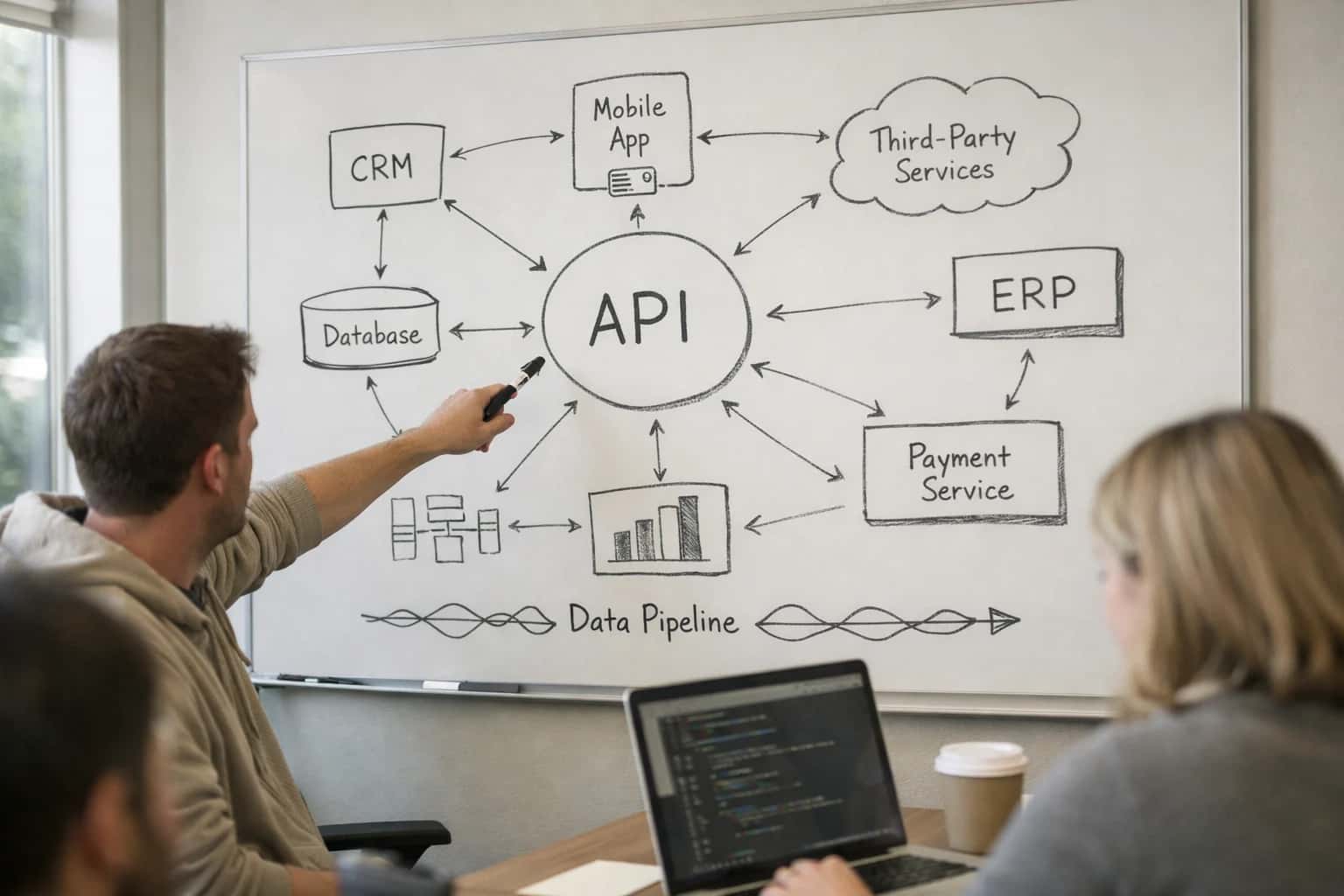
ARCHITECTURE & ROLLOUT
Beyond Basic Routing: AI-Enhanced Scheduling for Jobber
How to move from static schedules to dynamic, AI-optimized daily plans that consider real-world constraints.
Implementation typically involves a lightweight microservice that subscribes to Jobber's job.created, job.updated, and visit.assigned webhooks. This service runs the optimization model (often a constraint-satisfaction algorithm) and pushes the revised schedule back to Jobber as updated visit records with adjusted scheduled_start_at and scheduled_end_at times. For dispatchers, the new schedule can be visualized in a custom dashboard or surfaced as actionable suggestions directly within Jobber's dispatch board via a custom field or sidebar app. The impact is operational: reducing average drive time by 15-25%, increasing daily job capacity by 1-2 visits per technician, and providing customers with more accurate, dynamic ETAs.
Rollout should be phased, starting with a pilot team. Governance is critical: the AI's schedule changes should be logged as Notes on the job for auditability, and a human-in-the-loop approval step can be maintained for the first few weeks. Dispatchers need clear override controls. The system must also handle exceptions gracefully—like a technician calling in sick—by triggering a re-optimization for the remaining team. This approach turns Jobber from a record-keeping system into an intelligent operations co-pilot, making the most of your most constrained resource: technician time. For a deeper look at integrating AI directly into the mobile experience for field crews, see our guide on AI Integration with Jobber Mobile App.
INTEGRATION SURFACES
Where AI Connects to Jobber's Scheduling Engine
The Scheduling API & Webhooks
Jobber's REST API provides the primary integration surface for injecting AI-driven logic into the scheduling lifecycle. Key endpoints include GET /jobs to retrieve the day's schedule with technician and location data, and PATCH /jobs/{id} to update job statuses, notes, or assigned resources.
AI models connect here to:
- Ingest the daily schedule for optimization analysis.
- Push dynamic updates back to Jobber, such as revised time blocks or reassigned technicians.
- Listen via webhooks (e.g.,
job.created,job.updated) to trigger real-time AI re-optimization when a job is added, canceled, or runs long.
This API-first approach allows an external AI service to act as a dynamic scheduling layer, reading from and writing to Jobber without disrupting the core user experience for dispatchers.
BEYOND BASIC MILEAGE
High-Value AI Routing Use Cases for Jobber
Jobber's built-in routing provides a foundation, but AI can transform it into a dynamic, predictive engine. These use cases show where to connect intelligence to optimize schedules, reduce drive time, and improve first-time fix rates.
01
Dynamic Daily Dispatch with Real-Time Constraints
Integrate an AI scheduler that ingests Jobber's daily job list, technician locations (via mobile app), and real-time constraints like traffic, weather, and job priority. The system recommends an optimized dispatch sequence, pushing assignments directly to the Jobber dispatch board or technician apps. Operational value: Reduces manual juggling for dispatchers and cuts average drive time by 15-25%.
Hours -> Minutes
Dispatch planning
02
Predictive Travel Buffer & Job Duration
Connect AI models to Jobber's historical job data to predict accurate job durations and required travel buffers. Use this to auto-adjust calendar blocks in Jobber's scheduling module, preventing overbooking and creating realistic technician days. Operational value: Increases on-time arrivals and reduces technician burnout from consistently running behind.
Batch -> Real-time
Schedule accuracy
03
Intelligent Break & Compliance Scheduling
Augment Jobber's scheduling with AI that factors in mandatory breaks, certifications needed for specific jobs, and local labor regulations. The system intelligently slots breaks between jobs based on location and travel time, ensuring compliance. Operational value: Mitigates compliance risk and optimizes technician well-being without sacrificing job density.
Manual -> Automated
Compliance checks
04
Multi-Day, Multi-Technician Territory Optimization
For businesses covering large areas, implement AI that plans routes across multiple days and technicians. It clusters jobs by geographic zone and technician specialty across the week, balancing workloads. Results sync to Jobber's future schedules. Operational value: Maximizes territory coverage, reduces fuel costs, and improves customer density in service areas.
1 sprint
Implementation scope
05
AI-Powered Rescheduling & Exception Handling
Build an AI agent that monitors Jobber for same-day cancellations, urgent add-ons, or delays. It automatically evaluates the optimal reshuffle—reassigning nearby standby jobs or pushing less urgent work—and proposes changes via the Jobber API. Operational value: Maintains schedule efficiency despite daily disruptions, protecting revenue and technician utilization.
Same day
Impact visibility
06
Proactive Customer ETA & Communication
Integrate AI routing outputs with Jobber's customer communication features. As routes are optimized, the system automatically triggers personalized SMS or email updates via Jobber with accurate, dynamic ETAs. Operational value: Drastically reduces "where's my tech?" calls and improves customer satisfaction scores directly linked to communication.
100+ messages/day
Automated comms
JOBBER INTEGRATION PATTERNS
Example AI-Driven Routing Workflows
These workflows illustrate how to augment Jobber's scheduling and dispatch capabilities with AI that considers real-world constraints like traffic, technician skill, job priority, and parts availability. Each pattern connects to Jobber's API to read schedules and update assignments.
Trigger: Dispatcher logs in each morning or a significant new job is added.
Context Pulled:
- Today's scheduled jobs from Jobber (
Jobobjects withscheduled_date,customer_address,estimated_duration). - Assigned technician details (
Userobjects withskill_tags,home_addressfor start point). - Real-time traffic conditions from a service like Google Maps Distance Matrix API.
AI/Agent Action:
- An AI agent ingests the job list and technician data.
- It models the day as a vehicle routing problem (VRP), using traffic-aware travel times.
- The agent respects hard constraints: technician skill match, job time windows (if in Jobber), and estimated job duration.
- It outputs an optimized sequence of jobs for each technician, minimizing total drive time while balancing workload.
System Update:
- The optimized schedule is presented to the dispatcher in a side-by-side comparison with the original.
- Upon approval, the integration calls Jobber's API to update the
scheduled_dateandassigned_touser on each Job, effectively re-sequencing the day.
Human Review Point: Dispatcher reviews the proposed changes, especially for jobs with customer-specific time requests, before applying the update.
BUILDING A HYBRID ROUTING LAYER
Implementation Architecture: Data Flow & System Design
A practical blueprint for connecting an AI routing engine to Jobber's core scheduling APIs to optimize daily technician routes.
The integration architecture operates as a hybrid scheduling layer that sits between Jobber's dispatch console and its underlying data. It works by pulling key data objects via the Jobber API—specifically jobs, clients, visits, and users (technicians)—each morning or in real-time. This data is enriched with external context like live traffic from Google Maps, weather forecasts, and historical job duration data. The AI engine then processes this combined dataset, applying constraints like technician skill certifications, required tools, job priority (from Jobber's tags or custom fields), and legally mandated break windows to generate an optimized sequence and schedule.
The optimized schedule is pushed back into Jobber not as a wholesale replacement, but as intelligent recommendations via the API, creating or updating visits with proposed start times and travel buffers. Dispatchers review these suggestions within the familiar Jobber interface, maintaining human oversight. For dynamic re-optimization, the system can listen for webhook events from Jobber (e.g., job.cancelled, visit.running_late) to trigger a re-calculation. The resulting routes typically reduce total drive time by 15-25%, increase jobs per day, and improve on-time arrival rates, directly impacting fuel costs and customer satisfaction.
Rollout is phased, starting with a pilot group of technicians. Governance is critical: all AI-generated schedule changes are logged in an audit trail linked to the Jobber job_id. The system includes a fallback to Jobber's native scheduling if the AI service is unavailable. For teams using Jobber's GraphQL API, the integration can be built to fetch and update data more efficiently, minimizing sync latency. This approach ensures the AI augments—rather than disrupts—existing dispatch workflows, providing a clear path to scale. For related patterns on enhancing field communication, see our guide on AI Integration with Jobber Customer Portal.
ARCHITECTURE FOR AI-ENHANCED ROUTING
Code & Integration Patterns
Connecting to Jobber's Data Layer
To feed an AI routing model, you first need to extract the necessary data from Jobber. This typically involves pulling scheduled jobs, technician profiles, and historical performance via the Jobber API. The key objects are jobs, clients, and users (technicians).
A common pattern is to run a scheduled extraction (e.g., nightly or hourly) to build a routing dataset. This includes:
- Job Details: Service address (geocoded), estimated duration, required skills/tools, priority, and any client-specific notes.
- Technician Context: Home base/location, certifications, skill ratings, preferred work areas, and scheduled breaks.
- Historical Data: Past drive times between job locations, actual vs. estimated job duration, and technician efficiency metrics.
This data is then formatted into a structured payload for the routing optimization engine. Ensure your sync handles incremental updates to avoid recalculating the entire schedule unnecessarily.
AI-ENHANCED ROUTING VS. MANUAL DISPATCH
Realistic Time Savings & Operational Impact
This table compares manual dispatch processes in Jobber against an AI-integrated approach, showing realistic improvements in efficiency, cost, and service quality for field service operations.
| Metric | Before AI | After AI | Notes |
|---|---|---|---|
Daily route planning | 45–90 minutes manual drag-and-drop | 5–15 minutes AI-generated draft | AI proposes optimal sequence; dispatcher reviews and adjusts. |
Drive time per technician | 2.5–3.5 hours (varies widely) | 2–2.8 hours (optimized for traffic/breaks) | AI factors real-time traffic, job priority, and technician breaks. |
On-time arrival rate | 75–85% | 88–94% | Fewer delays from better buffer time and dynamic rerouting. |
Fuel cost per truck (monthly) | $450–$650 | $380–$520 | Reduced mileage from efficient clustering and sequence. |
Dispatch exception handling | Reactive phone calls, 10–20 min per issue | Proactive AI alerts, <5 min to reassign | AI flags conflicts (e.g., parts shortage) and suggests alternatives. |
Technician utilization | 5–6 billable hours per day | 5.5–6.5 billable hours per day | AI minimizes gaps and travel between jobs, increasing productive time. |
Customer ETA accuracy | ±60 minute windows | ±30 minute windows | More reliable ETAs from predictive travel time and job duration models. |
Rollout timeline | Pilot: 4–6 weeks, Full rollout: 3–4 months | Pilot: 2–3 weeks, Full rollout: 6–8 weeks | Integration uses Jobber's APIs; impact scales as historical data grows. |
ARCHITECTING A CONTROLLED DEPLOYMENT
Governance, Security, and Phased Rollout
A practical blueprint for implementing AI-enhanced routing in Jobber with proper controls and a low-risk rollout.
Integrating an AI routing engine with Jobber requires a secure, API-first approach. The core pattern involves a middleware service that pulls scheduled jobs, technician locations, and customer addresses from Jobber's Jobs API and Users API. This service, hosted in your cloud, runs the optimization model—considering real-time traffic (via Google Maps), weather forecasts, job priority flags, and configured break rules—then posts the optimized sequence and estimated travel times back to Jobber as custom fields or notes. All data exchanges should use OAuth 2.0, with API keys and model credentials managed in a secrets vault. Audit logs must capture every optimization run, the input parameters, and the resulting schedule change for compliance and debugging.
A phased rollout is critical for user adoption and operational stability. Start with a shadow mode: run the AI optimizer in parallel with your existing dispatch process for a pilot team, displaying its suggested route in a separate dashboard without making live changes in Jobber. This builds trust and provides a baseline. Phase two introduces assisted dispatch: the AI presents its top recommendation within the dispatcher's console, requiring a human to review and approve the changes before syncing to Jobber. The final phase is conditional automation: configure rules (e.g., for non-urgent, same-day jobs) where the AI can automatically update the schedule in Jobber, while exceptions and high-priority jobs still route for human review. This tiered approach balances efficiency gains with dispatcher oversight.
Governance focuses on continuous calibration and bias mitigation. Establish a weekly review to analyze key metrics like driver adherence to the AI route, on-time arrival rates, and technician feedback collected via a simple in-app form. The optimization model's weightings (e.g., cost vs. speed vs. work-life balance) should be adjustable by operations leadership. Implement a fallback switch to instantly revert to manual dispatch if API issues arise or optimization quality degrades. By treating the AI as a co-pilot that enhances, rather than replaces, dispatcher expertise, you ensure the integration drives tangible efficiency—reducing drive time by 10-20% and enabling more jobs per day—while maintaining control over your most critical field operations.
Enabling Efficiency, Speed & Accuracy
Intelligent Analysis, Decision & Execution
We build AI systems for teams that need search across company data, workflow automation across tools, or AI features inside products and internal software.
Talk to Us
Search across company data
Give teams answers from docs, tickets, runbooks, and product data with sources and permissions.
Useful when people spend too long searching or get different answers from different systems.
Enterprise searchRAGPermissions
Read more
Automate internal workflows
Use AI to route work, draft outputs, trigger actions, and keep approvals and logs in place.
Useful when repetitive work moves across multiple tools and teams.
AI agentsWorkflow automationGovernance
Read more
Add AI to products and internal tools
Build assistants, guided actions, or decision support into the software your team or customers already use.
Useful when AI needs to be part of the product, not a separate tool.
AI integrationDecision supportModel routing
Read moreIMPLEMENTATION & WORKFLOW
Frequently Asked Questions
Practical questions for technical teams planning to integrate AI-driven route optimization with Jobber's scheduling and dispatch workflows.
The integration typically uses Jobber's REST API to pull live data and push optimized schedules. A common architecture involves:
- Trigger: A scheduled cron job (e.g., every 15 minutes) or a webhook from Jobber when a new job is created or a status changes.
- Context Pulled: The system fetches:
- Today's and tomorrow's scheduled
visits(jobs) with their addresses, estimated duration, priority, and required skills. - Active
crew members(technicians) with their current location (from mobile app), skill certifications, and work hours. - Any
visitconstraints like customer time windows or required parts flagged in custom fields.
- Today's and tomorrow's scheduled
- AI Action: This payload is sent to an AI routing engine (like Google OR-Tools, a custom model, or a third-party service like Routific). The model considers live traffic, weather APIs, and business rules to calculate the most efficient sequence.
- System Update: The optimized schedule is posted back to Jobber via the API, updating the
scheduled_dateandassigned_tofields for each visit. Technicians receive updated routes in their Jobber Go app. - Human Review: Dispatchers can review the AI-suggested changes in Jobber's schedule view and manually override any assignments before finalizing.

About the author
Prasad Kumkar
CEO & MD, Inference Systems
Prasad Kumkar is the CEO & MD of Inference Systems and writes about AI systems architecture, LLM infrastructure, model serving, evaluation, and production deployment. Over 5+ years, he has worked across computer vision models, L5 autonomous vehicle systems, and LLM research, with a focus on taking complex AI ideas into real-world engineering systems.
His work and writing cover AI systems, large language models, AI agents, multimodal systems, autonomous systems, inference optimization, RAG, evaluation, and production AI engineering.
LinkedIn
Limited slotsGet a Free AI Consultation
Partnered with leading AI, data, and software stack.





How We Work
Custom AI workflows for your Business
One-fit-all AI don't work for modern businesses. At Inferensys, we aim to understand your business & custom requirements; which we use to define most efficient agentic workflows, the data, and the tools for your business.
01
Review the use case
We understand the task, the users, and where AI can actually help.
Read more02
Pick the right approach
We define what needs search, automation, or product integration.
Read more03
Build the first useful version
We implement the part that proves the value first.
Read more04
Improve from there
We add the checks and visibility needed to keep it useful.
Read moreThe first call is a practical review of your use case and the right next step.
Talk to Us