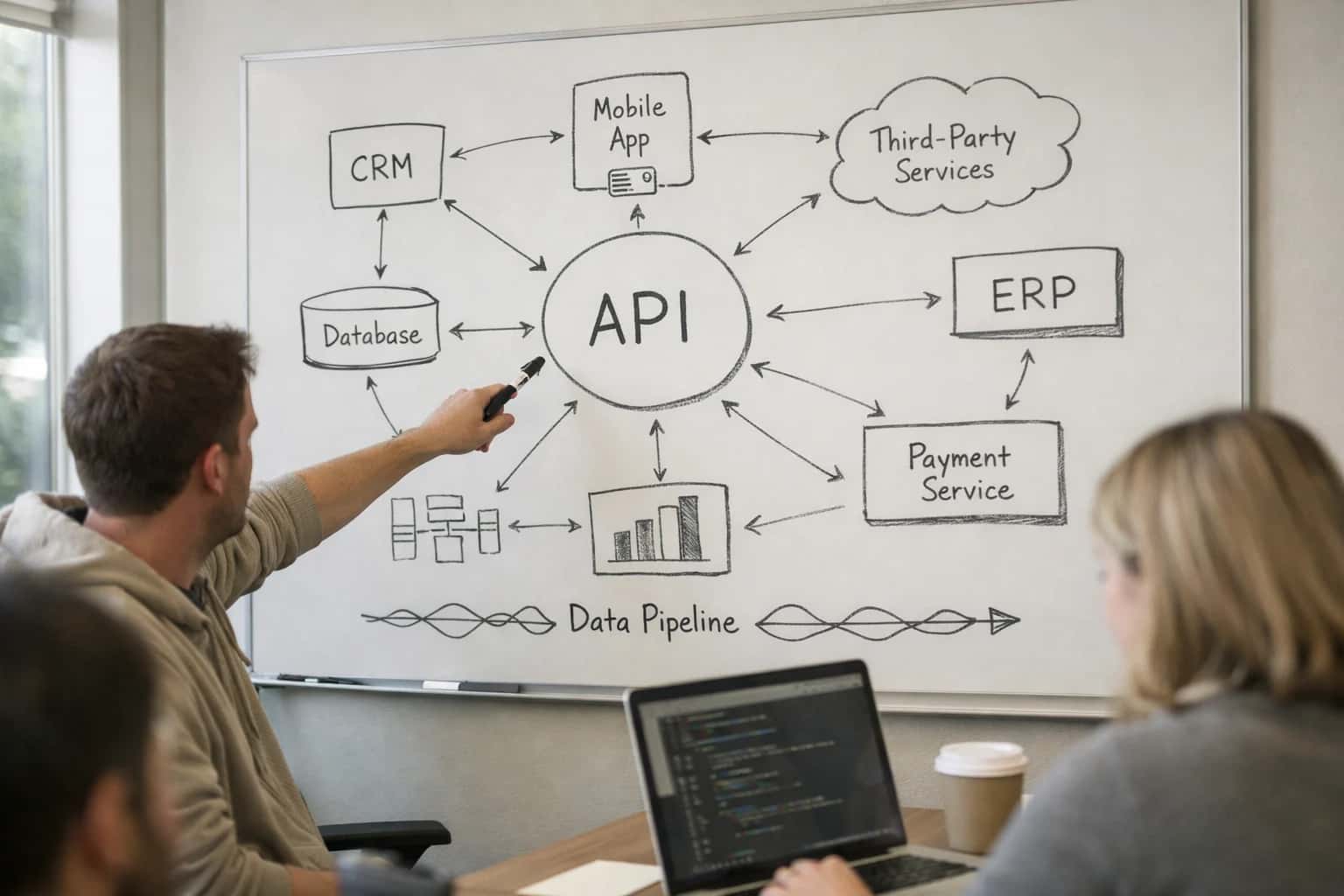
The integration connects two core data models: Zuper's Work Orders, Customers, and Service History with HubSpot's Contacts, Companies, and Deals. AI acts as the orchestration layer, listening for events via webhooks from Zuper's customer portal or completed jobs. When a new service request is submitted or a job is closed, the AI agent evaluates the context—such as job type, customer spend history, and request sentiment—to qualify the lead in HubSpot, score it, and assign it to the appropriate sales or account management queue. This closes the loop between one-off service transactions and long-term customer relationship management.

Integration
AI Integration for Zuper HubSpot
A technical blueprint for connecting Zuper's field service platform to HubSpot CRM with AI logic to automate lead qualification, personalize follow-ups, and calculate service-driven customer lifetime value.
ARCHITECTURE BLUEPRINT
Where AI Fits Between Field Service and CRM
A technical blueprint for integrating AI between Zuper's field service operations and HubSpot's CRM to automate lead qualification, enhance customer follow-ups, and calculate lifetime value.
Implementation typically involves a middleware service (like an Inference Systems agent) that subscribes to Zuper's workorder.created and invoice.paid webhooks. The agent enriches this data by querying Zuper's API for full job details and customer history, then uses a configured LLM to analyze intent and value. Based on rules (e.g., a high-value repeat customer requesting a new service line), the agent creates or updates a HubSpot Contact, links a Company record, and initiates a Deal with a probability score. It can also trigger a HubSpot workflow to send a personalized follow-up email or schedule a call, using job specifics to craft relevant messaging.
For governance, the integration should log all AI decisions and data payloads for audit. A human-in-the-loop approval step can be configured for high-value lead creation or unusual patterns. Rollout is best phased: start with read-only sync to build a unified customer view, then activate automated lead scoring for new portal submissions, and finally implement proactive outreach workflows for customers with expiring service contracts or high lifetime value scores calculated from Zuper's historical data.
A TECHNICAL BLUEPRINT FOR SERVICE-TO-MARKETING AUTOMATION
Key Integration Surfaces in Zuper and HubSpot
Synchronizing the 360-Degree View
The core integration surface is the bi-directional sync of customer profiles between Zuper's Customer 360 and HubSpot's Contact and Company objects. AI logic determines which system is the source of truth for specific fields.
Key Data Flows:
- Zuper → HubSpot: Service history, asset lists, average ticket value, and recent job satisfaction scores enrich HubSpot contact properties. This creates marketing segments like "high-value HVAC customers" or "customers with aging water heaters."
- HubSpot → Zuper: Marketing engagement data (email opens, website visits, form submissions) and lead source information populate custom fields in Zuper. This allows dispatchers to prioritize "hot leads" or service teams to understand a customer's journey before arriving on-site.
AI Governance: Implement deduplication logic and conflict resolution rules (e.g., service address from Zuper overrides mailing address from HubSpot) to maintain a clean, unified record.
INTEGRATION BLUEPRINT
High-Value AI Use Cases for Zuper-HubSpot
Connect Zuper's field service operations to HubSpot's marketing and sales engine with AI logic. This blueprint details where to inject intelligence to qualify leads, automate follow-ups, and report on customer lifetime value from service interactions.
01
Automated Lead Qualification from Service Portal
Use AI to analyze service requests submitted through the Zuper customer portal. Classify intent, predict potential upsell value (e.g., a request for AC repair could indicate an old system), and automatically create or score a lead in HubSpot with relevant tags and notes.
Batch -> Real-time
Lead routing
02
Intelligent Post-Service Nurture Sequences
Trigger personalized HubSpot email sequences based on AI analysis of the completed Zuper work order. For example, after a furnace tune-up, automatically send maintenance tips and a discount on a humidifier install. The AI determines the optimal message and timing based on job type and customer history.
Same day
Personalized follow-up
03
Service-Driven Customer Lifetime Value Reporting
Build an AI-powered dashboard that unifies Zuper service revenue, frequency, and parts data with HubSpot deal history. The model segments customers by predicted lifetime value, identifying high-value service clients for targeted sales outreach and at-risk accounts for retention campaigns.
1 sprint
Insight deployment
04
AI-Powered Dispatcher & Sales Handoff
When a Zuper dispatcher identifies a sales opportunity (e.g., a customer needs a full system replacement), an AI agent summarizes the job context, technician notes, and recommended next steps, then creates a high-priority task for a sales rep in HubSpot with all relevant data pre-attached.
Hours -> Minutes
Internal coordination
05
Dynamic Customer Profile Enrichment
Continuously sync key service attributes from Zuper to the corresponding HubSpot contact record. Use AI to extract and summarize trends from service history—like frequent repair types, average invoice value, and responsiveness to communications—creating a 360-degree view for marketing and sales teams.
06
Marketing Campaign Attribution to Service Revenue
Implement AI logic to trace which HubSpot marketing campaigns (e.g., a 'Spring HVAC Check' email) lead to service bookings in Zuper. The model attributes revenue back to campaigns, providing clear ROI for marketing spend and informing future campaign targeting based on actual service conversion data.
ZUPER + HUBSPOT INTEGRATION PATTERNS
Example AI-Enhanced Workflows
These workflows illustrate how to connect Zuper's field service data to HubSpot's CRM with AI logic, automating lead qualification, customer follow-up, and lifetime value reporting.
Trigger: A new service request is submitted through the Zuper customer portal for a non-contract customer.
AI Action & Context:
- An integration service (e.g., n8n, Make) captures the request payload and enriches it with AI.
- The AI agent analyzes the request text, customer history (from Zuper), and property data (if available) to assess:
- Urgency and potential for emergency pricing.
- Job complexity and estimated value.
- Likelihood of converting to a recurring maintenance contract.
- The agent generates a lead score and a summary, tagging the request with labels like
High-Value HVAC RepairorRoutine Plumbing Maintenance.
System Update:
- The enriched lead data is posted to HubSpot via the Contacts and Deals API.
- A new Deal is created in HubSpot, linked to the contact, with the AI-generated score, summary, and value estimate populating custom properties.
- A HubSpot workflow automatically routes the deal to the appropriate sales queue based on the score and tags.
Human Review Point: The sales team reviews the AI-scored deal in HubSpot, using the summary to prioritize calls, rather than starting from a blank form.
BUILDING A PRODUCTION PIPELINE
Implementation Architecture: Data Flow and Guardrails
A secure, governed data flow is critical for connecting Zuper's service operations to HubSpot's marketing and sales engine with AI.
The core integration architecture establishes a bi-directional sync between Zuper's Jobs, Customers, and Invoices objects and HubSpot's Contacts, Companies, and Deals pipelines. AI logic is injected at key hand-off points using a middleware layer (like a secure cloud function or n8n workflow) that orchestrates the flow. For example, when a new Job is marked "Complete" in Zuper, the integration triggers an AI agent to analyze the work order details, customer history, and invoice total. This agent then decides whether to: 1) create a new Deal in HubSpot for a potential upsell (e.g., a maintenance plan), 2) update the contact's Lead Status based on satisfaction signals, or 3) add the contact to a "Service Champion" list for a referral campaign. All data moves via secure, authenticated API calls, with idempotent keys to prevent duplicates.
To ensure quality and compliance, the pipeline includes several guardrails:
- Pre-sync Data Validation: AI checks incoming Zuper data for completeness (e.g., customer email, job type) before allowing a sync to HubSpot, flagging incomplete records for human review.
- PII Scrubber: Before any data is sent to an LLM (like OpenAI or Anthropic) for analysis, a separate process redacts sensitive fields (e.g., credit card notes from job descriptions).
- Approval Gates: For high-value actions—like creating a
Dealover a certain amount or changing aLead Score—the workflow can be configured to pause and require manager approval in Slack or via email. - Audit Logging: Every AI decision, data point synced, and workflow trigger is logged to a separate audit database, creating a traceable lineage for compliance and debugging.
Rollout is typically phased, starting with a read-only sync to populate HubSpot with clean service history. The AI logic is then introduced in a "human-in-the-loop" mode, where its recommendations are presented to a sales or marketing operator for a week to build trust and tune prompts. Finally, full automation is enabled for high-confidence, low-risk workflows, like automated NPS follow-up emails or adding service tags to HubSpot contact profiles. This controlled approach minimizes disruption while delivering incremental value from unified customer lifetime data. For a deeper look at connecting field service data to CRM systems, see our guide on AI Integration for Salesforce Field Service CRM.
INTEGRATION PATTERNS
Code and Payload Examples
Inbound Webhook from HubSpot to Zuper
When a new lead is created in HubSpot, a webhook triggers an AI agent to qualify it for service. The agent analyzes the lead's description, property details, and source to determine urgency and job type, then creates a preliminary work order in Zuper if qualified.
Example JSON Payload from HubSpot to Your AI Endpoint:
json{ "event": "lead.created", "objectId": "123456", "properties": { "company": "Acme Corp", "firstname": "Jane", "lastname": "Doe", "email": "[email protected]", "phone": "555-1234", "hs_lead_status": "NEW", "service_request": "HVAC unit not cooling in the 2nd-floor office. It's making a rattling noise.", "property_address": "123 Main St", "property_type": "Commercial", "source": "Website Form" } }
Your AI service processes this payload, classifies the job (e.g., HVAC Repair), scores urgency based on keywords (not cooling, commercial), and returns a structured payload to create a Zuper job.
ZUPER + HUBSPOT AI INTEGRATION
Realistic Time Savings and Business Impact
How connecting Zuper's field service data to HubSpot's CRM with AI logic transforms lead-to-service operations.
| Workflow / Metric | Before AI Integration | After AI Integration | Implementation Notes |
|---|---|---|---|
Lead qualification from service portal | Manual review by sales or CS rep | AI-assisted scoring & routing | AI analyzes service history & request urgency; human approves final assignment |
New customer onboarding follow-up | Generic email sequence, 1-2 days later | Personalized, triggered comms within hours | AI drafts messages based on initial service request & technician notes |
Service-to-sales opportunity identification | Quarterly manual report review | Weekly automated alerts on high-LTV signals | AI monitors completed jobs, repeat service, and positive feedback in Zuper |
Customer lifetime value reporting | Manual spreadsheet consolidation, monthly | Automated dashboard with predictive trends | AI syncs Zuper job revenue & costs to HubSpot contact & company records |
Post-service review request | Batched email blast to all customers | Intelligent, timed send based on job sentiment | AI triggers request after positive job closure, skips after negative feedback |
Marketing list segmentation for service clients | Static lists based on service type | Dynamic lists based on predicted needs & value | AI scores customers for cross-sell campaigns (e.g., PM plans) |
Data sync & hygiene between systems | Scheduled nightly sync, manual error checks | Continuous sync with AI validation & correction | AI flags mismatched IDs, duplicates, and missing required fields |
ARCHITECTING A CONTROLLED, SECURE INTEGRATION
Governance, Security, and Phased Rollout
A blueprint for implementing AI between Zuper and HubSpot with enterprise-grade controls and a low-risk rollout strategy.
A production-grade integration must respect the security and data models of both platforms. For Zuper, this means securing access to its REST APIs for jobs, customers, and invoices. For HubSpot, it involves managing OAuth tokens for the Contacts, Companies, Deals, and Timeline Events APIs. The core AI logic—which qualifies leads, triggers follow-ups, and calculates lifetime value—should run in a secure middleware layer (like an Inference Systems-managed service) that acts as a policy engine. This layer enforces role-based access, logs all AI decisions and data movements for audit trails, and ensures no PII is sent to LLM APIs without proper anonymization or customer consent flags checked in both systems.
A phased rollout mitigates risk and demonstrates value incrementally. Phase 1 could focus on a single, high-impact workflow: automatically creating a HubSpot Contact and Deal when a high-value service job is completed in Zuper, with an AI-generated summary of the work for the sales team. Phase 2 introduces bi-directional intelligence: using the integrated customer profile to power an AI agent in the Zuper customer portal that can answer billing questions by retrieving data from HubSpot invoices. Phase 3 operationalizes the full vision, with automated, AI-scored lead lists from the service portal feeding personalized HubSpot marketing campaigns, and closed-loop reporting on service-to-sales conversion rates visible in both dashboards.
Governance is critical for maintaining trust. Implement a human-in-the-loop approval step for any AI-generated communication before it's sent to a customer. Use the Timeline Events API in HubSpot to create an immutable record of every AI action taken, linking back to the source Zuper job ID. Regularly evaluate the AI's lead-scoring accuracy and follow-up content against business outcomes, using these metrics to fine-tune prompts and retrain models. This controlled approach ensures the integration enhances operations without introducing unmanaged risk, turning your field service data into a compliant, scalable growth engine. For related architectural patterns, see our guides on AI Integration for Zuper CRM and AI Integration with Jobber HubSpot.
Enabling Efficiency, Speed & Accuracy
Intelligent Analysis, Decision & Execution
We build AI systems for teams that need search across company data, workflow automation across tools, or AI features inside products and internal software.
Talk to Us
Search across company data
Give teams answers from docs, tickets, runbooks, and product data with sources and permissions.
Useful when people spend too long searching or get different answers from different systems.
Enterprise searchRAGPermissions
Read more
Automate internal workflows
Use AI to route work, draft outputs, trigger actions, and keep approvals and logs in place.
Useful when repetitive work moves across multiple tools and teams.
AI agentsWorkflow automationGovernance
Read more
Add AI to products and internal tools
Build assistants, guided actions, or decision support into the software your team or customers already use.
Useful when AI needs to be part of the product, not a separate tool.
AI integrationDecision supportModel routing
Read moreIMPLEMENTATION BLUEPRINT
Frequently Asked Questions
Practical questions for service leaders and RevOps teams planning to connect Zuper's field service data with HubSpot's marketing and sales automation using AI.
The AI agent analyzes multiple signals from Zuper to score and segment customers for HubSpot campaigns:
- Trigger: A service job is marked
Completedin Zuper. - Context Pulled: The agent retrieves the customer's Zuper record, including:
- Service history (frequency, job types, average ticket value)
- Asset list and age (e.g., HVAC unit installed 7 years ago)
- Customer satisfaction score (CSAT) from post-service surveys
- Contract status (e.g., preventive maintenance plan active)
- AI Action: A model evaluates this data against rules to assign a HubSpot Lifecycle Stage and Lead Score.
- High-Value Example: Customer with high spend, older assets, and an expiring contract →
Lifecycle Stage: Opportunity,Lead Score: 85. Triggers a HubSpot workflow for a "Contract Renewal & Upgrade" campaign. - Retention Example: Customer with declining service frequency and low CSAT →
Lifecycle Stage: Lead,Lead Score: 40. Triggers a "Check-in & Special Offer" nurturing sequence.
- High-Value Example: Customer with high spend, older assets, and an expiring contract →
- System Update: The agent uses the HubSpot API to create/update the contact, apply the lifecycle stage, score, and relevant contact properties (e.g.,
Last_Service_Date,Primary_Asset_Age). - Human Review Point: Marketing managers can review the AI-scored segment in a HubSpot list before campaigns are launched.

About the author
Prasad Kumkar
CEO & MD, Inference Systems
Prasad Kumkar is the CEO & MD of Inference Systems and writes about AI systems architecture, LLM infrastructure, model serving, evaluation, and production deployment. Over 5+ years, he has worked across computer vision models, L5 autonomous vehicle systems, and LLM research, with a focus on taking complex AI ideas into real-world engineering systems.
His work and writing cover AI systems, large language models, AI agents, multimodal systems, autonomous systems, inference optimization, RAG, evaluation, and production AI engineering.
LinkedIn
Limited slotsGet a Free AI Consultation
Partnered with leading AI, data, and software stack.





How We Work
Custom AI workflows for your Business
One-fit-all AI don't work for modern businesses. At Inferensys, we aim to understand your business & custom requirements; which we use to define most efficient agentic workflows, the data, and the tools for your business.
01
Review the use case
We understand the task, the users, and where AI can actually help.
Read more02
Pick the right approach
We define what needs search, automation, or product integration.
Read more03
Build the first useful version
We implement the part that proves the value first.
Read more04
Improve from there
We add the checks and visibility needed to keep it useful.
Read moreThe first call is a practical review of your use case and the right next step.
Talk to Us