AI integration connects to Granular's core data model—Fields, Crops, Inputs, Activities, and Financial Transactions—through its APIs and data warehouse. The primary surfaces for AI are the Planning and Analysis modules, where economic scenarios are built and evaluated. AI agents act as a co-pilot layer, ingesting this structured operational data alongside external market feeds, weather forecasts, and historical yield maps to generate probabilistic forecasts for ROI, cash flow, and whole-farm profitability.

Integration
AI Integration with Granular Farm Economics
Technical blueprint for connecting AI models to Granular's economic planning modules to automate ROI analysis, investment appraisal, and whole-farm profitability optimization.
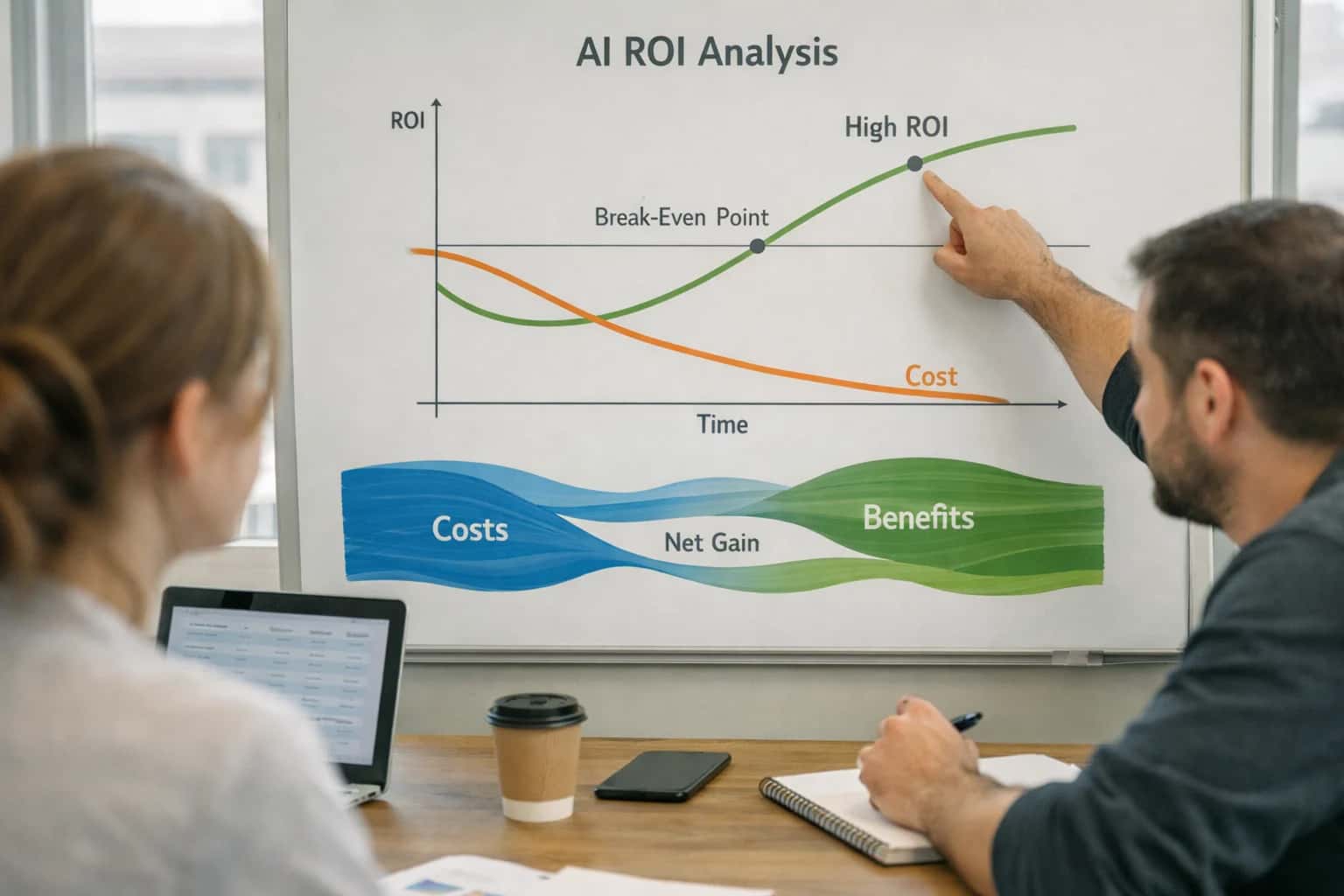
ARCHITECTURE FOR ENTERPRISE-LEVEL DECISION SUPPORT
Where AI Fits into Granular's Economic Planning
Integrating AI into Granular's farm business platform transforms static financial records into dynamic, predictive economic models.
Implementation typically involves a secure middleware layer that subscribes to Granular's event webhooks (e.g., new field activity logged, input purchase recorded) and uses this to trigger AI model runs. For example, an AI model for investment appraisal can be called when a user evaluates a new equipment purchase in Granular's capital planning tool. The agent retrieves the relevant field histories, current lease rates, and fuel price trends, then returns a net present value analysis and sensitivity table directly back into the planning interface via a custom UI component or enriched data object.
Rollout focuses on augmenting, not replacing, the planner's workflow. Initial use cases include automated budget variance analysis, where AI flags cost line items deviating from plan due to weather or market shifts, and multi-year scenario modeling, where AI rapidly simulates hundreds of combinations of crop mix, input strategy, and contract pricing. Governance is critical: all AI-generated recommendations are stored as versioned Insight records in Granular, tagged with the source data and model version, and require planner review and approval before any financial plan is officially updated, ensuring auditability and human-in-the-loop control.
WHERE AI CONNECTS TO THE FARM BUSINESS PLAN
Key Integration Surfaces in Granular's Economic Modules
Connecting AI to Multi-Year Financial Models
Granular's Enterprise Planning modules are built for complex, multi-entity farm operations. AI integration surfaces here focus on scenario modeling and predictive budgeting. Key API touchpoints include the budget object model, crop plan records, and enterprise hierarchy data.
An AI agent can be triggered to run Monte Carlo simulations on budget variables (e.g., commodity prices, input costs, yield volatility) using historical data and market forecasts. The output updates scenario records within Granular, allowing managers to compare probabilistic outcomes. Integration is typically event-driven: a user requests a new scenario, or a scheduled job runs after a market close. The AI call passes structured budget data (crop mix, acreage, cost centers) and receives updated financial projections (cash flow, ROI, breakeven points) for write-back.
This moves planning from static spreadsheets to dynamic, data-grounded forecasts, enabling same-day re-forecasting instead of quarterly manual updates.
GRANULAR INTEGRATION PATTERNS
High-Value AI Use Cases for Farm Economics
Integrating AI with Granular's farm economics platform moves analysis from reactive reporting to predictive, prescriptive decision support. These patterns connect to Granular's financial data model, planning modules, and reporting surfaces to automate complex modeling and surface hidden insights.
01
Automated ROI Forecasting for Input Decisions
AI agents ingest planned input applications from Granular's Crop Plans and Field Records, then model ROI across multiple price, yield, and weather scenarios. Outputs are written back as Scenario Analyses within the Planning Module, enabling side-by-side comparison of fertilizer, seed, and crop protection investments.
Batch -> Real-time
Analysis speed
02
Whole-Farm Profitability Optimization
An AI optimization engine connects to Granular's Enterprise View, evaluating thousands of combinations of crop mix, land allocation, lease terms, and input strategies against market forecasts and cost projections. It recommends the optimal Profit & Loss structure and generates the supporting Budget and Cash Flow projections automatically.
1 sprint
Implementation timeline
03
Anomaly Detection in Cost-of-Production
Continuously monitors Actuals vs. Budget data in Granular's Financial Reporting. AI flags outliers in input costs, equipment repairs, or custom work by field, crop, or operation. Alerts are pushed to the Activity Feed with root-cause suggestions, prompting immediate review in the Cost Analysis dashboard.
Same day
Issue identification
04
Dynamic Cash Flow Forecasting & Alerting
Extends Granular's native cash flow tools by integrating AI that models variable grain marketing timelines, input payment terms, and operating line draws. The agent updates forecasts weekly, triggering Alerts in the Banking & Finance module for potential shortfalls and recommending hedging or selling actions.
05
AI-Powered Investment Appraisal
For capital expenditure decisions (e.g., new irrigation, grain storage), an AI model evaluates the Capital Projects record in Granular. It performs NPV, IRR, and payback period analysis under multiple financing and commodity price scenarios, auto-generating a lender-ready Investment Memo as a PDF attachment.
06
Automated Benchmarking & Peer Insights
Leverages anonymized, aggregated data (where permitted) to benchmark the operation's Key Performance Indicators against similar farms. An AI synthesizes the analysis into narrative insights within a Benchmarking Report, highlighting top-performing practices and economic gaps for management review.
Hours -> Minutes
Report generation
GRANULAR FARM BUSINESS PLATFORM
Example AI-Powered Economic Workflows
These workflows illustrate how AI agents can be integrated into Granular's economic modules to automate analysis, generate forecasts, and provide decision support. Each flow connects to specific Granular APIs and data objects to drive closed-loop automation.
Trigger: A new bulk input purchase order is created or a quote is uploaded in Granular's procurement module.
Context Pulled: The AI agent retrieves the product SKU, proposed price, application rate, and target field(s). It then fetches:
- Historical yield data for those fields from the
yield_historytable. - Current forward contract or local basis price for the crop from market data APIs.
- Soil test results and recent satellite NDVI for the field to estimate yield potential delta.
Agent Action: A model calculates the expected yield increase (bu/ac) from the input, multiplies by the expected price, and subtracts the product cost and application cost. It generates a probabilistic ROI range and a payback period.
System Update: The analysis is appended as a structured comment to the purchase order in Granular. If the ROI falls below a configurable threshold (e.g., <15%), the agent can:
- Flag the order for manager review.
- Suggest a comparable, lower-cost alternative product from the approved vendor list.
- Automatically route the order through a special approval workflow.
Human Review Point: The farm manager reviews flagged orders in the Granular UI, with the AI's analysis and reasoning displayed side-by-side with the original quote.
FROM DATA TO DECISIONS
Implementation Architecture: Data Flow & System Design
A production-ready blueprint for connecting AI models to Granular's economic data models and workflows.
The integration architecture connects to Granular's core economic objects—Farms, Fields, Crop Plans, Input Applications, and Sales Contracts—via its REST APIs and webhooks. An AI orchestration layer, deployed as a secure microservice, acts as a middleware. It subscribes to key events (e.g., a finalized crop plan, a new sales contract) and pulls the associated financial and operational data. This data is then structured into prompts for specialized AI models focused on ROI simulation, sensitivity analysis, and profitability optimization. The models' outputs—structured recommendations and forecast scenarios—are written back to custom objects in Granular or attached as notes to relevant records, ensuring the insights are contextual and actionable within existing user workflows.
For a whole-farm profitability analysis, the system executes a multi-step agentic workflow: First, a data agent consolidates current-season budgets, historical yields, and forward commodity prices from linked market data feeds. A forecasting agent then runs Monte Carlo simulations, generating probabilistic outcomes for net income under various weather and price scenarios. Finally, an optimization agent evaluates alternative strategies (e.g., shifting acreage, adjusting input levels, forward contracting percentages) and ranks them by risk-adjusted return. All agent reasoning is logged, and key assumptions are stored with the analysis for full auditability and model governance.
Rollout is phased, beginning with read-only analysis and reporting agents that provide 'what-if' modeling in a sandbox environment. Once validated, agents are granted write access to create Scenario records in Granular, allowing side-by-side comparison of AI-generated plans with the operational baseline. Governance is critical: we implement approval gates for any AI-recommended changes to live financial plans and establish a human-in-the-loop review for scenarios exceeding predefined risk thresholds. This architecture ensures AI augments the economic decision-making process within Granular without disrupting established financial controls or data integrity.
ECONOMIC ANALYSIS WORKFLOWS
Code & Payload Examples
API Integration for Predictive ROI
Integrate AI models directly with Granular's economic data layer to generate dynamic ROI forecasts for capital investments like new equipment or land acquisition. The model consumes operational cost history, projected yield uplift, and market price scenarios.
Example Python API Call:
pythonimport requests # Define the investment scenario payload investment_payload = { "farm_id": "farm_12345", "analysis_type": "equipment_roi", "investment_amount": 250000, "asset_type": "self_propelled_sprayer", "inputs": { "projected_acres_treated_annual": 5000, "current_labor_cost_per_acre": 8.50, "projected_labor_savings_pct": 60, "fuel_efficiency_improvement_pct": 15, "financing_terms": {"rate": 5.5, "term_years": 7} }, "granular_data_sources": ["field_ops_logs", "machinery_costs", "fuel_usage"] } # Call the Inference Systems forecasting endpoint response = requests.post( 'https://api.inferencesystems.com/granular/roi-forecast', json=investment_payload, headers={'Authorization': 'Bearer YOUR_API_KEY'} ) # Response includes annual cash flow and key metrics forecast = response.json() print(f"Net Present Value: ${forecast['metrics']['npv']:,.2f}") print(f"Payback Period: {forecast['metrics']['payback_years']} years")
The API returns a multi-year cash flow projection, NPV, IRR, and a confidence interval based on historical volatility, enabling data-driven capital planning within Granular's financial modules.
GRANULAR FARM ECONOMICS
Realistic Time Savings & Business Impact
How AI integration transforms key financial planning and analysis workflows in Granular, moving from manual, reactive processes to proactive, data-driven decision support.
| Metric | Before AI | After AI | Notes |
|---|---|---|---|
ROI Forecast for New Equipment | Days of manual spreadsheet modeling | Hours with AI-generated scenarios | AI pulls historical cost/yield data, runs multiple what-if analyses |
Whole-Farm Profitability Review | Monthly, manual consolidation across modules | Weekly, automated synthesis with narrative insights | AI correlates operational data from fields, inventory, and sales |
Investment Appraisal for Land Lease | Manual comps research and static modeling | Assisted analysis with market data integration | AI enriches internal data with external comps and zoning info |
Input Cost Variance Analysis | Post-season review, manual exception hunting | Real-time anomaly detection and alerts | Flags cost outliers against budget and benchmarks as they occur |
Multi-Year Strategic Scenario Planning | Quarterly, high-effort static models | On-demand, dynamic scenario modeling | AI adjusts assumptions based on real-time commodity prices and weather forecasts |
Budget vs. Actual Reporting | Days to compile and format for stakeholders | Same-day automated report generation | AI synthesizes data, writes executive summaries, and formats outputs |
Capital Allocation Prioritization | Gut-feel based on limited analysis | Data-driven ranking based on predictive ROI | AI scores projects using financial and operational constraints |
ENTERPRISE AI IMPLEMENTATION
Governance, Security & Phased Rollout
A structured approach to deploying AI for farm economics that prioritizes data integrity, financial control, and measurable ROI.
Integrating AI with Granular's economic modules requires a data-first governance layer. This begins by mapping AI inputs to specific Granular objects—Fields, Crops, Input Purchases, Equipment Records, and Sales Contracts—and establishing a unified data pipeline that feeds from Granular's APIs into a secure, versioned vector store. All AI-generated outputs, such as ROI forecasts or investment appraisals, are written back to Granular as annotated records (e.g., a Scenario Analysis object) with clear provenance, linking predictions to the source data and model version used. This creates a full audit trail for financial decisions and regulatory scrutiny.
Security is enforced through role-based access control (RBAC) synced with Granular's permissions. A field manager's AI co-pilot only accesses data for their assigned fields, while a CFO-level agent can run whole-farm profitability models. Sensitive financial predictions are never exposed in raw logs; instead, access is gated behind Granular's existing user management. We implement prompt shielding and output validation to ensure recommendations stay within agronomic and financial guardrails, preventing unrealistic suggestions like negative seeding rates or breaching pre-approved budget constraints.
A phased rollout minimizes risk and builds trust. Phase 1 focuses on read-only analysis, such as an AI agent that reviews historical Enterprise Analysis data to identify top cost drivers or profitability gaps, presenting insights within a new Granular dashboard. Phase 2 introduces assistive writing, where AI drafts narrative summaries for lender reports or board meetings based on live Financial Statements. Phase 3 enables prescriptive workflows, where AI suggests optimal input purchasing timing or land lease decisions, triggering Granular tasks or alerts for manager approval before any system-of-record changes are made. Each phase includes defined success metrics (e.g., reduction in manual analysis hours, improvement in forecast accuracy) measured within Granular's own reporting framework.
Enabling Efficiency, Speed & Accuracy
Intelligent Analysis, Decision & Execution
We build AI systems for teams that need search across company data, workflow automation across tools, or AI features inside products and internal software.
Talk to Us
Search across company data
Give teams answers from docs, tickets, runbooks, and product data with sources and permissions.
Useful when people spend too long searching or get different answers from different systems.
Enterprise searchRAGPermissions
Read more
Automate internal workflows
Use AI to route work, draft outputs, trigger actions, and keep approvals and logs in place.
Useful when repetitive work moves across multiple tools and teams.
AI agentsWorkflow automationGovernance
Read more
Add AI to products and internal tools
Build assistants, guided actions, or decision support into the software your team or customers already use.
Useful when AI needs to be part of the product, not a separate tool.
AI integrationDecision supportModel routing
Read moreIMPLEMENTATION AND WORKFLOW
Frequently Asked Questions
Common technical and operational questions for integrating AI-driven economic analysis into Granular's farm business platform.
The integration connects via Granular's REST APIs and webhooks to access the core data objects required for economic modeling. Key entities include:
- Fields and Land Units: For spatial cost and revenue attribution.
- Crop Plans & Actuals: For planned vs. actual input usage, seeding rates, and chemical applications.
- Input Inventory & Purchases: For real-time cost of goods and inventory valuation.
- Equipment & Labor Records: For operational expense allocation.
- Sales Contracts & Market Data: For projected and realized revenue streams.
A typical data pipeline:
- Authentication: Use OAuth 2.0 with scoped permissions for financial data.
- Extraction: Scheduled or event-driven sync of relevant entities to a secure staging area.
- Enrichment: AI models join this data with external feeds (e.g., futures prices, weather forecasts).
- Processing: Models run calculations for ROI, contribution margin, and whole-farm profitability.
- Write-back: Results are pushed back to custom objects or notes within Granular for user visibility, respecting Granular's data governance and field-level security.

About the author
Prasad Kumkar
CEO & MD, Inference Systems
Prasad Kumkar is the CEO & MD of Inference Systems and writes about AI systems architecture, LLM infrastructure, model serving, evaluation, and production deployment. Over 5+ years, he has worked across computer vision models, L5 autonomous vehicle systems, and LLM research, with a focus on taking complex AI ideas into real-world engineering systems.
His work and writing cover AI systems, large language models, AI agents, multimodal systems, autonomous systems, inference optimization, RAG, evaluation, and production AI engineering.
LinkedIn
Limited slotsGet a Free AI Consultation
Partnered with leading AI, data, and software stack.





How We Work
Custom AI workflows for your Business
One-fit-all AI don't work for modern businesses. At Inferensys, we aim to understand your business & custom requirements; which we use to define most efficient agentic workflows, the data, and the tools for your business.
01
Review the use case
We understand the task, the users, and where AI can actually help.
Read more02
Pick the right approach
We define what needs search, automation, or product integration.
Read more03
Build the first useful version
We implement the part that proves the value first.
Read more04
Improve from there
We add the checks and visibility needed to keep it useful.
Read moreThe first call is a practical review of your use case and the right next step.
Talk to Us