AI integrates directly with Trimble's water monitoring data streams—typically via APIs like the Trimble Ag Software Developer Kit (SDK) or direct MQTT/HTTP ingestion from connected sensors (e.g., YSI, In-Situ, Campbell Scientific). The primary architectural touchpoints are the water quality data objects (dissolved oxygen, pH, temperature, ammonia, nitrates), pond/raceway asset records, and the alert/notification engine. AI acts as a middleware intelligence layer, consuming real-time telemetry and historical logs to predict issues before threshold-based alarms fire.

Integration
AI Integration for Trimble Ag Water Quality Monitoring
A technical blueprint for embedding predictive AI models into Trimble Ag's water monitoring workflows to forecast quality issues and automate corrective actions for ponds, raceways, and recirculating systems.
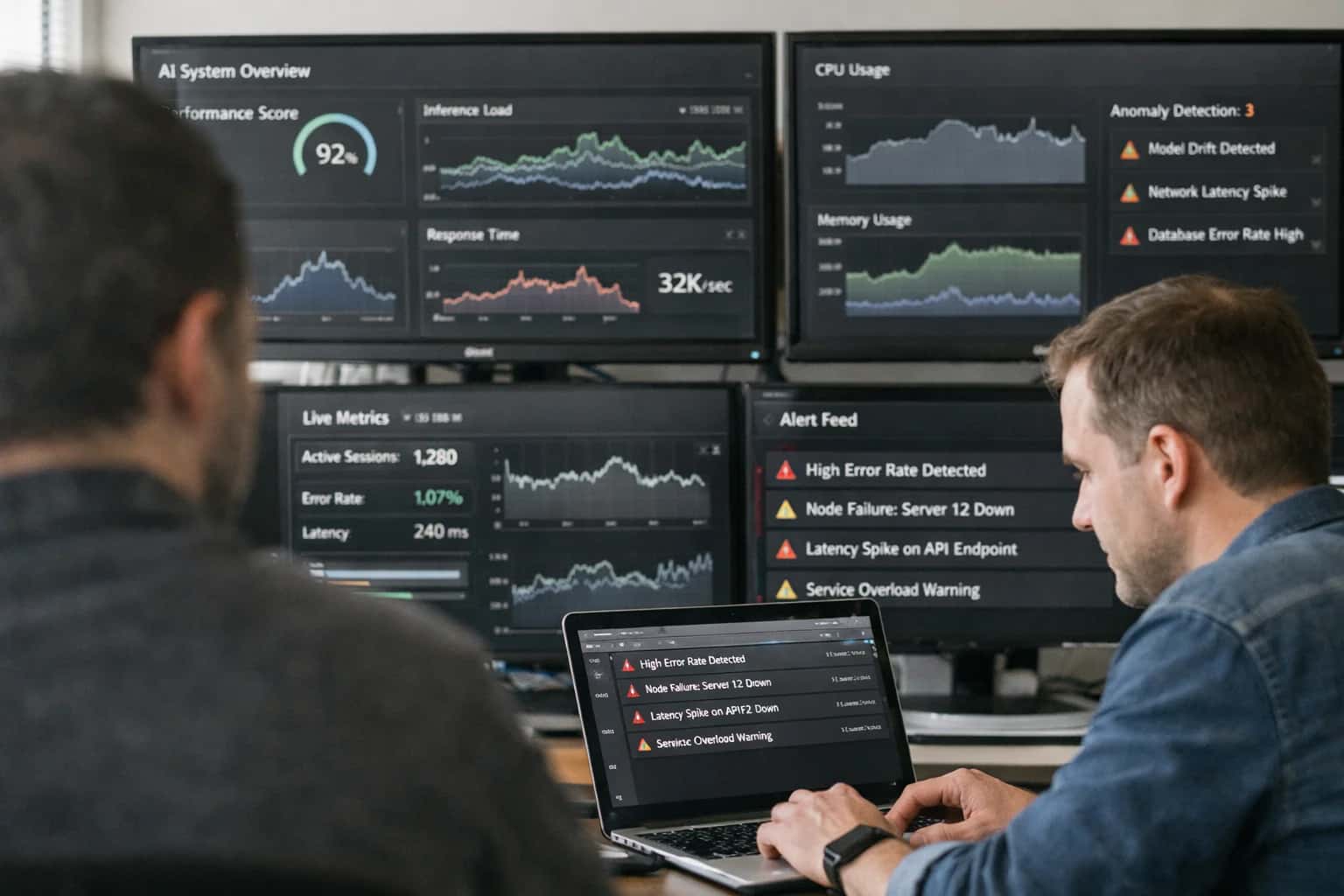
ARCHITECTURE
Where AI Fits in Trimble Ag Water Monitoring
A technical blueprint for integrating predictive AI models with Trimble's sensor networks to automate water quality management.
In a production implementation, a dedicated AI microservice subscribes to sensor data topics. It runs lightweight, containerized models (e.g., LSTM or gradient boosting) that forecast parameters like dissolved oxygen crashes 6-12 hours ahead. When a high-probability event is predicted, the service calls Trimble's Tasks API to create a corrective action work order (e.g., 'Increase aeration in Pond B-12') and/or uses the Messaging API to push a prioritized alert to the farm manager's Connected Farm mobile app. This shifts response from reactive to proactive, aiming to reduce fish stress and mortality.
Rollout requires a phased calibration period where AI predictions are logged alongside actual outcomes to tune model confidence and avoid alert fatigue. Governance is critical: all AI-generated recommendations should be logged in an immutable audit trail linked to the source sensor data and model version. For sensitive actions like chemical dosing, the workflow should include a human-in-the-loop approval step via Trimble's task assignment system before any control system API is called.
ARCHITECTURE BLUEPRINT
Trimble Ag Integration Surfaces for Water Quality AI
Ingesting Real-Time Water Quality Data
Water quality AI models require a reliable stream of sensor data. Trimble Ag's Connected Farm platform can ingest telemetry from a variety of in-pond and in-raceway sensors monitoring parameters like dissolved oxygen (DO), pH, temperature, turbidity, and ammonia.
Key Integration Points:
- Trimble Field-IQ & Display APIs: Pull real-time sensor data logged by field computers during monitoring rounds.
- Third-Party IoT Gateway Webhooks: Configure gateways from sensor providers (e.g., YSI, Sensorex) to push JSON payloads to a designated Trimble webhook endpoint or a middleware service.
- Trimble Data Sync Services: Use scheduled sync jobs to batch import historical water quality logs from external data lakes or lab information systems.
This data layer forms the foundation for predictive models that forecast hypoxic events or ammonia spikes hours in advance.
INTEGRATION PATTERNS FOR TRIMBLE AG
High-Value AI Use Cases for Water Quality
Integrating predictive AI models with Trimble Ag's sensor networks and water management modules enables proactive, data-driven decisions for aquaculture and irrigation. These use cases focus on connecting AI inference to Trimble's data layers and workflow surfaces.
01
Predictive Pond & Raceway Health Scoring
AI models analyze real-time sensor streams (dissolved oxygen, pH, temperature, ammonia) from Trimble-connected devices to predict stress events 12-48 hours in advance. The system generates health scores and alerts within Trimble's monitoring dashboards, allowing managers to intervene before losses occur.
Batch -> Real-time
Alerting cadence
02
Automated Corrective Action Recommendations
When a water quality anomaly is detected, an AI agent cross-references the sensor data with farm records (stocking density, feed logs, weather) to generate grounded remediation steps. These actionable recommendations—like adjusting aeration or scheduling a water exchange—are pushed as tasks into Trimble's Connected Farm task management module.
1 sprint
Typical integration timeline
03
Irrigation Scheduling Optimization
For integrated aquaponics or crop irrigation from pond sources, AI models process water quality data alongside soil moisture and crop stage information. The system outputs optimized irrigation schedules and valve control signals that can be consumed by Trimble's irrigation management APIs, balancing crop needs with pond system stability.
Hours -> Minutes
Schedule generation
04
Regulatory Compliance & Reporting Automation
AI automates the consolidation of water quality data from disparate Trimble-connected sensors into audit-ready compliance reports. It identifies trends, flags parameters nearing regulatory limits, and drafts narrative summaries. Reports are formatted and saved back to Trimble's document storage or pushed to external systems via webhook.
Same day
Report turnaround
05
Feed Response & Waste Prediction
By correlating water quality sensor trends with feeding events logged in Trimble, AI models predict the impact of feed regimens on ammonia and dissolved oxygen levels. This enables prescriptive feeding adjustments to optimize growth while minimizing waste, with insights surfaced in the Trimble operational planning interface.
06
Anomaly Investigation Copilot
An AI assistant embedded within Trimble's platform allows managers to ask natural language questions about water quality events (e.g., 'What caused the DO drop in Pond B yesterday?'). The agent retrieves and synthesizes relevant sensor logs, weather data, and operational records from Trimble's data cloud to provide a concise, evidence-based explanation.
TRIMBLE AG INTEGRATION PATTERNS
Example AI-Driven Water Quality Workflows
These workflows illustrate how AI models connect to Trimble Ag's sensor data and tasking systems to predict water quality issues and automate corrective actions. Each flow is designed to integrate via Trimble's APIs, webhooks, and data models, creating closed-loop intelligence for ponds and raceways.
Trigger: Hourly ingestion of sensor data (DO, temperature, pH) from Trimble's water monitoring module via its REST API.
AI Action:
- A time-series forecasting model analyzes the incoming stream against historical patterns, weather forecasts (pulled via a separate service), and biomass estimates (from feeding logs).
- The model predicts a critical drop in dissolved oxygen below a safety threshold within the next 4-6 hours with >85% confidence.
System Update & Tasking:
- The integration platform posts a high-priority alert to Trimble's connected activity log, tagging the specific water body and including the predicted time and severity.
- Simultaneously, it automatically generates a pre-configured "Emergency Aeration" task in Trimble's task management module. The task includes:
- Assigned equipment (e.g., "Pond 3 Aerator")
- Recommended start time (now)
- Estimated runtime based on the forecast
- A push notification is sent via Trimble's mobile alerting system to the farm manager's device.
Human Review Point: The system logs the prediction, the triggered action, and the subsequent sensor readings. A daily report highlights prediction accuracy, allowing farm managers to fine-tune thresholds and model confidence.
FROM SENSOR TO ACTION
Implementation Architecture: Data Flow & Model Layer
A production-ready architecture for integrating predictive AI models with Trimble Ag's sensor networks and water management workflows.
The integration connects at three key layers within the Trimble Ag ecosystem: the Connected Farm data lake for historical sensor logs, the real-time telemetry API for live pond/raceway data (pH, dissolved oxygen, temperature, ammonia), and the task management module for issuing corrective work orders. Data flows through a secure, event-driven pipeline: sensor readings are ingested, validated, and timestamped before being passed to the hosted AI inference service. The model layer typically consists of an ensemble—a time-series forecasting model (e.g., Prophet or LSTM) to predict parameter drift, and a causal inference model to recommend specific interventions (e.g., aeration timing, water exchange volume, treatment dosage) based on predicted outcomes and operational constraints.
Each prediction triggers a structured payload to Trimble's API, creating a draft 'Water Quality Alert' record with severity, predicted issue, root cause probability, and recommended actions. For high-confidence, high-severity alerts, the system can automatically generate a pre-populated work order in the task module, assigned to the appropriate crew with linked sensor data and step-by-step instructions. All model inputs, outputs, and triggered actions are logged with a full audit trail back to the source sensor IDs, enabling traceability and model performance review. This closed-loop design turns passive monitoring into a proactive management system, aiming to shift response times from reactive hours to preemptive, same-day interventions.
Rollout is phased, starting with a single pond system in monitoring-only mode to establish baseline accuracy and tune alert thresholds. Governance is critical: a human-in-the-loop approval step is maintained for all automated work order creation during the initial pilot, with alerts visible in a dedicated Trimble dashboard for agronomist review. Post-implementation, a feedback loop is established where crew completion notes and subsequent sensor readings are used to retrain and improve the recommendation models. This architecture ensures the AI augments—rather than replaces—existing operator expertise, embedding intelligence directly into the daily water management workflow.
INTEGRATION PATTERNS
Code & Payload Examples
Ingesting & Structuring Telemetry
AI-driven water quality monitoring starts with reliable data ingestion from Trimble's sensor networks. The integration typically involves subscribing to Trimble's data streams (often via MQTT or REST APIs) for parameters like dissolved oxygen, pH, temperature, and turbidity. The payload is then normalized, timestamped, and enriched with location metadata before being routed to an AI inference pipeline.
A key step is structuring this time-series data for model consumption. The example below shows a typical payload after initial processing, ready for anomaly detection or predictive analysis.
json{ "farm_id": "TRIM-FARM-78910", "pond_id": "POND-ALPHA-01",\ "timestamp": "2024-05-15T14:30:00Z", "coordinates": {"lat": 38.8951, "lng": -77.0364}, "readings": { "dissolved_oxygen_mgL": 5.2, "ph": 7.8, "temperature_c": 24.5, "turbidity_ntu": 12.3, "ammonia_mgL": 0.15 }, "sensor_metadata": { "device_id": "TRIM-SEN-4456",\ "calibration_date": "2024-04-01" } }
AI-PREDICTIVE WATER QUALITY MANAGEMENT
Operational Impact: Time Saved & Risk Reduction
How AI integration transforms reactive water quality monitoring into proactive management, reducing labor hours and mitigating stock loss.
| Metric | Before AI | After AI | Notes |
|---|---|---|---|
Water Quality Issue Detection | Manual review of sensor dashboards (daily) | Automated anomaly alerts (real-time) | Alerts trigger via Trimble Ag API/webhook to farm manager |
Corrective Action Recommendation | Consultation with agronomist (2-4 hours) | AI-generated action plan (minutes) | Plan includes dosage calculations, timing, and predicted outcome |
Data Logging & Compliance Reporting | Manual entry into spreadsheets/Trimble (1-2 hours/week) | Automated audit trail generation | AI logs predictions, actions, and outcomes for regulatory and certification needs |
Risk of Critical Water Event | High (reliance on periodic checks) | Moderate to Low (predictive buffer) | AI forecasts trends 12-48 hours out, enabling preemptive adjustments |
Labor for Pond/Raceway Rounds | Physical checks 2-3 times daily | Remote monitoring with targeted checks | Staff dispatched only for AI-flagged verification or corrective tasks |
Response Time to Deteriorating Conditions | Next-day (after visible signs) | Same-day (pre-symptomatic) | Early intervention reduces treatment costs and stress on stock |
Root Cause Analysis for Recurring Issues | Manual correlation of historical logs | AI-powered pattern recognition & correlation | Identifies links between weather, feed, stocking density, and water parameters |
PRODUCTION-READY AI FOR AGRICULTURAL OPERATIONS
Governance, Security & Phased Rollout
A structured approach to deploying AI for water quality monitoring that prioritizes safety, control, and measurable impact.
Integrating AI with Trimble Ag's water monitoring systems requires a secure, governed data pipeline. Our implementation typically establishes a dedicated service layer that ingests sensor data (e.g., dissolved oxygen, pH, temperature, ammonia) from Trimble's APIs or data lake. This data is processed through a vectorization pipeline to create embeddings for anomaly detection models, while raw values feed into predictive time-series models. All AI inferences—such as a predicted oxygen crash or elevated ammonia risk—are written back to a dedicated object or custom table within Trimble Ag, tagged with a confidence score and model version for full auditability. Access to the AI service and its outputs is controlled via Trimble's existing role-based permissions, ensuring only authorized farm managers or consultants can view recommendations and override automated alerts.
A phased rollout is critical for trust and operational refinement. We recommend starting with a silent monitoring phase for 4-6 weeks, where AI models run in parallel with existing processes without triggering any automated actions. During this phase, predictions are logged and compared against actual water quality events to calibrate model accuracy. Phase two introduces human-in-the-loop alerts, where the system generates prioritized notifications within the Trimble Ag dashboard or via integrated email/SMS, requiring a manager's review and manual confirmation before any action is taken. The final phase, guarded automation, enables pre-approved corrective actions—like triggering an aeration system via integrated control APIs—but only for high-confidence predictions and within defined safety parameters. This tiered approach de-risks adoption and builds operator confidence.
Governance extends beyond the model to the entire recommendation lifecycle. We implement a prompt registry and model card for each water quality scenario, documenting the training data, decision boundaries, and known limitations. Every AI-generated recommendation is stored with its source data snapshot, enabling root-cause analysis if a prediction is inaccurate. For compliance-driven operations, this traceability is essential. Furthermore, the system is designed for continuous learning; operator feedback (e.g., marking an alert as 'false positive' or logging an un-predicted event) is captured to create a retraining dataset, ensuring the models adapt to your specific ponds, species, and feed regimens over time.
Enabling Efficiency, Speed & Accuracy
Intelligent Analysis, Decision & Execution
We build AI systems for teams that need search across company data, workflow automation across tools, or AI features inside products and internal software.
Talk to Us
Search across company data
Give teams answers from docs, tickets, runbooks, and product data with sources and permissions.
Useful when people spend too long searching or get different answers from different systems.
Enterprise searchRAGPermissions
Read more
Automate internal workflows
Use AI to route work, draft outputs, trigger actions, and keep approvals and logs in place.
Useful when repetitive work moves across multiple tools and teams.
AI agentsWorkflow automationGovernance
Read more
Add AI to products and internal tools
Build assistants, guided actions, or decision support into the software your team or customers already use.
Useful when AI needs to be part of the product, not a separate tool.
AI integrationDecision supportModel routing
Read moreAI INTEGRATION FOR TRIMBLE AG
Frequently Asked Questions
Common questions about implementing AI-powered water quality monitoring and corrective action workflows within Trimble's Connected Farm ecosystem.
The integration uses Trimble Ag's APIs to pull real-time and historical data from connected water quality sensors (e.g., pH, dissolved oxygen, temperature, ammonia).
Typical data flow:
- Trigger: A scheduled job (e.g., every 15 minutes) calls the Trimble Ag API for the latest readings from designated ponds or raceways.
- Context Enrichment: The payload is enriched with static data (e.g., pond volume, species stocked, feed schedule) from Trimble's farm records.
- Model Inference: The consolidated data is sent to a hosted AI model (e.g., a time-series forecasting model or anomaly detection service).
- Action: The model returns a prediction (e.g., "Dissolved oxygen predicted to fall below 4 mg/L in 3 hours") and a recommended corrective action (e.g., "Increase aeration by 50% for 2 hours").
Key API Endpoints:
GET /api/v1/sensors/{sensorId}/readingsGET /api/v1/locations/{pondId}/detailsPOST /api/v1/actions(to log the AI-recommended action for review or automated execution)

About the author
Prasad Kumkar
CEO & MD, Inference Systems
Prasad Kumkar is the CEO & MD of Inference Systems and writes about AI systems architecture, LLM infrastructure, model serving, evaluation, and production deployment. Over 5+ years, he has worked across computer vision models, L5 autonomous vehicle systems, and LLM research, with a focus on taking complex AI ideas into real-world engineering systems.
His work and writing cover AI systems, large language models, AI agents, multimodal systems, autonomous systems, inference optimization, RAG, evaluation, and production AI engineering.
LinkedIn
Limited slotsGet a Free AI Consultation
Partnered with leading AI, data, and software stack.





How We Work
Custom AI workflows for your Business
One-fit-all AI don't work for modern businesses. At Inferensys, we aim to understand your business & custom requirements; which we use to define most efficient agentic workflows, the data, and the tools for your business.
01
Review the use case
We understand the task, the users, and where AI can actually help.
Read more02
Pick the right approach
We define what needs search, automation, or product integration.
Read more03
Build the first useful version
We implement the part that proves the value first.
Read more04
Improve from there
We add the checks and visibility needed to keep it useful.
Read moreThe first call is a practical review of your use case and the right next step.
Talk to Us