AI integration for Trimble Ag harvest logistics focuses on three primary surfaces: the Connected Farm task engine, vehicle telematics streams, and grain cart/storage inventory APIs. The goal is to create a closed-loop system where AI agents consume real-time data on combine location/yield, truck GPS and weight, bin capacity, and weather forecasts to dynamically optimize the flow of grain from field to storage. This means building agents that sit alongside Trimble's existing dispatch and monitoring dashboards, using their webhooks and REST APIs to ingest events and post optimized recommendations or automated task assignments back into the workflow.

Integration
AI Integration for Trimble Ag Harvest Logistics
A technical blueprint for embedding AI agents into Trimble Ag's logistics workflows to optimize harvest crew dispatch, transportation routing, and storage facility allocation in real-time.
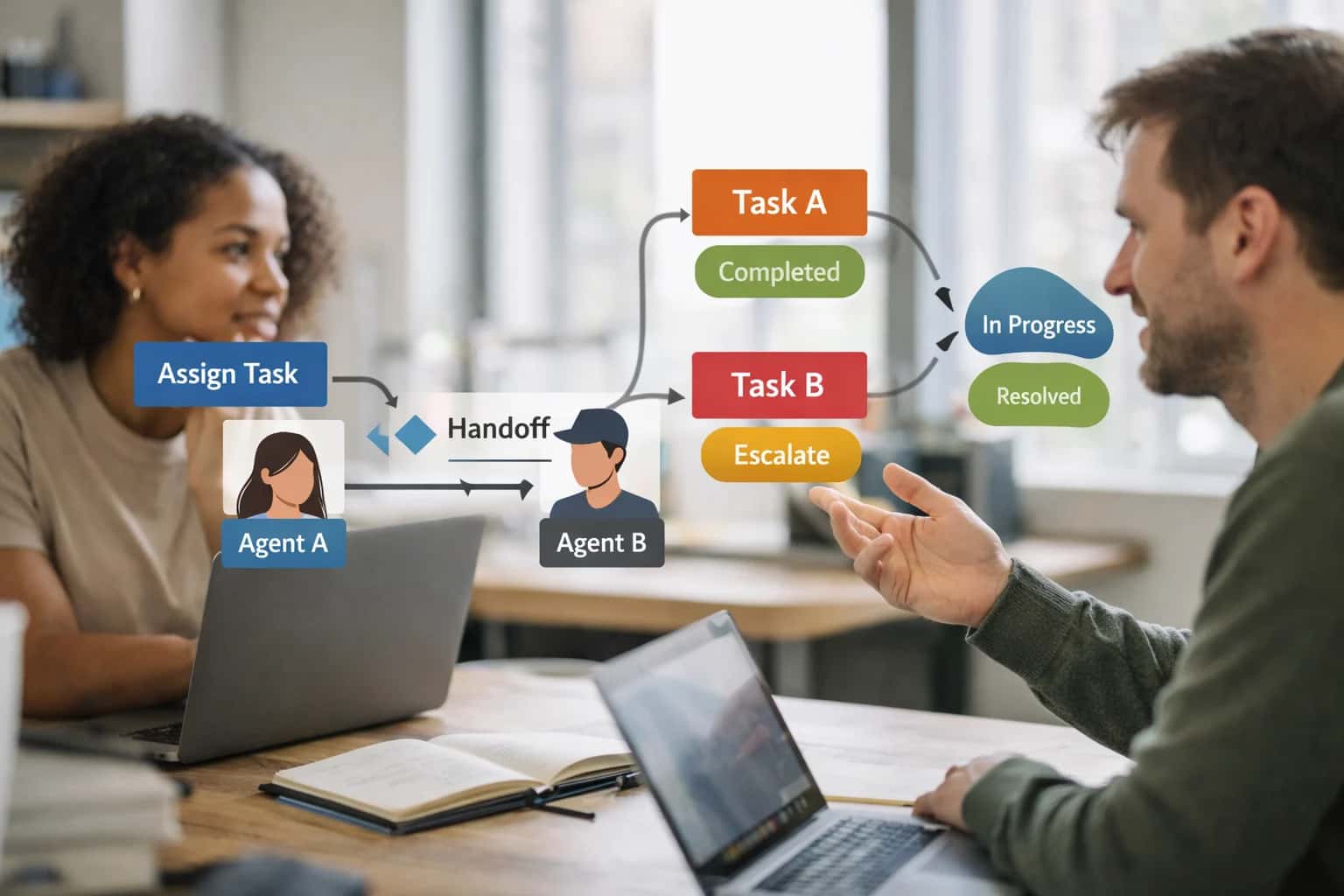
ARCHITECTURE FOR REAL-TIME COORDINATION
Where AI Fits into Trimble Ag's Harvest Logistics
A technical blueprint for integrating AI agents and optimization models into Trimble Ag's harvest logistics, telematics, and task management surfaces to reduce delays and spoilage.
Implementation typically involves a dedicated AI orchestration layer that subscribes to Trimble's telematics data streams (via Trimble Ag Software APIs or Fleet Manager integrations) and maintains a real-time digital twin of the harvest operation. Agents use this model to perform continuous optimization: rerouting trucks around bottlenecks, pre-assigning storage bins based on moisture content, and alerting crew managers to impending delays. High-impact workflows include automated work order generation for hauling and drying when a combine's yield monitor predicts a full grain cart, or dynamic scheduling that shifts crews between fields based on real-time yield data and predicted weather windows.
Rollout requires a phased approach, starting with a recommendation engine that surfaces insights to dispatchers within Trimble's interface before progressing to semi-automated task assignment. Governance is critical; all AI-generated dispatches should be logged as suggestions with human-override capabilities, and audit trails must be maintained in alignment with Trimble's existing activity logs. The integration's value is measured in reduced truck idle time, lower grain spoilage from delayed drying, and more efficient use of labor and storage assets—turning a reactive, communication-heavy process into a coordinated, predictive workflow. For teams evaluating this, start by mapping your current data flows from combines, trucks, and bins into Trimble, as this data foundation is the primary prerequisite for effective AI coordination.
HARVEST LOGISTICS
Key Integration Surfaces in Trimble Ag
Automating Crew and Equipment Coordination
Integrate AI directly into Trimble's task management and dispatch workflows. AI agents can analyze real-time field readiness data (e.g., crop moisture, yield monitor feeds), weather forecasts, and crew availability to dynamically generate and prioritize harvest tasks. These tasks are pushed via Trimble's APIs into the Connected Farm platform, automatically assigning them to specific crews, operators, or machinery.
Key integration points include the Task API for creating and updating work orders, and the User/Team management endpoints for resource allocation. The AI can also consume telematics from Trimble's TLM (Trimble Load Manager) and TMX-2050 displays to monitor progress and adjust schedules based on actual field speed and truck loading times, creating a closed-loop system that reduces idle time and improves daily harvested acreage.
TRIMBLE AG INTEGRATION PATTERNS
High-Value AI Use Cases for Harvest Logistics
Integrate AI directly into Trimble Ag's logistics and telematics workflows to coordinate crews, trucks, and storage in real-time, turning reactive operations into predictive, optimized systems.
01
Dynamic Harvest Crew Dispatch
AI agents analyze real-time yield monitor data, field progress, and machine telematics from Trimble to predict completion times. The system automatically re-ranks and reassigns crews to the next highest-priority fields, reducing idle time and keeping combines moving. Integrates with Trimble's task management APIs to update schedules.
Hours -> Minutes
Re-planning time
02
Grain Cart & Hauler Optimization
Prevents combine stoppages by optimizing grain cart routes. An AI model ingests combine location, fill rate, and unload point data from Trimble telematics. It calculates optimal intercept points and dispatches instructions to cart operators via integrated mobile workflows, maximizing equipment utilization.
Batch -> Real-time
Routing logic
03
Storage Facility Load Forecasting
Predicts daily inbound volume to each elevator or on-farm bin. The AI model synthesizes harvest progress, truck GPS pings, and bin sensor data from the Trimble platform. It generates load forecasts and alerts managers to potential congestion or capacity issues hours in advance, enabling proactive adjustments.
Same day
Visibility lead time
04
Automated Driver Check-In & Weighment
Replaces manual ticket processes at the scale house. An AI workflow uses Trimble's truck location data and harvest lot IDs to auto-populate weigh tickets upon geofence entry. A voice or chat agent handles driver authentication via integrated comms, reducing queues and data entry errors.
5 min -> <1 min
Check-in duration
05
Moisture-Based Load Routing
Dynamically routes trucks based on grain quality. An AI agent reads real-time moisture data from the combine via Trimble's data streams. It cross-references destination drying capacity and pricing schedules, then updates the truck's destination in the dispatch system to maximize revenue and minimize spoilage risk.
1 sprint
Implementation scope
06
Post-Harvest Logistics Summary
Automates end-of-shift reporting. An AI agent queries Trimble's operational data lake for miles driven, fuel consumed, loads delivered, and delays. It generates a narrative summary with key bottlenecks and recommendations for the next day, sent via email or posted to a Trimble dashboard.
Manual -> Automated
Report generation
TRIMBLE AG LOGISTICS AUTOMATION
Example AI-Driven Harvest Workflows
These concrete workflows illustrate how AI agents can be integrated with Trimble Ag's logistics and telematics data to automate coordination, reduce delays, and optimize resource use during the critical harvest window.
Trigger: A field's yield monitor data crosses a pre-set readiness threshold, or a field manager manually flags a block as ready via the Trimble Ag mobile app.
Context Pulled: The AI agent queries Trimble's APIs for:
- Real-time GPS location and status (idle/en route/working) of all harvesters and grain carts from the telematics module.
- Field boundary and accessibility data from the farm map.
- Current weather conditions and short-term forecast for the field zone.
Agent Action: A routing optimization model processes locations, field access points, and machine capacity to generate an updated dispatch plan. It selects the optimal machine, calculates the most efficient route considering field terrain and road conditions, and estimates the job duration.
System Update: The agent pushes a new task directly into the assigned operator's Trimble Ag mobile task list with:
- Target field and specific entry point.
- Optimized navigation route.
- Estimated start and completion times.
Human Review Point: The field manager receives a push notification with the proposed dispatch plan and can approve, modify, or reject it with one tap before it's sent to the operator.
REAL-TIME LOGISTICS COORDINATION
Implementation Architecture: Data Flow & Agent Orchestration
A production-ready blueprint for embedding AI agents into Trimble Ag's harvest logistics workflows, connecting telematics, field data, and storage systems.
The integration architecture connects three core data streams to a central orchestration layer: Trimble Ag field completion data (via its APIs or data export feeds), real-time telematics from harvesters and trucks (via Trimble or third-party platforms like Samsara/Geotab), and storage facility capacity data (often from weigh scales or silo monitoring systems). This data is ingested, normalized, and processed by a Logistics Orchestrator Agent. This primary agent evaluates the state of the harvest—completed acres, yield estimates, machine locations, and bin space—to make dynamic decisions. It then dispatches tasks to subordinate agents: a Transport Dispatch Agent to assign trucks and optimize routes, and a Facility Load Agent to manage bin allocation and sequencing at receiving points.
In practice, the workflow is event-driven. When a harvester's yield monitor signals a full grain tank, or a field task is marked complete in Trimble Ag, an event triggers the orchestrator. The agent consults real-time GPS and traffic data, checks assigned storage destinations for capacity and wait times, and dispatches a work order—often via a webhook back to Trimble's tasking module or a dedicated mobile driver app. Key implementation details include:
- Building idempotent APIs to handle duplicate telematics pings.
- Implementing a priority queue for transport requests weighted by crop moisture, field distance, and harvester downtime cost.
- Configuring fallback rules for when connectivity drops (e.g., cache last-known good dispatch).
- Logging every agent decision with the underlying data snapshot for audit and continuous training.
Rollout is typically phased, starting with a monitoring and recommendation phase where agents suggest dispatches for human confirmation via a Trimble Ag dashboard alert or SMS. After trust is built, workflows move to semi-automated execution, where agents create and assign tasks in Trimble that require a single approval. Governance is critical: establish clear overrides (e.g., a field manager can manually reassign a truck) and set agent boundaries (e.g., never dispatch a truck without verifying driver hours-of-service compliance via the integrated telematics platform). The final architecture creates a closed loop where completion data from the storage facility feeds back to Trimble Ag to update field status, providing a real-time, single source of truth for the entire harvest operation.
TRIMBLE AG HARVEST LOGISTICS
Code & Payload Examples
Real-Time Crew & Truck Assignment
This example calls an AI optimization service to re-assign harvest crews and trucks based on real-time yield data and equipment status from Trimble's telematics. The AI model considers field completion estimates, bin locations, and road conditions to minimize idle time and transportation costs.
pythonimport requests # Payload to AI optimization endpoint dispatch_payload = { "operation_id": "harvest_2024_09_15", "crews": [ { "crew_id": "swather_alpha", "location": {"lat": 45.123, "lon": -93.456}, "status": "active", "capacity_kg_per_hour": 12000, "current_field": "field_n7" } ], "trucks": [ { "truck_id": "hopper_01", "location": {"lat": 45.125, "lon": -93.460}, "status": "en_route", "capacity_kg": 40000, "current_destination": "elevator_central" } ], "fields": [ { "field_id": "field_n7", "crop": "corn", "estimated_yield_remaining_kg": 150000, "completion_forecast": "2024-09-15T18:30:00Z", "unload_points": [{"lat": 45.122, "lon": -93.455}] } ], "storage_facilities": [ { "facility_id": "elevator_central", "location": {"lat": 45.200, "lon": -93.500}, "available_capacity_kg": 500000 } ] } # Call AI optimization service response = requests.post( "https://api.inferencesystems.com/v1/trimble/dispatch/optimize", json=dispatch_payload, headers={"Authorization": f"Bearer {API_KEY}"} ) # Returns optimized assignments assignments = response.json() # {'crew_assignments': [...], 'truck_routes': [...]}
The AI service returns a new dispatch plan, which can be pushed back to Trimble Ag's task management modules via their REST API to update operator tablets and fleet dashboards in near real-time.
AI-ENHANCED HARVEST LOGISTICS
Realistic Operational Impact & Time Savings
How AI integration with Trimble Ag's logistics and telematics data transforms harvest coordination workflows from reactive to proactive.
| Metric | Before AI | After AI | Notes |
|---|---|---|---|
Harvest crew dispatch | Manual phone calls & radio | Automated, optimized assignments | Uses real-time location, capacity, and field readiness |
Truck arrival coordination | Driver check-in calls to office | ETA-based automated yard scheduling | Integrates telematics for live ETAs and dock status |
Storage bin allocation | Spreadsheet tracking & walkie-talkie updates | Dynamic allocation based on yield & moisture | AI matches incoming loads to optimal storage to preserve quality |
Yield data to logistics sync | End-of-day manual data entry | Real-time sync from combine to trucking plan | Closes loop between field data and transport needs instantly |
Exception handling (breakdowns, weather) | Panicked calls, manual rerouting | Assisted scenario planning & re-optimization | AI proposes revised plans; human approves final decision |
Daily harvest logistics briefing | 1–2 hour morning meeting | 10-minute AI-generated summary & plan | Auto-prioritizes issues and highlights critical path |
Post-harvest logistics reporting | Half-day manual compilation | Automated report generation | Generates summaries for management, accounting, and compliance |
PRODUCTION-READY INTEGRATION
Governance, Security & Phased Rollout
A controlled, secure approach to deploying AI agents into live harvest operations.
Integrating AI into Trimble Ag's harvest logistics requires a security-first, phased architecture. The AI layer operates as a read-only analytics and recommendation engine initially, consuming real-time data from Trimble's telematics, Connected Farm tasking, and grain cart/transport APIs. All AI-generated dispatch suggestions, route optimizations, and storage alerts are written to a dedicated ai_recommendations object via Trimble's APIs, requiring explicit human approval or automated rule-based acceptance before any system-of-record updates occur. This ensures the core Trimble workflow engine remains the single source of truth, with AI acting as an intelligent advisor.
A phased rollout is critical for user adoption and risk management. Phase 1 (Observation) deploys AI agents to monitor live logistics data, generating internal dashboards that predict bottlenecks and simulate 'what-if' scenarios without any operational changes. Phase 2 (Assisted Dispatch) introduces AI recommendations into the dispatcher's console within Trimble, highlighting priority shifts and optimized routes that can be accepted with one click. Phase 3 (Conditional Automation) enables rule-based auto-acceptance for low-risk decisions (e.g., rerouting around a verified road closure) and triggers escalation workflows for complex exceptions, all logged in a tamper-evident audit trail.
Governance is enforced through role-based access controls (RBAC) within the AI orchestration layer, aligning with Trimble user permissions. Every AI-suggested action is tagged with a confidence score, supporting data citations (e.g., based on grain cart 75% full, field_eta 45min), and a traceable prompt chain. This allows managers to review the 'why' behind any recommendation. Data never leaves the client's designated cloud environment; AI models are served via private endpoints, and all prompts are grounded in the customer's own Trimble data context to prevent hallucination. Start with a single harvest corridor or commodity type, validate the AI's performance against historical outcomes, and then scale across the operation.
Enabling Efficiency, Speed & Accuracy
Intelligent Analysis, Decision & Execution
We build AI systems for teams that need search across company data, workflow automation across tools, or AI features inside products and internal software.
Talk to Us
Search across company data
Give teams answers from docs, tickets, runbooks, and product data with sources and permissions.
Useful when people spend too long searching or get different answers from different systems.
Enterprise searchRAGPermissions
Read more
Automate internal workflows
Use AI to route work, draft outputs, trigger actions, and keep approvals and logs in place.
Useful when repetitive work moves across multiple tools and teams.
AI agentsWorkflow automationGovernance
Read more
Add AI to products and internal tools
Build assistants, guided actions, or decision support into the software your team or customers already use.
Useful when AI needs to be part of the product, not a separate tool.
AI integrationDecision supportModel routing
Read moreIMPLEMENTATION BLUEPRINT
Frequently Asked Questions
Common technical and operational questions for integrating AI agents into Trimble Ag's harvest logistics workflows, covering architecture, data flows, and rollout.
Integration occurs through Trimble Ag's REST APIs and webhook systems, primarily interacting with these core objects and surfaces:
- Telematics & Location Data: Pull real-time GPS, engine hours, and implement status from the
EquipmentandTelematicsDataAPIs to monitor harvester and truck positions. - Work Orders & Tasks: Read and write to the
WorkOrderAPI to dynamically adjust assignments based on AI-predicted field completion times and truck ETA. - Grain Cart & Truck Assets: Manage the
Assetinventory (trucks, carts, drivers) and theirAssignmentrecords for optimal load matching. - Storage Facility Data: Query
BinandStorageLocationcapacities via theInventoryAPI to direct loads and prevent overflows. - Field Boundaries & Yield Data: Use the
FieldandYieldMapAPIs to estimate remaining harvestable volume per polygon.
Typical API Payload for Dynamic Dispatch:
jsonPOST /api/v1/workorders/{id}/assignments { "assetId": "truck-789", "driverId": "driver-456", "scheduledStart": "2024-10-15T14:30:00Z", "priority": "HIGH", "notes": "AI-optimized: Redirected to Field B-12 due to harvester progress 85% complete." }
AI agents act as an orchestration layer, calling these APIs to read state and write optimized instructions, while logging all decisions for auditability in a separate AIActionLog.

About the author
Prasad Kumkar
CEO & MD, Inference Systems
Prasad Kumkar is the CEO & MD of Inference Systems and writes about AI systems architecture, LLM infrastructure, model serving, evaluation, and production deployment. Over 5+ years, he has worked across computer vision models, L5 autonomous vehicle systems, and LLM research, with a focus on taking complex AI ideas into real-world engineering systems.
His work and writing cover AI systems, large language models, AI agents, multimodal systems, autonomous systems, inference optimization, RAG, evaluation, and production AI engineering.
LinkedIn
Limited slotsGet a Free AI Consultation
Partnered with leading AI, data, and software stack.





How We Work
Custom AI workflows for your Business
One-fit-all AI don't work for modern businesses. At Inferensys, we aim to understand your business & custom requirements; which we use to define most efficient agentic workflows, the data, and the tools for your business.
01
Review the use case
We understand the task, the users, and where AI can actually help.
Read more02
Pick the right approach
We define what needs search, automation, or product integration.
Read more03
Build the first useful version
We implement the part that proves the value first.
Read more04
Improve from there
We add the checks and visibility needed to keep it useful.
Read moreThe first call is a practical review of your use case and the right next step.
Talk to Us