This integration connects two critical but often siloed systems: the event management platform (Cvent, Bizzabo) as the system of engagement and the ERP (NetSuite, SAP S/4HANA) as the system of record. The AI layer acts as a real-time orchestrator, mapping event objects—like Registration Fees, Sponsorship Invoices, Vendor POs, and Attendee Refunds—to their corresponding financial records in the ERP's Accounts Receivable, Accounts Payable, and General Ledger modules. Instead of end-of-month manual reconciliation, transactions are validated and posted as they occur, using APIs and webhooks to maintain a single source of truth for event P&L.

Integration
Event Management Integration with ERP Systems
Technical blueprint for connecting event platforms like Cvent and Bizzabo to ERP systems (SAP, NetSuite, Oracle) using AI to automate budget reconciliation, procurement workflows, and financial reporting.
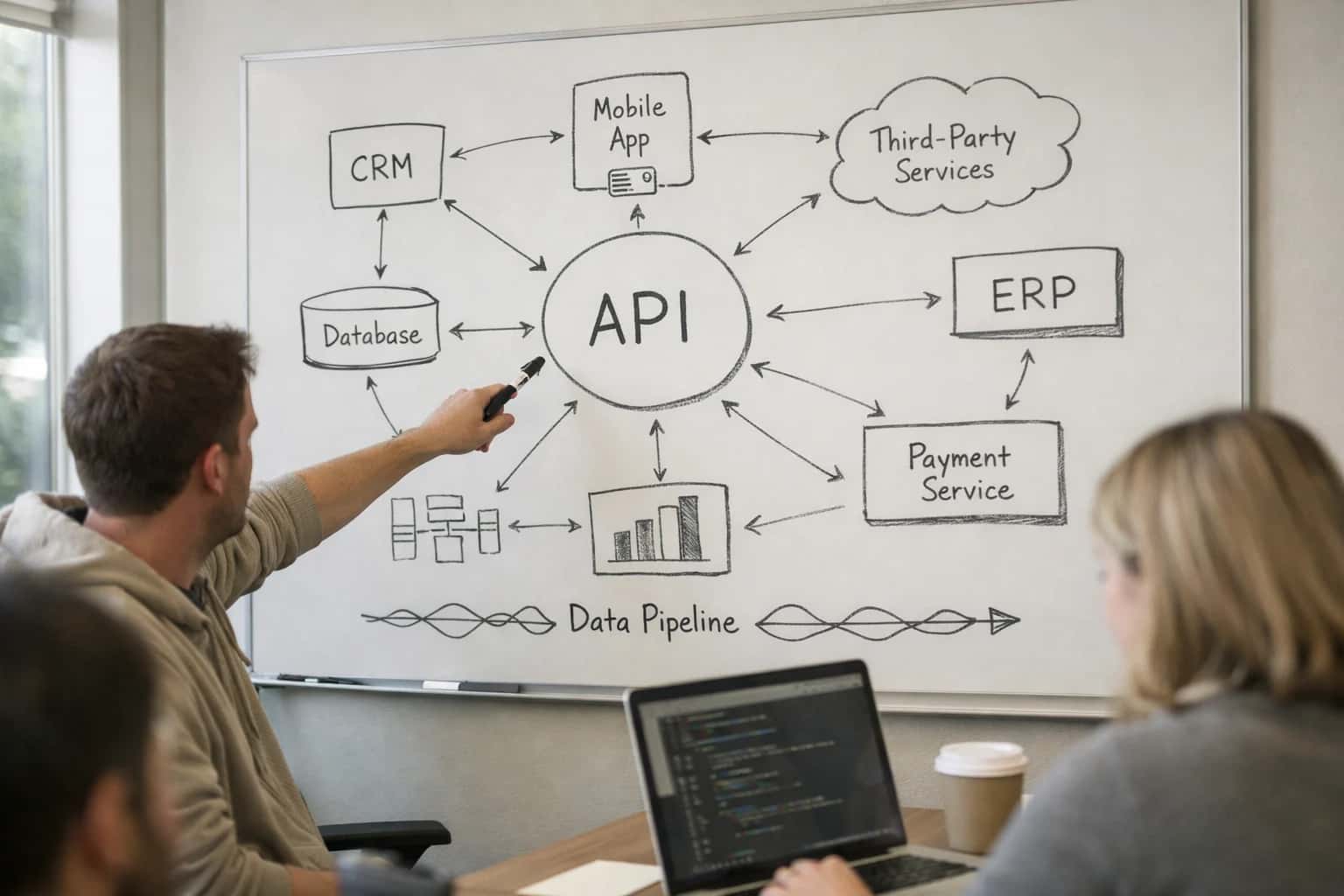
ARCHITECTURE FOR REAL-TIME FINANCIAL OPERATIONS
Where AI Bridges Event Operations and Financial Systems
A technical blueprint for connecting event platforms like Cvent to ERP systems (SAP, NetSuite) to automate budget reconciliation, procurement, and financial reporting.
Implementation centers on three automated workflows: 1) Procurement for Event Supplies, where an AI agent monitors Cvent's vendor module for approved purchase requests, creates requisitions in SAP Ariba or Coupa, and updates the event budget in real-time; 2) Budget vs. Actual Reconciliation, where the agent continuously matches Cvent expense categories to ERP cost centers, flagging variances for review; and 3) Financial Reporting Automation, where the agent aggregates data from both systems to generate accrual-based financial statements, cash flow forecasts, and audit trails without manual spreadsheet work. This reduces the event finance close cycle from days to hours.
Rollout requires a phased approach: start with a single event type and a one-way sync (e.g., Cvent → NetSuite Journal Entries) before enabling bi-directional workflows. Governance is critical—implement RBAC to control which AI agents can create financial records, and maintain a full audit log of all automated postings. The result is not just efficiency; it's financial clarity, allowing event managers to see real-time budget burn and finance teams to trust the accuracy of event-related financial data. For a deeper dive on the underlying ERP automation patterns, see our guide on [/integrations/enterprise-resource-planning-platforms/ai-for-erp-reconciliation-and-close](AI for ERP Reconciliation and Close).
ARCHITECTURE BLUEPRINT
Integration Touchpoints: Event Platform Modules to ERP Objects
Connecting Event Budgets to ERP GL Codes
AI integration synchronizes event financials between platforms like Cvent and ERP systems (SAP, NetSuite) for real-time budget reconciliation. Key touchpoints include:
- Event Budget Module → ERP General Ledger: Map line items (venue, catering, AV) to specific GL accounts and cost centers. AI agents can classify uncoded expenses and flag discrepancies.
- Actual Spend Tracking: Ingest invoices and receipts from the event platform's payment module, validate against purchase orders in the ERP, and update commitment ledgers.
- Forecasting & Accruals: Use historical event data and current registrations to predict final costs, generating accrual journal entries in the ERP for month-end close.
This creates a closed-loop where event managers see real-time budget health, and finance teams receive AI-enriched, audit-ready data feeds.
AUTOMATE FINANCIAL AND LOGISTICAL WORKFLOWS
High-Value AI Use Cases for Event-ERP Integration
Connecting event platforms like Cvent or Bizzabo to ERP systems (SAP, NetSuite, Oracle) unlocks AI-driven automation for budget control, procurement, and financial reporting. This blueprint details where AI agents can bridge operational gaps between event execution and corporate finance.
01
Real-Time Budget Reconciliation
AI agents monitor live event spend in Cvent (catering, A/V, venue) against the approved project budget in NetSuite or SAP. The system flags variances, suggests reallocations, and automatically updates forecast vs. actual reports, moving reconciliation from a post-event audit to a continuous process.
Weeks -> Days
Close cycle
02
AI-Triggered Procurement Workflows
When an event requisition is approved in Cvent, an AI agent analyzes the request, checks vendor catalogs in SAP Ariba or Coupa, and initiates the appropriate P2P workflow. It can draft purchase orders, route for approvals, and track deliveries back to the event's logistics timeline.
Batch -> Real-time
Procurement trigger
03
Automated Attendee Revenue Recognition
For paid events on Eventbrite, AI syncs finalized attendee lists and payment data to the ERP's revenue recognition module (e.g., NetSuite ARM). It maps ticket sales to the correct GL accounts and deferral schedules, ensuring compliance and reducing manual journal entries.
Hours -> Minutes
Revenue posting
04
Vendor Invoice Matching & Exception Handling
AI cross-references vendor invoices from event suppliers against Cvent purchase orders and NetSuite receipts. It flags discrepancies in quantities or rates, extracts data for AP entry, and routes exceptions to a human reviewer, streamlining the entire accounts payable workflow for events.
80% Auto-matched
Typical outcome
05
Event-Specific Financial Forecasting
Leveraging historical event data from Cvent and current market data, an AI model running in the ERP environment generates predictive forecasts for future events. It projects costs per attendee, optimizes budget allocations, and provides scenario analysis for event portfolio planning.
1 sprint
Implementation lead time
06
Compliance & Audit Trail Automation
AI agents ensure all financial transactions tied to an event (from registration refunds to sponsor payments) create a complete, immutable audit trail in the ERP. They auto-tag transactions with event IDs, maintain document links, and generate ready-to-submit audit packages for finance and compliance teams.
Same day
Audit readiness
ERP FINANCIAL OPERATIONS
Example AI Agent Workflows
Connecting event platforms like Cvent to ERP systems (SAP, NetSuite) enables AI agents to automate financial reconciliation, procurement, and reporting. Below are concrete workflows that bridge event data with core financial operations.
Trigger: An event concludes in Cvent, marked with a status of 'Completed'.
Context/Data Pulled:
- The AI agent retrieves the final event record from Cvent, including all associated budget line items (venue, catering, AV, marketing).
- It queries the ERP (e.g., NetSuite) for all posted invoices, purchase orders, and credit card charges tagged with the event's unique project ID.
Model/Agent Action:
- The agent uses an LLM to classify and map ERP transactions to Cvent budget categories, handling variances in vendor naming.
- It calculates variances for each line item, flagging any discrepancies >5% for review.
- It generates a reconciliation summary, noting any missing POs or outstanding invoices.
System Update/Next Step:
- The summary is posted as a comment in the Cvent event record and attached to the corresponding project in NetSuite.
- An alert is sent via email to the event manager and finance controller with a link to the report.
- For flagged discrepancies, a task is created in the event manager's Asana project.
Human Review Point: All flagged discrepancies (>5% variance) require manual sign-off in the ERP before the event's financial period is closed.
ERP FINANCIAL RECONCILIATION & PROCUREMENT WORKFLOWS
Implementation Architecture: Data Flow, APIs, and Guardrails
A production-ready blueprint for connecting AI agents to the financial and operational data flows between event platforms and ERP systems.
The core integration surfaces are the financial transaction objects and procurement modules within your ERP (e.g., SAP's FI/CO modules, NetSuite's Vendor Bills and Purchase Orders). AI agents act as middleware, ingesting raw spend data from the event platform (Cvent's Budget, Invoice, and Expense APIs) and mapping it to the corresponding ERP records. Key data flows include: 1) Event-to-GL Reconciliation: Matching Cvent Actual Cost records to SAP General Ledger postings, flagging variances for review. 2) Procurement Initiation: Automatically creating NetSuite Purchase Requisitions for approved event supplies based on Cvent Order triggers, enriched with vendor data from a master list. 3) Payment Status Sync: Polling the ERP's Accounts Payable status and updating the event platform's financial dashboard in near real-time via webhook.
Implementation requires a secure orchestration layer, typically built with a workflow engine like n8n or Apache Airflow. This layer handles:
- API Call Sequencing: First, the agent queries Cvent's
Reporting APIfor new expenses, then calls the ERP'sODataorRESTendpoints (e.g., SAP'sS/4HANA Cloud API) to find matching documents. - Data Enrichment & Validation: Using a RAG pipeline with a vector store (like Pinecone) containing your company's chart of accounts and procurement policies to ground LLM decisions—e.g., "Is this floral arrangement charge a valid
Marketing Expense(account 6120)?" - Human-in-the-Loop Approvals: For discrepancies over a configurable threshold, the agent creates a task in Asana or a ticket in ServiceNow, attaching the source documents and its analysis for a finance manager's review.
Governance and rollout are critical. Start with a pilot on post-event reconciliation for a single business unit. Implement guardrails:
- Strict RBAC: AI service accounts should have read-only access to most ERP data, with write permissions scoped only to specific
Purchase Requisitioncreation endpoints. - Audit Trail Logging: Every agent action—data fetched, decision made, record updated—must be logged to a secure datastore with a correlation ID traceable back to the original event.
- Phased Automation: Begin with AI as a copilot, generating reconciliation reports and draft POs for human sign-off. Only after validating >95% accuracy over several event cycles should you move to fully automated posting for low-risk, rule-based transactions.
ERP INTEGRATION PATTERNS
Code and Payload Examples
NetSuite Journal Entry Creation
When an event concludes in Cvent, an AI agent reviews final invoices and attendee counts against the original budget in NetSuite. It identifies variances, proposes adjusting journal entries, and submits them via NetSuite's REST API for approval. This automates the month-end close process for event-related GL accounts.
Example Payload to NetSuite API:
json{ "recordType": "journalEntry", "subsidiary": {"id": "1"}, "tranDate": "2024-11-15", "memo": "AI-Adjusted JE for Cvent Event ID: CONF2024 - Catering Overrun", "lineItems": [ { "account": {"id": "550"}, "debit": 1250.00, "memo": "Actual catering cost vs. budget" }, { "account": {"id": "210"}, "credit": 1250.00, "memo": "Accrual adjustment" } ], "customForm": {"id": "105"} }
The AI agent generates this payload after analyzing the variance report, ensuring the debits and credits balance before submission.
AI-ENHANCED ERP INTEGRATION
Realistic Time Savings and Operational Impact
How AI integration between event platforms like Cvent and ERP systems like SAP or NetSuite transforms manual, error-prone financial workflows into automated, intelligent operations.
| Workflow | Before AI | After AI | Key Considerations |
|---|---|---|---|
Event budget reconciliation | Manual spreadsheet work, 4-8 hours per event | Automated matching & variance reports in 30-60 minutes | AI cross-references Cvent POs with ERP invoices; flags exceptions for human review |
Procurement for event supplies | Manual vendor search, RFQ drafting, 1-2 days lead time | AI-assisted vendor selection & PO generation, same-day processing | AI suggests pre-approved vendors from ERP; drafts POs in Cvent for manager approval |
Expense claim categorization & coding | Manual GL code assignment by event staff, prone to errors | AI auto-codes 80-90% of line items based on historical patterns | Human review for high-value or ambiguous items; learns from corrections |
Financial reporting & accruals | Month-end manual compilation from multiple systems, 2-3 days | Real-time dashboards & automated accrual suggestions, 1-2 hours | AI pulls live data from Cvent and ERP; provides audit trail for finance team |
Attendee refund processing | Manual check of terms, approval routing, 24-48 hour turnaround | AI validates policy & triggers approved refunds, <4 hour turnaround | Integrates with ERP payment modules; requires predefined business rules |
Vendor payment scheduling | Manual review of payment terms and event dates | AI optimizes cash flow by scheduling payments aligned with event milestones | Considers ERP payment runs and event completion status to avoid prepayment risk |
Compliance & audit trail generation | Manual document gathering for internal/external audits | AI assembles a coherent audit packet (contracts, POs, invoices) on-demand | Links records across Cvent and ERP; essential for regulated industries |
ENTERPRISE-GRADE INTEGRATION
Governance, Security, and Phased Rollout
A practical approach to connecting AI workflows between your event platform and ERP with control and minimal disruption.
A production integration between platforms like Cvent and NetSuite or SAP S/4HANA must enforce strict data governance. AI agents should operate within a defined security perimeter, accessing only the necessary objects—such as Cvent Event records, Budget lines, and Attendee lists—and mapping them to corresponding ERP entities like Purchase Orders, GL Accounts, and Vendor records. All API calls and data transformations should be logged to an immutable audit trail, and sensitive financial data should be masked or tokenized in prompts. Implement role-based access control (RBAC) so AI-driven actions, like creating a draft PO, require the same approvals as manual processes.
We recommend a phased rollout to de-risk implementation and demonstrate value incrementally:
- Phase 1: Read-Only Analysis. Deploy agents to analyze historical event spend in the ERP and Cvent, identifying reconciliation discrepancies and generating variance reports. No write-backs.
- Phase 2: Assisted Procurement. Enable AI to draft procurement requests within the ERP for pre-approved event supplies (e.g., catering, AV) based on Cvent budget lines, but require human review and approval before submission.
- Phase 3: Closed-Loop Reconciliation. Activate automated matching of actual invoices in the ERP to Cvent budget categories, with the AI flagging exceptions and suggesting journal entry adjustments for finance team sign-off.
This crawl-walk-run approach allows your teams to build trust in the AI's outputs, refine guardrails, and adapt workflows. It transforms a high-stakes financial integration from a "big bang" project into a controlled, value-driven program. For related patterns on securing AI access to enterprise systems, see our guide on Secure AI Access with IAM.
Enabling Efficiency, Speed & Accuracy
Intelligent Analysis, Decision & Execution
We build AI systems for teams that need search across company data, workflow automation across tools, or AI features inside products and internal software.
Talk to Us
Search across company data
Give teams answers from docs, tickets, runbooks, and product data with sources and permissions.
Useful when people spend too long searching or get different answers from different systems.
Enterprise searchRAGPermissions
Read more
Automate internal workflows
Use AI to route work, draft outputs, trigger actions, and keep approvals and logs in place.
Useful when repetitive work moves across multiple tools and teams.
AI agentsWorkflow automationGovernance
Read more
Add AI to products and internal tools
Build assistants, guided actions, or decision support into the software your team or customers already use.
Useful when AI needs to be part of the product, not a separate tool.
AI integrationDecision supportModel routing
Read moreERP INTEGRATION
Frequently Asked Questions
Practical questions for connecting AI to your event management and ERP financial workflows.
This workflow automates the tedious matching of event expenses and revenue between platforms.
- Trigger: A nightly sync job or a webhook from Cvent when an event's financial status is marked "Closed."
- Context Pulled: The AI agent retrieves the finalized event record from Cvent, including all budget line items (venue, catering, A/V), actual spend from integrated invoices, and registration revenue.
- Agent Action: The agent calls the NetSuite API to find the corresponding Project record and Purchase Orders. It performs a line-item comparison, identifying discrepancies (e.g., a $500 catering overage, a missing sponsor payment). It generates a reconciliation report with notes on variances.
- System Update: The report is posted as a File in the NetSuite Project record. For approved variances (within a configured threshold), the agent can create Journal Entry lines in NetSuite to true up the books.
- Human Review Point: Discrepancies over a defined dollar amount or percentage flag an approval task in the ERP for the event or finance manager.

About the author
Prasad Kumkar
CEO & MD, Inference Systems
Prasad Kumkar is the CEO & MD of Inference Systems and writes about AI systems architecture, LLM infrastructure, model serving, evaluation, and production deployment. Over 5+ years, he has worked across computer vision models, L5 autonomous vehicle systems, and LLM research, with a focus on taking complex AI ideas into real-world engineering systems.
His work and writing cover AI systems, large language models, AI agents, multimodal systems, autonomous systems, inference optimization, RAG, evaluation, and production AI engineering.
LinkedIn
Limited slotsGet a Free AI Consultation
Partnered with leading AI, data, and software stack.





How We Work
Custom AI workflows for your Business
One-fit-all AI don't work for modern businesses. At Inferensys, we aim to understand your business & custom requirements; which we use to define most efficient agentic workflows, the data, and the tools for your business.
01
Review the use case
We understand the task, the users, and where AI can actually help.
Read more02
Pick the right approach
We define what needs search, automation, or product integration.
Read more03
Build the first useful version
We implement the part that proves the value first.
Read more04
Improve from there
We add the checks and visibility needed to keep it useful.
Read moreThe first call is a practical review of your use case and the right next step.
Talk to Us