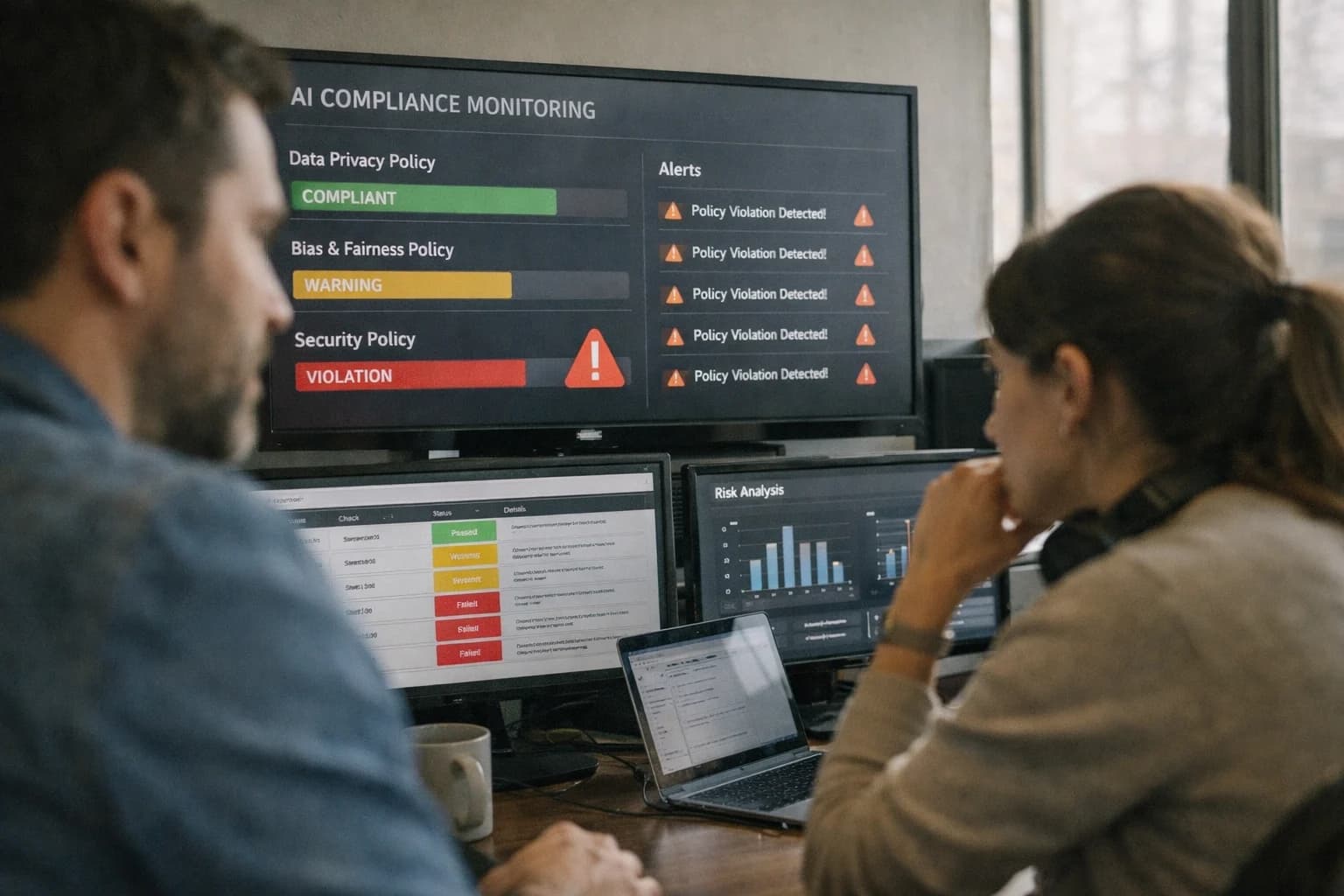
AI Integration for ESG Regulatory Change Tracking | Inference Systems
Integration
AI Integration for ESG Regulatory Change Tracking
Build AI agents that continuously monitor regulatory bodies, news, and legal databases for ESG rule changes, summarize material impacts, and trigger compliance update workflows in platforms like Workiva, Enablon, and Novata.
Deploy AI monitors that scan for ESG rule changes, summarize impacts, and trigger compliance workflows in platforms like Enablon, Workiva, and Novata.
ESG compliance teams face a constant influx of new regulations from bodies like the EU (CSRD, SFDR), the SEC, and global stock exchanges. Manually tracking these changes across news feeds, legal databases, and regulatory portals is slow and error-prone. An AI integration connects directly to your ESG and sustainability platform—whether it's Enablon for EHSQ, Workiva for reporting, or Novata for data management—to automate this intelligence layer. The system uses configured agents to continuously monitor RSS feeds, regulatory websites, and premium legal databases, using NLP to filter for material updates relevant to your industry, geography, and reported ESG topics.
When a relevant change is detected—such as a new draft rule for Scope 3 reporting—the AI agent extracts key details: effective dates, amended disclosure requirements, and affected frameworks (e.g., ESRS, TCFD). It then generates a structured summary and a preliminary impact assessment, which is posted as a new record or alert within your compliance software. For example, in Enablon, this could create a new 'Regulatory Change' item, automatically linked to relevant compliance obligations and control procedures. The integration can also trigger downstream workflows, such as assigning a task to the legal team for review or flagging a data gap in your Workiva Wdata pipeline that needs filling before the next report.
Rollout involves configuring source feeds, defining materiality filters, and mapping output to your platform's data model via its API (e.g., Enablon's REST API, Workiva's Wdata APIs). Governance is critical: all AI-generated summaries should be tagged for human review and approval before triggering irreversible actions. The system maintains an audit log of scans, detections, and triggered workflows, ensuring transparency for internal audit and external assurance. This moves regulatory tracking from a reactive, manual process to a proactive, orchestrated workflow, reducing the risk of missing critical updates and compressing the time from regulatory change to internal action plan from weeks to hours.
ARCHITECTURE SURFACES
Where AI Connects to Your ESG Compliance Stack
Ingesting and Analyzing Regulatory Sources
AI agents connect to the primary feeds your compliance team already monitors but automates the heavy lifting. This includes scanning official publications from the European Commission, SEC, ISSB, and EFRAG, as well as legal databases, industry news aggregators, and NGO reports.
The integration surfaces within your ESG platform's Regulatory Change Management or Compliance Calendar modules. AI parses new documents, extracts key obligations, deadlines, and scope changes, and creates structured update records. It can cross-reference new requirements against your existing control framework and mapped data points, flagging potential gaps for review. This transforms a manual monitoring task into an automated alerting system, ensuring no material change is missed.
python
# Example: Agent workflow to process a new regulatory publication
agent_workflow = {
"trigger": "RSS feed or API webhook from regulatory body",
"action_1": "Download and chunk PDF/HTML content",
"action_2": "LLM extracts: affected frameworks (CSRD, SFDR), entities, deadlines, new metrics",
"action_3": "Match extracted obligations to internal control IDs in ESG platform",
"action_4": "Create "Potential Gap" task in compliance workflow with linked source",
"output": "Structured alert posted to Enablon/Workiva module via REST API"
}
ESG AND SUSTAINABILITY PLATFORMS
High-Value Use Cases for AI-Powered Regulatory Tracking
Automate the monitoring, analysis, and workflow integration of evolving ESG regulations like CSRD, SEC Climate Rules, and EU Taxonomy to reduce compliance risk and manual effort.
01
Automated Regulatory Change Detection
Deploy AI agents to continuously scan official journals, regulatory body websites (EFRAG, SEC, ECHA), and legal databases for new drafts, final rules, and amendments. Key workflows include entity extraction of affected sectors, impact classification, and triggering alerts in platforms like Enablon or Workiva.
Batch → Real-time
Monitoring cadence
02
Requirement-to-Control Gap Analysis
Ingest new regulatory text (e.g., CSRD ESRS) and use an LLM to map requirements to your internal control framework and data catalog. The AI identifies missing KPIs, data source gaps, and process deficiencies, generating prioritized remediation tickets in your ESG platform.
1 sprint
Analysis timeline
03
Disclosure Drafting & Template Updates
When a regulation changes, AI automatically updates reporting templates in Workiva Wdesk or Datamaran, pre-populates new datapoints with available data, and drafts narrative explanations for gaps. This keeps disclosure frameworks aligned with latest ESRS, SASB, or GRI standards.
Hours → Minutes
Template revision
04
Stakeholder Communication Workflows
Automate internal and external communication. AI generates summary briefs for legal & compliance teams, drafts supplier data request updates for Scope 3, and creates board-level impact summaries. These are routed via platform-native workflows in Novata or Salesforce for review and distribution.
05
Audit Evidence Compilation
For each regulatory requirement, the AI agent traces data lineage, automatically gathers supporting evidence (policy documents, calculation logs, approval records) from connected systems, and compiles a structured audit trail within the compliance module. This slashes prep time for internal and external assurance.
Days → Hours
Evidence collection
06
Peer Benchmarking & Impact Forecasting
Analyze how peers are reporting against new rules. The AI scrapes and compares public disclosures, simulates the impact of different reporting approaches on your ESG scores, and forecasts resource needs for compliance. Insights feed into strategic planning in sustainability performance platforms.
ESG COMPLIANCE AUTOMATION
Example AI Agent Workflows for Regulatory Change
These workflows illustrate how AI agents can be integrated into ESG platforms to automate the monitoring, analysis, and actioning of regulatory changes, reducing manual effort and accelerating compliance.
Trigger: Scheduled daily scan of regulatory body RSS feeds, news APIs, and legal databases (e.g., EUR-Lex, SEC.gov).
Context/Data Pulled: The agent retrieves new publications, proposed rules, and final rulings from pre-configured sources (CSRD, SFDR, SEC Climate Rules, TNFD). It uses vector embeddings to compare against a baseline of known regulations.
Model/Agent Action: An LLM classifies the document's relevance to the company's operations and material ESG topics. For high-relevance items, it generates a structured summary: {Regulation, Issuing Body, Key Change, Effective Date, Potential Impact Level}.
System Update/Next Step: The summary and source link are posted as a task in the compliance platform (e.g., Enablon Action Item) and a Slack/Teams alert is sent to the ESG & Legal teams.
Human Review Point: The compliance officer reviews the AI-generated summary, confirms the impact assessment, and initiates a formal gap analysis workflow.
AUTOMATED REGULATORY INTELLIGENCE PIPELINE
Implementation Architecture: Data Flow and System Design
A production-ready AI system that monitors, analyzes, and operationalizes ESG regulatory changes.
The integration is built on a three-tiered data pipeline. The Ingestion Layer uses scheduled agents to continuously scrape and ingest structured and unstructured data from target sources: RSS feeds and APIs from regulators (e.g., SEC, EFRAG, IOSCO), legal databases (Westlaw, LexisNexis), news aggregators, and industry bodies. This raw data—including PDFs, press releases, and proposed rules—is normalized and stored in a document store with metadata tagging for source, jurisdiction, and publication date. The Analysis Layer employs a Retrieval-Augmented Generation (RAG) pipeline. Documents are chunked, embedded, and indexed in a vector database like Pinecone or Weaviate. An orchestration agent, using a framework like LangChain or CrewAI, queries this index for relevant changes based on a configured taxonomy of material ESG topics (e.g., 'CSRD Article 8', 'Scope 3 reporting', 'biodiversity'). A large language model (LLM) then summarizes the change, extracts affected obligations, and assesses impact severity based on your company's operations and existing compliance framework.
The processed intelligence triggers workflows in the Operational Layer. Via secure webhooks or direct API calls, the system creates or updates records in your ESG platform. For example, in Enablon, it might generate a new 'Regulatory Change' record in the Compliance module, link it to relevant control objectives, and auto-assign it to a compliance officer. In Workiva, it could create a task in a disclosure project plan or post an alert to a dedicated reporting workspace. The architecture includes critical governance components: a human-in-the-loop approval step for high-impact changes, a full audit log of the AI's analysis and actions, and configurable RBAC to control who receives alerts and can approve workflow triggers. Data flows are secured using platform-specific OAuth and secrets management, with all AI-generated content flagged for traceability.
Rollout follows a phased approach, starting with a single high-priority jurisdiction (e.g., EU CSRD) and 2-3 data sources. The initial implementation focuses on detection and alerting only, allowing compliance teams to validate AI accuracy before enabling automated workflow creation. Success is measured by reduction in manual monitoring hours, time from publication to internal assessment, and completeness of the audit trail for assurance purposes. This architecture ensures regulatory intelligence is not just captured, but seamlessly integrated into the operational fabric of your ESG compliance program.
AI-Powered Regulatory Monitoring Workflows
Code and Payload Examples
Ingesting and Structuring Regulatory Updates
AI agents monitor official sources like the European Commission, SEC, and CSRD implementation sites. The core task is to fetch, parse, and structure raw text into a standardized payload for analysis and routing.
A typical workflow uses a scheduled job to call source APIs or scrape RSS feeds, then passes the raw content to an LLM for structured extraction. The resulting JSON payload includes the source, publication date, extracted entities (like affected industries and jurisdictions), and a preliminary classification of relevance (e.g., High, Medium, Low). This structured data is then posted to a webhook endpoint on your ESG platform or a dedicated queue for the next processing step.
python
# Example: Structuring a regulatory alert
import requests
payload = {
"source": "European Commission",
"url": "https://ec.europa.eu/.../delegated-regulation-2024-123",
"published_date": "2024-05-15",
"title": "Delegated Regulation amending Annexes to the CSRD",
"raw_text": "...full text of the regulation...",
"structured_summary": {
"affected_frameworks": ["CSRD", "ESRS"],
"jurisdictions": ["EU"],
"affected_industries": ["Manufacturing", "Financial Services"],
"key_changes": ["New mandatory GHG disclosure for Scope 3", "Revised materiality assessment guidance"],
"effective_date": "2025-01-01",
"compliance_deadline": "2026-12-31"
},
"relevance_score": 0.87
}
# Post to your ESG platform's ingestion endpoint
response = requests.post(
"https://your-esg-platform.com/api/v1/regulatory-alerts",
json=payload,
headers={"Authorization": "Bearer YOUR_API_KEY"}
)
AI-Powered Regulatory Monitoring
Realistic Time Savings and Operational Impact
How AI integration transforms the manual, reactive process of tracking ESG regulatory changes into a proactive, automated workflow, quantifying impact across key compliance activities.
Activity
Before AI
After AI
Key Impact
Regulatory Source Scanning
Manual daily checks across 10+ websites
Automated, continuous monitoring of 50+ feeds
Eliminates 15+ hours/week of manual scanning
Change Impact Assessment
Team review meetings to analyze relevance
AI-generated summaries with relevance scoring
Reduces assessment time from days to hours
Internal Control Mapping
Spreadsheet-based manual mapping to controls
Automated mapping to Enablon/Workiva control modules
Accelerates gap analysis by 70%
Stakeholder Alerting
Email blasts after manual compilation
Automated, role-based alerts via Teams/Slack
Ensures same-day awareness vs. next-week updates
Compliance Workflow Initiation
Manual ticket creation in EHSQ platform
AI-triggered tasks in Enablon/ServiceNow
Cuts workflow start time from 48 hours to 2 hours
Evidence Package Compilation
Manual gathering of supporting documents
AI-assisted collection from document repositories
Reduces prep time for audits by 60%
Disclosure Draft Updates
Manual edits to report narratives and data points
AI-suggested edits to CSRD/SEC disclosure drafts
Accelerates report revision cycles by 50%
Regulatory Trend Reporting
Quarterly manual analysis for leadership
Automated monthly briefings with peer comparisons
Provides proactive insights instead of retrospective analysis
CONTROLLED IMPLEMENTATION
Governance, Security, and Phased Rollout
A production-ready AI integration for ESG regulatory tracking requires a deliberate approach to data security, model governance, and controlled release.
The AI agent must operate within the security and compliance boundaries of your primary ESG platform (e.g., Workiva, Enablon, Novata). This means using the platform's native authentication (OAuth, API keys), respecting its role-based access controls (RBAC), and writing all findings—summarized regulatory changes, impact assessments, and suggested action items—directly into designated modules or custom objects as structured records. This creates a single, auditable source of truth within the system your compliance team already uses, avoiding shadow data stores.
A phased rollout is critical for managing risk and building trust. We recommend starting with a monitor-only pilot for a single, high-priority regulatory body (e.g., the SEC for climate disclosures or the EFRAG for CSRD). In this phase, the AI agent scans, summarizes, and posts alerts to a sandbox environment or a dedicated 'AI Insights' dashboard for review by a core team. Only after validation of accuracy and relevance are these insights promoted to trigger formal workflows, such as creating a compliance task in Enablon's Action Management module or initiating a disclosure update project in Workiva.
Governance is built into the workflow. Every AI-generated summary includes source citations (URL, publication date, jurisdiction) and a confidence score. High-impact or low-confidence findings can be routed through a mandatory human-in-the-loop approval step before any automated workflow is triggered. This ensures legal and subject matter expert oversight where it matters most. Furthermore, all agent activity—queries run, sources scanned, records created—is logged to the platform's audit trail, providing full transparency for internal audit and external assurance.
Enabling Efficiency, Speed & Accuracy
Intelligent Analysis, Decision & Execution
We build AI systems for teams that need search across company data, workflow automation across tools, or AI features inside products and internal software.
IMPLEMENTATION AND OPERATIONS
Frequently Asked Questions
Practical questions for teams planning AI-driven regulatory monitoring for ESG compliance.
The integration uses the ESG platform's API as the system of record. A typical flow is:
Trigger & Ingestion: An AI agent, scheduled or triggered by a webhook, scans designated sources (regulatory body RSS feeds, legal databases like LexisNexis, news aggregators).
Analysis & Summarization: The agent uses an LLM to analyze the retrieved text, classifying it by relevance (e.g., CSRD, SEC, SFDR), jurisdiction, and impacted ESG topics. It generates a concise summary of the change and its potential operational impact.
Platform Update: The agent calls the ESG platform's API (e.g., Workiva's Wdata API, Enablon's REST API) to create or update a 'Regulatory Change' record. This payload typically includes:
Workflow Trigger: Creating this record automatically triggers the platform's native workflow (e.g., in Enablon or a Workiva task list), assigning it to the compliance lead for review and initiating gap assessment procedures.
About the author
Prasad Kumkar
CEO & MD, Inference Systems
Prasad Kumkar is the CEO & MD of Inference Systems and writes about AI systems architecture, LLM infrastructure, model serving, evaluation, and production deployment. Over 5+ years, he has worked across computer vision models, L5 autonomous vehicle systems, and LLM research, with a focus on taking complex AI ideas into real-world engineering systems.
His work and writing cover AI systems, large language models, AI agents, multimodal systems, autonomous systems, inference optimization, RAG, evaluation, and production AI engineering.
Partnered with leading AI, data, and software stack.
How We Work
Custom AI workflows for your Business
One-fit-all AI don't work for modern businesses. At Inferensys, we aim to understand your business & custom requirements; which we use to define most efficient agentic workflows, the data, and the tools for your business.
The first call is a practical review of your use case and the right next step.