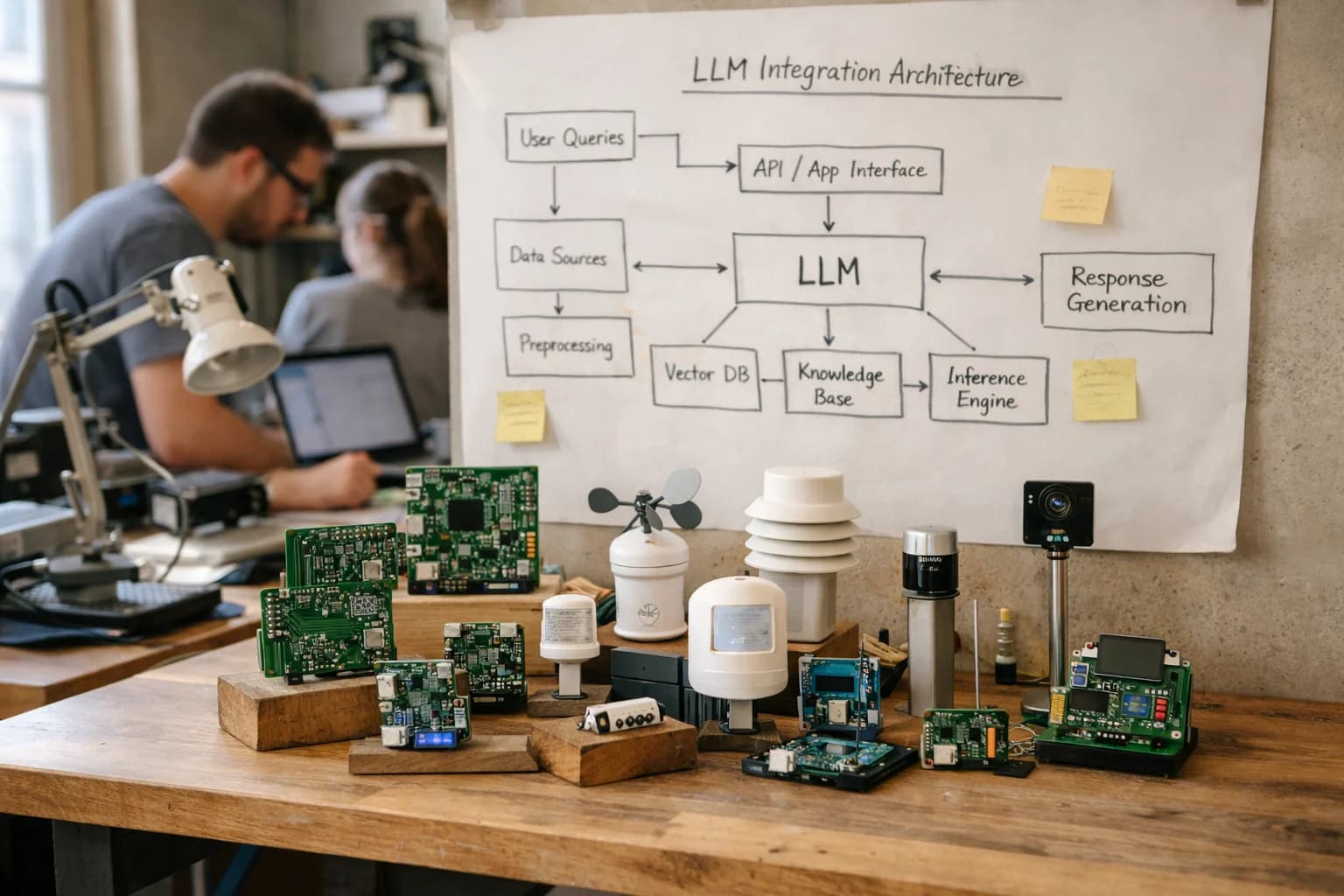
Build AI-powered connectors and normalization engines for platforms aggregating ESG data from IoT sensors, utility bills, ERP systems, and third-party providers. Automate ingestion, validation, and enrichment.
A practical blueprint for integrating AI into platforms like Workiva, Novata, Sweep, and Enablon to automate the most manual and error-prone parts of ESG data collection.
AI integration targets the data ingestion and normalization layer of ESG platforms. This is where raw data from IoT sensors, utility PDFs, ERP general ledgers (like SAP or Oracle), and third-party provider APIs converges. An AI agent acts as a connector and normalization engine, automating tasks like extracting kilowatt-hour figures from scanned bills, categorizing spend data into relevant GHG Protocol categories for Scope 3, and mapping supplier names from procurement systems to master records. Instead of manual CSV uploads and spreadsheet wrangling, AI pipelines can validate, cleanse, and structure inbound data streams in near real-time.
The implementation typically involves deploying lightweight AI agents that listen to webhooks or monitor designated storage (e.g., an S3 bucket) for new source documents. For a platform like Novata's Data Hub, an agent could process a feed of supplier invoices, use OCR and NLP to identify relevant activities (e.g., natural_gas_purchase), apply the correct emission factor based on geography and supplier data, calculate the CO₂e, and post the validated result via the platform's REST API. This turns a multi-day manual data preparation task into an automated, auditable workflow, significantly reducing the time private equity teams spend aggregating portfolio company data.
Rollout requires a phased, workflow-specific approach. Start with a single, high-volume data source—such as global electricity invoices—to prove the accuracy and ROI of automated extraction and calculation. Governance is critical: all AI-generated data points must be tagged with source document references and confidence scores, and routed for human-in-the-loop review when confidence falls below a set threshold (e.g., 95%). This creates a reliable audit trail for assurance. The end goal is an AI-augmented aggregation engine that handles the routine 80% of data, freeing ESG analysts to investigate anomalies, manage stakeholder engagement, and drive strategic reduction initiatives.
ARCHITECTURE BLUEPRINT
AI Integration Points Across Leading ESG Data Aggregation Platforms
Automating the Collection and Cleansing of Raw ESG Data
The first critical integration point is the data ingestion layer. AI agents can be deployed to automate the collection of raw ESG data from a sprawling array of source systems, which typically include:
ERP and financial systems (e.g., SAP, Oracle) for spend-based Scope 3 data.
Utility and facility management platforms (e.g., EnergyCAP, BuildingOS) for energy, water, and waste invoices.
IoT sensor streams from building management systems (BMS) and manufacturing equipment.
Third-party data providers via APIs for supplier-specific emission factors or risk scores.
An AI integration here acts as a smart ETL pipeline, using NLP to classify document types (e.g., a PDF utility bill vs. a fuel purchase receipt), extract relevant figures, apply validation rules, and map the data to the platform's internal data model. This reduces manual data entry, improves accuracy, and accelerates the time-to-insight for sustainability teams.
python
# Example: AI-powered ingestion agent for utility data
def process_utility_statement(pdf_path, platform_client):
# 1. Extract text and tables from PDF
extracted_data = extract_with_vision_ai(pdf_path)
# 2. Classify document & validate
doc_type = classify_document(extracted_data['text'])
if doc_type != 'ELECTRICITY_BILL':
raise ValueError('Unexpected document type')
# 3. Normalize and map to platform schema
normalized_payload = {
'meter_id': extract_meter_id(extracted_data),
'consumption_kwh': extract_consumption(extracted_data),
'period_start': extract_date(extracted_data, 'start'),
'source_file': pdf_path
}
# 4. Post to ESG platform API
platform_client.post('/api/v1/energy-data', normalized_payload)
AUTOMATION PATTERNS
High-Value AI Use Cases for ESG Data Aggregation
ESG data aggregation is a manual, multi-source challenge. These AI integration patterns connect disparate data streams, automate normalization, and transform raw inputs into auditable, report-ready metrics for platforms like Workiva, Novata, and Sweep.
01
Automated Data Ingestion & Entity Resolution
AI agents monitor and pull data from ERP systems (SAP, Oracle), utility portals, IoT sensor streams, and supplier spreadsheets. They resolve entity matching (e.g., mapping 'Facility A - North' to the correct site ID in the ESG platform) and trigger validation workflows for missing or anomalous data points.
Batch -> Real-time
Data collection cadence
02
Intelligent Emissions Factor Selection
For Scope 1, 2, and 3 calculations, AI analyzes activity data (e.g., fuel type, spend category, supplier location) and selects the most appropriate, region-specific emission factors from databases like DEFRA or EPA. It logs the selection rationale, creating an audit trail for assurance and recalculating automatically when factors are updated.
Hours -> Minutes
Factor mapping time
03
Unstructured Document Intelligence
Process PDF utility bills, supplier sustainability reports, and audit certificates. AI extracts key metrics (kWh consumption, waste tonnage, certification IDs), validates them against expected formats, and posts structured data to the ESG platform. Flags discrepancies for human review, turning manual data entry into a QA step.
1 sprint
Implementation timeline
04
Anomaly Detection & Data Quality Scoring
Continuously monitors incoming ESG data streams. AI models learn site-specific baselines for energy, water, and waste. Flags statistical outliers, unit conversion errors, or period-over-period spikes for investigation. Assigns a real-time data quality score to each source, prioritizing cleanup efforts for low-confidence inputs.
Same day
Issue identification
05
Automated Framework Mapping & Gap Analysis
AI maps internal KPIs to multiple reporting frameworks (GRI, SASB, TCFD, CSRD ESRS). Identifies gaps where required data is missing or not yet collected. Automatically generates a remediation checklist for the sustainability team and updates mapping as framework taxonomies evolve.
06
Predictive Analytics for Target Tracking
Integrates with the ESG platform's goal-tracking module. AI uses historical performance, operational calendars, and external factors (like weather forecasts) to predict year-end emissions or water usage. Provides early warnings if sites are trending off-course from SBTi or net-zero targets, enabling proactive intervention.
Proactive vs. Reactive
Management style
IMPLEMENTATION PATTERNS
Example AI-Powered ESG Data Workflows
These workflows illustrate how AI agents and automation connect to ESG data aggregation platforms, transforming manual data collection and validation into a governed, scalable process. Each pattern is designed to be triggered by common events in your source systems or reporting calendar.
Trigger: A new supplier ESG self-assessment questionnaire (SAQ) is uploaded to the platform's document repository or arrives via email.
Context Pulled: The AI agent retrieves the supplier's existing profile (industry, spend tier, risk category) and the specific questionnaire template (e.g., CDP, EcoVadis, custom).
Agent Action:
An LLM with document intelligence extracts answers from the PDF/Word document.
A classification model maps extracted answers to the platform's structured data fields.
A validation agent flags inconsistencies (e.g., a supplier claiming "zero waste" in an industry where it's improbable) or missing required attachments.
For gaps, the agent drafts a follow-up clarification request.
System Update: The processed, structured data is written back to the supplier's record in the ESG platform (e.g., Novata Data Hub, Sweep). A confidence score and audit trail of extracted values are stored.
Human Review Point: The sustainability analyst reviews flagged inconsistencies, approves the agent's follow-up draft, and signs off on high-risk or high-spend supplier profiles before the data is used in scoring or reporting.
FROM RAW DATA TO AUDIT-READY INSIGHTS
Implementation Architecture: Data Flow, APIs, and Guardrails
A practical blueprint for connecting AI to the data ingestion, normalization, and calculation engines of platforms like Workiva, Novata, and Sweep.
The core of an ESG data aggregation platform is its ability to pull, harmonize, and calculate metrics from disparate sources. AI integration targets three key functional layers: the connector framework for automated ingestion from ERP, IoT, and utility APIs; the data normalization engine where unstructured documents (PDF bills, supplier certificates) are parsed and classified; and the calculation module where activity data meets emission factors and reporting logic. AI agents act as intelligent orchestrators, listening for new data files via platform webhooks, processing them through vision and NLP models for extraction, and triggering validation or calculation jobs via the platform's REST API.
A production implementation typically follows a decoupled, event-driven pattern. For example, an AI service subscribes to a data_uploaded event from the ESG platform. It retrieves the raw file (e.g., a spend data CSV), uses an LLM with function-calling to map vendor names to industry classification codes (NAICS) for Scope 3 categorization, and posts the enriched, normalized records back to a dedicated AI_Validated dataset via the platform's POST /datasets/{id}/records endpoint. For calculations, an agent can review the platform's derived emissions, run statistical outlier detection, and flag anomalies in a governance queue for human review before final reporting periods close.
Governance is non-negotiable. Every AI-generated data point or suggestion must be traceable. This is implemented by having the AI service append a provenance payload—including the source document hash, model version, prompt signature, and confidence score—to a dedicated audit trail object linked to the final metric. Role-based access controls (RBAC) in the ESG platform should govern who can approve AI-suggested values, with all changes logged. Rollout starts with a single, high-volume data stream (e.g., electricity invoices) in a sandbox environment, measuring AI accuracy against human-labeled benchmarks before expanding to other source types and enabling automated posting to production datasets.
AI-ENABLED DATA PIPELINES
Code and Payload Examples
Automating Raw Data Processing
AI agents orchestrate the ingestion of disparate ESG data from utility APIs, ERP extracts, and IoT streams. The core task is to classify, normalize, and map raw values (e.g., "natural_gas_therms") to standardized metrics and units required by the aggregation platform's data model.
python
# Example: AI-powered data point classification and normalization
def normalize_esg_reading(raw_data: dict, platform_client) -> dict:
"""Uses an LLM to classify and normalize an incoming data record."""
prompt = f"""
Classify this ESG data point and convert to standard units:
Raw: {raw_data}
- Identify metric (e.g., electricity, water, waste).
- Convert value to base unit (kWh, cubic meters, metric tons).
- Map to platform field from: {platform_client.get_metric_schema()}.
Return JSON with: metric, normalized_value, unit, platform_field_id.
"""
llm_response = call_llm(prompt)
normalized = json.loads(llm_response)
# Post to aggregation platform API
payload = {
"source_id": raw_data['source'],
"timestamp": raw_data['timestamp'],
"field_id": normalized['platform_field_id'],
"value": normalized['normalized_value'],
"unit": normalized['unit'],
"confidence_score": 0.92 # From LLM classification
}
return platform_client.post_data_point(payload)
"""
This pattern handles the 'long tail' of supplier formats without hardcoded rules, scaling data onboarding.
AI FOR ESG DATA AGGREGATION
Realistic Time Savings and Operational Impact
How AI integration transforms the manual, error-prone process of consolidating ESG data from disparate sources into a streamlined, auditable workflow.
Process Step
Before AI
After AI
Key Impact
Data Ingestion from Source Systems
Manual file uploads, email parsing, and spreadsheet consolidation
Automated API/webhook ingestion with schema mapping
Reduces data collection cycle from days to hours
Data Validation & Cleansing
Manual spot-checks and formula-based validation prone to oversight
AI-powered anomaly detection and automated correction suggestions
Improves data quality score and reduces manual review by ~70%
Emission Factor Application
Manual lookup in static tables; risk of outdated or incorrect factors
Dynamic, context-aware factor selection from integrated databases
Increases calculation accuracy and ensures audit-ready methodology
Supplier Data Normalization
Manual reconciliation of supplier names and units across files
Automated entity resolution and unit conversion
Enables scalable Scope 3 aggregation for 100s of suppliers
Gap Filling & Estimation
Manual extrapolation or leaving fields blank, hurting completeness
AI-driven imputation using historical trends and peer benchmarks
Improves dataset completeness for reporting without manual work
Audit Trail Generation
Manual linking of source documents to final reported numbers
Automated lineage tracking from source to disclosure point
Cuts preparation time for external assurance by 50-60%
Disclosure Draft Population
Manual copy-paste of numbers into report templates and frameworks
Automated data pushes to Workiva, Novata, or CDP templates
Eliminates manual transfer errors and accelerates report drafting
ARCHITECTING FOR AUDITABILITY AND SCALE
Governance, Security, and Phased Rollout
A production AI integration for ESG data aggregation requires a deliberate approach to data security, model governance, and controlled rollout.
Data Governance and Access Control is foundational. AI agents must operate within strict data boundaries, accessing only the necessary source systems (e.g., ERP, IoT, utility portals) and ESG platform objects (like emission_factor, data_source, validation_rule). Implement role-based access (RBAC) at the integration layer, ensuring AI-triggered writes to the ESG platform's data_point or disclosure_draft tables are logged and attributable. For platforms like Novata or Sweep, this means using service accounts with scoped API permissions and maintaining a full audit trail of all AI-generated data submissions and transformations.
Security and Compliance by Design involves encrypting data in transit and at rest, especially for sensitive operational and financial data feeding emissions calculations. The integration architecture should support data residency requirements and allow for PII stripping before processing. For regulated disclosures, implement a human-in-the-loop approval step for AI-generated narratives or material calculations before they are finalized in the platform. Use the ESG platform's native workflow engines (like Workiva's review cycles or Enablon's task assignments) to route AI outputs for validation, ensuring compliance with internal controls and external assurance standards.
A Phased, Value-First Rollout mitigates risk and builds confidence. Start with a pilot on a discrete, high-volume workflow: for example, automating the ingestion and classification of utility bill PDFs into a carbon accounting module. Measure success by reduction in manual processing hours and improvement in data latency. Phase two might expand to AI-driven anomaly detection in aggregated Scope 1 & 2 data, flagging outliers for analyst review. The final phase orchestrates multi-step agents for end-to-end disclosure drafting, pulling validated data, applying framework logic (GRI, SASB), and generating a first draft report. Each phase incorporates feedback loops to refine prompts, data mappings, and business rules, ensuring the AI augments—rather than disrupts—established ESG governance processes.
Enabling Efficiency, Speed & Accuracy
Intelligent Analysis, Decision & Execution
We build AI systems for teams that need search across company data, workflow automation across tools, or AI features inside products and internal software.
AI INTEGRATION FOR ESG DATA AGGREGATION
Frequently Asked Questions
Practical questions for technical leaders evaluating AI to automate data ingestion, normalization, and quality control for ESG reporting.
AI integration acts as a middleware layer between your source systems and your ESG data hub (e.g., Workiva Wdata, Novata). It typically involves:
API & Connector Orchestration: AI agents are configured to call APIs from source systems (ERP, utility providers, IoT platforms, supplier portals) on a schedule or trigger.
Unstructured Data Processing: For documents like PDF utility bills or supplier certificates, AI uses document intelligence models to extract relevant figures (kWh, fuel volumes) and metadata.
Normalization & Mapping: The AI applies rules to convert raw data into standardized units and maps it to the correct ESG metric and reporting framework (e.g., GRI 302-1, SASB IF-EU-140a.1).
Platform Ingestion: The cleansed, structured payload is then posted via the aggregation platform's REST API (e.g., Novata Data Hub API, Workiva Wdata API) into the appropriate dataset or table.
This creates an automated pipeline, replacing manual CSV uploads and spreadsheet manipulation.
About the author
Prasad Kumkar
CEO & MD, Inference Systems
Prasad Kumkar is the CEO & MD of Inference Systems and writes about AI systems architecture, LLM infrastructure, model serving, evaluation, and production deployment. Over 5+ years, he has worked across computer vision models, L5 autonomous vehicle systems, and LLM research, with a focus on taking complex AI ideas into real-world engineering systems.
His work and writing cover AI systems, large language models, AI agents, multimodal systems, autonomous systems, inference optimization, RAG, evaluation, and production AI engineering.
Partnered with leading AI, data, and software stack.
How We Work
Custom AI workflows for your Business
One-fit-all AI don't work for modern businesses. At Inferensys, we aim to understand your business & custom requirements; which we use to define most efficient agentic workflows, the data, and the tools for your business.
The first call is a practical review of your use case and the right next step.