The integration connects at three primary surfaces within the VelocityEHS data model: the Compliance Obligation Library, the Action Tracking module, and the site/program-level compliance registers. AI agents ingest regulatory text, internal policies, and audit findings to map requirements to specific site, process, and chemical records. This automates the population of the obligation library, ensuring the system-of-record reflects a live, parsed view of what must be managed, moving updates from a quarterly manual review to a continuous, automated process.

Integration
AI Integration with VelocityEHS Compliance Management System
Add an AI intelligence layer to your VelocityEHS CMS to automate regulatory analysis, obligation tracking, gap identification, and compliance verification workflows.
ARCHITECTING THE INTELLIGENCE LAYER
Where AI Fits into VelocityEHS Compliance Management
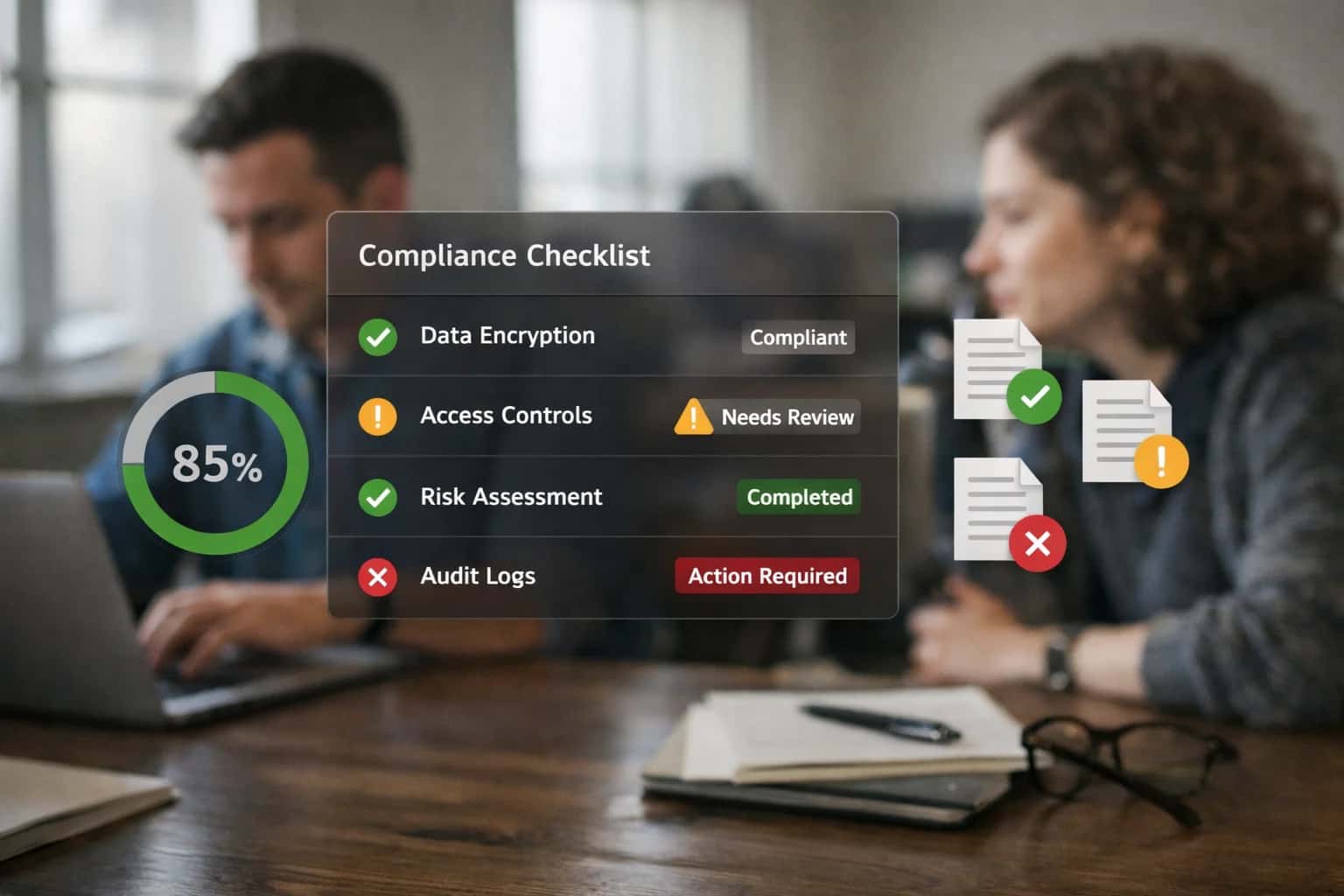
AI serves as the dynamic intelligence layer for the VelocityEHS Compliance Management System, automating the identification, assignment, and verification of obligations.
For workflow automation, AI orchestrates the Compliance Calendar and Action Tracking workflows. When a new or updated obligation is identified, the AI evaluates its attributes—regulatory body, deadline, affected site, required evidence—to auto-generate tasks, assign them to the correct compliance owner based on RBAC rules, and set priority. High-impact use cases include automated gap analysis against existing controls, drafting initial action plans for review, and triggering evidence collection workflows via integrations with document management or IoT sensor platforms.
Governance is critical. A production implementation typically uses a queued architecture where AI-generated obligations and tasks enter a human-in-the-loop review queue before being committed to the live VelocityEHS database. All AI actions are logged in the system's audit trail with a distinct source: AI_Agent and a link to the source regulatory text or finding. Rollout follows a phased approach: start with a single regulatory domain (e.g., OSHA) and a pilot site, validate AI accuracy and task relevance, then scale to additional regulations and geographic footprints, continuously tuning prompts and confidence thresholds based on user feedback and closure rates.
PLATFORM SURFACES
Key VelocityEHS CMS Surfaces for AI Integration
The Central Registry for AI-Driven Gap Analysis
The Compliance Obligations Register is the core data model for tracking regulatory requirements, permits, and internal policies. AI integration here focuses on automating the initial population and continuous monitoring of this register.
Key integration surfaces include:
- Obligation API Endpoints: For programmatically creating, updating, and querying compliance records.
- Regulatory Text Parsing: Using AI to ingest new regulatory documents (EPA, OSHA, state rules) and map clauses to existing obligations, automatically creating new records or flagging changes to existing ones.
- Gap Analysis Engine: An AI layer that compares the current state of controls, procedures, and evidence in other VelocityEHS modules against each obligation to generate a real-time, prioritized action plan.
This transforms the register from a static list into a dynamic intelligence hub that drives the entire compliance program.
COMPLIANCE MANAGEMENT SYSTEM
High-Value AI Use Cases for VelocityEHS CMS
Integrate AI as an intelligence layer for the VelocityEHS Compliance Management System (CMS) to automate the identification, tracking, and verification of obligations. These use cases target the core workflows where AI can reduce manual review, accelerate risk assessment, and ensure continuous compliance.
01
Automated Regulatory Change Impact Analysis
AI continuously monitors and parses new regulations, agency guidance, and internal policies. It maps new requirements to your existing obligations, controls, and procedures within the CMS, generating a prioritized gap analysis and recommended action items for compliance officers. This moves impact assessment from a quarterly manual review to a continuous, automated workflow.
Weeks -> Hours
Impact assessment time
02
Intelligent Obligation Tracking & Task Assignment
AI extracts specific tasks, deadlines, and responsible parties from regulatory texts and permits, auto-populating the CMS obligation register. It dynamically assigns tasks based on role, location, and expertise, and sends predictive alerts for upcoming deadlines. This ensures no obligation slips through the cracks and optimizes workload distribution across the EHS team.
Batch -> Real-time
Obligation management
03
AI-Powered Proof-of-Compliance Package Assembly
For internal audits or regulatory inspections, AI assembles evidence packages on-demand. It queries the CMS and connected systems to pull relevant records—training completions, inspection reports, monitoring data, corrective actions—and generates a structured, audit-ready narrative. This turns a multi-day manual scramble into a same-day, click-to-generate process.
Days -> Same Day
Audit preparation
04
Dynamic Compliance Risk Scoring & Prioritization
AI creates a live risk score for each compliance obligation by analyzing internal performance data (past violations, audit findings, overdue tasks) against external factors (regulatory scrutiny, site complexity). The CMS dashboard prioritizes high-risk items, enabling compliance managers to focus mitigation efforts where they matter most and forecast potential exposure.
05
Automated Regulatory Reporting Draft Generation
AI automates the initial draft of mandatory reports (e.g., Tier II, Form R, EPA GHG). It aggregates data from the CMS chemical inventory, emissions modules, and training records, validates it against reporting thresholds, and populates the correct forms. This reduces manual data consolidation and minimizes transcription errors, giving specialists more time for review and analysis.
Hours -> Minutes
First draft creation
06
Cross-Module Compliance Workflow Orchestration
AI orchestrates multi-step compliance processes that span different VelocityEHS modules. For example, when a new chemical is approved, AI can trigger a cascade: update the chemical inventory, assign required SDS training, schedule initial exposure monitoring, and add review tasks to the industrial hygiene calendar. This ensures end-to-end process integrity without manual handoffs.
IMPLEMENTATION PATTERNS
Example AI-Augmented Compliance Workflows
These workflows illustrate how AI agents, powered by large language models, can be integrated into the VelocityEHS Compliance Management System to automate high-effort tasks, reduce manual review, and ensure obligations are tracked and verified. Each pattern connects to specific CMS modules, APIs, and data objects.
Trigger: A new or updated regulation (e.g., OSHA 1910.269, EPA NPDES rule) is published to a monitored regulatory feed or database.
AI Agent Action:
- The agent ingests the regulatory text and metadata (jurisdiction, industry, effective date).
- It uses an LLM to perform a semantic comparison against the company's master list of obligations stored in the VelocityEHS
Compliance Obligationsmodule. - The LLM identifies new requirements, modified clauses, and rescinded items.
System Update:
- The agent creates or updates
Obligationrecords in VelocityEHS via API, tagging them with[NEW],[MODIFIED], or[RESCINDED]status. - For each new/modified obligation, it suggests links to relevant internal
Policies,Procedures, andControl Measuresby searching the CMS document repository. - It auto-generates a draft Gap Analysis Report in the
Action Plansmodule, outlining required updates to programs, training, and monitoring.
Human Review Point: A compliance officer reviews the generated obligations and the gap analysis report for accuracy before approving and assigning action items to responsible parties.
AI AS THE INTELLIGENCE LAYER FOR VELOCITYEHS
Implementation Architecture: Data Flow and Integration Points
A practical blueprint for integrating AI into the VelocityEHS Compliance Management System (CMS) to automate obligation tracking and verification.
The integration architecture connects AI agents directly to the VelocityEHS CMS data model via its REST API and webhook system. Key integration points include the Obligations and Requirements modules for core compliance tracking, the Action Tracking system for task management, and the Document Control repository for evidence. AI models are deployed as a secure, containerized service that polls for new regulatory updates, ingested documents, or pending verification tasks, processes them, and writes structured outputs—like newly identified obligations, assigned action items, or compliance status updates—back into the appropriate VelocityEHS records.
A typical workflow begins when a new regulatory document (e.g., a revised OSHA standard) is uploaded to the CMS. An AI agent parses the text, cross-references it against the company's existing Facility, Process, and Chemical Inventory records to determine applicability, and then creates or updates specific Compliance Obligation records. For each obligation, the agent can draft a verification plan, auto-assign it to the relevant site EHS coordinator based on RBAC rules, and populate the Action Tracking queue with due dates. This shifts the workflow for compliance officers from manual review and data entry to review and validation, often reducing the time to identify and assign new requirements from days to hours.
Governance and rollout are critical. We implement a human-in-the-loop approval step for all AI-generated obligations and actions before they are committed to the live system. All AI activity is logged to a dedicated Audit Trail object, creating a transparent record of the source data, the AI's reasoning (via traceability features), and the human reviewer. The initial rollout typically focuses on a single, high-volume regulatory domain (e.g., air permits or safety training records) within a pilot facility. This allows for tuning the AI's classification logic against your specific data before scaling the integration across the entire VelocityEHS CMS footprint, ensuring the AI acts as a reliable, governed copilot for your compliance team.
VELOCITYEHS COMPLIANCE MANAGEMENT
Code and Payload Examples
Automating Regulatory Text to Structured Obligations
AI ingests new regulatory documents (e.g., OSHA eCFR updates, state rulemakings) and parses them into structured obligations within VelocityEHS. The system identifies the regulated entity, required actions, deadlines, and applicable facilities. This payload shows the AI service returning a parsed obligation for creation via the VelocityEHS Compliance Obligations API.
json{ "source_document": "OSHA 1910.147(c)(4)(i)", "parsed_obligation": { "title": "Lockout/Tagout: Energy Control Procedure", "description": "The employer shall establish a program consisting of energy control procedures...", "regulation_code": "29 CFR 1910.147(c)(4)(i)", "jurisdiction": "Federal OSHA", "required_action": "Develop, document, and utilize procedures for the control of potentially hazardous energy.", "applicable_sites": ["Plant_A", "Plant_B"], "assigned_role": "EHS Manager", "deadline_type": "ongoing", "category": "Safety" } }
This structured data is then posted to the VelocityEHS API to create or update a compliance task, ensuring the CMS is always current.
AI-ENHANCED COMPLIANCE WORKFLOWS
Realistic Time Savings and Operational Impact
How AI integration transforms manual, reactive compliance tasks into automated, proactive workflows within the VelocityEHS Compliance Management System.
| Workflow / Task | Before AI | After AI | Key Notes |
|---|---|---|---|
Regulatory Change Impact Analysis | Manual review of updates by specialists (hours per change) | Automated alerting with initial gap analysis (minutes per change) | AI filters thousands of updates to relevant obligations; human reviews AI summary |
Compliance Obligation Tracking | Spreadsheet or checklist updates across sites (weekly effort) | Dynamic register auto-updated from audit/incident data (daily sync) | AI correlates findings and actions to obligations, flags gaps |
Audit Finding Categorization & Triage | Manual reading and tagging of each finding (15-30 mins each) | AI-powered NLP categorization and severity scoring (2-3 mins each) | Ensures consistent taxonomy, surfaces systemic issues faster |
Corrective Action Plan (CAPA) Drafting | Investigator writes narrative and tasks from scratch (1-2 hours) | AI suggests action items and owners based on similar past CAPAs (20-30 mins) | Accelerates closure, improves plan quality with historical data |
Compliance Report Generation (e.g., internal status) | Manual data pull from multiple modules, consolidation (half-day to full day) | AI aggregates data, drafts narrative, highlights risks (1-2 hours) | Report consistency improves; frees specialists for analysis |
Audit Schedule Optimization | Annual planning based on fixed cycles or manager intuition | AI-driven risk-based scheduling using compliance history and operational data | Focuses audit resources on highest-risk areas, improves coverage |
Proof-of-Compliance Package Assembly | Manual collection of evidence records for external audits (days of effort) | AI identifies and compiles relevant records from system modules (hours of effort) | Reduces pre-audit scramble, ensures evidence is current and linked |
ARCHITECTING FOR ENTERPRISE CONTROL
Governance, Security, and Phased Rollout
A production AI integration for VelocityEHS requires a governance-first architecture that respects compliance data sensitivity and enables controlled, value-driven adoption.
Implementation begins by mapping AI access to specific VelocityEHS Compliance Management System objects and modules. A secure middleware layer, often deployed within your cloud tenancy, acts as a policy-enforcing broker. It uses service accounts with granular, read-only API permissions—initially targeting modules like Compliance Obligations, Tasks, Documents, and Audit Findings—to extract and vectorize relevant text for analysis without ever modifying source data. All queries and AI-generated outputs (e.g., gap analyses, action plans) are logged with full audit trails, linking back to the source obligation ID, user, and timestamp.
A phased rollout is critical for user adoption and risk management. Phase 1 typically focuses on a single, high-value workflow, such as AI-assisted Regulatory Change Impact Analysis. Here, the AI parses new regulatory text, cross-references it against your registered obligations in VelocityEHS, and drafts a preliminary impact assessment for compliance officer review. Phase 2 expands to Automated Evidence Gathering, where the AI scans linked document repositories and past audit records to suggest proof of compliance for specific obligations. Each phase includes a parallel human-in-the-loop review stage, allowing the team to validate AI accuracy and refine prompts before broadening access.
Security is engineered at multiple levels: data in transit to LLM providers (like OpenAI or Azure OpenAI) is encrypted, and sensitive payloads can be redacted or processed through private endpoints. The system enforces your existing VelocityEHS Role-Based Access Control (RBAC); a site manager only sees AI insights for their facility's obligations. Governance workflows are built into the integration itself—for example, any AI-generated task or action plan created in VelocityEHS can be configured to require a Compliance Manager's approval before it becomes active, ensuring final human accountability for all compliance decisions.
Enabling Efficiency, Speed & Accuracy
Intelligent Analysis, Decision & Execution
We build AI systems for teams that need search across company data, workflow automation across tools, or AI features inside products and internal software.
Talk to Us
Search across company data
Give teams answers from docs, tickets, runbooks, and product data with sources and permissions.
Useful when people spend too long searching or get different answers from different systems.
Enterprise searchRAGPermissions
Read more
Automate internal workflows
Use AI to route work, draft outputs, trigger actions, and keep approvals and logs in place.
Useful when repetitive work moves across multiple tools and teams.
AI agentsWorkflow automationGovernance
Read more
Add AI to products and internal tools
Build assistants, guided actions, or decision support into the software your team or customers already use.
Useful when AI needs to be part of the product, not a separate tool.
AI integrationDecision supportModel routing
Read moreAI INTEGRATION WITH VELOCITYEHS
FAQ: Technical and Commercial Questions
Common questions from EHS leaders, IT architects, and compliance officers evaluating AI integration for the VelocityEHS Compliance Management System (CMS).
Integration is achieved through a secure, API-first layer that sits alongside your VelocityEHS instance. The primary touchpoints are:
- Compliance Obligation API: Pulls obligation records (regulatory citations, permit conditions, internal policies) for AI analysis and automated tracking.
- Action Tracking API: Enables AI to create, assign, and update corrective actions or tasks based on its analysis of gaps or findings.
- Document Management API: Allows AI to retrieve policies, procedures, and audit evidence, and to store generated reports or gap analyses.
- Webhook Subscriptions: VelocityEHS can push events (e.g., new regulatory update ingested, audit scheduled) to trigger AI workflows.
Example Payload for Obligation Analysis:
jsonPOST /ai-workflow/analyze-obligation { "obligation_id": "OBL-2024-EPA-001", "source_text": "40 CFR 262.11...", "applicable_facilities": ["Plant-12"], "current_controls": ["SOP-12", "Training-2023"] }
The AI layer processes this, cross-references it with your internal control library, and returns a gap assessment directly to the VelocityEHS action tracking module.

About the author
Prasad Kumkar
CEO & MD, Inference Systems
Prasad Kumkar is the CEO & MD of Inference Systems and writes about AI systems architecture, LLM infrastructure, model serving, evaluation, and production deployment. Over 5+ years, he has worked across computer vision models, L5 autonomous vehicle systems, and LLM research, with a focus on taking complex AI ideas into real-world engineering systems.
His work and writing cover AI systems, large language models, AI agents, multimodal systems, autonomous systems, inference optimization, RAG, evaluation, and production AI engineering.
LinkedIn
Limited slotsGet a Free AI Consultation
Partnered with leading AI, data, and software stack.





How We Work
Custom AI workflows for your Business
One-fit-all AI don't work for modern businesses. At Inferensys, we aim to understand your business & custom requirements; which we use to define most efficient agentic workflows, the data, and the tools for your business.
01
Review the use case
We understand the task, the users, and where AI can actually help.
Read more02
Pick the right approach
We define what needs search, automation, or product integration.
Read more03
Build the first useful version
We implement the part that proves the value first.
Read more04
Improve from there
We add the checks and visibility needed to keep it useful.
Read moreThe first call is a practical review of your use case and the right next step.
Talk to Us