AI connects to Intelex through its core data objects and automation layer, primarily focusing on the Compliance Obligations, Tasks, Documents, and Audit Findings modules. The integration acts on three key surfaces: 1) Data Ingestion via APIs to parse regulatory updates, internal policies, and audit evidence; 2) Workflow Automation within Intelex's native task engine to generate, assign, and track compliance actions; and 3) User Interface augmentation, providing copilot-style assistance for compliance officers drafting reports or reviewing obligations.

Integration
AI Integration for Intelex Compliance Automation
Automate routine compliance tracking, reporting, and documentation in Intelex with AI, freeing EHS specialists for higher-value analysis and program improvement.
ARCHITECTURE AND ROLLOUT
Where AI Fits into Intelex Compliance Workflows
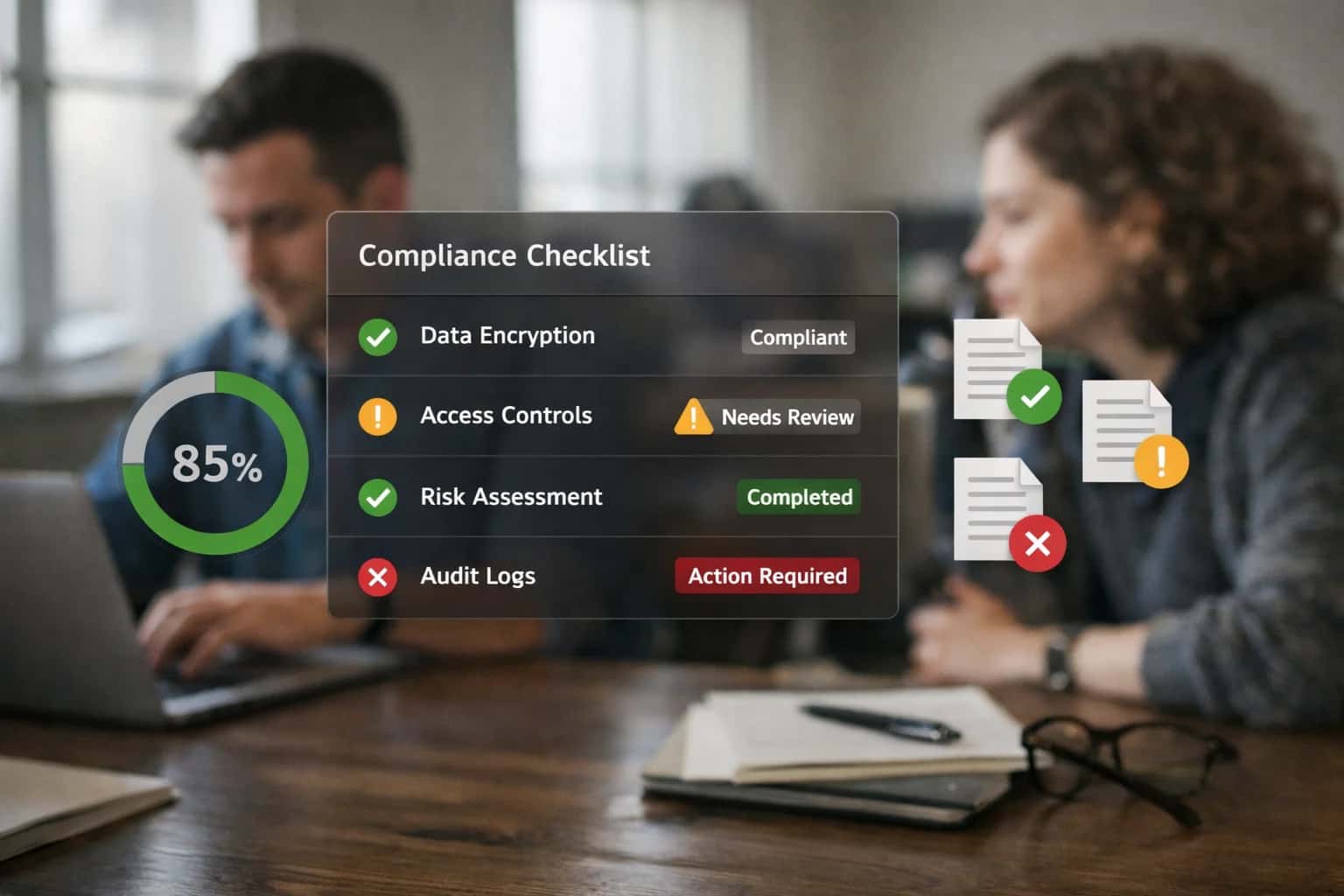
AI integration for Intelex targets the manual, repetitive tasks in compliance tracking, reporting, and documentation, freeing specialists for strategic program improvement.
A typical implementation wires a secure middleware layer between Intelex's REST API and an AI service. For example, a new regulatory text is ingested, an LLM analyzes it against existing obligations in the Compliance_Library object, and automatically creates gap analysis tasks with suggested owners and due dates in the Tasks module. For audit support, AI can pre-fill Audit_Checklist items by retrieving relevant Document_Control records and past Findings, reducing preparation from days to hours. Governance is critical: all AI-generated content is flagged in the Audit_Trail, and key outputs—like a draft compliance report—route through a human-in-the-loop approval workflow before final submission.
Rollout follows a phased, risk-based approach. Start with a single, high-volume workflow like automating the monthly compliance calendar update to demonstrate value and establish trust. Next, expand to AI-assisted audit evidence compilation, where the system retrieves and summarizes required documents (Permits, Training_Records, Inspection_Reports). Finally, implement predictive analytics on the Findings object to identify systemic compliance risks. This staged method allows teams to validate output quality, adjust RBAC for AI-generated tasks, and scale without disrupting existing Intelex configurations or user certifications.
COMPLIANCE AUTOMATION
Key Intelex Modules and Surfaces for AI Integration
Automating the Audit Lifecycle
The Audit Management module is a prime surface for AI to reduce planning overhead and improve audit quality. AI can analyze historical findings, compliance history, and operational risk scores to dynamically generate the annual audit schedule, prioritizing high-risk sites and processes.
During execution, AI assists auditors by:
- Auto-generating checklists based on the audit scope and applicable regulations.
- Providing real-time document retrieval during site visits, pulling relevant policies, past reports, and certificates.
- Using NLP to categorize free-text findings and suggest severity ratings, ensuring consistency.
Post-audit, AI can cluster findings to identify systemic issues, track recurrence rates, and automatically draft executive summaries, transforming raw data into actionable intelligence for compliance officers.
AUTOMATE ROUTINE TASKS, ELEVATE SPECIALIST WORK
High-Value AI Use Cases for Intelex Compliance
Integrating AI into Intelex transforms compliance from a reactive, manual process into a proactive, automated workflow. These use cases target specific modules and data objects to reduce administrative burden, accelerate reporting, and free compliance officers for strategic program improvement.
01
Automated Regulatory Change Impact Analysis
AI monitors regulatory feeds and internal policy libraries, automatically mapping new requirements to existing controls, procedures, and permits within Intelex. It generates a gap analysis report and recommends updates to the Compliance Obligation register, prioritizing actions based on risk and deadline.
Weeks -> Hours
Impact assessment time
02
Intelligent Audit Finding Categorization & Clustering
As audit findings are logged in Intelex, NLP analyzes free-text descriptions to auto-assign categories, severity, and regulatory references. AI clusters similar findings across audits to identify systemic issues, tracks recurrence rates, and measures the long-term effectiveness of Corrective Action (CAPA) plans.
Batch -> Real-time
Finding analysis
03
AI-Powered Compliance Calendar & Task Management
AI parses permit conditions, regulatory deadlines, and recurring task requirements (e.g., annual reports, training refreshers) to auto-populate and dynamically prioritize the Compliance Calendar. It generates task reminders, assigns owners based on role, and escalates overdue items, all within Intelex workflows.
Manual → Automated
Deadline tracking
04
Document Intelligence for Evidence Packages
For internal or external audits (e.g., ISO 14001), AI scans the Document Control module. It identifies and retrieves relevant policies, procedures, training records, and inspection reports to auto-assemble evidence packages. It can also simulate auditor questioning by mapping requirements to system records.
Days -> 1 Sprint
Audit preparation
05
Automated Environmental & Safety Report Drafting
AI aggregates data from Intelex modules (Emissions, Waste, Incidents, Training) and performs required calculations (e.g., TRI, GHG, OSHA 300A). It generates first-draft narratives for mandatory regulatory reports, highlighting trends and anomalies, with all data traceable back to source records for audit readiness.
Hours -> Minutes
Report generation
06
Predictive Compliance Risk Scoring
AI creates a dynamic risk score for each site, process, or permit by analyzing combined data from incidents, audit findings, overdue actions, and training compliance within Intelex. This predictive model helps optimize the annual audit plan and direct compliance resources to the highest-risk areas before violations occur.
Reactive → Proactive
Risk management
AI-ORCHESTRATED WORKFLOWS FOR INTELEX
Example Automated Compliance Workflows
These are concrete, production-ready examples of how AI agents and automations can be wired into Intelex to handle routine compliance tasks. Each workflow connects to specific Intelex objects, APIs, and user roles, demonstrating a practical path from manual process to intelligent automation.
Trigger: A new or updated regulation (e.g., OSHA standard, EPA rule) is published to a monitored regulatory feed.
Workflow:
- Ingestion & Parsing: An AI agent ingests the regulatory text and uses an LLM to extract key obligations, deadlines, affected industries, and chemical/substance references.
- Context Retrieval: The agent queries Intelex via its API to pull relevant context:
Compliance Obligationsrecords tagged with similar regulations.Chemical Inventoryfor matching substances.SiteandProcessdata to assess applicability.- Existing
PoliciesandProcedures.
- Impact Analysis & Gap Creation: The LLM compares the new requirements against the retrieved context. It generates a structured impact report and, for each gap, automatically creates:
- A new
Action Itemin Intelex, assigned to the relevantCompliance Manager. - A draft
Procedureupdate in the Document Control module. - An entry in the
Compliance Calendarwith the regulatory deadline.
- A new
- Notification & Routing: The workflow triggers an alert in Intelex and sends a summary email to the assigned manager and EHS leadership, with a link to the full analysis and pending actions.
Human Review Point: The Compliance Manager reviews the auto-generated gap analysis and action items for accuracy before proceeding with implementation.
HOW AI INTEGRATES WITH INTELEX'S COMPLIANCE ENGINE
Implementation Architecture: Data Flow and Guardrails
A production-ready integration connects AI to Intelex's data model and workflow engine to automate compliance tasks without disrupting existing processes.
The integration architecture typically connects via Intelex's REST API and webhook infrastructure. An external AI service acts as a middleware layer, listening for events like the creation of a new Compliance Obligation record, the upload of a regulatory document, or the update of an Action Item status. Key data objects—Obligations, Tasks, Documents, Audit Findings—are synchronized in near-real-time. The AI layer processes this data to perform functions like regulatory text analysis, deadline extraction, and automated task drafting, then posts the results back to Intelex as structured updates, new Action records, or enriched document metadata.
Critical guardrails are implemented at multiple points. Before any AI-generated task or document is created in Intelex, it passes through a human-in-the-loop approval step, configured within Intelex's native workflow rules. All AI interactions are logged in a dedicated audit trail object, capturing the source data, prompt, model used, and output for compliance review. Data governance is enforced via field-level security and role-based access controls (RBAC) native to Intelex, ensuring AI only accesses and modifies records permitted for the automated service account. For sensitive data, a zero-retention policy can be configured on the AI side, processing data in-memory without persisting it externally.
Rollout follows a phased approach, starting with a single, high-volume compliance workflow—such as automating the tracking of new permit conditions—within a pilot site or business unit. This allows for tuning of prompts, validation of output quality, and integration with existing approval queues and notification schemes. Success is measured by the reduction in manual data entry hours and the acceleration of the compliance calendar's update cycle from days to same-day. The architecture is designed to scale horizontally, adding new AI use cases—like automated gap analysis for audit findings or draft regulatory report generation—as modular services that plug into the same secure middleware layer.
INTELEX COMPLIANCE AUTOMATION
Code and Payload Examples
Parsing New Regulations into Structured Records
When a new regulatory document (e.g., a Federal Register notice) is added to Intelex's Document Control module, an AI workflow can parse it to extract specific obligations. This creates structured ComplianceTask records, linking them to relevant sites, processes, and responsible parties.
Example JSON Payload for a Created Task:
json{ "taskType": "REGULATORY_UPDATE", "sourceDocumentId": "DOC-2024-EPA-12345", "title": "Update SPCC Plan for New Secondary Containment Rule", "description": "EPA final rule 40 CFR 112.7(c) requires revised calculations for secondary containment capacity at all tank farms. AI extracted requirement from FR Vol. 89, No. 123.", "regulatoryCitation": "40 CFR 112.7(c)", "applicableSites": ["SITE-US-TX-01", "SITE-US-LA-03"], "assignedToRole": "EHS_Manager", "dueDate": "2024-11-30", "priority": "HIGH", "linkedModule": "spcc_plans" }
This payload can be posted to the Intelex Tasks API, automatically populating the compliance calendar and action tracking system.
AI-ASSISTED COMPLIANCE OPERATIONS
Realistic Time Savings and Operational Impact
How AI integration transforms manual, reactive compliance tasks into automated, proactive workflows within Intelex, freeing specialists for strategic program improvement.
| Compliance Workflow | Before AI | After AI | Implementation Notes |
|---|---|---|---|
Regulatory Change Impact Analysis | Manual review of updates by specialist | AI-scanned alerts with relevance scoring & gap summaries | Specialist reviews AI-highlighted changes; reduces search time by ~70% |
Compliance Calendar & Deadline Tracking | Manual entry from emails/websites; spreadsheet tracking | AI auto-populates deadlines from parsed regulatory texts | Ensures no missed deadlines; calendar syncs with Intelex task module |
Evidence Package Compilation for Audits | Days of manual document collection and organization | AI retrieves & tags relevant records from Intelex modules | Audit-ready packages generated in hours; includes version control |
Routine Compliance Report Generation (e.g., monthly metrics) | Manual data pull, consolidation in Excel, narrative drafting | AI aggregates data, drafts narrative, flags anomalies | Report cycle reduced from days to hours; human final review required |
Corrective Action (CAPA) Plan Drafting from Findings | Manual write-up based on investigator notes | AI suggests action items, assigns owners based on role/rules | Accelerates CAPA initiation; plan quality more consistent |
Permit Condition Monitoring & Expiration Alerts | Manual log of permit documents; calendar reminders | AI extracts conditions, links to monitoring data, predicts renewals | Proactive alerts 90-120 days out; reduces risk of lapse |
Document Control & Procedure Updates | Manual review for impacted documents during changes | AI maps regulatory changes to affected policies/procedures | Targeted update lists created; reduces oversight risk |
ARCHITECTING CONTROLLED AUTOMATION
Governance, Security, and Phased Rollout
Integrating AI into Intelex compliance workflows requires a deliberate approach to data security, change management, and operational control.
A production-ready architecture for Intelex compliance automation typically involves a secure middleware layer that sits between Intelex's APIs and the AI service. This layer handles authentication via Intelex's OAuth or API keys, manages rate limits, and orchestrates data flow. Key data objects like Compliance Obligations, Audit Findings, Tasks, and Document records are retrieved, processed, and updated. The AI service—whether a hosted LLM or a fine-tuned model—should never store Intelex data persistently, operating in a stateless manner with all prompts and responses logged to a secure audit trail for compliance review.
Rollout follows a phased, risk-based approach. Phase 1 focuses on read-only automation, such as using AI to analyze new regulatory text and auto-suggest mappings to existing Obligations and Control records in Intelex. Phase 2 introduces assisted writing for Corrective Action plans and Audit Report drafts, with a mandatory human-in-the-loop review and approval step within Intelex's workflow engine before any system of record is updated. Phase 3 expands to conditional automation for routine tasks, like auto-creating and assigning Tasks for recurring permit renewals, but only after validation rules and exception thresholds are met.
Governance is anchored in Intelex's existing role-based access control (RBAC). AI-generated actions and content inherit the permissions of the initiating user or service account. A dedicated AI-Generated flag should be added to relevant records, and all automated modifications should be captured in Intelex's native audit log. This ensures traceability for internal audits and regulatory inquiries. Start with a pilot on a low-risk compliance area, such as tracking training certificate expirations, to validate the integration pattern, measure time savings, and refine guardrails before scaling to more complex workflows like environmental reporting or management of change (MOC).
Enabling Efficiency, Speed & Accuracy
Intelligent Analysis, Decision & Execution
We build AI systems for teams that need search across company data, workflow automation across tools, or AI features inside products and internal software.
Talk to Us
Search across company data
Give teams answers from docs, tickets, runbooks, and product data with sources and permissions.
Useful when people spend too long searching or get different answers from different systems.
Enterprise searchRAGPermissions
Read more
Automate internal workflows
Use AI to route work, draft outputs, trigger actions, and keep approvals and logs in place.
Useful when repetitive work moves across multiple tools and teams.
AI agentsWorkflow automationGovernance
Read more
Add AI to products and internal tools
Build assistants, guided actions, or decision support into the software your team or customers already use.
Useful when AI needs to be part of the product, not a separate tool.
AI integrationDecision supportModel routing
Read moreAI INTEGRATION FOR INTELEX
Frequently Asked Questions
Practical questions from EHS leaders and IT architects planning to add AI-driven automation to Intelex compliance workflows.
AI integration typically connects at three key layers of Intelex:
- API Layer: We use Intelex's REST API to read and write data to core objects like
Compliance Obligations,Tasks,Documents, andFindings. This is the primary method for triggering automations and updating records. - Event/Webhook Layer: For real-time reactions, we configure Intelex to send webhook notifications for events like a new
Obligationbeing created, aTaskdeadline approaching, or aDocumentbeing uploaded. An AI agent listens and processes these events. - Document Storage: For analyzing policy PDFs, regulatory text, or audit evidence, we securely access documents stored in Intelex's repository via API, process them with AI, and attach summaries or extracted data back to the relevant record.
Example Payload for Reading an Obligation:
jsonGET /api/v2/compliance/obligations/{id} { "title": "EPA TRI Reporting - Facility A", "description": "Annual Toxics Release Inventory report due July 1.", "status": "Open", "dueDate": "2024-07-01", "assignedTo": "user123", "relatedDocuments": ["doc456"] }
The AI uses this context to generate task breakdowns or draft reports.

About the author
Prasad Kumkar
CEO & MD, Inference Systems
Prasad Kumkar is the CEO & MD of Inference Systems and writes about AI systems architecture, LLM infrastructure, model serving, evaluation, and production deployment. Over 5+ years, he has worked across computer vision models, L5 autonomous vehicle systems, and LLM research, with a focus on taking complex AI ideas into real-world engineering systems.
His work and writing cover AI systems, large language models, AI agents, multimodal systems, autonomous systems, inference optimization, RAG, evaluation, and production AI engineering.
LinkedIn
Limited slotsGet a Free AI Consultation
Partnered with leading AI, data, and software stack.





How We Work
Custom AI workflows for your Business
One-fit-all AI don't work for modern businesses. At Inferensys, we aim to understand your business & custom requirements; which we use to define most efficient agentic workflows, the data, and the tools for your business.
01
Review the use case
We understand the task, the users, and where AI can actually help.
Read more02
Pick the right approach
We define what needs search, automation, or product integration.
Read more03
Build the first useful version
We implement the part that proves the value first.
Read more04
Improve from there
We add the checks and visibility needed to keep it useful.
Read moreThe first call is a practical review of your use case and the right next step.
Talk to Us