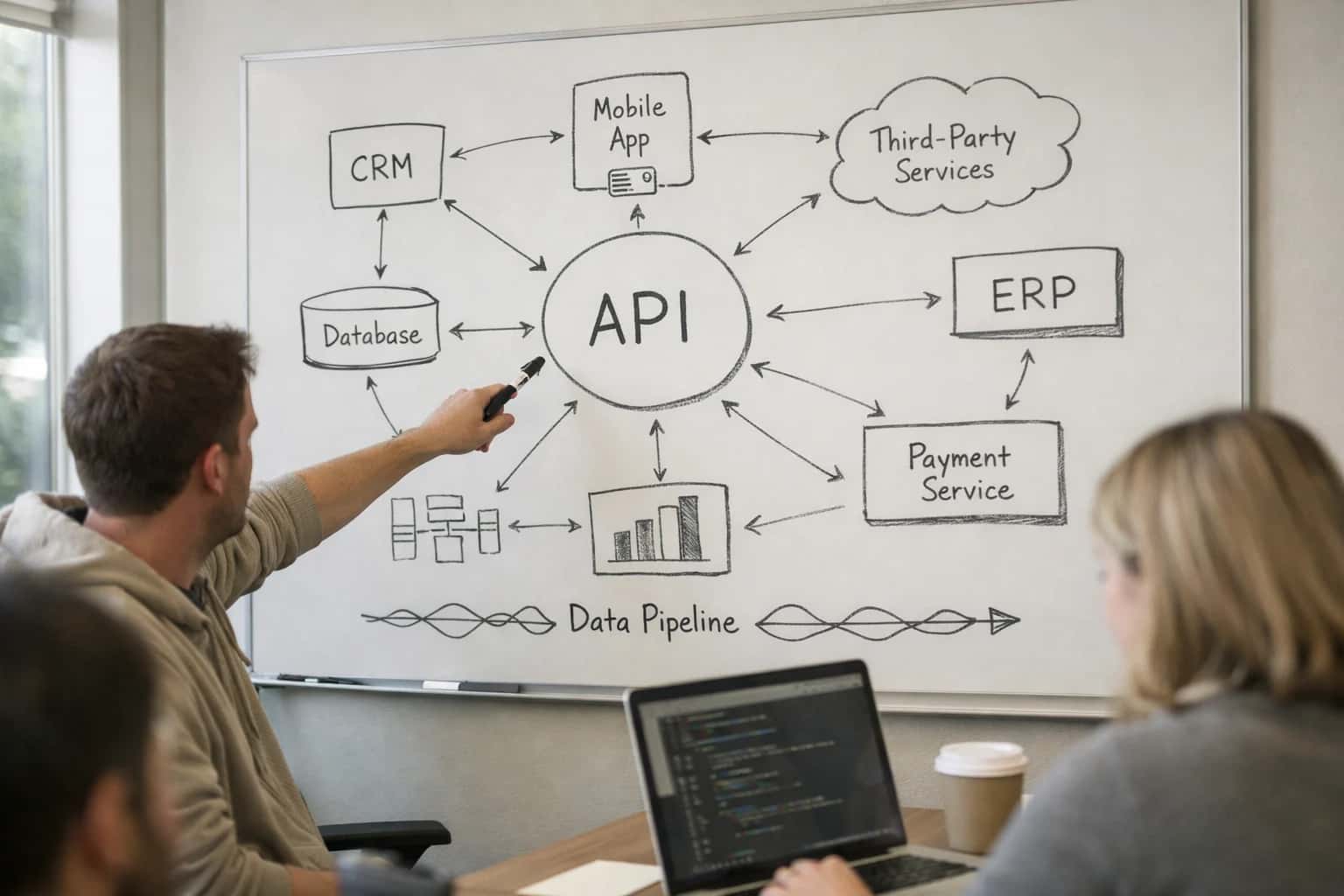
AI integration connects to Cority's core ORM data model—primarily the Risk Register, Control Library, and Incident modules—to automate risk aggregation and prioritization. Instead of relying on periodic, qualitative assessments, an AI agent can continuously analyze incoming data from connected systems: new incidents from the EHS module, audit findings from compliance, maintenance work orders from asset integrity, and process safety events. It uses this stream to dynamically update risk scores, correlate seemingly isolated events into systemic risk patterns, and flag control failures before they lead to a major loss event. The integration typically sits as a middleware service, subscribing to Cority webhooks for new records and using the Cority REST API to write back updated risk scores, recommended actions, and generated narratives.

Integration
AI Integration for Cority Operational Risk
Where AI Fits in Cority Operational Risk Management
Integrating AI into Cority's Operational Risk Management (ORM) modules creates a dynamic, predictive layer on top of static risk registers and manual assessments.
For implementation, focus starts with the unified risk view. An AI model is trained or prompted to understand your specific risk taxonomy (e.g., process safety, environmental, human factors) and scoring methodology. It then performs three key workflows: 1) Automated Risk Identification, parsing incident reports and audit findings to suggest new risks for the register; 2) Predictive Risk Scoring, using historical loss data and leading indicators to forecast which rated risks are most likely to materialize; and 3) Mitigation Recommendation, analyzing the control library to suggest additional or enhanced controls for high-priority risks, potentially creating linked action items in Cority's action tracking module. The impact is moving risk management from a quarterly review cycle to a daily operational practice, allowing teams to allocate mitigation resources where they will have the greatest effect on reducing enterprise-wide exposure.
Rollout requires a phased, governance-first approach. Begin with a pilot on a single risk category (e.g., process safety risks at one facility) to tune the AI's output against expert judgment. Establish a clear human-in-the-loop approval step in Cority's workflow engine for any AI-suggested risk register changes before they go live. Governance must also address model transparency; each AI-generated risk score or recommendation should have an audit trail in Cority showing the source data (e.g., 'Score updated based on analysis of Incident COR-2024-187 and Audit FAC-24-003'). This ensures the system remains explainable for internal audits and regulatory reviews. Finally, integrate the AI's outputs into Cority's dashboard and reporting modules to provide risk leaders with an always-current, AI-explained view of top enterprise risks, shifting the conversation from "what happened" to "what might happen next."
Key Cority Modules and Data Surfaces for AI Integration
The Central Risk Object
The Cority Risk Register is the primary surface for AI integration. Each risk record contains structured fields (likelihood, severity, inherent/residual scores, control effectiveness) and critical unstructured data in the description, impact analysis, and mitigation plan fields.
AI can automate the initial population and ongoing enrichment of these records by:
- Ingesting and correlating data from linked incidents, audits, inspections, and change management records to dynamically update risk scores.
- Generating narrative summaries for new risks, synthesizing information from source documents into a consistent format for reviewers.
- Recommending control measures based on historical data of what has been effective for similar risks across the enterprise.
This transforms the register from a static list into an intelligent, living system that reflects real-time operational conditions.
High-Value AI Use Cases for Operational Risk
Integrating AI into Cority's Operational Risk Management module transforms static risk registers into dynamic, predictive systems. These use cases focus on aggregating and analyzing cross-functional risk data to prioritize enterprise-wide mitigation.
Automated Risk Register Population & Scoring
AI continuously ingests findings from incident reports, audits, inspections, and safety observations across Cority modules. It maps these to the central operational risk register, de-duplicates entries, and applies dynamic qualitative and quantitative scoring based on likelihood, severity, and control effectiveness. This moves risk updates from a quarterly manual process to a real-time, data-driven workflow.
Cross-Module Risk Correlation & Systemic Issue Detection
AI analyzes patterns across disparate data sources—linking a spike in maintenance work orders, a cluster of near-miss reports in a specific area, and recent audit findings on procedure adherence. It identifies latent systemic risks (e.g., a failing piece of equipment causing multiple hazard types) that would be missed in siloed reviews, enabling proactive mitigation before a major incident occurs.
AI-Powered Risk Treatment & Mitigation Planning
For each high-priority risk in the register, AI suggests mitigation actions by referencing historical data on what controls were effective for similar risks. It drafts treatment plans, estimates resource requirements, and can even auto-populate corrective action (CAPA) tasks in linked modules. This turns risk identification into actionable, traceable workflows.
Predictive Risk Heat Maps & Scenario Modeling
Beyond current state, AI models 'what-if' scenarios (e.g., impact of a new process, a regulatory change, or a key control failure). It generates predictive risk heat maps for sites or business units, allowing leadership to visualize and allocate resources to future risk hotspots. These models update automatically as new incident or performance data flows in.
Automated Risk & Control Performance Reporting
AI compiles executive and board-level reports on operational risk posture. It pulls data from the risk register, control performance metrics, and mitigation progress to generate narrative summaries, trend analyses, and data visualizations. This automates the manual consolidation typically required for management review cycles and regulatory disclosures.
Regulatory Change Impact Analysis on Risk Profile
When new regulations are published, AI parses the text and cross-references it against the operational risk register and associated controls. It flags which existing risks become more severe, identifies new compliance risks, and recommends updates to risk assessments and treatment plans. This ensures the risk management system stays aligned with the legal landscape.
Example AI-Driven Risk Workflows
These workflows illustrate how AI agents can automate risk consolidation, analysis, and mitigation within Cority's operational risk modules, moving from reactive data entry to proactive, unified risk intelligence.
Trigger: Daily scheduled job or a new risk entry in any connected module (Incident, Audit, Inspection, MOC).
Context Pulled: The agent queries Cority APIs for new or updated risk records across:
- EHS Module: Incident reports, safety observations.
- Process Safety Module: PHA/LOPA studies, SIF (Safety Instrumented Function) performance data.
- Asset Integrity Module: Inspection findings, predictive maintenance alerts.
- Compliance Module: New regulatory changes, audit non-conformances.
Agent Action:
- Normalizes disparate risk descriptions into a standard taxonomy.
- Calculates a Unified Risk Score using a configurable model that weighs factors like:
Unified Score = (Inherent Severity * Likelihood) + (Number of Linked Records) + (Regulatory Criticality) - Clusters similar risks from different sources to eliminate duplicates and show systemic issues.
- Generates a Prioritized Action List for the risk owner, suggesting whether to accept, treat, transfer, or monitor.
System Update: Updates the master Operational Risk Register in Cority with the consolidated view, new scores, and recommended priority flags. Sends a daily digest email to risk managers.
Human Review Point: The risk owner must review and confirm the AI's priority assignment and action recommendation before the risk is officially promoted in the register.
Implementation Architecture: Data Flow and AI Layer
A practical blueprint for integrating AI into Cority's Operational Risk Management workflows, focusing on data orchestration, secure tool calling, and actionable insights.
The integration architecture connects Cority's operational risk data model—including Risk Registers, Control Assessments, Incident Reports, and Audit Findings—to a dedicated AI inference layer. This is achieved via Cority's REST API and webhook system, which streams risk object updates (like a new high-severity finding or a control effectiveness rating change) to a secure middleware queue. The AI layer, built on platforms like Azure OpenAI or Anthropic Claude, processes these events. It uses Retrieval-Augmented Generation (RAG) against a vector store populated with your company's historical risk data, control libraries, and policy documents to ground its analysis in your specific operational context.
For a unified risk view, the AI agent performs cross-module correlation. For example, when a new process safety incident is logged, the agent can automatically query related asset integrity records, past audit non-conformances for the same equipment, and mitigation actions from the risk register. It then generates a consolidated risk briefing, prioritizes enterprise-wide mitigation efforts, and suggests updates to the risk scoring model. These outputs are posted back to Cority as draft Risk Action Items or enriched Risk Assessment narratives, triggering standard Cority approval and assignment workflows without disrupting existing governance.
Rollout follows a phased approach, starting with read-only analysis of historical data to validate insights, then progressing to assisted drafting for risk assessments, and finally to automated, policy-governed updates for high-confidence, low-risk recommendations. Governance is enforced through a human-in-the-loop review step for all AI-generated actions before they are committed to Cority, with a full audit trail logging the source data, AI prompt, and resulting output. This architecture ensures the AI acts as a copilot, augmenting the risk manager's judgment while keeping Cority as the single source of truth. For related architectural patterns, see our guide on [/integrations/environmental-health-and-safety-platforms/ai-integration-for-cority-risk-assessment](AI Integration for Cority Risk Assessment) and [/integrations/environmental-health-and-safety-platforms/ai-integration-with-velocityehs-risk-management](AI Integration with VelocityEHS Risk Management).
Code and Payload Examples
Pulling Unified Risk Data
To build a unified operational risk view, an AI service first needs to aggregate risk data from across Cority modules like Incident Management, Audits, and Asset Integrity. This Python example uses a hypothetical Cority REST API to fetch and combine risk records for AI analysis. The payload includes filters for risk score, status, and source module to ensure the AI receives a relevant, actionable dataset.
pythonimport requests import json # Example: Fetch risks from multiple Cority modules for AI consolidation cority_api_base = "https://your-instance.cority.com/api/v1" headers = { "Authorization": "Bearer YOUR_API_TOKEN", "Content-Type": "application/json" } # Define payload to get high-priority, open risks from last 90 days risk_payload = { "filters": { "risk_score_min": 15, # Medium-High and High risks "status": ["Open", "In Progress"], "date_range": {"start": "2024-01-01", "end": "2024-03-31"}, "source_modules": ["Incident", "Audit", "ProcessSafety", "Asset"] }, "fields": [ "id", "title", "description", "source_module", "source_record_id", "risk_score", "likelihood", "severity", "controls", "assigned_to", "due_date" ] } response = requests.post( f"{cority_api_base}/risks/query", headers=headers, data=json.dumps(risk_payload) ) unified_risks = response.json() # This unified dataset is now ready for AI prioritization and mitigation planning.
Realistic Time Savings and Business Impact
This table illustrates the practical impact of integrating AI into Cority's Operational Risk Management workflows, focusing on time savings, process improvements, and risk mitigation for enterprise teams.
| Workflow / Metric | Before AI Integration | After AI Integration | Key Impact & Notes |
|---|---|---|---|
Risk Register Consolidation | Manual aggregation across EHS, Process Safety, and Asset modules | Automated data ingestion and entity resolution | Reduces consolidation from days to hours; ensures a single source of truth |
Risk Scoring & Prioritization | Qualitative workshops and subjective scoring every quarter | Dynamic, quantitative scoring updated with new incident/audit data | Shifts from periodic to continuous prioritization; focuses resources on top 20% of risks |
Mitigation Plan Drafting | Manual creation of action plans based on templates | AI-assisted generation of control recommendations and task assignments | Cuts plan development from 4-6 hours to 30-60 minutes per risk |
Enterprise Risk Reporting | Manual data pull, slide deck creation for leadership reviews | Automated report generation with narrative summaries and trend analysis | Prepares monthly risk reviews in hours instead of days; enables data-driven Q&A |
Control Effectiveness Monitoring | Periodic manual checks and sample-based audits | Continuous correlation of risk indicators with control performance data | Provides early warning of control degradation; moves from reactive to predictive |
Regulatory Change Impact Assessment | Manual review of regulatory updates against risk library | AI-powered mapping of new regulations to existing risks and controls | Reduces assessment time from weeks to days; improves compliance posture proactively |
Risk Treatment Cost-Benefit Analysis | Spreadsheet modeling for major capital projects | AI-driven scenario modeling for mitigation options and ROI forecasts | Enables rapid evaluation of 3-5 treatment options per risk, supporting better investment decisions |
Governance, Security, and Phased Rollout
A practical approach to implementing AI for Cority Operational Risk that prioritizes control, auditability, and measurable impact.
An AI integration for Cority Operational Risk must be architected to respect the platform's existing data model and security framework. This means connecting via Cority's REST APIs to read from and write to core objects like RiskRegister, Control, MitigationAction, and associated Incident or Audit records. All AI-generated outputs—such as risk narratives, aggregated scores, or mitigation recommendations—should be written back as system notes or draft fields, preserving a full audit trail and requiring explicit user approval before finalizing any automated changes to the risk register. Access is governed by Cority's native role-based permissions, ensuring AI insights are only surfaced to users with the appropriate view/edit rights for that risk data.
A phased rollout is critical for adoption and risk management. A typical implementation starts with a read-only analysis phase, where AI reviews existing risk assessments to generate consistency reports and identify gaps, providing value without altering live data. The next phase introduces assistive drafting, where AI suggests unified risk descriptions and control mappings as users create or update records. The final phase enables predictive prioritization, where AI correlates incoming data from EHS, process safety, and asset modules to dynamically adjust risk scores and flag emerging enterprise threats. Each phase includes human-in-the-loop checkpoints and is accompanied by change management support for risk managers and site leads.
Security is paramount when integrating external AI models with sensitive operational risk data. We recommend a zero data retention policy with the LLM provider, using payload anonymization techniques for any data sent externally, and implementing a private inference endpoint for organizations with strict data sovereignty requirements. All AI interactions should be logged within Cority or a separate governance platform for traceability. This controlled approach allows teams to harness AI for a unified risk view while maintaining the integrity, security, and compliance posture expected of a system like Cority.
Enabling Efficiency, Speed & Accuracy
Intelligent Analysis, Decision & Execution
We build AI systems for teams that need search across company data, workflow automation across tools, or AI features inside products and internal software.
Talk to Us
Search across company data
Give teams answers from docs, tickets, runbooks, and product data with sources and permissions.
Useful when people spend too long searching or get different answers from different systems.

Automate internal workflows
Use AI to route work, draft outputs, trigger actions, and keep approvals and logs in place.
Useful when repetitive work moves across multiple tools and teams.

Add AI to products and internal tools
Build assistants, guided actions, or decision support into the software your team or customers already use.
Useful when AI needs to be part of the product, not a separate tool.
Frequently Asked Questions
Common questions about implementing AI to unify and prioritize enterprise-wide operational risk within Cority, connecting EHS, process safety, and asset integrity data.
The integration uses Cority's API layer and a scheduled ingestion process to unify risk-related data objects. A typical data flow includes:
-
API Calls & Webhooks: Scheduled jobs pull from key modules:
incident_managementfor incident severity, root causes, and recurrence.risk_assessmentfor qualitative/quantitative risk scores and control ratings.audit_managementfor audit findings and non-conformance status.asset_integrityfor equipment condition and inspection overdue flags.process_safetyfor PHA/LOPA results and safety system status.
-
Data Harmonization: AI agents normalize disparate risk scores (e.g., converting a 5x5 matrix score and a "High/Medium/Low" rating into a unified numerical scale) and tag data with standard entity identifiers (Site ID, Process Unit, Asset Tag).
-
Vectorization for Context: Critical text fields—like incident narratives, audit findings, and risk assessment descriptions—are chunked and embedded into a vector store. This enables the AI to perform semantic search across all risk data when generating unified views or answering natural language queries about risk correlations.

About the author
Prasad Kumkar
CEO & MD, Inference Systems
Prasad Kumkar is the CEO & MD of Inference Systems and writes about AI systems architecture, LLM infrastructure, model serving, evaluation, and production deployment. Over 5+ years, he has worked across computer vision models, L5 autonomous vehicle systems, and LLM research, with a focus on taking complex AI ideas into real-world engineering systems.
His work and writing cover AI systems, large language models, AI agents, multimodal systems, autonomous systems, inference optimization, RAG, evaluation, and production AI engineering.
Partnered with leading AI, data, and software stack.





How We Work
Custom AI workflows for your Business
One-fit-all AI don't work for modern businesses. At Inferensys, we aim to understand your business & custom requirements; which we use to define most efficient agentic workflows, the data, and the tools for your business.
01
Review the use case
We understand the task, the users, and where AI can actually help.
Read more02
Pick the right approach
We define what needs search, automation, or product integration.
Read more03
Build the first useful version
We implement the part that proves the value first.
Read more04
Improve from there
We add the checks and visibility needed to keep it useful.
Read moreThe first call is a practical review of your use case and the right next step.
Talk to Us