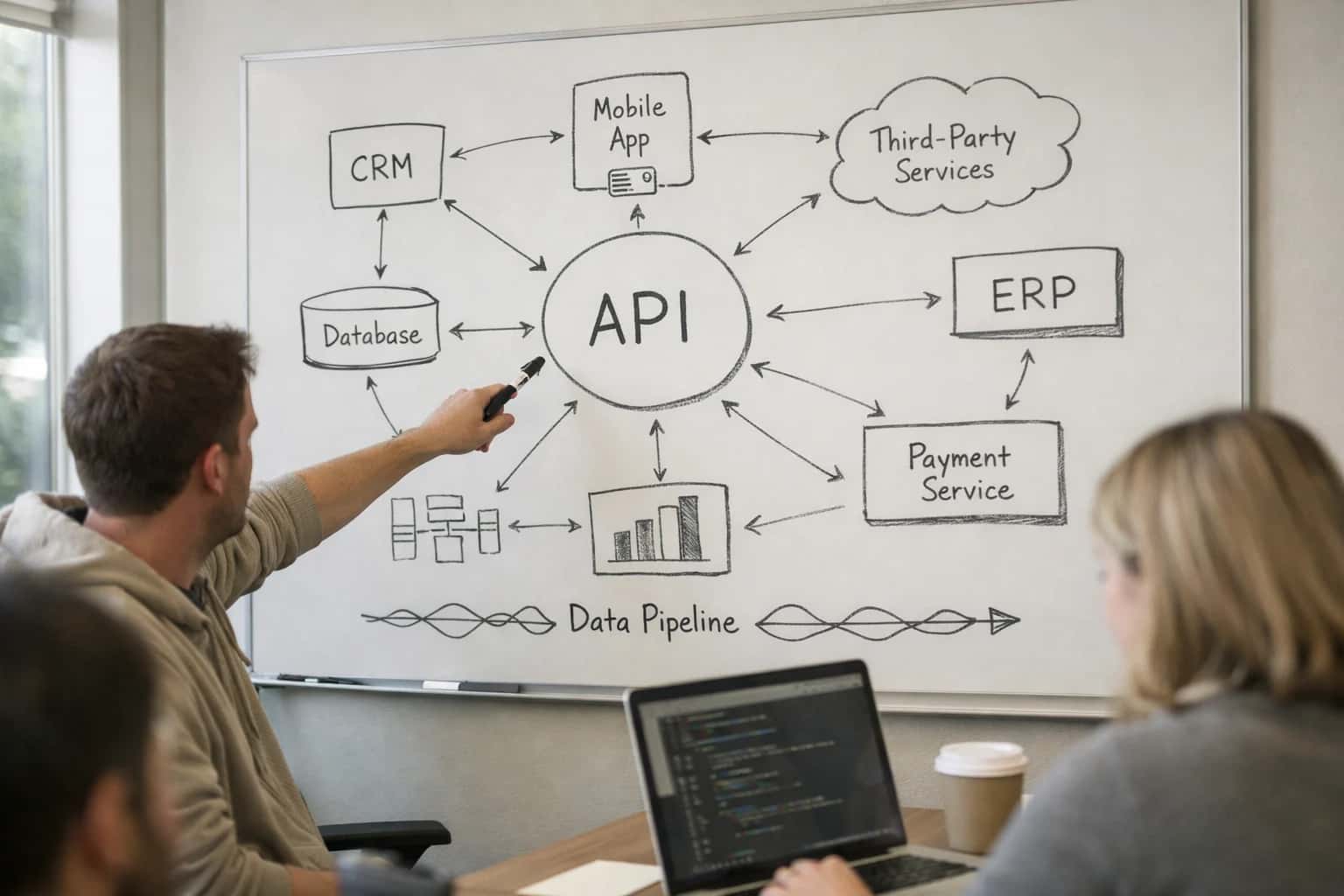
AI integration for cash flow forecasting connects directly to the transactional heart of your ERP—primarily the Accounts Receivable (AR), Accounts Payable (AP), and General Ledger (GL) modules in platforms like SAP S/4HANA, Oracle Cloud ERP, NetSuite, and Infor. The integration surfaces at three key layers: 1) Data Ingestion, where APIs (like SAP's OData, NetSuite's SuiteTalk, or Oracle REST APIs) pull real-time invoice, payment, and open item data; 2) Prediction Engine, where models analyze historical payment patterns, customer/vendor risk signals, and seasonal trends; and 3) Action Layer, where results are written back to the ERP as forecast records, dashboard alerts in Fiori or custom workspaces, or recommended actions in treasury workbenches.

Integration
AI Integration for ERP Cash Flow Forecasting
Where AI Fits into ERP Cash Flow Management
A practical guide to embedding AI into ERP Accounts Receivable, Accounts Payable, and Treasury modules to build a dynamic, predictive view of liquidity.
The core workflow begins by aggregating open AR invoices, customer credit limits, and payment term history to predict daily cash inflows, while simultaneously analyzing AP due dates, vendor discounts, and purchase commitments to model outflows. AI agents can then simulate scenarios—like delaying a vendor payment by one week or prioritizing collection calls for a specific customer segment—and project the impact on the daily cash position over a 30-90 day horizon. For treasury managers, this moves reporting from a static, rear-view snapshot to a dynamic, forward-looking instrument for deciding on short-term investments, debt drawdowns, or intercompany funding.
A production rollout typically follows a phased approach: start with a read-only pilot that generates forecasts in a separate dashboard without touching live ERP data, focusing on a single entity or currency. After validating accuracy against actuals, phase two writes forecast objects back to a custom ERP table or treasury module and triggers low-risk automated actions, like generating a dunning list for overdue invoices. The final phase integrates with payment proposal workflows in the ERP's cash management module, suggesting optimal payment batches to preserve liquidity. Governance is critical: establish an override protocol where AI recommendations above a threshold require treasury analyst approval, and maintain a full audit trail linking every forecasted amount back to the source ERP transactions and model version.
ERP Modules and APIs for Cash Flow Data
AR, AP, and Treasury Data Surfaces
Cash flow forecasting requires real-time access to transactional data from three primary ERP modules:
- Accounts Receivable (AR): The primary source for cash inflows. Key objects include
Customer,Invoice,Payment, andCredit Memo. APIs must retrieve open invoice balances, payment terms, and aging reports to model collection timing. - Accounts Payable (AP): The primary source for cash outflows. Key objects include
Vendor,Purchase Order,Invoice, andPayment Proposal. Integration focuses on extracting invoice due dates, discount terms, and committed spend to predict payment obligations. - Treasury & Cash Management: The system of record for actual cash positions. This module provides
Bank Accountbalances,Cash Pooldata, andForecastentries. APIs here are used to validate AI predictions against actuals and to initiate recommended payment or transfer actions.
Integrating with these modules via REST or SOAP APIs (e.g., NetSuite's SuiteTalk, SAP's OData for S/4HANA) allows an AI agent to build a daily, rolling 13-week cash position model.
High-Value AI Use Cases for Treasury Teams
Integrate AI directly with your ERP's AR, AP, and treasury modules to move from reactive cash positioning to proactive liquidity intelligence. These use cases connect real-time transactional data with predictive models to forecast, explain, and act.
Predict Short-Term Cash Flow Gaps
AI models continuously analyze ERP payment proposals, open receivables, and purchase order commitments to generate rolling 13-week cash forecasts. The system flags predicted shortfalls with reasoning (e.g., 'Large vendor payment due before key customer payment clears'), allowing proactive action.
Optimize Payment Timing & Discount Capture
An AI agent reviews ERP vendor invoices and payment terms, models daily cash positions, and recommends which invoices to pay early to capture discounts versus which to defer. It generates a daily payment priority list within the treasury workstation or AP module.
Prioritize Collections with Payment Likelihood Scoring
Integrate AI with the ERP Accounts Receivable subledger to score each open invoice based on customer payment history, recent interactions, and external signals. Collections teams receive a daily worklist ranked by risk and potential impact, with suggested communication templates.
Automate Cash Flow Variance Explanation
Instead of manually investigating forecast vs. actual variances, an AI copilot connected to ERP GL and transaction details automatically generates a narrative report. It explains major variances (e.g., 'Actual cash out was 15% higher due to accelerated tax payment not in forecast').
Dynamic Liquidity Buffer Recommendation
AI analyzes historical cash flow volatility, upcoming ERP-payroll runs, and market conditions to recommend an optimal daily target cash balance for operating accounts. This integrates with treasury management systems to inform short-term investment or borrowing decisions.
Automated Intercompany Netting & Settlement
For groups with multiple ERP instances, AI analyzes intercompany payable/receivable balances across entities, suggests optimal netting cycles, and can draft settlement instructions. This reduces external banking fees and manual reconciliation effort for the treasury team.
Example AI Agent Workflows for Cash Forecasting
These workflows illustrate how AI agents connect to ERP AR, AP, and treasury modules via APIs to automate cash flow analysis, predict liquidity gaps, and recommend actions. Each pattern includes the trigger, data context, agent action, and system update.
Trigger: Scheduled job runs each morning at 6 AM local time.
Context/Data Pulled:
- From ERP AR Module: Open invoices (
customer_id,due_date,amount,customer_payment_terms). - From ERP AP Module: Approved payables (
vendor_id,due_date,amount,discount_terms). - From Treasury/Bank Module: Current bank balances via bank feed API.
- External Context: Upcoming payroll batch amount from HCM system, known large customer payment confirmations from previous day's emails.
Agent Action:
- Models expected cash inflows using historical on-time payment rates per customer segment.
- Models expected cash outflows, prioritizing payments by due date and available discounts.
- Runs a Monte Carlo simulation to generate a probabilistic 7-day cash forecast.
- Flags any day where the probability of a liquidity shortfall exceeds a configurable threshold (e.g., 15%).
System Update/Next Step:
- A summary forecast and alert are posted to a dedicated channel in Microsoft Teams/Slack for the treasury team.
- A detailed forecast record is written to a custom
cash_forecast_snapshotobject in the ERP via REST API, preserving the model's assumptions for audit. - If a shortfall is predicted, the agent suggests specific actions (e.g., "Delay payment VEND-4567 ($50k) by 2 days to avoid overdraft").
Implementation Architecture: Data Flow and AI Layer
A production-ready blueprint for connecting AI to ERP transactional modules to generate dynamic cash flow forecasts.
The integration architecture connects to three primary ERP data surfaces: Accounts Receivable (AR) modules for open invoices and payment terms, Accounts Payable (AP) modules for outstanding obligations and vendor terms, and the General Ledger (GL) for historical cash positions and bank transaction feeds. Data is pulled via the ERP's native REST or SOAP APIs (e.g., NetSuite's SuiteTalk, SAP's OData for S/4HANA, Oracle Cloud ERP's Financials REST APIs) on a scheduled or event-driven basis, focusing on objects like CustomerInvoice, VendorBill, BankStatement, and CashBalance. This raw transactional data is staged in a secure, intermediate data layer.
The core AI forecasting layer operates on this staged data. A time-series model ingests historical cash-in and cash-out patterns, while a classification model analyzes invoice and bill attributes (customer/vendor, size, aging, terms) to predict likely payment dates, moving beyond simple due-date logic. This layer is often built using a vector database (like Pinecone or Weaviate) to store and rapidly retrieve similar historical transaction patterns for comparison. The system generates a rolling 13-week forecast, highlighting predicted liquidity gaps and surpluses, and can trigger alerts or recommended actions—such as prioritizing collection calls on specific invoices or proposing optimal payment dates to capture early-pay discounts—back to the ERP or a treasury dashboard.
Governance and rollout are critical. Implementations typically start with a read-only pilot, delivering forecasts to treasury managers via a separate dashboard or embedded within the ERP using Fiori apps or NetSuite Suitelets. The AI's recommendations are presented as suggestions requiring approval, creating an audit trail. As confidence grows, the system can be granted limited write-back permissions, such as auto-updating a CashForecast custom record in the ERP or posting a journal entry to accrue for a predicted shortfall. Role-based access ensures only authorized treasury and finance personnel can view or act on forecasts, and all AI-driven recommendations are logged with the underlying data rationale for explainability during audits.
Code and Payload Examples
Fetching AR/AP Data for Forecasting
To build a cash flow forecast, your AI service first needs access to transactional data from the ERP's Accounts Receivable and Accounts Payable modules. This is typically done via REST APIs or OData services.
Example: NetSuite SuiteTalk REST API Call
This Python snippet retrieves open invoices and bills within a date range, which are core inputs for a short-term cash flow model.
pythonimport requests import json # NetSuite REST API headers for authentication headers = { 'Authorization': 'Bearer YOUR_ACCESS_TOKEN', 'Content-Type': 'application/json', 'Prefer': 'respond-async' } # Query for open transactions (Invoices and Vendor Bills) query_payload = { "q": "SELECT id, tranid, type, duedate, amount FROM Transaction " \ "WHERE type IN ('Invoice', 'VendBill') " \ "AND status = 'Open' " \ "AND duedate BETWEEN '2024-07-01' AND '2024-09-30'" } response = requests.post( 'https://YOUR_ACCOUNT.suitetalk.api.netsuite.com/services/rest/query/v1/suiteql', headers=headers, json=query_payload ) transactions = response.json()['items'] # Pass this structured data to your forecasting model
The returned JSON array provides the due dates and amounts needed to project daily cash in/out flows.
Realistic Time Savings and Business Impact
This table illustrates the operational and strategic impact of integrating AI with ERP cash flow modules, moving from manual, periodic analysis to a dynamic, predictive system.
| Process / Metric | Before AI Integration | After AI Integration | Implementation Notes |
|---|---|---|---|
Short-Term Cash Forecast Generation | 2-4 hours manual spreadsheet work, weekly | Automated daily refresh in <15 minutes | AI ingests ERP AR/AP/GL data, external bank feeds, and payment history |
Liquidity Gap Detection | Reactive, identified during weekly review | Proactive alerts 3-5 days in advance | AI models predict timing mismatches between inflows and outflows |
Collection Strategy Prioritization | Manual aging report review, generic dunning | AI-scored customer list with recommended contact approach | Factors in payment history, relationship value, and recent communications |
Payment Timing Optimization | Standard payment runs, missed early-pay discounts | Dynamic payment scheduling to maximize discounts & preserve cash | AI evaluates vendor terms, discount windows, and current cash position |
Forecast Variance Analysis | Manual investigation of major discrepancies post-period | Automated root-cause attribution with narrative | AI explains forecast vs. actual differences (e.g., 'Large customer X paid 2 days late') |
Treasury Reporting Preparation | Half-day monthly to compile slides and commentary | Automated executive summary & key metric slides in 30 minutes | AI generates narrative insights from forecast data and trend analysis |
Initial Model Training & Calibration | N/A (Manual Process) | Pilot Phase: 2-3 weeks of historical data ingestion | Requires 12-24 months of historical ERP transactional data for baseline accuracy |
Governance, Security, and Phased Rollout
A pragmatic approach to deploying AI-driven cash flow forecasting with the controls and oversight finance demands.
A production integration touches sensitive financial data across General Ledger (GL), Accounts Receivable (AR), and Accounts Payable (AP) modules. Governance starts with a clear data access model: the AI agent should operate via a dedicated service account with role-based access control (RBAC) scoped to read-only access on transactional tables (e.g., CUST_TRX, AP_INVOICES, GL_JE) and write access only to a dedicated forecast staging table or custom object. All API calls between your ERP (like NetSuite's SuiteTalk or SAP's OData services) and the inference layer must be logged with a correlation ID for a full audit trail, linking every forecast adjustment back to the source data and model reasoning.
Rollout should follow a phased, risk-managed path. Phase 1 is a parallel run: the AI generates forecasts in a sandbox environment while treasury managers continue their existing process. This builds trust and provides a baseline for accuracy. Phase 2 introduces a human-in-the-loop approval: the system proposes a daily cash position forecast, highlighting predicted shortfalls and recommended actions (e.g., "Delay payment to Vendor X by 3 days"), which a manager must review and approve before any data is written back to the ERP. Phase 3 moves to fully automated updates for high-confidence predictions, with configurable thresholds and exception queues for manual review.
Security is non-negotiable. All data in transit must be encrypted, and prompts containing financial context should never be sent to a third-party LLM without strict data masking. A private inference endpoint, using a model fine-tuned on your industry's cash flow patterns, is ideal. Furthermore, the system should be designed for explainability: for every forecast, the agent must be able to cite the top contributing factors (e.g., "Based on 15% higher than average invoices due from Customer Segment Y next Tuesday"). This transparency is critical for audit compliance and user adoption. For a deeper dive on securing AI access to financial systems, see our guide on AI Governance for ERP Platforms.
Enabling Efficiency, Speed & Accuracy
Intelligent Analysis, Decision & Execution
We build AI systems for teams that need search across company data, workflow automation across tools, or AI features inside products and internal software.
Talk to Us
Search across company data
Give teams answers from docs, tickets, runbooks, and product data with sources and permissions.
Useful when people spend too long searching or get different answers from different systems.

Automate internal workflows
Use AI to route work, draft outputs, trigger actions, and keep approvals and logs in place.
Useful when repetitive work moves across multiple tools and teams.

Add AI to products and internal tools
Build assistants, guided actions, or decision support into the software your team or customers already use.
Useful when AI needs to be part of the product, not a separate tool.
Frequently Asked Questions
Common technical and operational questions for integrating AI with ERP cash flow forecasting modules in SAP, Oracle, NetSuite, and Infor.
An effective AI model needs both internal ERP data and, optionally, external signals.
Core ERP Data Feeds (via APIs/ODBC):
- Accounts Receivable: Open invoices, customer payment terms, aging reports, and historical collection patterns.
- Accounts Payable: Outstanding vendor invoices, payment terms, and scheduled payment runs.
- General Ledger: Historical cash account balances and transactional journal entries.
- Sales Order Management: Booked but unbilled revenue and order fulfillment schedules.
- Treasury Module: Existing cash positions, short-term investments, and credit facility details.
External Enrichment (Optional):
- Bank Feeds: Direct connections via APIs (e.g., Plaid, Yodlee) for real-time balance and transaction confirmation.
- Economic Indicators: Macro data (e.g., interest rates) for scenario modeling.
- Customer/Vendor Risk Data: External scores to weight collection/payment probabilities.
The integration architecture typically involves a scheduled ETL job or a change-data-capture (CDC) stream from the ERP to a dedicated analytics environment where the AI model runs. See our guide on Real-Time Analytics with AI for ERP for streaming patterns.

About the author
Prasad Kumkar
CEO & MD, Inference Systems
Prasad Kumkar is the CEO & MD of Inference Systems and writes about AI systems architecture, LLM infrastructure, model serving, evaluation, and production deployment. Over 5+ years, he has worked across computer vision models, L5 autonomous vehicle systems, and LLM research, with a focus on taking complex AI ideas into real-world engineering systems.
His work and writing cover AI systems, large language models, AI agents, multimodal systems, autonomous systems, inference optimization, RAG, evaluation, and production AI engineering.
Partnered with leading AI, data, and software stack.





How We Work
Custom AI workflows for your Business
One-fit-all AI don't work for modern businesses. At Inferensys, we aim to understand your business & custom requirements; which we use to define most efficient agentic workflows, the data, and the tools for your business.
01
Review the use case
We understand the task, the users, and where AI can actually help.
Read more02
Pick the right approach
We define what needs search, automation, or product integration.
Read more03
Build the first useful version
We implement the part that proves the value first.
Read more04
Improve from there
We add the checks and visibility needed to keep it useful.
Read moreThe first call is a practical review of your use case and the right next step.
Talk to Us