The most effective AI integration for ECM platforms like OpenText, Hyland OnBase, or Laserfiche occurs at the capture gateway—the moment a document is scanned, emailed, or uploaded. Instead of storing unstructured files and processing them later, you inject an AI agent into the ingestion pipeline. This agent, typically triggered by a platform webhook or listening to a network folder, uses a combination of computer vision and a Large Language Model (LLM) to perform three core tasks in seconds: document classification (e.g., invoice vs. contract vs. application), key data extraction (vendor name, invoice number, total amount), and metadata assignment (project ID, department, retention code). The enriched document and its extracted data are then posted via the platform's REST API (e.g., POST /api/documents) directly into the correct workspace, folder, or workflow queue with all required fields populated.

Integration
AI Integration for Smart Content Capture in Enterprise Platforms
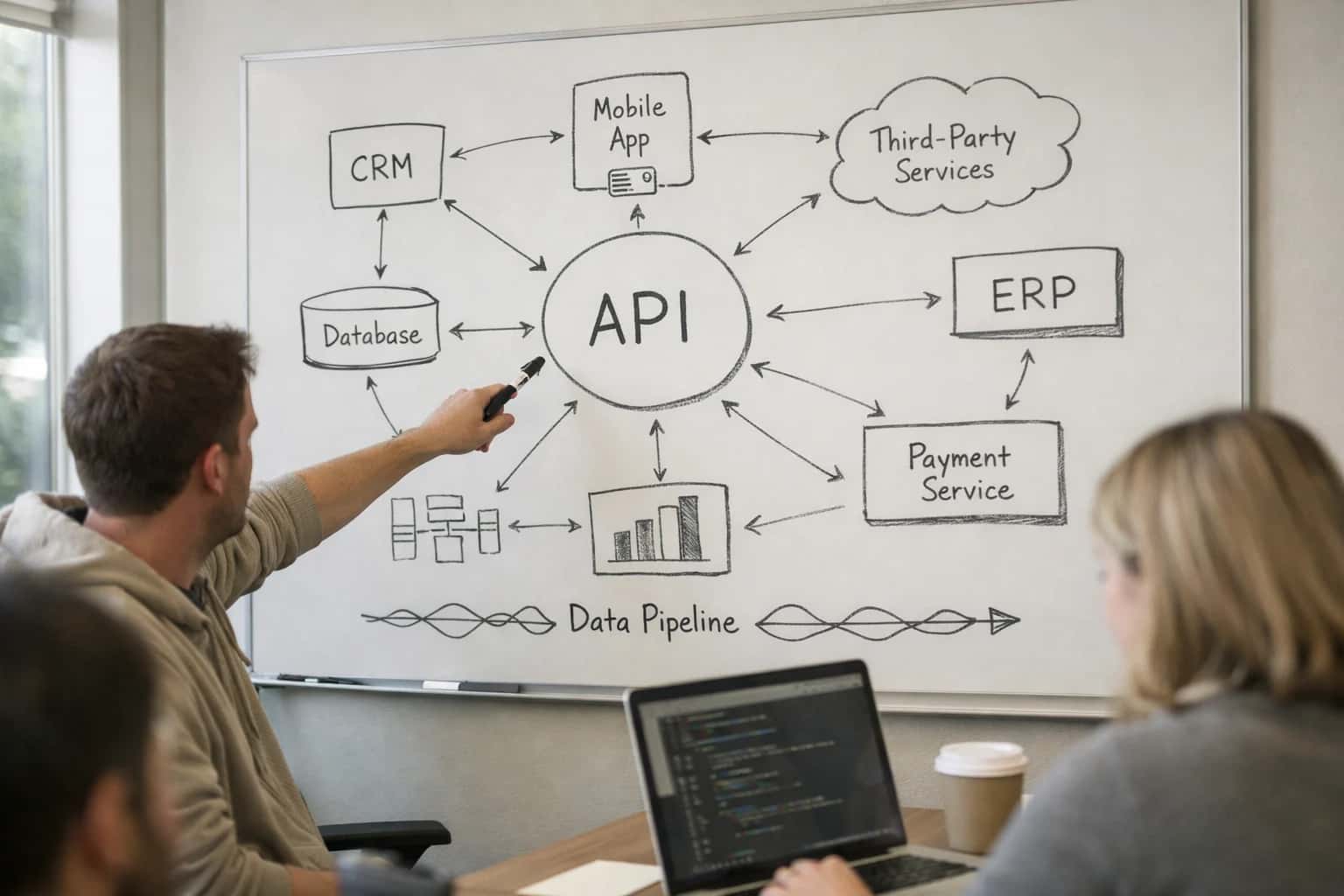
Where AI Fits in the Content Capture Pipeline
A technical blueprint for injecting AI at the point of ingestion to classify, tag, and route documents before they enter your ECM repository.
This architecture transforms downstream operations. For example, an invoice arriving via email to a shared mailbox can be automatically classified, have its line items and totals validated against a purchase order in SAP, and be routed to the correct AP clerk's queue in Hyland Perceptive Content—all before a human sees it. The implementation involves a lightweight, containerized service that sits between the capture source and the ECM platform, using event-driven patterns (via Azure Event Grid, AWS EventBridge, or a simple message queue) to ensure scalability and resilience. Critical design considerations include idempotency to handle retries, fallback logic for low-confidence classifications that route to a human review queue, and audit logging of every AI decision for compliance and model tuning.
Rollout should be phased, starting with a single, high-volume document type (like supplier invoices) to validate accuracy and ROI. Governance is paramount: establish a human-in-the-loop review panel for the first 100-200 documents to tune prompts and thresholds, and implement continuous evaluation to monitor for model drift as document formats evolve. By placing AI at the capture point, you convert raw content into structured, actionable data the moment it enters your system, eliminating manual filing and triage, and unlocking straight-through processing for compliant workflows.
Integration Touchpoints Across Major ECM Platforms
Inbound Document Channels
Smart capture begins where documents enter the platform. Each ECM provides specific APIs and event hooks at these ingestion points:
- Email Inboxes & Mailroom Scanners: Services like OpenText RightFax, Hyland Brainware mailrooms, or Laserfiche Email Import. AI can intercept inbound streams to perform OCR, classification, and initial data extraction before the document hits the repository, enabling immediate routing.
- Web Portals & Upload Widgets: Custom portals in SharePoint, Box, or OpenText Core. Integrate AI directly into the upload flow using client-side JavaScript or server-side webhooks to validate, pre-fill metadata, and flag missing information in real-time.
- Mobile Capture Apps: Native apps from Hyland, Laserfiche, or Box. AI models can run on-device or via API to guide users during capture—for example, checking photo quality, auto-cropping, and suggesting document types.
- Bulk Import Tools & Connectors: Scheduled imports from network folders, SFTP, or ERP systems (e.g., Laserfiche Connectors). Insert an AI processing step in the pipeline to transform unstructured files into indexed, classified records ready for workflow.
Implementation typically involves deploying a lightweight microservice that subscribes to platform-specific events (webhooks, watched folders, SMTP) and returns enriched metadata via REST API.
High-Value Use Cases for AI-Powered Capture
Integrating AI at the point of document ingestion transforms passive storage into active intelligence. These patterns show where to inject LLMs and computer vision into capture workflows for OpenText, Hyland, Laserfiche, SharePoint, and Box to classify, enrich, and route content immediately.
Intelligent Mailroom & Inbound Document Triage
Process scanned documents, faxes, and emailed attachments upon arrival. Use AI to classify document type (invoice, contract, application), extract key entities (vendor name, PO number, amount), and automatically route to the correct workflow queue or ERP integration point (e.g., SAP, NetSuite).
Automated Metadata Tagging & Taxonomy Alignment
Eliminate manual data entry by using AI to analyze document content and auto-populate metadata fields (client, project, document type, sensitivity). Enforce governance by mapping extracted terms to the enterprise taxonomy in the ECM's term store, ensuring consistent search and retention policy application.
Compliance Gatekeeper for Sensitive Data
Deploy AI as a security layer during upload. Scan for PII, PHI, and confidential data (credit card numbers, SSNs) within documents and images. Automatically apply classification labels, trigger redaction workflows, or enforce access policies based on content sensitivity before the file is stored.
Dynamic Forms Processing & Validation
Handle semi-structured forms (HR onboarding, patient intake, service requests) with variable layouts. Use AI to locate and extract handwritten or typed fields, cross-validate data against backend systems (e.g., validate employee ID), and flag incomplete or inconsistent submissions for immediate review.
Contract & Agreement Intake Automation
Accelerate legal and procurement workflows. At capture, AI identifies contract type (NDA, MSA, SOW), extracts key parties, dates, and clauses, and pre-populates a contract management system (like Icertis or Ironclad). Routes high-risk clauses for legal review and standard agreements for automated approval.
Quality Assurance for Scanned Archives
Integrate AI into legacy document digitization projects. As batches are scanned and OCR'd, the model checks for scan quality (skew, cut-off text), validates OCR accuracy against context, and flags low-confidence pages for rescanning before ingestion into the ECM repository, ensuring a clean, searchable archive.
Example AI Capture Workflows
These workflows illustrate how AI can be injected at the point of ingestion in platforms like OpenText, Hyland OnBase, Laserfiche, and SharePoint to classify, extract, and route documents immediately, reducing manual touchpoints from hours to minutes.
Trigger: A batch of scanned documents (PDF, TIFF) is dropped into a designated network folder or ingested via an MFP scan-to-email address.
Context/Data Pulled: The system retrieves the raw image files and any available scan session metadata (source, batch ID).
Model/Agent Action: A multi-step AI agent processes each document:
- Classification: A vision/LLM model determines the document type (e.g.,
Invoice,Purchase Order,Utility Bill). - Extraction: For invoices, a specialized extractor pulls key fields: Vendor Name, Invoice Number, Invoice Date, Total Amount, Line Items.
- Validation: Extracted data is cross-referenced against the ERP (e.g., SAP, NetSuite) via API to validate against open POs and vendor master data.
System Update/Next Step: The processed document and its enriched metadata (document type, confidence scores, extracted JSON) are written to the ECM repository (e.g., an OnBase document class or a SharePoint library with managed metadata). A workflow is automatically triggered—valid invoices route to AP for payment, exceptions route to a clerk's queue.
Human Review Point: Documents with low classification confidence (<85%) or validation mismatches (e.g., invoice total doesn't match PO) are flagged for human review in a dedicated exception handling dashboard before proceeding.
Implementation Architecture: Event-Driven AI Processing
A production-ready architecture for injecting AI at the point of document ingestion in ECM platforms.
In platforms like OpenText Documentum, Hyland OnBase, or Laserfiche, the capture process is typically triggered by a scanner, email ingestion service, or user upload. This creates an event—a new file lands in a watched folder, queue, or temporary storage area. Our integration architecture places an AI processing layer directly in this event stream. Using platform-specific APIs (e.g., OpenText Content Server Web Services, OnBase Unity API, Laserfiche REST API) or native webhooks (like Box Events or SharePoint webhooks), we subscribe to document.created or file.uploaded events. The incoming document payload—including its binary content and any initial metadata—is immediately routed to a secure, scalable processing service.
The core AI processing is handled by a containerized service that orchestrates several steps: First, document classification using a fine-tuned model or a zero-shot LLM determines the document type (e.g., invoice, contract, application form). Next, optical character recognition (OCR) is applied if needed, and then data extraction models pull out key fields (vendor name, invoice number, effective date). For complex documents, a retrieval-augmented generation (RAG) step can query a vector store of policy documents or clause libraries to validate extracted terms. The results—classification, extracted data, confidence scores—are formatted as structured JSON and posted back to the ECM platform via API to populate metadata fields, apply tags, and move the document into a classified folder or kick off a subsequent workflow.
Governance and rollout are critical. The architecture includes a human-in-the-loop review queue for low-confidence extractions, with results logged to an audit trail. Processing can be configured per document type or source, allowing a phased rollout. For on-premises ECM systems like SharePoint Server, the AI service can be deployed within the same network boundary to meet data residency requirements. This event-driven approach ensures documents are AI-ready within seconds of capture, enabling downstream workflows—like automated invoice approval in SAP or case creation in Salesforce—to act on intelligent, structured data from the start.
Code and Payload Examples
Real-Time Classification on Ingest
When an email with attachments hits a shared mailbox or ingestion service, a webhook can trigger immediate AI processing before the document is committed to the ECM repository. This pattern uses the platform's event system (e.g., Box webhooks, SharePoint event receivers) to call an AI service for classification and initial metadata extraction.
Typical Payload & Flow:
- Email ingestion service (like MuleSoft, Power Automate) receives an email with a PDF invoice attached.
- Service extracts the file and posts it, along with sender/subject context, to your AI classification endpoint.
- The AI service returns a structured JSON response with predicted document type, confidence, and extracted key fields (e.g., vendor name, invoice number, total).
- The ingestion workflow uses this data to route the file to the correct folder, apply metadata tags, and trigger a downstream accounts payable workflow.
json// Example AI Service Response Payload { "document_id": "temp_abc123", "predictions": [ { "class": "invoice", "confidence": 0.97, "extracted_data": { "vendor": "Contoso Supplies Inc.", "invoice_number": "INV-2024-04567", "date": "2024-03-15", "total_amount": 2450.00, "currency": "USD" } } ] }
Realistic Time Savings and Operational Impact
How AI integration at the point of ingestion transforms manual intake into an automated, intelligent process within ECM platforms.
| Process Step | Before AI | After AI | Operational Impact |
|---|---|---|---|
Document Classification & Routing | Manual review and folder assignment by staff | Automatic classification and workflow triggering | Eliminates intake queue; documents enter correct process in seconds |
Metadata Tagging | Manual entry of 5-10 key fields per document | AI suggests and pre-fills 80-90% of metadata | Reduces data entry time by 70%; enforces tagging consistency |
Data Extraction from Forms | Manual keying or basic OCR with high error rates | LLM validates and extracts from complex, variable layouts | Cuts extraction time from minutes to seconds; improves accuracy |
Exception Handling & Validation | Batch review by supervisors for errors and mismatches | AI flags discrepancies and suggests corrections in real-time | Shifts focus from finding errors to resolving them; accelerates throughput |
Compliance & Sensitivity Check | Periodic manual audits or rule-based scans | Real-time PII/PHI detection and policy application on ingest | Proactive risk mitigation; ensures compliance from moment of capture |
Records Declaration | Manual application of retention schedules post-filing | AI recommends retention code based on content and context | Ensures consistent, defensible records management from day one |
Content Summarization for Triage | Staff must open and skim each document to understand priority | AI generates a concise summary and urgency score on upload | Enables priority-based workflow assignment; faster response to critical items |
Governance, Security, and Phased Rollout
A production-ready AI integration for content capture requires a deliberate approach to security, data governance, and user adoption.
At the point of capture—whether via a multifunction printer scan, email ingestion service, or direct upload portal—AI models process raw, often sensitive, documents. A secure architecture isolates this processing in a dedicated, containerized service layer. This layer ingests documents via secure API calls or webhooks from the ECM platform (e.g., OpenText Capture Center, Hyland Brainware, Laserfiche Import Agent), performs classification and extraction using models deployed in a private VPC or via a Bring-Your-Own-Key Azure OpenAI endpoint, and returns structured JSON metadata. No raw document data is persisted in the AI service's logs, and all communication is encrypted in transit. The processed metadata and a pointer to the original document are then written back to the ECM repository, maintaining a single source of truth and leveraging the platform's native permissions and audit trails.
Governance is enforced through a multi-layered validation model. The primary AI classification can be configured with confidence thresholds; documents scoring below a set threshold are automatically routed to a human-in-the-loop review queue within the ECM's workflow engine (like a Laserfiche Workflow or an OnBase workflow queue). For sensitive document types—such as HR records or contracts—you can implement a second-stage "reasonableness" check, where the AI cross-references extracted data (like dates or amounts) against business rules before finalizing metadata. All AI-generated metadata fields should be clearly tagged within the ECM system (e.g., using a custom property like AI_Confidence_Score) to allow for easy auditing, correction, and model retraining based on user overrides.
A phased rollout mitigates risk and builds trust. Start with a pilot on a single, high-volume, low-risk document stream, such as vendor invoices in Accounts Payable. Use this phase to calibrate confidence thresholds, refine prompts, and establish a feedback loop where AP clerks can correct errors, directly improving the model. The second phase expands to adjacent document types within the same department (e.g., purchase orders, packing slips), leveraging lessons learned. Finally, enterprise scale-out involves deploying capture AI across departments, integrating with department-specific ECM workflows and taxonomies. Throughout, usage analytics should track straight-through processing rates, user correction frequency, and time-to-file metrics to demonstrate concrete ROI and guide ongoing optimization. For related architectural patterns, see our guide on [/integrations/enterprise-content-management-platforms/intelligent-document-processing-in-ecm-platforms](Intelligent Document Processing in ECM Platforms).
Enabling Efficiency, Speed & Accuracy
Intelligent Analysis, Decision & Execution
We build AI systems for teams that need search across company data, workflow automation across tools, or AI features inside products and internal software.
Talk to Us
Search across company data
Give teams answers from docs, tickets, runbooks, and product data with sources and permissions.
Useful when people spend too long searching or get different answers from different systems.

Automate internal workflows
Use AI to route work, draft outputs, trigger actions, and keep approvals and logs in place.
Useful when repetitive work moves across multiple tools and teams.

Add AI to products and internal tools
Build assistants, guided actions, or decision support into the software your team or customers already use.
Useful when AI needs to be part of the product, not a separate tool.
Frequently Asked Questions
Common questions from architects and operations leaders planning AI integration at the point of document ingestion.
The AI integration acts as an intelligent gatekeeper in your capture pipeline. Here’s the typical event-driven flow:
- Trigger: A document is uploaded via a web portal, email ingestion service, or scanned through a multifunction printer (MFP).
- Context Pull: The system captures minimal metadata (source, user, filename) and sends the document binary to a secure processing queue.
- AI Action: A lightweight AI model performs initial classification. It doesn't just look at file extensions; it analyzes the document's visual structure, text patterns, and content to determine its type (e.g.,
invoice,employment contract,insurance claim form,engineering drawing). - System Update: The classification result is written back to the ECM platform as metadata (e.g.,
DocumentClass=Invoice). This triggers the next step: routing the document to the correct processing workflow or folder based on its AI-determined type. - Human Review Point: A low-confidence score from the AI model can automatically route the document to a human-in-the-loop review queue within the ECM interface before proceeding.

About the author
Prasad Kumkar
CEO & MD, Inference Systems
Prasad Kumkar is the CEO & MD of Inference Systems and writes about AI systems architecture, LLM infrastructure, model serving, evaluation, and production deployment. Over 5+ years, he has worked across computer vision models, L5 autonomous vehicle systems, and LLM research, with a focus on taking complex AI ideas into real-world engineering systems.
His work and writing cover AI systems, large language models, AI agents, multimodal systems, autonomous systems, inference optimization, RAG, evaluation, and production AI engineering.
Partnered with leading AI, data, and software stack.





How We Work
Custom AI workflows for your Business
One-fit-all AI don't work for modern businesses. At Inferensys, we aim to understand your business & custom requirements; which we use to define most efficient agentic workflows, the data, and the tools for your business.
01
Review the use case
We understand the task, the users, and where AI can actually help.
Read more02
Pick the right approach
We define what needs search, automation, or product integration.
Read more03
Build the first useful version
We implement the part that proves the value first.
Read more04
Improve from there
We add the checks and visibility needed to keep it useful.
Read moreThe first call is a practical review of your use case and the right next step.
Talk to Us