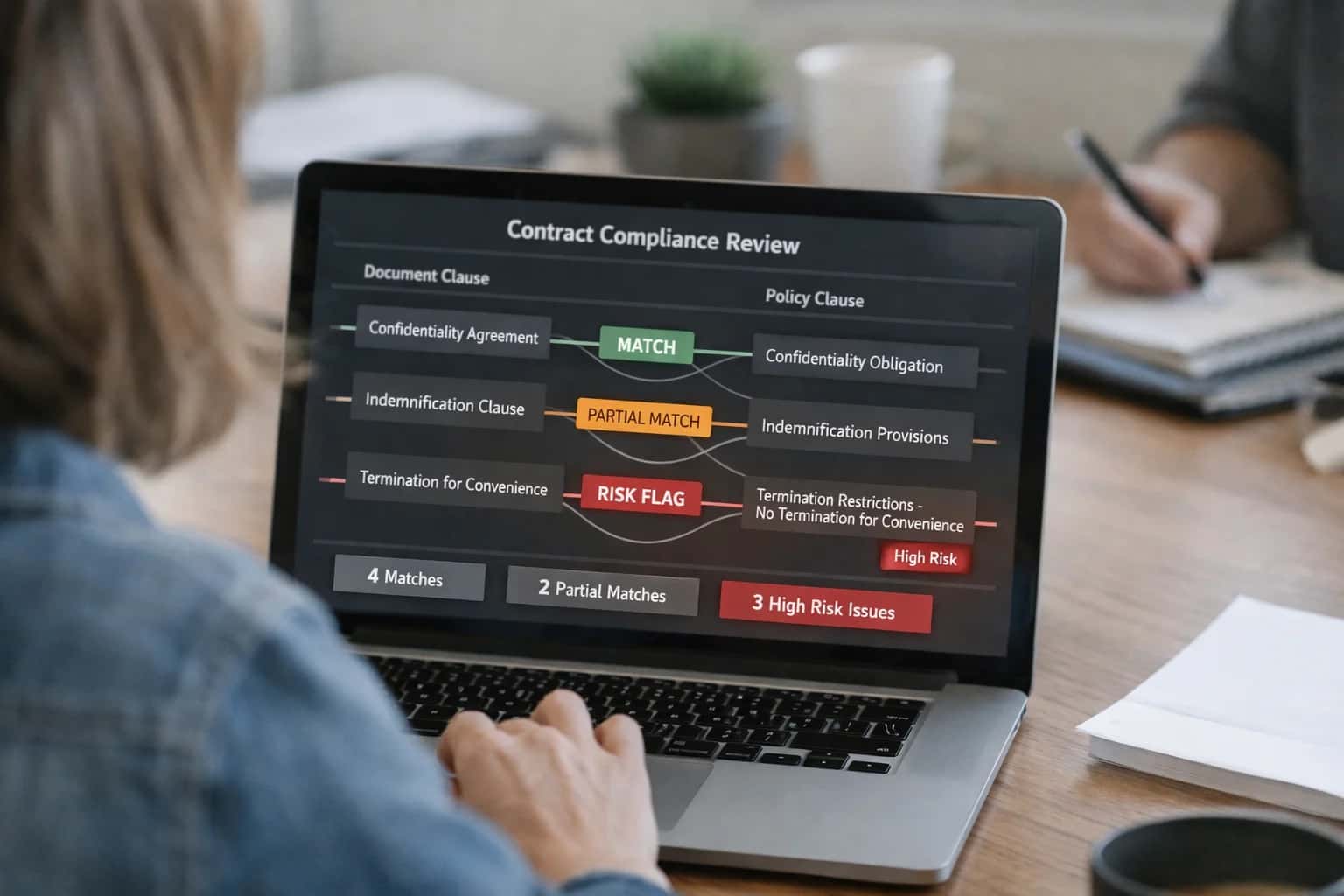
AI connects to Box Sign at three key integration points: the pre-signature review, the signature event itself, and the post-signature repository. Before a document is sent, an AI agent can analyze the uploaded file via the Box API, extracting key clauses, obligations, and potential red flags. This analysis can be appended as a summary comment on the file or used to dynamically adjust the signer roles and approval workflow in Box Sign based on the content's risk profile. During the signing process, AI can monitor the webhook events from Box Sign to trigger real-time validations or compliance checks.

Integration
AI Integration for Box Sign
Add AI-powered contract review, clause analysis, and obligation extraction directly into Box Sign workflows to reduce legal risk, accelerate approvals, and ensure compliance.
ARCHITECTURE & ROLLOUT
Where AI Fits into Box Sign Workflows
Integrating AI into Box Sign transforms static e-signature workflows into intelligent agreement lifecycle management.
Post-signature, the executed agreement is stored in Box. Here, a final AI processing step is triggered to perform a definitive extraction of all obligations, dates, parties, and key terms. This data is written back to the file's metadata and can be pushed to downstream systems like a CRM, CLM, or project management tool via Box connectors. This creates a searchable, actionable record, turning a signed PDF into structured data for obligation tracking, renewal forecasting, and audit reporting.
Rollout should be phased, starting with a single high-volume agreement type (e.g., NDAs or service orders). Governance is critical: implement a human-in-the-loop review for the AI's pre-signature analysis during the pilot, logging all AI actions and confidence scores to the Box audit log. This builds trust and creates a feedback loop for model improvement. The goal isn't to replace legal review but to augment it—surfacing risks faster and ensuring no signed agreement becomes a 'dark' data asset in your Box repository.
WHERE AI CONNECTS TO THE SIGNING WORKFLOW
Key Integration Surfaces in Box Sign
Analyze Agreement Content Before Sending
Integrate AI directly into the document preparation phase of Box Sign. Before a signature request is sent, an AI agent can analyze the uploaded agreement to identify key clauses, potential risks, and missing information.
Integration Points:
- Box Sign API
POST /files/{id}/copy& Webhooks: Trigger an AI analysis workflow when a file is added to a designated "pre-signature review" folder. The AI reviews the document, generates a summary, and attaches metadata (e.g.,risk_score,key_clauses) back to the file via the Box API before the signing workflow is initiated. - Box Skills Framework: Build a custom Skill that processes documents in the signing queue, extracting obligations, dates, and parties for pre-population into the agreement's
descriptionor custom metadata fields.
This surface allows legal, sales, and procurement teams to catch issues early, reducing back-and-forth and accelerating deal cycles.
INTELLIGENT AGREEMENT WORKFLOWS
High-Value AI Use Cases for Box Sign
Integrate AI directly into Box Sign workflows to analyze agreement content, highlight risks, and extract obligations—turning a simple e-signature process into a proactive contract intelligence layer.
01
Pre-Signature Clause Analysis
Analyze agreement content before sending for signature to flag non-standard clauses, highlight missing terms, and suggest fallback language. Integrates via Box Sign webhooks to trigger AI review upon document upload to a signing workflow.
Same day
Risk review time
02
Automated Obligation Extraction
After a document is signed via Box Sign, automatically extract key obligations, dates, parties, and payment terms. Populate a structured obligation register in a connected system like Salesforce or a compliance platform for post-signature tracking.
Batch -> Real-time
Extraction trigger
03
Signer Intent & Risk Summarization
Generate a plain-language summary of the agreement's intent and primary risks for each signer. This AI-generated summary can be appended to the Box Sign email notification or made available via a secure link, improving signer comprehension and reducing legal back-and-forth.
1 sprint
Implementation cycle
04
Compliance Gate for Standard Agreements
Use AI as a compliance gate in high-volume signing workflows (e.g., NDAs, service agreements). The AI validates that the document matches an approved template and contains no unauthorized modifications before the Box Sign envelope is finalized and sent.
Hours -> Minutes
Compliance check
05
Post-Signature Data Sync
Orchestrate multi-system data sync after signing. When Box Sign reports a completed envelope, an AI agent reads the final document, extracts key fields (e.g., contract value, effective date), and updates the corresponding records in CRM, ERP, or CLM systems via their APIs.
Real-time
System update
06
Anomaly Detection in Signing Patterns
Monitor Box Sign activity logs and document content to detect anomalous signing patterns, such as agreements signed from unusual locations, deviations from standard deal sizes, or clauses that frequently trigger manual review. Alerts are sent to legal or security ops.
IMPLEMENTATION PATTERNS
Example AI-Enhanced Box Sign Workflows
These workflows illustrate how AI can be injected into Box Sign's pre-signature, in-process, and post-signature stages to analyze content, guide signers, and extract obligations for downstream tracking.
Trigger: A user uploads a document (e.g., an NDA, SOW, or vendor agreement) to a designated Box folder and initiates a Box Sign request.
AI Action:
- A Box webhook triggers a serverless function upon the
sign_request.createdevent. - The function retrieves the document via the Box API and sends it to an LLM for analysis.
- The model performs:
- Clause Identification: Flags non-standard indemnification, termination, or liability clauses.
- Risk Scoring: Compares clauses against a pre-approved library or playbook.
- Obligation Extraction: Pulls out key dates, deliverables, and reporting requirements.
System Update:
- The analysis results are appended as a secure, read-only comment on the Box Sign request, visible to internal approvers.
- A custom metadata field on the Box file is updated with the risk score (e.g.,
Low,Medium,High). - If the score exceeds a threshold, the workflow can automatically pause signing and route the document to a legal review queue in a connected system like ServiceNow.
Human Review Point: Legal or procurement teams review the AI-generated highlights before approving the request to proceed to external signers.
FROM SIGNATURE EVENT TO OBLIGATION TRACKING
Implementation Architecture & Data Flow
A secure, event-driven architecture that connects AI analysis to Box Sign's workflow lifecycle.
The integration is anchored on Box's webhook and API event system. When a document completes its signing journey in Box Sign, a SIGNING_COMPLETE event triggers a serverless function (e.g., AWS Lambda, Azure Function). This function securely retrieves the final, signed PDF from the Box API, passing it to a configured AI pipeline. This design ensures analysis occurs only on the executed agreement, avoiding noise from in-progress drafts, and maintains Box's native security and compliance posture.
The core AI pipeline performs two sequential tasks: Clause Highlighting & Risk Analysis and Obligation Extraction. Using a purpose-tuned LLM (like GPT-4 or Claude 3), the system first analyzes the document to identify key clauses (termination, liability, payment terms), flagging potential risks or deviations from standard language. It then extracts structured obligations—such as report_due_date, notice_period, or renewal_term—outputting them as JSON. This data is written back to the Box file as metadata via the Box API, populating custom fields for search and reporting, and can simultaneously be posted to a downstream system like a CRM or CLM platform.
For governance, all AI interactions are logged with the document's file_id and version_id, creating an immutable audit trail. The system can be configured for human-in-the-loop review, where high-risk clauses or low-confidence extractions are routed to a legal ops queue within Box Relay or a connected task management system. Rollout typically starts with a pilot workflow (e.g., NDAs or standard service agreements), using the extracted metadata to build dashboards in Box Governance for tracking obligation fulfillment, before scaling to more complex contract types.
IMPLEMENTATION PATTERNS
Code & Payload Examples
Real-Time Document Analysis on Upload
When a document is uploaded to a Box Sign request, a Box webhook triggers your AI service. This handler validates the event, retrieves the file via the Box API, and sends it to an LLM for analysis before the signing ceremony begins.
Key steps include:
- Verifying the webhook signature from Box.
- Fetching the file content using a service account with appropriate permissions.
- Calling an LLM endpoint (e.g., Azure OpenAI, Anthropic) with a prompt to analyze contract terms, highlight risks, and extract obligations.
- Storing the analysis results as metadata on the Box file or in an external system for the signer or legal team to review.
This pattern enables proactive risk assessment, ensuring key clauses are understood before signatures are applied.
AI-ENHANCED AGREEMENT WORKFLOWS
Realistic Time Savings & Operational Impact
How AI integration transforms Box Sign from a simple e-signature tool into an intelligent agreement hub, accelerating cycles and reducing risk.
| Workflow Stage | Before AI | After AI | Implementation Notes |
|---|---|---|---|
Agreement Pre-Signature Review | Manual scan for red flags by legal/ops (30-60 min per complex doc) | AI highlights key clauses, obligations, and potential risks in minutes | AI provides a summary dashboard; human review remains for final approval |
Obligation Extraction for Tracking | Post-signature manual entry into CLM or spreadsheet (hours per contract) | AI auto-extracts parties, dates, SLAs, and obligations upon signing completion | Extracted data populates a tracking system or Box metadata via API |
Counterparty & Internal Routing | Manual email forwarding based on sender/recipient analysis | AI analyzes content to auto-suggest routing to correct legal team or department | Integrates with Box Relay or email to trigger defined approval workflows |
Standard Clause Identification | Visual comparison against playbooks to spot deviations | AI flags non-standard language and suggests approved alternative clauses | Requires initial clause library upload; model improves with feedback |
Post-Signature Compliance Check | Periodic manual audits to ensure signed docs meet policy | AI continuously scans signed agreements in Box for policy violations (e.g., missing clauses) | Runs as a scheduled Box Skill or event-driven webhook |
Renewal & Expiry Forecasting | Manual calendar tracking or spreadsheet maintenance | AI extracts key dates and generates renewal forecasts and alerts | Feeds data into BI tools or project management platforms like Asana |
Bulk Agreement Analysis | Impractical for large portfolios; relies on sampling | AI processes entire Box folders to summarize contract types, common terms, and risk exposure | Useful for M&A due diligence or portfolio rationalization projects |
ARCHITECTING FOR COMPLIANCE AND CONTROL
Governance, Security & Phased Rollout
A secure, governed rollout is critical for AI in legally-binding signature workflows.
Integrating AI with Box Sign requires a security-first architecture. The AI service should operate as a trusted, external processor that never stores Box content. Implementations typically use the Box Events API via webhooks to trigger analysis when a document enters a signature workflow. The AI service fetches the file via a scoped Service Account with least-privilege access (e.g., only to specific folders), processes it in-memory, and posts structured insights—like extracted obligations or highlighted clauses—back to the file as metadata or to a linked Box Note. All data in transit is encrypted, and processing can be configured for specific Box Zones to maintain data residency compliance.
Governance is enforced through a phased rollout and human-in-the-loop design. Start with a pilot workflow for low-risk, high-volume agreements (e.g., NDAs, service agreements). Configure the AI to run in "Assist Mode" initially, where its analysis is presented as a recommendation to the sender or legal reviewer within the Box Sign interface, requiring a human to review and approve before sending. This builds trust and creates an audit trail. Use Box Metadata to log the AI's confidence scores, the timestamp of analysis, and the reviewer who approved it, creating a transparent chain of custody for the signed document.
For enterprise-scale rollout, integrate with existing Identity Providers (IdP) and Compliance Platforms. The AI service's access should be gated by the organization's SSO and RBAC. Implement prompt governance to ensure the AI's analysis instructions (e.g., "identify termination clauses") are standardized and version-controlled. Finally, establish a continuous monitoring dashboard that tracks key metrics: agreement volume processed, average review time reduction, and user feedback on AI highlight accuracy. This data-driven approach allows for controlled scaling and demonstrates clear ROI while maintaining stringent oversight over the signature process.
Enabling Efficiency, Speed & Accuracy
Intelligent Analysis, Decision & Execution
We build AI systems for teams that need search across company data, workflow automation across tools, or AI features inside products and internal software.
Talk to Us
Search across company data
Give teams answers from docs, tickets, runbooks, and product data with sources and permissions.
Useful when people spend too long searching or get different answers from different systems.
Enterprise searchRAGPermissions
Read more
Automate internal workflows
Use AI to route work, draft outputs, trigger actions, and keep approvals and logs in place.
Useful when repetitive work moves across multiple tools and teams.
AI agentsWorkflow automationGovernance
Read more
Add AI to products and internal tools
Build assistants, guided actions, or decision support into the software your team or customers already use.
Useful when AI needs to be part of the product, not a separate tool.
AI integrationDecision supportModel routing
Read moreAI INTEGRATION FOR BOX SIGN
Frequently Asked Questions
Common technical and operational questions about incorporating AI into Box Sign workflows for pre-signature analysis, clause highlighting, and post-signature obligation tracking.
AI integrates with Box Sign via the Box API and webhooks, operating in two primary phases:
- Pre-Signature Analysis: When a document is uploaded to a Box Sign request, a webhook triggers an AI processing pipeline. The system retrieves the document via the API, sends it to an LLM (like GPT-4 or Claude) for analysis, and posts the results back to the Box file as metadata or a companion summary file before the signer receives it.
- Post-Signature Processing: Upon signature completion, another webhook triggers an AI agent to extract the final, executed terms. This data is written to a structured data store (like a database or Salesforce) for obligation tracking.
This architecture keeps Box Sign as the system of record for the signing process, while AI acts as an intelligent layer that augments it.

About the author
Prasad Kumkar
CEO & MD, Inference Systems
Prasad Kumkar is the CEO & MD of Inference Systems and writes about AI systems architecture, LLM infrastructure, model serving, evaluation, and production deployment. Over 5+ years, he has worked across computer vision models, L5 autonomous vehicle systems, and LLM research, with a focus on taking complex AI ideas into real-world engineering systems.
His work and writing cover AI systems, large language models, AI agents, multimodal systems, autonomous systems, inference optimization, RAG, evaluation, and production AI engineering.
LinkedIn
Limited slotsGet a Free AI Consultation
Partnered with leading AI, data, and software stack.





How We Work
Custom AI workflows for your Business
One-fit-all AI don't work for modern businesses. At Inferensys, we aim to understand your business & custom requirements; which we use to define most efficient agentic workflows, the data, and the tools for your business.
01
Review the use case
We understand the task, the users, and where AI can actually help.
Read more02
Pick the right approach
We define what needs search, automation, or product integration.
Read more03
Build the first useful version
We implement the part that proves the value first.
Read more04
Improve from there
We add the checks and visibility needed to keep it useful.
Read moreThe first call is a practical review of your use case and the right next step.
Talk to Us