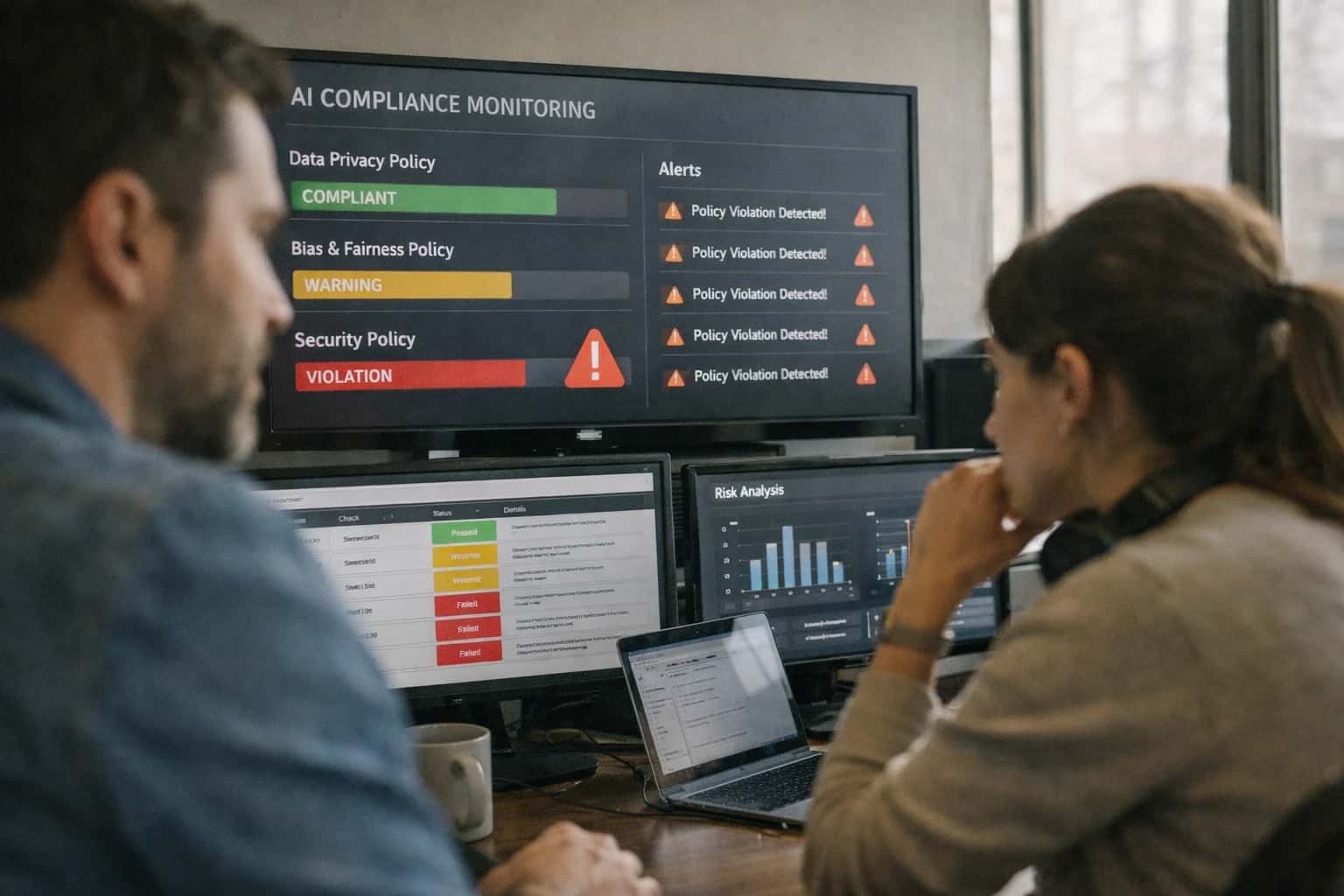
AI integration for Box compliance operates across three primary surfaces: the Box Content API for real-time file scanning, Box Governance for policy enforcement, and Box Relay for orchestrating remediation workflows. The core pattern involves deploying event-driven AI agents that subscribe to webhooks for file uploads, updates, and sharing events. These agents use LLMs and specialized classifiers to scan file contents and metadata for regulated data (e.g., PII, PHI, financial data), policy violations (e.g., improper sharing of confidential documents), and retention schedule triggers. Findings are written back to Box as structured metadata on the file or folder, which then powers automated governance actions.

Integration
AI Integration for Box Compliance
Deploy AI models to continuously monitor Box for regulatory compliance (GDPR, HIPAA, CCPA), generating audit-ready reports and triggering remediation workflows.
ARCHITECTURE & ROLLOUT
Where AI Fits into Box Compliance Workflows
A practical guide to integrating AI for continuous compliance monitoring, audit reporting, and automated remediation within the Box content cloud.
High-value use cases center on reducing manual audit burden and accelerating response. For example, an AI model can continuously monitor a Box Folder designated for GDPR subject access requests, automatically redacting third-party PII from documents before they are compiled for delivery. For HIPAA, AI can scan shared links and collaborations, flagging potential ePHI exposure in comments or file names and triggering a Box Governance policy to revoke access. In financial services, AI can parse thousands of contracts in a Box for Compliance instance, extracting clause types and dates to auto-populate a central obligations register and alert legal teams of upcoming renewals or breaches.
A production rollout requires a phased, governed approach. Start with a pilot folder or co-marked Box Zone to process data in-region. Implement a human-in-the-loop step where AI-generated classifications and redaction suggestions are presented in a low-code dashboard (e.g., built with the Box UI Elements) for reviewer approval before any automated action is taken. This builds trust and creates a labeled dataset for model refinement. Architecturally, the AI service should be deployed as a secure, scalable container that interacts with Box via service accounts using OAuth 2.0 and JWT authentication, with all actions logged to a separate SIEM for a defensible audit trail. Governance is critical: define clear confidence thresholds for automated actions versus human escalation, and establish regular model drift checks to ensure classification accuracy as content evolves.
ARCHITECTURE BLUEPRINT
Key Box Surfaces for AI Compliance Integration
Core Data Access for AI Analysis
The Box API provides programmatic access to file content and metadata, which is the foundation for any compliance monitoring system. Key endpoints include:
GET /files/{id}/content: Stream file bytes to your AI model for analysis, supporting over 120 file types with Box's built-in text extraction.GET /files/{id}/metadata: Retrieve custom metadata templates applied to files, such aslegalHoldStatusordataClassification. AI can validate or suggest metadata based on content analysis.POST /metadata_cascade_policies: Enforce metadata inheritance from folder to file, ensuring AI-applied classifications propagate correctly.
This surface allows AI to read documents at scale, extract entities (PII, PHI, financial data), and assess against regulatory frameworks like GDPR Article 17 or CCPA deletion requests. The API's watermarking and download restrictions ensure secure data handling during AI processing.
CONTINUOUS MONITORING & AUTOMATED REMEDIATION
High-Value AI Compliance Use Cases for Box
Deploy AI agents to continuously scan Box content for regulatory risks, automate evidence collection, and trigger remediation workflows—turning a static repository into a proactive compliance engine.
01
Automated PII & PHI Discovery
Continuously scan Box folders and files for unprotected personal data (SSNs, credit card numbers, medical record numbers). AI classifies sensitivity, tags files, and triggers automated workflows to quarantine, redact, or apply encryption via Box Shield.
Batch -> Real-time
Detection mode
02
GDPR & CCPA Data Subject Request Fulfillment
Automate the discovery, review, and redaction of files related to a data subject across the entire Box instance. AI maps user identities to content, identifies relevant documents, and prepares a compliant response package, reducing manual search from days to hours.
Days -> Hours
Request fulfillment
03
Policy Violation & Insider Risk Monitoring
Monitor uploads, shares, and downloads against custom compliance policies (e.g., sharing confidential docs externally). AI analyzes content and context, flags high-risk events in real-time, and can automatically revoke shares or alert security via Box Governance webhooks.
Real-time
Alerting
04
Automated Retention Schedule Application
Use AI to analyze document content, metadata, and context to automatically assign and enforce Box retention policies. AI determines if a file is a contract, financial record, or HR document and applies the correct legal hold or disposal schedule, ensuring defensible disposition.
Manual -> Automated
Policy assignment
05
Audit Evidence Package Assembly
For SOC 2, ISO 27001, or HIPAA audits, AI agents query Box via API to gather evidence documents (policies, access logs, training records). It organizes them into a structured, indexed audit package, saving weeks of manual collection for compliance teams.
Weeks -> Days
Audit prep
06
Contract Obligation & Clause Monitoring
For contracts stored in Box, AI extracts key obligations, dates, and clauses. It monitors for upcoming renewals, expiries, or compliance breaches (e.g., missing insurance certificates), triggering alerts in connected systems like Salesforce or ServiceNow.
Proactive
Obligation tracking
BOX COMPLIANCE AUTOMATION
Example AI-Driven Compliance Workflows
These workflows illustrate how AI models can be integrated with Box's APIs, metadata, and event system to automate continuous compliance monitoring for regulations like GDPR, HIPAA, and CCPA, reducing manual audit preparation from weeks to hours.
Trigger: A file is uploaded or modified in any monitored Box folder.
Context/Data Pulled: The file's binary content is retrieved via the Box API. The system checks the file's existing metadata and the folder's classification (e.g., HR, Patient Records).
Model/Agent Action: A multi-modal AI model scans the document text and images. It identifies patterns matching:
- PII: Social Security Numbers, passport numbers, driver's licenses.
- PHI: Patient names, diagnosis codes, treatment dates.
- Financial Data: Credit card numbers, bank account details.
The agent classifies the file's sensitivity level (e.g., Confidential - PII, Restricted - PHI) and extracts the specific entities found.
System Update: The agent uses the Box API to:
- Apply a corresponding metadata template (e.g.,
classification=high_risk). - Add a custom metadata field listing the entity types found.
- If a
sensitive_contentfolder exists, optionally move the file there.
Human Review Point: Files flagged with high-confidence matches are logged for review. Low-confidence matches are queued for a compliance officer to verify via a dashboard built on Box metadata.
CONTINUOUS MONITORING & GOVERNANCE
Implementation Architecture & Data Flow
A production-ready AI integration for Box Compliance operates as a secure, event-driven layer that scans, classifies, and triggers actions without disrupting user workflows.
The core architecture connects to the Box Events API via webhooks, listening for file uploads, updates, and sharing events. When a trigger occurs, a secure payload containing the file ID and metadata is sent to a dedicated processing queue. An orchestration service retrieves the file via the Box API (using appropriate OAuth 2.0 scopes and service accounts) and passes it through a pipeline of AI models. This typically includes:
- A classification model to identify document types (e.g., contract, HR file, financial report).
- A PII/PHI detection model to scan for regulated data patterns (SSNs, credit card numbers, medical codes).
- A policy engine that evaluates findings against configured compliance rules for GDPR, HIPAA, or CCPA.
Based on the AI analysis, the system updates the file's Box metadata with classification tags (e.g., sensitivity:high, regulation:hipaa) and writes a detailed log to a secure audit database. For violations, it can trigger automated remediation workflows via Box Governance API actions, such as:
- Applying a retention policy or legal hold.
- Adjusting shared link settings or collaborator permissions.
- Moving the file to a quarantine folder for manual review.
- Generating a task in a connected ServiceNow or Jira instance for the compliance team. All actions are recorded with a full audit trail, linking the AI's findings to the enforcement step for regulator-ready reporting.
Rollout is phased, starting with a monitor-only mode in a designated Box folder to validate model accuracy and false-positive rates. Governance is critical: a human-in-the-loop approval step is configured for high-risk actions (like auto-deletion) during initial deployment. The system's performance and drift are monitored via an LLMOps dashboard, tracking metrics like classification confidence and policy match rates. This architecture ensures compliance operations shift from periodic manual audits to continuous, automated governance, reducing the window of exposure and the manual effort for audit preparation.
ARCHITECTURE FOR CONTINUOUS MONITORING
Code & Integration Patterns
Real-Time Content Analysis with Box Events API
Deploy serverless functions (AWS Lambda, Azure Functions) that subscribe to the Box Events API via webhooks. This triggers AI analysis on file upload, update, or download, enabling continuous compliance monitoring without batch processing delays.
Key Integration Points:
POST /webhooksto subscribe toFILE.UPLOADED,FILE.PREVIEWED,FILE.DOWNLOADEDevents.- Event payloads contain
source.id(file ID) andsource.parent.id(folder ID) for context-aware policy application. - Use the
GET /files/{id}/contentendpoint to stream file content to your AI model for analysis.
This pattern ensures immediate detection of non-compliant content, allowing for automated quarantine or alerting before widespread access.
AI-POWERED COMPLIANCE WORKFLOWS
Realistic Time Savings & Operational Impact
How AI integration transforms manual, reactive Box compliance monitoring into a continuous, automated governance layer.
| Compliance Workflow | Manual Process | AI-Augmented Process | Impact & Notes |
|---|---|---|---|
Sensitive Data Discovery | Monthly sampling audits (40+ hours) | Continuous, full-repository scanning | Shifts from periodic sampling to real-time detection of PII/PHI/PCI. |
Policy Violation Triage | Manual review of flagged files (2-4 hours daily) | AI pre-classifies severity & suggests action | Analyst focus shifts from finding to fixing high-risk items. |
Audit Evidence Compilation | Manual collection for quarterly audits (3-5 days) | Automated report generation on-demand | Audit-ready reports generated in hours, not days. |
Retention Schedule Application | Rule-based on folder path/metadata only | AI analyzes content to apply correct schedule | Reduces misclassified records and retention risk. |
Legal Hold Identification | Keyword searches & custodian interviews | AI suggests relevant files based on case context | Speeds up preservation, reduces risk of spoliation. |
Remediation Workflow Initiation | Email alerts to data owners; follow-up required | Auto-triggers Box Tasks or ServiceNow tickets | Closes the loop from detection to assigned action. |
Compliance Dashboard Updates | Manual data aggregation from multiple reports | Real-time dashboard fed by AI analysis | Provides continuous visibility vs. snapshot reporting. |
ARCHITECTING FOR COMPLIANCE
Governance, Security & Phased Rollout
A Box compliance AI integration must be built on a secure, auditable foundation that respects data residency and regulatory boundaries.
The integration architecture typically involves a secure, event-driven pipeline: Box webhooks or scheduled scans trigger an API call to a containerized AI service, passing only the necessary file metadata and content via a secure channel. The AI service—hosted in your compliant cloud region or on-premises—processes the content using models fine-tuned for regulations like GDPR (personal data), HIPAA (PHI), or CCPA. Findings are written back to Box as metadata (e.g., custom compliance_status field) and to a separate audit database, never storing analyzed content. This ensures the source of truth remains Box, with AI acting as a stateless analysis layer.
Governance is enforced through role-based access control (RBAC) on the AI service and immutable audit logs. Each scan generates a log entry with a trace ID, timestamp, user/service principal, file ID, policy checked, and result. For remediation, the system can trigger Box workflows to move files to a quarantine folder, notify data owners via email, or create tasks in a GRC platform like ServiceNow. High-confidence violations can be auto-remediated (e.g., applying a Box classification label); lower-confidence findings route to a human-in-the-loop queue for review within Box Relay or a connected case management system.
Rollout follows a phased, risk-based approach: 1) Pilot a single policy (e.g., detect SSNs) on a non-sensitive Box folder with logging-only mode to tune model accuracy and false-positive rates. 2) Expand to a department with automated labeling and owner notifications, incorporating feedback loops to retrain models. 3) Enterprise deployment with full remediation workflows, integrating findings into quarterly access review cycles and compliance dashboards. This controlled rollout allows teams to validate AI performance, adjust policies, and build organizational trust before scaling. For ongoing operations, we implement drift detection to monitor for model degradation as document types evolve and new regulations emerge.
Enabling Efficiency, Speed & Accuracy
Intelligent Analysis, Decision & Execution
We build AI systems for teams that need search across company data, workflow automation across tools, or AI features inside products and internal software.
Talk to Us
Search across company data
Give teams answers from docs, tickets, runbooks, and product data with sources and permissions.
Useful when people spend too long searching or get different answers from different systems.
Enterprise searchRAGPermissions
Read more
Automate internal workflows
Use AI to route work, draft outputs, trigger actions, and keep approvals and logs in place.
Useful when repetitive work moves across multiple tools and teams.
AI agentsWorkflow automationGovernance
Read more
Add AI to products and internal tools
Build assistants, guided actions, or decision support into the software your team or customers already use.
Useful when AI needs to be part of the product, not a separate tool.
AI integrationDecision supportModel routing
Read moreBOX COMPLIANCE INTEGRATION
Frequently Asked Questions
Practical questions for teams planning to add AI-driven compliance monitoring and reporting to their Box environment.
The integration uses a combination of pre-trained and custom-tuned models to scan file content and metadata. The process is event-driven and typically follows this pattern:
- Trigger: A file is uploaded or modified in a monitored Box folder, triggering a webhook to our processing service.
- Context Pull: The service retrieves the file via the Box API (with appropriate service account permissions) and extracts text via OCR if needed.
- Model Action: The text is analyzed by Named Entity Recognition (NER) models for patterns matching:
- PII: Social Security numbers, driver's license numbers, passport numbers, financial account details.
- PHI: Patient names, medical record numbers, diagnosis codes, treatment dates.
- Other: Credit card numbers, specific keywords from internal compliance policies.
- System Update: Findings are logged to a secure audit database. The file's Box metadata is updated with classification tags (e.g.,
pii_detected: true,compliance_scan_date: <timestamp>). - Human Review Point: High-confidence matches can trigger an alert in a compliance dashboard or a task in a connected workflow platform (like ServiceNow) for analyst review. Low-confidence matches are flagged for sampling.

About the author
Prasad Kumkar
CEO & MD, Inference Systems
Prasad Kumkar is the CEO & MD of Inference Systems and writes about AI systems architecture, LLM infrastructure, model serving, evaluation, and production deployment. Over 5+ years, he has worked across computer vision models, L5 autonomous vehicle systems, and LLM research, with a focus on taking complex AI ideas into real-world engineering systems.
His work and writing cover AI systems, large language models, AI agents, multimodal systems, autonomous systems, inference optimization, RAG, evaluation, and production AI engineering.
LinkedIn
Limited slotsGet a Free AI Consultation
Partnered with leading AI, data, and software stack.





How We Work
Custom AI workflows for your Business
One-fit-all AI don't work for modern businesses. At Inferensys, we aim to understand your business & custom requirements; which we use to define most efficient agentic workflows, the data, and the tools for your business.
01
Review the use case
We understand the task, the users, and where AI can actually help.
Read more02
Pick the right approach
We define what needs search, automation, or product integration.
Read more03
Build the first useful version
We implement the part that proves the value first.
Read more04
Improve from there
We add the checks and visibility needed to keep it useful.
Read moreThe first call is a practical review of your use case and the right next step.
Talk to Us